Mildronate
Poland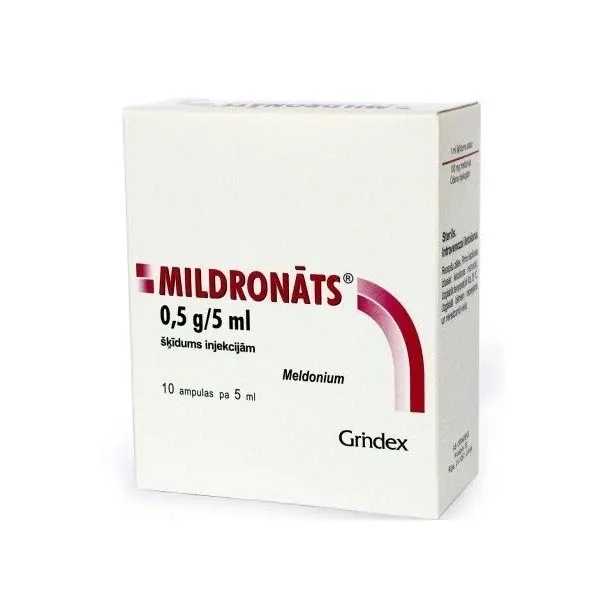
Table of Contents
Package leaflet: Information for the patient
Mildronate, 500 mg/5 mL, solution for injection
Meldonium dihydratum
Please read this leaflet carefully before using the medicine, because it contains
important information for the patient.
- Keep this leaflet, so that you can read it again if necessary.
- If you have any further questions, please consult your doctor, pharmacist or nurse.
- This medicine has been prescribed for a specific individual. Do not pass it on to others. The medicine may harm someone else, even if their symptoms are the same.
- If any adverse reactions occur in the patient, including any adverse reactions not listed in this leaflet, inform your doctor, pharmacist or nurse. See section 4.
Table of contents
- What Mildronate is and what it is used for
- Important information before using Mildronate
- How to use Mildronate
- Possible side effects
- How to store Mildronate
- Contents of the pack and other information
1. What Mildronate is and what it is used for
Mildronate is a structural analogue of the precursor of carnitine – gamma-butyrobetaine (GBB),
a substance present in every cell of the body.
Under conditions of impaired blood flow to the heart, Mildronate dilates blood vessels, activates
anaerobic glycolysis, and stimulates the production and transport of ATP, thereby restoring the balance between
oxygen supply and oxygen consumption, thus protecting the cell. Mildronate exhibits
cardioprotective properties. In chronic congestive heart failure, Mildronate improves
the contractile capacity of the heart muscle, increases tolerance to physical exertion,
and helps in rapid adaptation to new physical loads. Due to these
properties, Mildronate is used in the treatment of cardiovascular diseases.
Mildronate may be used as an adjunctive treatment in mild, chronic heart failure.
If no improvement occurs or the patient feels worse, consult a doctor.
2. Important information before using Mildronate
When not to use Mildronate
- if the patient is allergic to meldonium dihydrate or to any of the other ingredients of this medicine (listed in section 6).
If any of the above points apply, the patient should inform their doctor or
nurse before using this medicine.
Warnings and precautions
Before starting treatment with Mildronate, discuss this with your doctor or nurse:
- if the patient has chronic kidney or liver disease.
If you are unsure whether any of the above points apply, the patient should
consult their doctor before receiving Mildronate injection.
Children and adolescents
The safety and efficacy of Mildronate in children have not been established.
Mildronate and other medicines
Tell your doctor or nurse about all medicines the patient is currently taking or has recently taken, as well as any medicines they plan to use.
If directed by a physician, Mildronate may be used concomitantly with the following cardiovascular drugs: antianginal agents, blood-thinning medicines (anticoagulants and antiplatelet agents), drugs used in the treatment of cardiac arrhythmias (antiarrhythmics), cardiac glycosides, diuretics (medicines that increase urine production and excretion), etc. Mildronate may enhance the effects of certain cardiac drugs such as nitroglycerin, nifedipine, beta-blockers, antihypertensive drugs, and peripheral vasodilators. The physician will take this into account when prescribing Mildronate treatment, as dosage adjustments may be necessary.
Pregnancy, breastfeeding and fertility
If the patient is pregnant or breastfeeding, suspects she may be pregnant, or is planning to have a child, she should consult her doctor or nurse before using this medicine.
There are no available clinical data on the safety of using this medicine during pregnancy. To avoid potential adverse effects on the mother and fetus, use of Mildronate is not recommended during pregnancy. It is not known whether the active substance passes into human milk. If treatment with this medicine is necessary, breastfeeding must be discontinued.
Driving and operating machinery
No adverse effects of Mildronate on the ability to drive or operate machinery have been observed.
3. How to use Mildronate
Mildronate is administered by a doctor or nurse as an intravenous injection. The doctor will decide the appropriate dose for the patient, as well as the method and timing of administration. If in doubt, consult a doctor or nurse. Administration of Mildronate in the morning is recommended due to its possible stimulating effect.
Adults
The usual daily dose is 500–1000 mg (5–10 mL) administered intravenously. The daily dose may be divided into two single doses. The maximum daily dose is 1000 mg. The duration of treatment is 10 to 14 days, after which oral treatment should be continued. The total duration of treatment is 4 to 6 weeks. Treatment may be repeated 2 to 3 times per year.
Elderly patients
There are no specific recommendations for use in this age group. Elderly patients with impaired liver and/or kidney function may require reduced doses (see "Warnings and precautions").
Patients with impaired liver and/or kidney function
Since the drug is excreted by the kidneys, doses should be reduced in patients with impaired kidney function, as well as in patients with liver disease (see "Warnings and precautions").
Use in children and adolescents
Due to lack of data on safety and efficacy, the use of this medicinal product is not recommended in children.
If the effect of the medicine appears too strong or too weak, consult a doctor.
Use of a higher than recommended dose of Mildronate
There is no data available on overdose in humans. This medicine is low in toxicity and does not cause severe adverse effects. If a higher than recommended dose of Mildronate has been used, contact a doctor immediately.
Missed dose of Mildronate
If the patient believes they have missed a dose of Mildronate, they should contact their doctor or nurse.
Stopping Mildronate treatment
If there are any further doubts regarding the use of this medicine, consult a doctor, pharmacist, or nurse.
4. Possible adverse reactions
Like all medicines, this medicine can cause adverse reactions, although not everyone will experience them.
Mildronate is generally well tolerated.
Common (may affect up to 1 in 10 people):
- allergic reactions (redness, rash, itching, swelling),
- headache,
- gastric discomfort,
- nausea,
- vomiting,
- bitter taste in the mouth.
Very rare (may affect up to 1 in 10,000 people):
- increased heart rate,
- decreased blood pressure.
Unknown (frequency cannot be estimated from available data):
- eosinophilia (increased number of white blood cells called eosinophils),
- agitation,
- generalized weakness.
Concomitant and underlying diseases may cause other possible adverse reactions such as proteinuria (presence of increased levels of protein in urine), liver function disorders due to improper diet, and mood changes. The relationship between these reactions and the use of Mildronate is considered unlikely. Frequency is unknown.
Reporting of adverse reactions
If any adverse reactions occur, including any adverse reactions not listed in this leaflet, inform your doctor or pharmacist. Adverse reactions can be reported directly to the Department of Monitoring Adverse Drug Reactions at the Office for Registration of Medicinal Products, Medical Devices and Biocidal Products:
Al. Jerozolimskie 181C
02-222 Warsaw
Phone: +48 22 49 21 301
Fax: +48 22 49 21 309
Website: https://smz.ezdrowie.gov.pl
Adverse reactions can also be reported to the marketing authorization holder.
Reporting adverse reactions helps to provide more information on the safety of the medicine.
5. How to store Mildronate
Keep this medicine out of sight and reach of children.
Do not use this medicine after the expiry date stated on the carton after "EXP". The expiry date refers to the last day of the stated month.
This medicine does not require any special storage conditions. Do not freeze.
Do not use this medicine if you notice that the packaging is damaged or shows signs of tampering.
Medicines must not be disposed of via wastewater or household waste. Ask your pharmacist how to dispose of medicines no longer required. These measures will help protect the environment.
6. Contents of the pack and other information
What Mildronate contains
- The active substance is meldonium dihydrate. 1 mL of injection solution contains 100 mg of meldonium dihydrate. One ampoule (5 mL) contains 500 mg of meldonium dihydrate.
- The other ingredient is water for injections.
What Mildronate looks like and contents of the pack
A clear, colourless liquid, practically free from visible particles.
Ampoules made of colourless borosilicate glass of type I, with hydrolytic resistance class HGA, with a safety ring or single-point break are packed in sets of 5 into blisters made of polyvinyl chloride film. The blisters are packed into cardboard boxes containing 2 (10 ampoules) or 4 (20 ampoules) blisters.
Not all pack sizes may be marketed.
Marketing Authorisation Holder and Manufacturer
AS GRINDEKS
Krustpils iela 53,
Rīga, LV-1057,
Latvia
tel.: +371 67083205
e-mail: [email protected]
This medicinal product is authorised in the Member States of the European Economic Area under the following names:
Croatia Myldrox 500 mg/5 ml otopina za injekciju
Malta Myldrox 500 mg/5 ml solution for injection
Poland Mildronate
Slovenia Mildronate 500 mg/5 ml raztopina za injiciranje