Mepidont 2% with adrenaline 1:100,000
Poland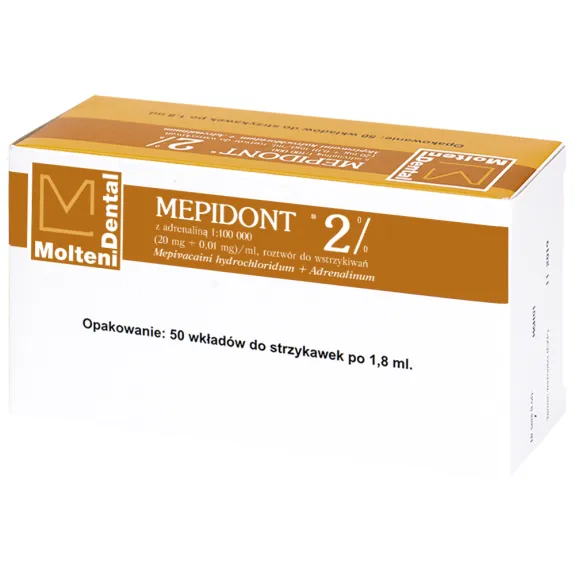
Table of Contents
Package leaflet: Information for the user
Please read all of this leaflet carefully before using the medicine.
- Keep this leaflet as you may need to read it again.
- If you have any further questions, please consult your doctor or pharmacist.
- This medicine has been prescribed for a specific individual. Do not pass it on to others. It may harm other people, even if their symptoms are the same.
- If any adverse reactions occur in the patient, including any adverse reactions not listed in this leaflet, they should be reported to the doctor or pharmacist.
MEPIDONT 3%
(Mepivacaini hydrochloridum)
30 mg/ml, solution for injection
MEPIDONT 2% with adrenaline 1:100,000
(Mepivacaini hydrochloridum + Adrenalinum)
(20 mg + 0.01 mg)/ml, solution for injection
Leaflet contents
- What Mepidont is and what it is used for
- Important information before using Mepidont
- How to use Mepidont
- Possible side effects
- How to store Mepidont
- Contents of the pack and other information
1. What Mepidont is and what it is used for
Mepivacaine, the active substance in this medicine, is an amide-type local anaesthetic. Its effects result from the inhibition of ion currents responsible for the generation and conduction of impulses across the neuronal cell membrane.
The anaesthetic effect begins rapidly.
The duration of effective action depends on the site of injection, concentration, and the presence or absence of adrenaline, a vasoconstrictor agent.
Mepivacaine is rapidly metabolized in the liver and excreted by the kidneys.
Mepivacaine binds to plasma proteins by 60% to 80%, and its plasma half-life is 115 minutes.
Indications:
All conservative and surgical procedures in dentistry.
MEPIDONT with adrenaline is indicated when prolonged local anaesthesia is desired, or when local haemostasis (ischaemia) is required.
2. Information before using Mepidont
When not to use Mepidont:
- if the patient is allergic to mepivacaine hydrochloride or any of the other ingredients of this medicine (listed in section 6). The use of a vasoconstrictor-containing drug is contraindicated in patients with severe heart disease and peripheral arterial disease, hypertension, migraine, hyperthyroidism, diabetes, prostatic hyperplasia, narrow-angle glaucoma, and nephropathy.
Warnings and precautions
Rare cases of death have been reported in individuals without previously known
hypersensitivity.
Mepidont with adrenaline contains sodium metabisulfite.
This substance may cause allergic reactions and severe asthma attacks in susceptible individuals.
The efficacy and safety of mepivacaine in dentistry depend on the appropriate selection of dose and method of administration, as well as on observing appropriate precautions.
Before starting treatment with Mepidont, a consultation with a physician is required.
Pregnancy, breastfeeding and fertility
If the patient is pregnant or breastfeeding, or suspects she may be pregnant, she should
consult a physician before using this medicine.
MEPIDONT should not be used during pregnancy.
Driving and operating machinery
MEPIDONT has a minor influence on the ability to drive and operate machinery.
The physician should decide whether the patient may drive or operate machinery after
administration of the drug.
MEPIDONT and other medicines
The preparation containing adrenaline should be used with caution in patients treated with
MAO inhibitors and tricyclic antidepressants (medicines used, among others, in psychiatry).
In each case, the lowest possible doses and concentrations necessary to achieve the desired effect should be used. The patient must be under close supervision, and administration of the drug should be immediately discontinued at the first sign of any disturbing symptom (e.g. sensory organ disturbances).
Solutions containing adrenaline may exhibit clinically significant interactions
with MAO inhibitors and tricyclic antidepressants (severe
hypertension), with phenothiazine or butyrophenone derivatives (possible reversal of adrenaline's pressor effect).
The patient should inform the physician about all medicines currently or recently used, as well as any medicines planned for future use.
3. How to use Mepidont
1 to 2 ml or more, depending on the procedure, administered infiltratively or as a peripheral nerve block.
The anesthetic solution should be injected in small increments at a rate of approximately 1 ml/min,
following prior aspiration.
In a healthy adult, who has not received sedatives, the maximum dose,
administered either as a single injection or in several consecutive injections over a period not exceeding
90 minutes, is 7 mg of mepivacaine hydrochloride per kilogram of body weight, up to a total
dose not exceeding 550 mg of mepivacaine hydrochloride, and 0.2 mg of adrenaline.
Maximum dose: 1000 mg of mepivacaine within 24 hours.
In children, the administered doses should be reduced according to body weight and age.
If you feel that the effect of Mepidont is too strong or too weak, you should
inform your doctor.
Use of a higher than recommended dose of Mepidont
Overdosing with the anesthetic agent should be avoided, and two
maximum doses should never be administered consecutively if the interval between them is less than 24 hours.
It is advisable to use lower concentrations and doses that will achieve the desired anesthetic effect.
The following toxic effects have been reported in cases of overdose:
- Central nervous system stimulation with symptoms of excitation, tremors, disorientation, dizziness, pupil dilation, increased metabolism, and elevated body temperature;
- After very large doses: jaw clenching and convulsions.
Management
At the first sign of any concerning symptom, administration of the drug should be discontinued. The patient should be placed in a horizontal position, and it should be ensured that breathing is unobstructed; if not, oxygen should be administered, and in case of respiratory arrest, artificial ventilation should be initiated.
The use of analeptics acting on the medulla oblongata should be avoided to prevent worsening of the patient's condition due to increased oxygen consumption.
Seizures can be controlled by intravenous administration of diazepam in doses of 10 to 20 mg.
Barbiturates are not recommended, as they may intensify depression of the medulla oblongata.
Improvement of circulatory function may be achieved by intravenous administration of
glucocorticoids. Additionally, diluted solutions of alpha- and beta-receptor agonists with vasoconstrictive action (e.g. methoxamine, metaraminol, etc.) or atropine sulfate may be used.
An appropriate emergency kit should always be immediately available, along with adequately trained personnel.
In several cases, following administration of local anesthetics, severe complications, even with fatal outcomes, have been observed despite the absence of personal hypersensitivity history.
Mepidont with adrenaline contains sodium metabisulfite; this compound may cause allergic reactions, particularly in sensitive individuals, especially those with bronchial asthma.
4. Possible adverse reactions
Like all medicines, this medicine can cause adverse reactions, although not everyone will
experience them.
Adverse reactions that may occur during the use of mepivacaine are similar to those
observed with other amide-type local anaesthetics.
These reactions depend on the dose and may be caused by high plasma concentrations of the
drug, resulting from overdose, rapid absorption, or accidental intravascular injection, or may
be due to hypersensitivity, idiosyncrasy, or reduced patient tolerance.
The following adverse reactions have been reported:
Nervous system disorders:
Central nervous system stimulation with excitement, tremors, disorientation, dizziness,
pupil dilation, increased metabolism, and elevated body temperature. After very high doses:
jaw clenching and convulsions.
Vascular disorders:
Vasodilation, hypertension.
Cardiac disorders:
Arrhythmias, bradycardia.
Immune system disorders:
Allergic reactions (in the most severe cases, anaphylactic shock).
Hypersensitivity reactions to mepivacaine are very rare (<1/10,000); if they occur, standard
management should be applied.
Respiratory, thoracic and mediastinal disorders:
Increased respiration rate, bronchodilation.
Gastrointestinal disorders:
Nausea, vomiting.
Skin and subcutaneous tissue disorders:
Skin changes, urticaria, swelling, sweating.
The vasoconstrictor component may cause the following reactions, especially in patients with
cardiovascular disease: anxiety, sweating, breathing difficulties, cardiac arrhythmias,
hypertension (which may be serious in patients with chronic hypertension and in patients with
hyperthyroidism), severe headache, photophobia, retro-orbital pain, vomiting.
If any adverse reactions occur, including any not listed in this leaflet, inform your doctor.
Reporting of adverse reactions
If any adverse reactions occur, including any not listed in this leaflet, inform your doctor or
pharmacist. Adverse reactions can be reported directly to the Department of Monitoring of
Adverse Drug Reactions of the Office for Registration of Medicinal Products, Medical Devices
and Biocidal Products,
Al. Jerozolimskie 181C, 02-222 Warsaw, tel. (22) 49 21 301, fax (22) 49 21 309. Website:
https://smz.ezdrowie.gov.pl.
Reporting adverse reactions helps to provide more information on the safety of using the medicine.
5. How to store Mepidont
Store below 25°C.
Keep in the original packaging to protect from light.
Keep this medicine out of the reach and sight of children.
Do not use this medicine after the expiry date stated on the packaging. The expiry date refers to the last day of the stated month.
6. Contents of the package and other information
What Mepidont contains
MEPIDONT 3%
1 ml of solution contains 30 mg of mepivacaine hydrochloride (Mepivacaini hydrochloridum).
1.8 ml of solution (1 cartridge) contains 54 mg of mepivacaine hydrochloride (Mepivacaini hydrochloridum).
MEPIDONT 2% with adrenaline 1:100,000
1 ml of solution contains 20 mg of mepivacaine hydrochloride (Mepivacaini hydrochloridum)
and 0.01 mg of adrenaline as adrenaline bitartrate.
1.8 ml of solution (1 cartridge) contains 36 mg of mepivacaine hydrochloride (Mepivacaini hydrochloridum)
and 0.018 mg of adrenaline as adrenaline bitartrate.
Other ingredients: Mepidont 3% contains the excipients: sodium chloride and water for injections;
Mepidont 2% with adrenaline additionally contains sodium metabisulfite.
What the package looks like and contents of the pack
The cardboard package contains 10 or 50 dental cartridges.
Marketing Authorisation Holder:
Molteni Dental s.r.l., Via Ilio Barontini 8, Localita Granatieri 50018 Scandicci (Firenze), Italy
Manufacturer:
Laboratorios Normon S.A., Ronda de Valdecarrizo 6, 28760 Tres Cantos, Madrid, Spain
For further information, please contact:
Molteni Stomat Sp. z o.o.,
30-733 Kraków, ul. Obrońców Modlina 3,
Tel. (012) 653 25 85; Fax. (012) 654 15 60