Menopur
Poland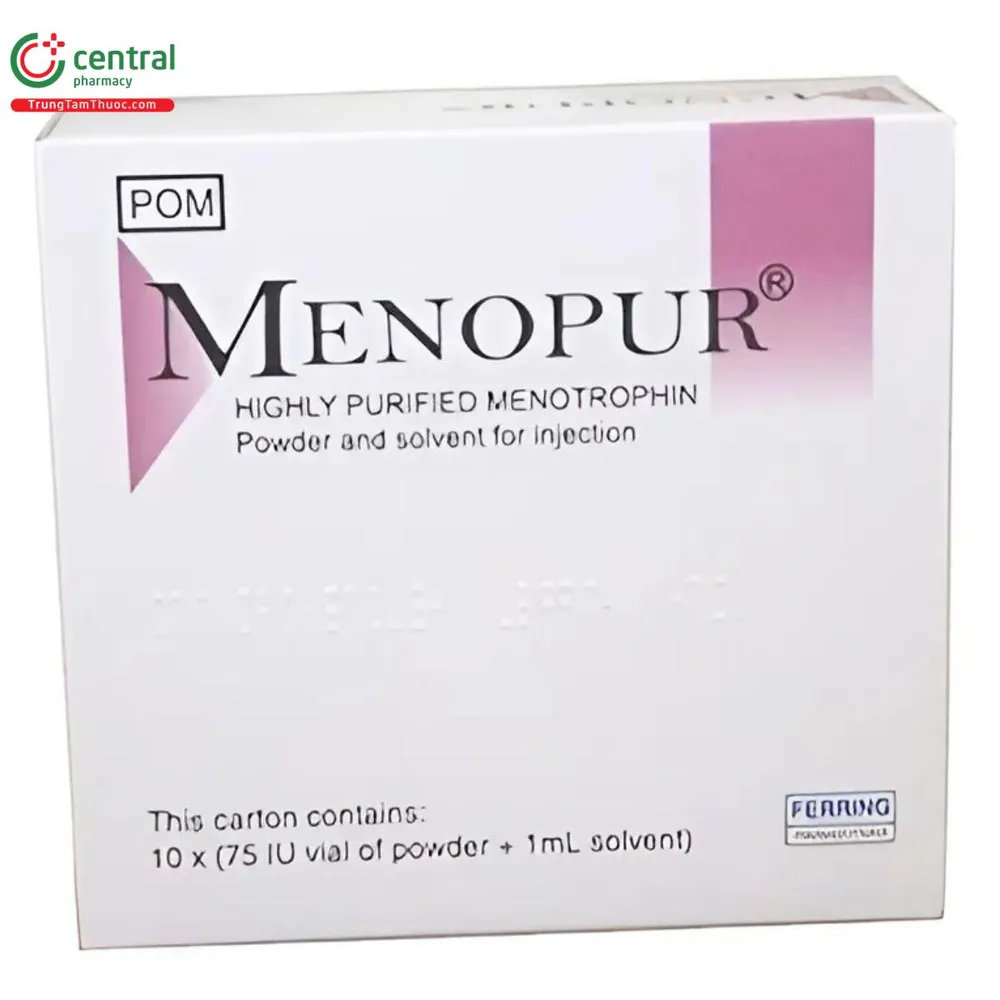
Table of Contents
Package leaflet: Information for the patient
MENOPUR, 150 IU FSH + 150 IU LH, powder and solvent for solution for injection
Menotropinum
Please read all of this leaflet carefully before using this medicine, because it contains important information for you.
- Keep this leaflet for future reference.
- If you have any further questions, please consult your doctor.
- This medicine has been prescribed for a specific individual. Do not pass it on to others. It may harm them even if their symptoms are the same as yours.
- If you experience any adverse effects, including any not listed in this leaflet, inform your doctor. See section 4.
Contents of the leaflet:
- What Menopur is and what it is used for
- Important information before using Menopur
- How to use Menopur
- Possible side effects
- How to store Menopur
- Contents of the pack and other information
1. What Menopur is and what it is used for
Menopur is a powder (in this case, a solid, compacted mass) which must be dissolved in a liquid (solvent) before use. The medicine is administered as a subcutaneous or intramuscular injection.
Menopur (highly purified menotropins extracted from the urine of postmenopausal women) contains two hormones: follicle-stimulating hormone (FSH) and luteinizing hormone (LH).
FSH and LH are hormones naturally produced in both women and men. They enable normal functioning of the reproductive organs.
Menopur is used in the treatment of infertility in the following situations:
- in women who are unable to become pregnant because their ovaries do not produce oocytes (including cases of polycystic ovarian syndrome). Menopur is used in women who have already been treated with clomiphene citrate for infertility but did not respond to this treatment;
- in women undergoing assisted reproductive technologies such as in vitro fertilization and embryo transfer, fallopian tube gamete transfer, and intracytoplasmic sperm injection. Menopur supports the development of multiple ovarian follicles in which oocytes can mature (multiple follicular development);
- in men who have insufficient sperm production due to gonadotropin deficiency (hormones produced by the pituitary gland that affect the testes).
2. Important information before using Menopur
Before starting treatment with Menopur, your doctor must evaluate the causes of infertility in both partners. In particular, the following conditions should be ruled out, as they require different, specific treatments:
- Hypothyroidism and adrenal insufficiency;
- High levels of a hormone called prolactin (hyperprolactinemia);
- Tumors of the pituitary gland (a gland located at the base of the brain);
- Tumors of the hypothalamus (an area located beneath the part of the brain called the thalamus).
If you have been diagnosed with any of the above conditions, you must inform your doctor before starting treatment with Menopur.
When not to use Menopur
In women and men:
- If you are allergic to menotropin or any of the other ingredients of this medicine (listed in section 6);
- If you have tumors of the pituitary gland or hypothalam游戏副本
3. How to use Menopur
This medicine should always be used exactly as prescribed by your doctor. If you have any doubts,
you should consult your doctor.
Women who do not ovulate (do not produce eggs)
Treatment should begin within the first 7 days of the menstrual cycle (day 1 being the first day of
menstruation). The medicine should be administered daily for at least 7 days.
The initial dose is usually 75 IU (International Units) FSH + 75 IU LH to 150 IU FSH + 150 IU LH (i.e.
from ½ vial to 1 vial of powder) per day. However, the dose may be adjusted according to the
patient's response up to a maximum of 225 IU FSH + 225 IU LH (i.e. 1 vial and ½ vial of powder) per
day. A given dose should be maintained for at least 7 days before any dose adjustment. It is
recommended that each dose adjustment should increase the dose by 37.5 IU FSH + 37.5 IU LH
(i.e. ¼ vial of powder), but not more than 75 IU FSH + 75 IU LH (i.e. ½ vial of powder). Treatment
should be discontinued if no response is observed after 4 weeks.
Once a satisfactory response has been achieved, another hormone, hCG, should be administered
as a single injection on the day following the last Menopur injection, at a dose of 5000 IU to 10,000
IU. Sexual intercourse is recommended on the day of hCG administration and the following day.
Alternatively, insemination (direct placement of sperm into the uterus) may be performed. The
patient remains under close medical supervision for at least 2 weeks after hCG administration.
Your doctor will monitor the effects of Menopur treatment. Depending on treatment progress, the
doctor may decide to discontinue Menopur and withhold hCG administration. In such a case, the
patient will be advised to use a mechanical contraceptive method (e.g. condom) or abstain from
sexual intercourse until the next menstrual period occurs.
Women undergoing assisted reproductive programs
If the patient has also been treated with a GnRH agonist (a medicine that enhances the action of
Gonadotropin Releasing Hormone - GnRH), Menopur treatment should begin approximately 2 weeks
after starting GnRH agonist therapy.
If the patient has also been treated with a GnRH antagonist, Menopur treatment should begin on
day 2 or 3 of the menstrual cycle (day 1 of menstruation being day 1 of the cycle).
The medicine should be administered daily for at least 5 days. The initial dose of Menopur is usually
150 IU FSH + 150 IU LH to 225 IU FSH + 225 IU LH (i.e. from 1 vial to 1 vial and ½ vial of powder) per
day. Depending on the patient's response, this dose may be increased up to a maximum of 450 IU
FSH + 450 IU LH (i.e. 3 vials of powder) per day. The dose should not be increased by more than
150 IU FSH + 150 IU LH (i.e. 1 vial of powder) at any one time. Treatment usually should not last
longer than 20 days.
Once a sufficient number of appropriately sized ovarian follicles have been observed, the patient
receives a single injection of hCG at a dose up to 10,000 IU to trigger ovulation (release of the egg).
The patient remains under close medical supervision for at least 2 weeks after hCG administration.
Your doctor will monitor the effects of Menopur treatment. Depending on treatment progress, the
doctor may decide to discontinue Menopur and withhold hCG administration. In such a case, the
patient will be advised to use a mechanical contraceptive method (e.g. condom) or abstain from
sexual intercourse until the next menstrual period occurs.
Men:
Treatment begins with administration of hCG 3 times per week at a dose of 1000 IU to 3000 IU until
normal serum testosterone levels are achieved. Then, Menopur is administered intramuscularly at a
dose of 75 IU FSH + 75 IU LH to 150 IU FSH + 150 IU LH (i.e. from ½ vial to 1 vial of powder) 3 times
per week for several months.
INSTRUCTIONS FOR USE
If your doctor has instructed you to self-inject Menopur, you must follow all provided instructions.
The first Menopur injection should be administered under the supervision of a doctor.
RECONSTITUTION (SOLUBILIZATION) OF MENOPUR:
Menopur is a powder and must be reconstituted (dissolved) before injection. The diluent to be used
for reconstitution is supplied with the powder. Menopur should be reconstituted immediately
before use. To do this:
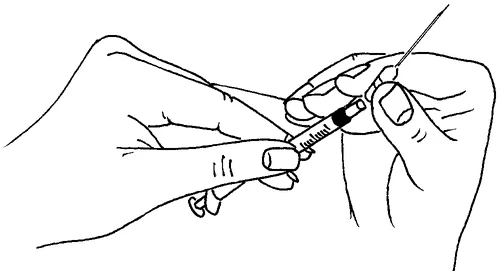
- Attach a thick, long needle (reconstitution needle) firmly to the syringe.
- Snap off the top of the ampoule containing the diluent at the point indicated by the dot.
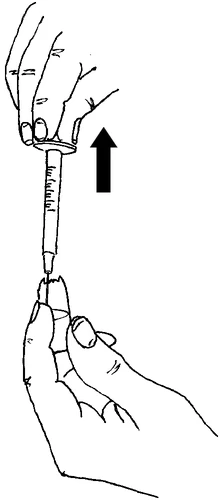
- Insert the needle into the ampoule with diluent.
- Draw all the liquid from the ampoule into the syringe.
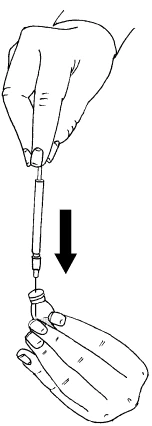
- Insert the needle through the rubber stopper of the vial containing the powder and slowly inject all the liquid. Aim at the vial wall to avoid foaming.
- The powder should dissolve quickly (within 2 minutes), forming a clear solution.
-
To facilitate dissolution, gently rock the vial. Do not shake, as this may cause air bubbles to form. If the solution is not clear or if it contains insoluble particles, do not use it.
-
Draw the solution back into the syringe.
If your doctor has prescribed more than one vial of Menopur per injection, the solution obtained
after reconstituting the powder from the first vial may be injected into a second vial of powder. This
procedure may be repeated with additional vials—up to a total of 3 vials of powder—but only if
prescribed by your doctor.
If your doctor has prescribed Bravelle together with Menopur, both medicines may be mixed.
To do this, reconstitute Menopur first, then slowly inject the resulting solution into the vial of Bravelle.
Wait until Bravelle is fully dissolved, draw the solution containing both medicines into the syringe,
and inject subcutaneously. This method avoids the need to inject each medicine separately.
INJECTION OF MENOPUR:
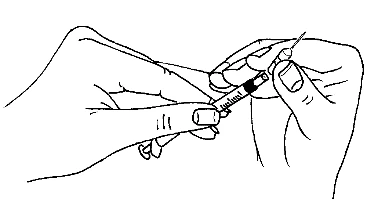
- After drawing the prescribed dose of medicine into the syringe, change the needle to a short, thin needle (injection needle).
- Hold the syringe with the needle pointing upward and gently tap the syringe to allow air bubbles to rise to the top. Carefully press the plunger until the first drop of liquid appears at the tip of the needle.
- The patient will be informed by the doctor or nurse where to inject the medicine (e.g. front of the thigh, abdomen, etc.).
- Disinfect (cleanse) the skin at the injection site.
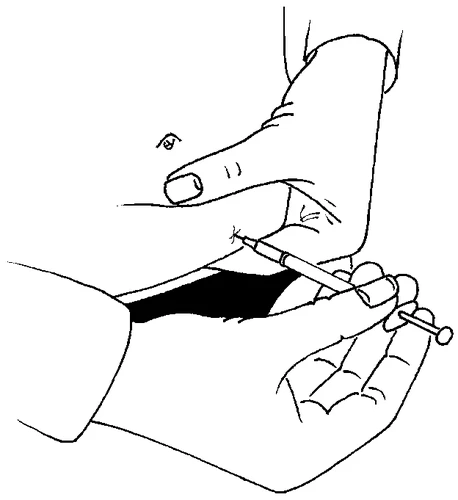
- To perform the injection, pinch the skin to form a skin fold and quickly insert the needle at a 90-degree angle (perpendicular). Inject the solution by pressing the syringe plunger, then withdraw the needle.
- After removing the needle, press gently on the injection site to prevent bleeding. Gentle massage at the injection site helps the solution disperse under the skin.
- Used materials must not be disposed of in household waste containers but must be discarded appropriately.
Use of a higher than recommended dose of Menopur
If a higher than recommended dose of Menopur has been used, inform your doctor immediately.
Missed dose of Menopur
Do not administer a double dose to make up for a missed dose. If you miss a dose of Menopur, inform your doctor.
4. Possible adverse reactions
Like all medicines, this medicine can cause adverse reactions, although they do not occur in everyone.
Hormones used in infertility treatment, such as Menopur, may cause excessive ovarian activity, leading to a condition called Ovarian Hyperstimulation Syndrome (OHSS), especially in women with polycystic ovary syndrome. Symptoms include: abdominal pain, abdominal distension, nausea, vomiting, diarrhoea, and weight gain. In severe cases of OHSS, complications have rarely occurred, such as accumulation of fluid in the abdominal cavity, pelvic cavity and/or pleural cavity, difficulty breathing, reduced frequency or amount of urine, blood clot formation in blood vessels (thromboembolic disorders), and ovarian torsion.
If any of these symptoms occur, contact your doctor immediately, even if they appear several days after the last dose of the medicine.
Allergic (hypersensitivity) reactions may occur during treatment. Symptoms of such reactions may include: rash, itching, throat swelling, and breathing difficulties. If any of these symptoms occur, contact your doctor immediately.
The following adverse reactions occur frequently, i.e. in 1 to 10 out of every 100 treated patients:
- abdominal pain;
- headache;
- nausea;
- abdominal distension;
- pelvic pain;
- excessive ovarian stimulation leading to high ovarian activity (Ovarian Hyperstimulation Syndrome);
- injection site reactions such as pain, redness, bruising, swelling, and/or itching.
The following adverse reactions occur uncommonly, i.e. in 1 to 10 out of every 1000 treated patients:
- vomiting;
- abdominal discomfort;
- diarrhoea;
- feeling of fatigue;
- dizziness;
- fluid-filled sacs in the ovaries (ovarian cysts);
- breast discomfort, including breast pain, breast tenderness, discomfort, nipple pain, and breast swelling;
- hot flushes.
The following adverse reactions occur rarely, i.e. in 1 to 10 out of every 10,000 treated patients:
- acne;
- rash.
In addition to the above, the following adverse reactions have been observed after Menopur was placed on the market, and their frequency is unknown:
- visual disturbances;
- fever;
- malaise;
- allergic reactions;
- weight gain;
- muscle and joint pain (e.g. back pain, neck pain, and pain in arms and legs);
- ovarian torsion, as a complication of increased ovarian activity caused by excessive stimulation;
- itching;
- urticaria;
- blood clots, as a complication of increased ovarian activity caused by excessive stimulation.
Reporting of adverse reactions
If any adverse reactions occur, including any adverse reactions not listed in this leaflet, inform your doctor. Adverse reactions can be reported directly to the Department of Monitoring Adverse Drug Reactions of the Office for Registration of Medicinal Products, Medical Devices and Biocidal Products: Aleje Jerozolimskie 181C, 02-222 Warsaw, Tel: +48 22 49 21 301, Fax: +48 22 49 21 309, e-mail: [email protected]
Adverse reactions can also be reported to the marketing authorization holder.
Reporting adverse reactions helps to provide more information on the safety of the medicine.
5. How to store Menopur
Keep this medicine out of the sight and reach of children.
Do not store above 25°C.
Store in the original packaging to protect from light.
Do not use this medicine after the expiry date stated on the carton and on the labels of the vial and ampoule following the word EXP. The expiry date refers to the last day of the specified month.
Medicines should not be disposed of via wastewater or household waste. Ask your pharmacist how to dispose of medicines no longer required. These measures will help protect the environment.
6. Contents of the pack and other information
What Menopur contains
- The active substance is highly purified menotropin (Menotropinum) (human menopausal gonadotrophin, hMG) in an amount corresponding to 150 IU FSH (follicle-stimulating hormone) and 150 IU LH (luteinising hormone).
- The other ingredients are:
- powder: monohydrate lactose, polysorbate 20, sodium hydroxide (for pH adjustment), hydrochloric acid (for pH adjustment)
- solvent: sodium chloride, hydrochloric acid 10% (for pH adjustment), water for injections
What Menopur looks like and contents of the pack
Menopur is a powder and solvent for solution for injection.
The cardboard box contains 1 vial or 5 vials made of colourless glass containing the powder.
The cardboard box also contains the same number of ampoules made of colourless glass containing the solvent.
Not all pack sizes may be marketed.
Marketing Authorisation Holder:
Ferring GmbH
Wittland 11
D-24109 Kiel
Germany
Manufacturer/Importer:
Ferring GmbH
Wittland 11
D-24109 Kiel
Germany
For further information about this medicinal product, please contact the representative of the Marketing Authorisation Holder:
Ferring Pharmaceuticals Poland Sp. z o.o.
Szamocka 8 Street, 01-748 Warsaw, Poland
Tel.: +48 22 246 06 80, Fax: +48 22 246 06 81