Megalotect cp
Poland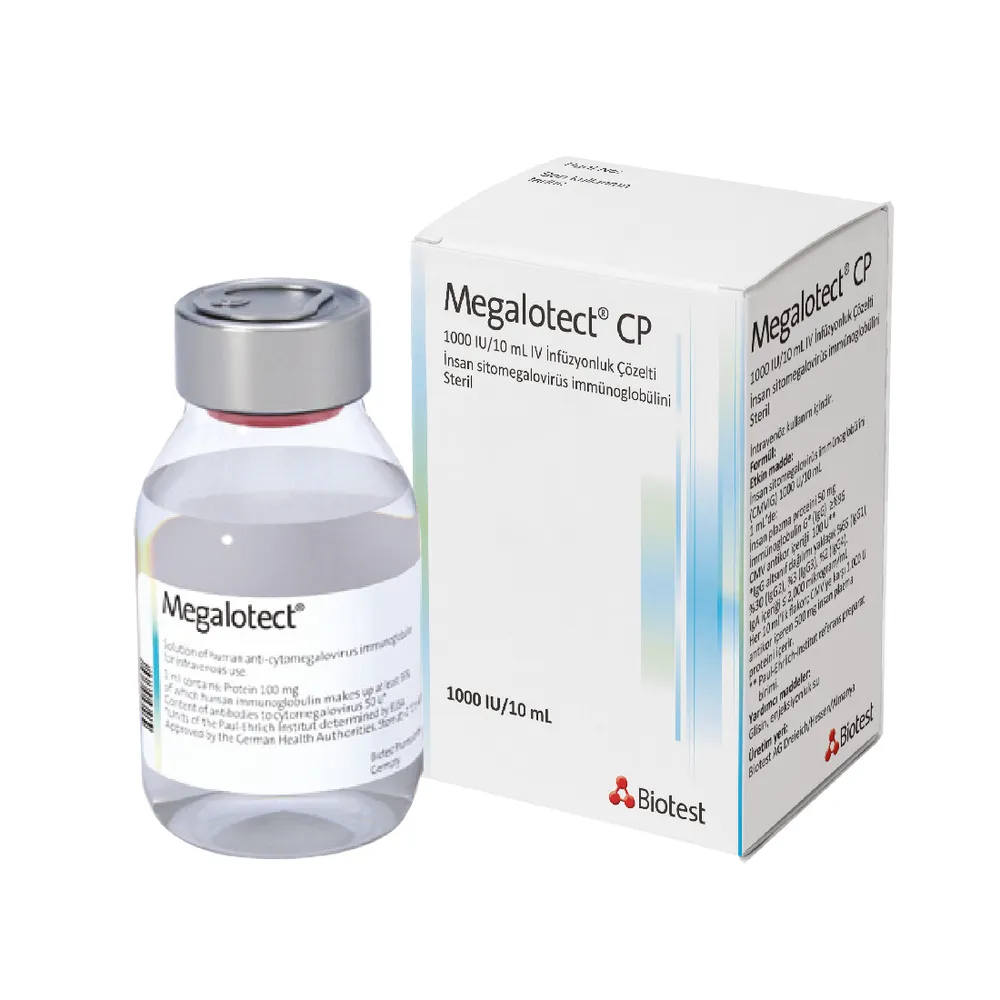
Table of Contents
- Package leaflet: Information for the user
- 1. What Megalotect CP is and what it is used for
- 2. Important information before using Megalotect CP
- 3. How to use Megalotect CP
- 4. Possible adverse reactions
- 5. How to store Megalotect CP
- 6. Contents of the package and other information
- Information intended exclusively for medical professionals:
Package leaflet: Information for the user
Megalotect CP, 100 U/ml, infusion solution
Human cytomegalovirus immunoglobulin
Please read all of this leaflet carefully before using this medicine, because it contains
important information for the patient.
- Keep this leaflet, as you may need to read it again.
- If you have any further questions, ask your doctor, pharmacist, or nurse.
- This medicine has been prescribed for a specific individual. Do not pass it on to others. It may harm other people, even if their symptoms are the same.
- If you experience any adverse reactions, including any not listed in this leaflet, inform your doctor, pharmacist, or nurse. See section 4.
Leaflet contents:
- What Megalotect CP is and what it is used for
- What you need to know before using Megalotect CP
- How to use Megalotect CP
- Possible side effects
- How to store Megalotect CP
- Contents of the pack and other information
1. What Megalotect CP is and what it is used for
Megalotect CP
- belongs to the group of immunoglobulins. These medicines contain antibodies (antibodies are components of the body's immune system).
- contains antibodies against cytomegalovirus.
- is an infusion solution administered intravenously (by "drip" or infusion).
Megalotect CP is given to patients receiving immunosuppressive therapy (treatment to suppress the immune system) to prevent clinical symptoms of cytomegalovirus infection, particularly in organ transplant recipients.
Your doctor may consider concomitant use of appropriate antiviral drugs during administration of Megalotect CP.
2. Important information before using Megalotect CP
When not to use Megalotect CP
- if the patient has hypersensitivity to human immunoglobulin or to any of the other components of this medicine (listed in section 6).
- if the patient has hypersensitivity to human immunoglobulin, particularly if they have antibodies against immunoglobulin A (IgA).
Warnings and precautions
Before receiving Megalotect CP, discuss this with your doctor, pharmacist, or nurse:
- if the patient is receiving human immunoglobulin for the first time or after a long break, or if the patient’s immunoglobulin-containing medicine is being changed. In such cases, the doctor will closely monitor the patient.
- if the patient has hypersensitivity to immunoglobulins (see section "When not to use Megalotect CP").
- if the patient
- has significant overweight or is elderly,
- has high blood pressure (hypertension), diabetes, or vascular diseases,
- has increased tendency for blood clotting in vessels,
- has been immobilized in bed for a prolonged period,
- has low blood volume (hypovolemia) or the patient’s blood is concentrated,
- has kidney disease or is taking medicines that may harm kidney function. In such cases, more adverse reactions may occur. If necessary, the doctor may discontinue treatment with Megalotect CP or take other precautions (e.g. reduce the infusion rate).
Hypersensitivity reactions
The patient may be allergic to immunoglobulins without knowing it. Hypersensitivity reactions may occur even if the patient has previously received human immunoglobulins and tolerated them well. However, true hypersensitivity reactions are rare. In such rare cases, hypersensitivity reactions (anaphylactic reactions) such as sudden drop in blood pressure or shock may occur (see also section 4 "Possible side effects").
If such reactions occur during administration of Megalotect CP, the patient must immediately inform the doctor. The doctor will decide whether to reduce the infusion rate, stop the infusion, and initiate necessary medical measures to treat the reaction.
Information regarding safety in relation to infections
Megalotect CP is manufactured from human plasma (the liquid part of blood). When medicines are manufactured from human blood or plasma, specific precautions are taken to prevent transmission of infections to patients. All blood donors are tested for the presence of viruses and infectious diseases. Additionally, steps are taken to inactivate or remove viruses.
Despite these precautions, it is not possible to completely exclude the risk of transmitting infectious agents when administering medicines derived from human blood or plasma.
The measures taken are considered effective against enveloped viruses, such as:
- human immunodeficiency virus (HIV),
- hepatitis A virus (HAV),
- hepatitis B virus (HBV),
- hepatitis C virus (HCV).
The effectiveness of these measures may be limited against non-enveloped viruses, such as:
- parvovirus B19.
No association has been found between immunoglobulins and hepatitis A virus infection or parvovirus B19 infection. This is likely because the antibodies contained in Megalotect CP against these infections provide protective effects.
It is strongly recommended that each time a patient receives a dose of Megalotect CP, the doctor records the product name and batch number. The batch number identifies the source materials used in the medicine. This allows, if necessary, linking the patient to the source material used.
Children and adolescents
Special warnings and precautions for use mentioned for adults should also be considered for children and adolescents.
Megalotect CP and other medicines
Inform the doctor about all medicines the patient is currently taking or has recently taken, as well as any medicines the patient plans to take.
Megalotect CP may reduce the effectiveness of certain vaccines, such as vaccines against:
- measles
- rubella
- mumps
- varicella (chickenpox)
After receiving Megalotect CP, it may be necessary to wait up to 3 months before receiving certain vaccines and up to 1 year before receiving the measles vaccine.
Children and adolescents
Interactions mentioned for adults are expected to occur in children and adolescents as well.
Pregnancy, breastfeeding, and fertility
If the patient is pregnant or breastfeeding, suspects she may be pregnant, or plans to have a child, she should consult her doctor or pharmacist before using this medicine.
The doctor will decide whether the patient can be treated with Megalotect CP during pregnancy or breastfeeding.
Driving and operating machinery
Some adverse reactions associated with the administration of Megalotect CP may impair the ability to drive or operate machinery. If the patient experiences adverse reactions during treatment, they should wait until these have subsided before driving or operating machinery.
3. How to use Megalotect CP
Megalotect CP is administered by a doctor.
The recommended dose is 1 ml per kg of body weight per day for adults, children, and adolescents.
The patient will receive this medicine at least 6 times in total, at intervals of 2-3 weeks. The doctor will decide exactly how many infusions the patient will need and when to start treatment.
Megalotect CP is given by intravenous infusion (via an IV drip). The medicinal product should reach room temperature or body temperature before use.
Receiving more than the recommended dose of Megalotect CP
An excessive amount of Megalotect CP may lead to fluid overload and increased blood viscosity (thickening), particularly in patients over 65 years of age and/or patients with impaired kidney function.
If the patient thinks they have received too much Megalotect CP, they should discuss this with their doctor as soon as possible.
If there are any further doubts regarding the use of this medicine, consult a doctor, pharmacist, or nurse.
4. Possible adverse reactions
Like all medicines, this medicine can cause adverse reactions, although not everyone will experience them.
The adverse reactions listed below have been reported spontaneously following the use of
Megalotect CP:
Unknown: frequency cannot be estimated from the available data
- transient anemia (reversible hemolytic anemia),
- hypersensitivity reactions and allergic reactions (e.g. skin reactions, feeling of warmth, chills, itching, shortness of breath) with sudden drop in blood pressure, in individual cases with anaphylactic shock, even if no reactions occurred during previous administration of the medicine (see also section 2. "Warnings and precautions", anaphylactic reactions),
- headache,
- vomiting,
- skin reactions,
- joint pain,
- blood test results indicating impaired kidney function (increased blood creatinine concentration) and (or) acute kidney failure,
- chills, fever
Human immunoglobulin preparations may generally cause the following adverse reactions:
Not very common (may affect up to 1 in 100 users):
- headache, dizziness
- nausea, vomiting
- joint pain, mild back pain
- low blood pressure
- chills, fever
- allergic reactions
Rare (may affect up to 1 in 1,000 users):
- transient cases of skin reactions
- hypersensitivity reactions with sudden drop in blood pressure and, in isolated cases, anaphylactic shock, even when the patient did not show any reaction during previous treatment (see also section 2 "Warnings and precautions").
Very rare (may affect up to 1 in 10,000 users):
- thromboembolic events, such as
- myocardial infarction,
- stroke,
- blockage of blood vessels in the lungs by blood clot (pulmonary embolism),
- blood clot in a vein (deep vein thrombosis)
Frequency not known (frequency cannot be estimated from the available data)
- transient anemia
- breakdown of red blood cells (hemolysis)
- blood test results indicating impaired kidney function (increased serum creatinine concentration) and (or) acute kidney failure
- transient meningitis (reversible aseptic meningitis)
Children and adolescents
The frequency, type, and severity of adverse reactions in the pediatric and adolescent population are expected to be similar to those in adults.
Reporting of adverse reactions
If any adverse reactions occur, including any adverse reactions not listed in this leaflet, inform your doctor, pharmacist, or nurse. Adverse reactions can be reported directly to the Department of Monitoring Adverse Drug Reactions of the Office for Registration of Medicinal Products, Medical Devices and Biocidal Products
Al. Jerozolimskie 181C
02-222 Warsaw
Tel.: +48 22 49 21 301
Fax: +48 22 49 21 309
e-mail: [email protected]
Adverse reactions can also be reported to the marketing authorization holder.
Reporting adverse reactions helps provide more information on the safety of this medicine.
5. How to store Megalotect CP
Keep the medicine out of sight and reach of children.
Do not use this medicine after the expiry date stated on the carton and vial after "Expiry".
Store in a refrigerator (2°C–8°C). Keep in the outer packaging to protect from light.
Do not freeze.
The solution should be inspected before use. The solution should be clear or slightly opalescent (milky sheen) and colourless or pale yellow. Do not use Megalotect CP if the solution is cloudy or contains a precipitate.
The medicinal product should be used immediately after first opening of the container.
Medicines must not be disposed of via wastewater or household waste. Ask your pharmacist how to dispose of medicines no longer required. Such measures help protect the environment.
6. Contents of the package and other information
What Megalotect CP contains
The active substance is human immunoglobulin against cytomegalovirus (CMVIG).
1 ml of solution contains:
50 mg of human plasma protein, of which at least 96% is immunoglobulin G (IgG),
with a cytomegalovirus (CMV) antibody content of 100 U*.
Each 10 ml vial contains: 500 mg of human plasma protein (of which at least 96% is immunoglobulin G),
with a CMV antibody content of 1000 U.
Each 50 ml vial contains: 2500 mg of human plasma protein (of which at least 96% is immunoglobulin G),
with a CMV antibody content of 5000 U.
The approximate IgG subclass distribution is: 65% IgG1, 30% IgG2, 3% IgG3, 2% IgG4.
Maximum content of immunoglobulin A (IgA) is 2,000 micrograms/ml.
* reference units of the Paul Ehrlich Institute
The other ingredients are glycine and water for injections.
What Megalotect CP looks like and contents of the pack
Megalotect CP is a clear or slightly opalescent (milky-shining), colourless or slightly yellowish solution in colourless glass vials.
Megalotect CP is available in the following pack sizes:
One carton containing 1 vial with 10 ml (1,000 U) of infusion solution.
One carton containing 1 vial with 50 ml (5,000 U) of infusion solution.
Not all pack sizes may be marketed.
Marketing Authorisation Holder and Manufacturer
Biotest Pharma GmbH
Landsteinerstraße 5
63303 Dreieich
Germany
Tel.: +49 6103 801-0
Fax: +49 6103 801-150
Email: [email protected]
This medicinal product is authorised in the European Economic Area countries under the following names:
Croatia, Germany, Hungary, Spain: Cytotect CP Biotest
Austria: Cytotect CP Biotest 100 E/ml Infusionslösung
Italy: Cytomegatect
Greece, Poland, Portugal: Megalotect CP
Belgium, Netherlands: Megalotect 100 E/ml
Slovenia: Megalotect 100 e./ml raztopina za infundiranje
Information intended exclusively for medical professionals:
Dosing and administration
Treatment should be initiated on the day of transplantation. In the case of bone marrow transplantation, prophylaxis may also be considered up to 10 days before transplantation, especially in CMV-seropositive patients. A total of at least 6 single doses should be administered at intervals of 2–3 weeks.
Route of administration
The medicinal product Megalotect CP must be administered as an intravenous infusion at an initial rate of 0.08 ml/kg body weight/hour for 10 minutes. If well tolerated, the infusion rate may be gradually increased up to a maximum of 0.8 ml/kg body weight/hour until completion of the infusion.
Warnings and precautions
Some severe adverse reactions may be related to the infusion rate. The recommended infusion rate must be strictly observed. Patients must be closely monitored and carefully observed during the infusion for any signs or symptoms.
Adverse reactions may occur more frequently:
- when the infusion rate is too high,
- in patients receiving human normal immunoglobulin for the first time, or in rare cases in patients who have switched from one immunoglobulin-containing product to another, or in patients who have had a long interval since their last treatment.
Potential complications can be avoided by ensuring that patients:
- do not have hypersensitivity to human immunoglobulin by starting with a slow initial infusion rate (0.08 ml/kg body weight/hour),
- are closely monitored during the infusion for any adverse reactions. In particular, patients who have not previously received human normal immunoglobulin, patients receiving a different immunoglobulin-containing product, and patients with a long interval since their last infusion should be monitored during and for one hour after the first infusion to detect possible adverse reactions. All other patients should be observed for at least 20 minutes after administration.
If an adverse reaction occurs, the infusion rate should be reduced or the infusion stopped. Required treatment depends on the type and severity of the adverse reaction.
In case of shock, current standard medical management for shock should be implemented.
Administration of immunoglobulins in all patients requires:
- adequate hydration prior to starting immunoglobulin infusion,
- monitoring of diuresis,
- monitoring of serum creatinine concentration,
- avoidance of concomitant use of loop diuretics.
Hypersensitivity
True hypersensitivity reactions are rare. They may occur in patients with antibodies against IgA.
Administration of immunoglobulin is not indicated in patients with selective IgA deficiency if the IgA deficiency is the only abnormal finding.
Immunoglobulin administration may rarely cause a drop in arterial blood pressure with an anaphylactic reaction, even in patients who previously tolerated immunoglobulin treatment well.
Thromboembolic complications
Clinical evidence indicates an association between intravenous immunoglobulin (IVIg) administration and thromboembolic events such as myocardial infarction, cerebrovascular events (stroke), pulmonary embolism, and deep vein thrombosis. High-dose immunoglobulin administration in patients at risk is believed to lead to a relative increase in blood viscosity. Caution is advised when prescribing and infusing intravenous immunoglobulins in obese patients and in patients with existing risk factors for thrombotic events (such as advanced age, hypertension, diabetes, vascular disease, history of thrombotic episodes, patients with acquired or congenital predispositions to thrombosis, patients after prolonged immobilization, patients with severe hypovolemia, and patients with conditions associated with increased blood viscosity).
In patients with existing risk of thromboembolic adverse events, intravenous immunoglobulin-containing products should be administered at the lowest possible infusion rate and at the smallest possible dose.
Acute renal failure
Cases of acute renal failure have been reported in patients receiving intravenous immunoglobulin therapy. In most cases, risk factors were identified, such as pre-existing renal impairment, diabetes, hypovolemia, overweight, concomitant use of nephrotoxic medicinal products, or patient age over 65 years.
If renal function impairment occurs, discontinuation of the immunoglobulin-containing product should be considered.
Cases of renal dysfunction and acute renal failure have been observed after administration of multiple licensed intravenous immunoglobulin products containing various excipients such as sucrose, glucose, and maltose. Products containing sucrose as a stabilizer accounted for the majority of such cases. In patients at risk, use of immunoglobulin products not containing these components may be considered. The medicinal product Megalotect CP does not contain sucrose, glucose, or maltose.
In patients with existing risk of acute renal failure, intravenous immunoglobulin-containing products should be administered at the lowest possible infusion rate and at the smallest possible dose.
Aseptic meningitis syndrome (AMS)
Aseptic meningitis syndrome (AMS) has been reported in association with intravenous immunoglobulin therapy (IVIg products). Discontinuation of intravenous immunoglobulin therapy resulted in resolution of AMS within several days without sequelae. The syndrome typically occurs within several hours to 2 days after initiation of IVIg therapy. Cerebrospinal fluid analysis often reveals pleocytosis with cell counts up to several thousand per mm³, predominantly granulocytic series, and increased protein levels up to several hundred mg/dl. AMS may occur more frequently with high-dose intravenous immunoglobulin therapy (2 g/kg).
Hemolytic anemia
Intravenous immunoglobulins (IVIg products) may contain blood group antibodies acting as hemolysins, leading to in vivo coating of red blood cells with immunoglobulins, resulting in a positive direct antiglobulin test (Coombs test) and, rarely, hemolysis.
Hemolytic anemia may develop following intravenous immunoglobulin therapy due to enhanced sequestration of red blood cells. Patients receiving intravenous immunoglobulins should be monitored for clinical signs and symptoms of hemolysis.
Effect on serological test results
Transient increases in various passively transferred antibodies in the patient's blood after immunoglobulin injection may lead to false-positive serological test results.
Passive transfer of antibodies against erythrocyte antigens, e.g., A, B, and D, may interfere with certain serological tests for red blood cell antibodies, such as the direct antiglobulin test (DAT, direct Coombs test).
Pharmaceutical incompatibilities and special precautions
Do not mix the medicinal product with other medicinal products.
The medicinal product should be used immediately after first opening of the container.
The product should reach room temperature or body temperature before use.
Products should be inspected visually prior to administration. The solution should be clear or slightly opalescent and colorless or pale yellow. Do not use solutions that are cloudy or contain particulate matter.