Maxitrol
Poland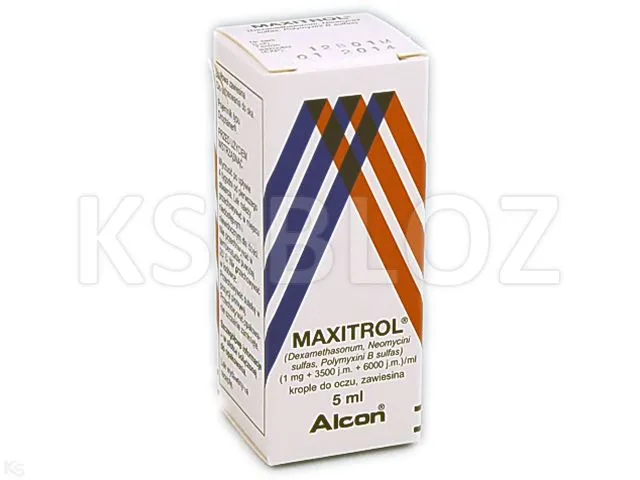
Table of Contents
Patient Information Leaflet
Warning! Keep this leaflet! Information on the immediate packaging is in a foreign language.
Maxitrol
(1 mg + 3500 i.u. + 6000 i.u.)/ml, eye drops, suspension
Dexamethasonum + Neomycini sulfas + Polymyxini B sulfas
Read all of this leaflet carefully before using this medicine because it contains important information for you.
- Keep this leaflet so that you can read it again if necessary.
- If you have any questions, please consult your doctor, pharmacist, or nurse.
- This medicine has been prescribed for a specific individual. Do not pass it on to others. This medicine may harm someone else, even if their symptoms are the same.
- If you experience any adverse reactions, including any not listed in this leaflet, inform your doctor, pharmacist, or nurse. See section 4.
Table of contents:
- What Maxitrol is and what it is used for
- Important information before using Maxitrol
- How to use Maxitrol
- Possible side effects
- How to store Maxitrol
- Contents of the pack and other information
1. What Maxitrol is and what it is used for
Maxitrol is used to treat inflammatory eye diseases that may be associated with infection.
Eye inflammation may result from infection, other agents entering the eye, or eye injury.
Maxitrol is a combination medicine containing antibacterial components and a corticosteroid.
Corticosteroids (in this case, dexamethasone) are used to prevent and reduce ocular inflammation. The antibacterial agents contained in the drops (in this case, neomycin sulfate and polymyxin B sulfate) are active against most pathogenic bacteria causing eye infections.
2. Important information before using Maxitrol
When not to use Maxitrol:
- if the patient is allergic to neomycin sulfate, polymyxin B sulfate, dexamethasone, or to any of the other ingredients of this medicine (listed in section 6),
- if the patient has:
- herpes simplex keratitis, vaccinia, varicella (chickenpox), or any other viral eye infection,
- fungal eye infection,
- untreated parasitic eye infection,
- tuberculous eye infection,
- untreated purulent eye infection.
Warnings and precautions
For ocular use only.
- Some patients may develop hypersensitivity to topically applied aminoglycoside antibiotics such as neomycin. If symptoms of hypersensitivity occur, discontinue use of the medicine immediately and contact a doctor without delay (see section 4). Hypersensitivity reactions may manifest as local itching or redness of the skin, severe allergic reactions (anaphylactic reactions), or severe skin reactions. Such skin reactions may also occur during treatment with other topical or systemic antibiotics from the same class (aminoglycosides).
- In addition, topical use of neomycin may cause redness, irritation, and discomfort of the skin.
- Patients who have experienced hypersensitivity reactions to topical neomycin may also be hypersensitive to other antibiotics.
- If the patient is using other antibiotics during treatment with Maxitrol, medical advice should be sought, as concomitant use of Maxitrol with other antibiotics may lead to serious adverse effects.
- In patients receiving long-term topical corticosteroid therapy, the following may occur:
‐ elevated intraocular pressure. Intraocular pressure should be monitored regularly during treatment with this medicine. This is particularly important in children, as corticosteroid-induced elevation in intraocular pressure may be greater and occur earlier in children than in adults. Consult a doctor, especially in the case of children. The risk of elevated intraocular pressure and/or cataract is also higher in predisposed patients (e.g., diabetic patients).
‐ development of drug-induced Cushing's syndrome due to systemic absorption. Seek medical advice if the patient develops swelling and weight gain, particularly noticeable in the trunk and face, as these are usually the first signs of a condition called Cushing's syndrome. Adrenal suppression may occur following discontinuation of prolonged or intensive treatment with Maxitrol. Consult a doctor before deciding to stop treatment. This risk is particularly significant in children and in patients treated with ritonavir or cobicistat. - If signs of eye infection appear or worsen, contact a doctor immediately. Patients using Maxitrol may have reduced resistance to eye infections, including antibiotic-resistant bacterial and fungal infections.
- In patients using corticosteroids and nonsteroidal anti-inflammatory drugs (NSAIDs) simultaneously, impaired healing of ocular surface damage may occur.
- If the patient has diseases causing thinning of the cornea or sclera, they should inform their doctor.
If the patient experiences blurred vision or other visual disturbances, they should contact a doctor.
If the patient has glaucoma, treatment duration should be limited to two weeks unless otherwise directed by a doctor.
The medicine should be used for as long as directed by the doctor. If symptoms worsen or do not improve, consult a doctor.
Children
The safety and efficacy of Maxitrol in children have not been established; therefore, use in this age group is not recommended.
Maxitrol and other medicines
Inform the doctor or pharmacist about all medicines the patient is currently using, has recently used, or plans to use, including those available without a prescription.
Particular attention should be given if the patient is using:
- topical nonsteroidal anti-inflammatory drugs (NSAIDs). Concurrent topical use of steroid and nonsteroidal anti-inflammatory medicines may impair healing of eye injuries;
- ritonavir or cobicistat, as they may increase blood levels of dexamethasone.
If the patient is using other eye drops or ointments simultaneously, at least a 5-minute interval should be maintained between administration of each medicine. Ophthalmic ointments should be applied last.
Pregnancy, breastfeeding, and fertility
If the patient is pregnant or breastfeeding, suspects she may be pregnant, or is planning to have a child, she should consult a doctor or pharmacist before using this medicine.
This medicine is not recommended during pregnancy or breastfeeding.
Driving and operating machinery
Maxitrol has no or negligible effect on the ability to drive and operate machinery.
However, vision may be blurred for a short time after instillation of Maxitrol. Do not drive or operate machinery until this effect has subsided.
Maxitrol eye drops contain benzalkonium chloride
The medicine contains 0.04 mg of benzalkonium chloride per millilitre (0.04 mg/ml).
Benzalkonium chloride may be absorbed by soft contact lenses and may cause discoloration. Soft contact lenses should be removed before instillation and not reinserted for at least 15 minutes.
Benzalkonium chloride may also cause eye irritation, particularly in patients with dry eye syndrome or corneal disorders (the transparent layer at the front of the eye). If abnormal sensations, stinging, or pain in the eye occur after using the medicine, contact a doctor.
3. How to use Maxitrol
Maxitrol should always be used exactly as directed by your doctor. If you are unsure, consult your doctor or pharmacist.
Maxitrol is intended exclusively for instillation into the eye; each container should be used by only one patient.
If the safety seal is loose after removing the cap, remove it before using the medicine.
It is recommended to close the eyelid and gently press the finger on the nasolacrimal duct (tear duct) to reduce absorption of the drug into the bloodstream after ocular administration.
Recommended dose
In mild conditions, instill one to two drops into the conjunctival sac (or sacs) four to six times daily.
In severe cases, instill one to two drops every hour. The dosage should then be gradually reduced, and treatment discontinued once inflammatory symptoms have resolved.
Your doctor will determine the duration of treatment. Do not stop treatment prematurely.
- Prepare the Maxitrol bottle and a mirror.
- Wash your hands.
- Shake the bottle.
- Unscrew the cap.
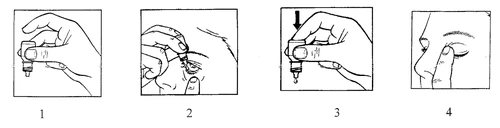
- Hold the bottle in your hand with the bottom facing upwards, grasping it between your thumb and middle finger (Figure 1).
- Tilt your head backward. Gently pull the lower eyelid downward with a clean finger to form a "pouch" between the eyelid and the eyeball—this is where the drop should be placed (Figure 2).
- Bring the dropper tip close to the eye. A mirror may be used to assist.
8. Do not touch the dropper tip to the eye, eyelid, surrounding areas, or any other surface.
Failure to follow this instruction may result in contamination of the drops.
- Gently squeeze the bottom of the bottle to release a single drop of Maxitrol (Figure 3).
- After instilling Maxitrol, remove the finger from the lower eyelid. Close the eye and press the finger against the inner corner of the eye near the nose (Figure 4). This helps prevent the medicine from entering the systemic circulation.
- If drops are required in both eyes, repeat the above steps for the second eye.
- Immediately after use, replace the cap on the bottle.
- Only one bottle of medicine should be used at a time.
If the drop misses the eye, repeat the procedure to correctly instill the drop.
Accidental overdose of Maxitrol
In case of local overdose, rinse the eye(s) with lukewarm water. Do not use the medicine again until the next scheduled dose.
Missed dose of Maxitrol
If you miss a dose, take the next scheduled dose as planned. However, if it is almost time for your next dose, skip the missed dose and continue with your regular dosing schedule. Do not take a double dose to make up for a missed one.
If you have any further questions about the use of this medicine, consult your doctor or pharmacist.
4. Possible adverse effects
Like all medicines, this medicine can cause adverse effects, although not everybody gets them.
If the patient experiences allergic reactions, including rash, swelling of the face, lips, tongue and (or)
throat, which may cause difficulty in breathing or swallowing, or if other serious
adverse effects occur, treatment with Maxitrol should be stopped immediately and the patient should
contact a doctor or the nearest hospital Emergency Department without delay.
The following adverse effects have been observed during treatment with Maxitrol:
Not very common (may occur in less than 1 in 1,000 patients): corneal inflammation, increased intraocular pressure, eye itching, sensation of eye discomfort, eye irritation.
Frequency unknown (frequency cannot be estimated from the available data): hypersensitivity, headache, corneal ulcerative keratitis, blurred vision, photophobia, pupil dilation, eyelid drooping, eye pain, eye swelling, sensation of foreign body in the eye, eye hyperaemia, excessive tearing, severe skin reactions (Stevens-Johnson syndrome), blurred vision, excessive increase in body hair growth (especially in women), muscle weakness and loss of muscle mass, purple striae on the skin, increased blood pressure, irregular menstruation or absence of menstruation, changes in protein and calcium levels in the body, growth suppression in children and adolescents, and fluid retention with weight gain, particularly noticeable in the trunk and face (a condition known as Cushing's syndrome) (see section 2 "Warnings and precautions").
Reporting of adverse effects
If any adverse effects occur, including any not listed in this leaflet, inform your doctor, pharmacist, or nurse. Adverse effects can also be reported directly to the Department of Monitoring Adverse Drug Reactions, Office for Registration of Medicinal Products, Medical Devices and Biocidal Products, Al. Jerozolimskie 181C, 02-222 Warsaw, Tel: +48 22 49 21 301, Fax: +48 22 49 21 309, Website: https://smz.ezdrowie.gov.pl.
Reporting adverse effects helps to provide more information on the safety of the medicine.
If any of the symptoms worsen or if any other adverse effects not mentioned in this leaflet occur, inform your doctor.
5. How to store Maxitrol medicine
To avoid contamination of the drops, discard the bottle 4 weeks after first opening.
The date of first opening should be recorded in the space provided below.
Date of first opening: ...............
Keep the medicine out of the sight and reach of children.
Do not store above 25°C.
Do not store in the refrigerator.
Store the bottle in an upright position.
Keep the container tightly closed.
Do not use this medicine after the expiry date stated on the packaging. The expiry date refers to the last day of the stated month.
Medicines must not be disposed of via wastewater or household waste. Ask your pharmacist how to dispose of medicines no longer required. This will help protect the environment.
6. Contents of the pack and other information
What Maxitrol contains
The active substances are:
Dexamethasone 1 mg/ml
Neomycin sulfate 3500 i.u./ml
Polymyxin B sulfate 6000 i.u./ml
The other components are: sodium chloride, polysorbate 20, benzalkonium chloride, hypromellose, water
for injection.
Minimal amounts of concentrated hydrochloric acid and/or sodium hydroxide are added to adjust the pH.
What the medicine looks like and contents of the pack
Maxitrol eye drops are a white to slightly yellowish suspension supplied in a 5 ml plastic bottle with dropper and cap, packed in a cardboard carton.
For further information, please contact the Marketing Authorisation Holder or the Parallel Importer.
Marketing Authorisation Holder in Bulgaria, country of export:
Novartis Europharm Limited
Vista Building
Elm Park, Merrion Road
Dublin 4
Ireland
Manufacturer:
Novartis Pharma GmbH, Roonstrasse 25, 90429 Nuremberg, Germany
Alcon-Couvreur NV, Rijksweg 14, 2870 Puurs, Belgium
Siegfried El Masnou SA, Camil Fabra 58, 08320 El Masnou, Barcelona, Spain
Novartis Farmacéutica, S.A., Gran Via de les Corts Catalanes, 764, 08013 Barcelona, Spain
Parallel Importer:
InPharm Sp. z o.o.
ul. Strumykowa 28/11
03-138 Warsaw
Poland
Repackaged in:
InPharm Sp. z o.o. Services sp. k.
ul. Chełmżyńska 249
04-458 Warsaw
Poland
Marketing Authorisation Number in Bulgaria, country of export: 9600056
Parallel Import Licence Number: 18/23