Maxipulmon
Poland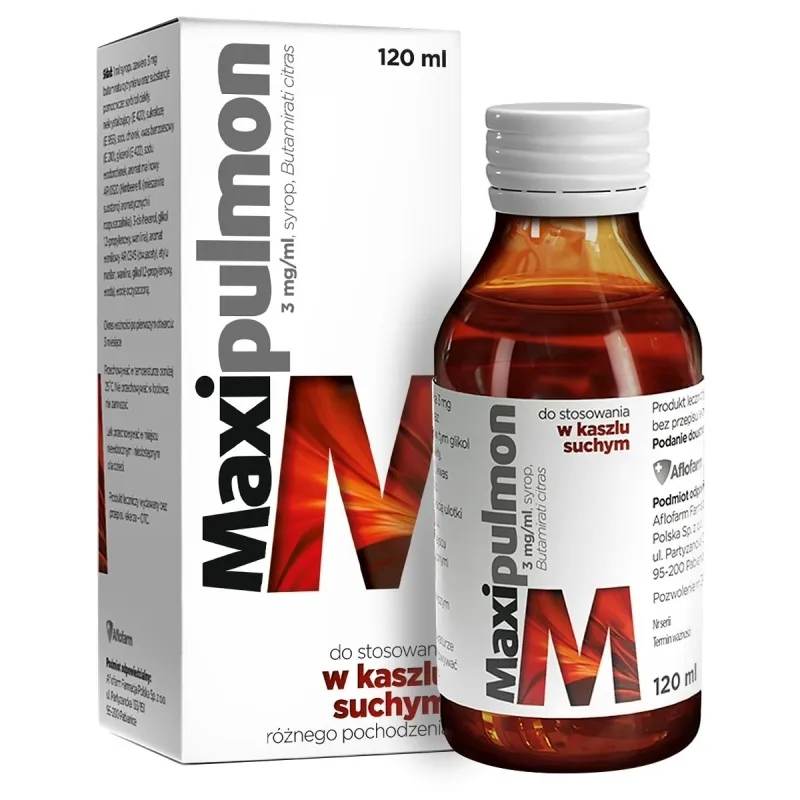
Table of Contents
Package leaflet: Information for the user
Maxipulmon, 3 mg/ml, syrup
Butamirati citras
Please read all of this leaflet carefully before taking this medicine, because it contains
important information for you.
This medicine should always be taken exactly as described in this patient leaflet or as directed by
your doctor or pharmacist.
- Keep this leaflet, as you may need to read it again.
- If you need advice or further information, please consult your pharmacist.
- If you experience any adverse reactions, including any possible adverse reactions not listed in this leaflet, inform your doctor or pharmacist. See section 4.
- If there is no improvement after 7 days, or if your condition worsens, contact your doctor.
Contents of the leaflet
- What Maxipulmon is and what it is used for
- What you need to know before taking Maxipulmon
- How to take Maxipulmon
- Possible side effects
- How to store Maxipulmon
- Contents of the pack and other information
1. What Maxipulmon is and what it is used for
Maxipulmon contains the active substance – butamirate citrate. Butamirate citrate is a non-opioid antitussive agent.
Indications
Symptomatic treatment of non-productive (dry) cough of various origins.
If there is no improvement after 7 days, or if you feel worse, contact your doctor.
2. Important information before taking Maxipulmon
When not to take Maxipulmon:
- if the patient is allergic to the active substance or to any of the other ingredients of this medicine (listed in section 6);
- during the first trimester of pregnancy (see section "Pregnancy and breastfeeding").
Warnings and precautions
Due to the suppression of the cough reflex by citric butamirate, concomitant administration of expectorant drugs should be avoided (see section "Maxipulmon with other medicines").
Children
Maxipulmon should not be used in children under 3 years of age.
Maxipulmon with other medicines
Inform your doctor or pharmacist about all medicines the patient is currently taking, has recently taken, or plans to take.
Concomitant use of expectorant medicines should be avoided, as this may lead to accumulation of secretions in the respiratory tract, increasing the risk of bronchospasm and respiratory tract infection.
Pregnancy and breastfeeding
If the patient is pregnant, breastfeeding, suspects she may be pregnant, or is planning to become pregnant, she should consult her doctor or pharmacist before using this medicine.
Pregnancy
Maxipulmon must not be used during the first trimester of pregnancy.
The medicine should not be used during the second and third trimesters of pregnancy.
Breastfeeding
This medicine should not be used during breastfeeding.
Driving and operating machinery
Maxipulmon may cause drowsiness. Therefore, caution should be exercised when driving or operating machinery. Children taking this medicine should avoid riding bicycles or scooters.
Maxipulmon contains propylene glycol, sorbitol, sodium, and benzoic acid
Propylene glycol
The medicine contains 2.18 mg of propylene glycol in each ml of syrup.
Sorbitol
The medicine contains 406 mg of sorbitol in each ml of syrup. Calorific value: 2.6 kcal/g sorbitol.
Sorbitol is a source of fructose. If the patient (or their child) has previously been diagnosed with intolerance to certain sugars or hereditary fructose intolerance, a rare genetic disorder in which the patient's body cannot break down fructose, the patient should consult a doctor before taking this medicine or giving it to a child.
Sorbitol may cause gastrointestinal discomfort and may have a mild laxative effect.
Sodium
The medicine contains 6.21 mg of sodium (main component of table salt) in each ml of syrup. This corresponds to 0.31% of the maximum recommended daily intake of sodium in the diet for adults.
Benzoic acid
The medicine contains 0.58 mg of benzoic acid in each ml of syrup.
Benzoic acid may cause local irritation.
3. How to take Maxipulmon
This medicine should always be taken exactly as described in this patient information leaflet, or as directed by your doctor or pharmacist. If in doubt, consult your doctor or pharmacist.
The medicine should be taken orally.
Recommended dose
- children from 3 to 6 years of age: 2.5 ml of syrup three times daily;
- children from 6 to 12 years of age: 5 ml of syrup three times daily;
- adolescents over 12 years of age: 7.5 ml of syrup three times daily;
- adults: 7.5 ml of syrup four times daily.
Do not use Maxipulmon for longer than 7 days without consulting a doctor.
An oral dosing device (measuring cup or oral syringe with adapter) is provided with the packaging to facilitate accurate dosing.
Instructions for using the oral syringe with adapter
- Unscrew the bottle cap.
- Insert the provided adapter into the neck of the bottle.
- Press the syringe firmly into the recess of the adapter.
- To fill the syringe, turn the bottle upside down and slowly pull down the plunger to draw the syrup up to the desired mark on the scale.
- Return the bottle to upright position and carefully remove the syringe.
- Place the tip of the syringe into the mouth and slowly press the plunger to administer the syrup gently, avoiding choking.
- After use, close the bottle and wash and dry the syringe.
If you take more Maxipulmon than you should
If you take more medicine than recommended, contact your doctor or pharmacist immediately.
Symptoms of overdose may include: drowsiness, nausea, vomiting, diarrhoea, dizziness, and low blood pressure.
If you forget to take Maxipulmon
Do not take a double dose to make up for a missed dose.
If you have any further questions about the use of this medicine, consult your doctor or pharmacist.
4. Possible adverse reactions
Like all medicines, this medicine can cause adverse reactions, although not everybody gets them.
The following adverse reactions may occur during treatment with Maxipulmon:
Rare (occur in 1 to 10 people per 10,000):
- somnolence;
- nausea;
- diarrhoea;
- urticaria (pinkish, itchy blisters on the skin).
Reporting of adverse reactions
If any adverse reactions occur, including any adverse reactions not listed
in this leaflet, inform your doctor or pharmacist.
Adverse reactions can be reported directly to the Department of Monitoring of Adverse Drug Reactions of the Office for Registration of Medicinal Products, Medical Devices and Biocidal Products
Al. Jerozolimskie 181 C, 02-222 Warsaw
Tel.: + 48 22 49 21 301
Fax: + 48 22 49 21 309
Website: https://smz.ezdrowie.gov.pl
Adverse reactions can also be reported to the marketing authorisation holder.
Reporting adverse reactions helps to provide more information on the safety of the medicine.
5. How to store the Maxipulmon medication
Keep the medication out of sight and reach of children.
Store below 25 °C. Do not store in the refrigerator or freeze.
Do not use this medication after the expiry date stated on the label and on the carton.
The expiry date refers to the last day of the stated month.
Shelf life after first opening: 3 months.
Medicines must not be disposed of via wastewater or household waste. Ask your pharmacist how to dispose of medicines no longer in use. This will help protect the environment.
6. Contents of the packaging and other information
What Maxipulmon contains
- The active substance is butamirate citrate. 1 ml of syrup contains 3 mg of butamirate citrate.
- Other ingredients include: sorbitol liquid, non-crystallizing (E 420), sucralose (E 955), sodium chloride, benzoic acid (E 210), glycerol (E 422), sodium hydroxide, raspberry flavour AR 0320 (Himbeere fl. (mixture of flavouring substances and solvent), 3-cis-hexenol, 1,2-propylene glycol, vanillin), vanilla flavour AR 0345 (diacetyl, ethyl butyrate, vanillin, 1,2-propylene glycol, water), purified water.
What Maxipulmon looks like and contents of the pack
Maxipulmon is a syrup. The syrup is colourless to yellow with a raspberry-vanilla taste.
Brown glass bottle type III with an aluminium cap with a closure made of foamed LDPE, and
an oral syringe with a capacity of 5 ml, graduated every 0.1 ml (cylinder and plunger tip made of LDPE, plunger made of polystyrene) with a connector made of LDPE or a measuring cup made of PP with a capacity of 15 ml, graduated every 2.5 ml, in a cardboard box.
The pack contains 120 ml of syrup.
Marketing Authorisation Holder
Aflofarm Farmacja Polska Sp. z o.o.
ul. Partyzancka 133/151
95-200 Pabianice
tel. (42) 22-53-100
Manufacturer
Aflofarm Farmacja Polska Sp. z o.o.
ul. Krzywa 2
95-030 Rzgów