Maxicortan
Poland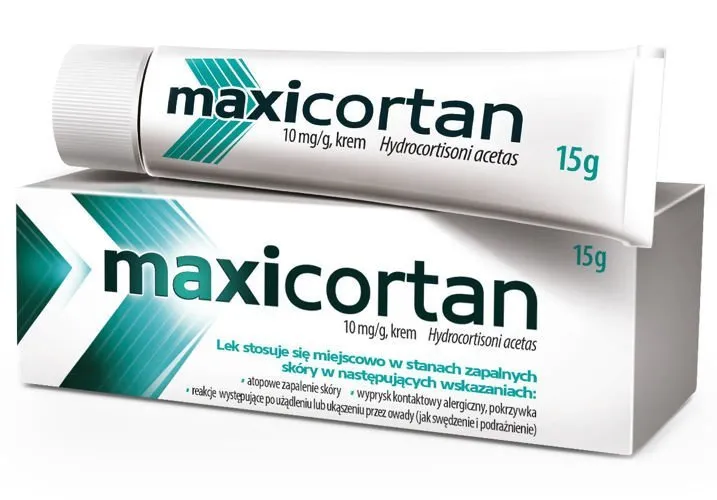
Table of Contents
Package leaflet: Information for the patient
Maxicortan
10 mg/g, cream
Hydrocortisoni acetas
Please read this leaflet carefully before using the medicine, as it contains
important information for the patient.
This medicine should always be used exactly as described in this patient leaflet or as directed by a
physician or pharmacist.
- Keep this leaflet, so that you can read it again if necessary.
- If you need advice or further information, please consult your pharmacist.
- If you experience any adverse reactions, including any not listed in this leaflet, inform your doctor or pharmacist. See section 4.
- If there is no improvement or if your condition worsens after 7 days, consult your doctor.
Table of contents
- What Maxicortan is and what it is used for
- Important information before using Maxicortan
- How to use Maxicortan
- Possible side effects
- How to store Maxicortan
- Contents of the pack and other information
1. What Maxicortan is and what it is used for
Maxicortan cream is intended for topical application to the skin.
It contains the active substance hydrocortisone acetate, which has anti-inflammatory, antipruritic,
and vasoconstrictive effects. This medicine belongs to a group of medicines called corticosteroids.
Indications
Maxicortan is used topically for inflammatory skin conditions of various origins, particularly those of
allergic origin, with moderate severity, which respond to glucocorticosteroids.
Topical treatment for:
- Atopic dermatitis;
- Allergic contact dermatitis, urticaria;
- Reactions following insect stings or bites (such as itching and irritation).
Do not use for longer than 7 days without medical advice.
2. Important information before using Maxicortan
When not to use Maxicortan:
- if the patient is allergic to hydrocortisone acetate or any of the other ingredients of this medicine (listed in section 6);
- if the patient has a bacterial, viral or fungal infection;
- if the patient has acne vulgaris or rosacea;
- if the patient has skin atrophy (skin thinning);
- if the patient has skin cancer or a pre-cancerous skin condition;
- if the patient has perioral dermatitis (inflammation around the mouth);
- if the patient has tuberculous skin lesions;
- if the patient has open wounds or damaged skin;
- on the facial skin;
- in children under 12 years of age without medical advice.
Warnings and precautions
Before starting to use Maxicortan, discuss this with your doctor or pharmacist.
You should inform your doctor:
- if the patient has diabetes;
- if the patient has glaucoma or cataracts, as use of the medicine on the eyelids or around the eyes may worsen symptoms of these conditions;
- if the patient has psoriasis, as local application of the medicine may cause recurrence of the disease.
While using Maxicortan, observe the following warnings:
- Do not apply the medicine to healthy skin.
- Do not use large doses, over large areas of skin, or for prolonged periods, as corticosteroids may be absorbed into the bloodstream and may cause adverse effects (listed in section 4: Possible side effects).
- If a skin infection develops at the site of application of Maxicortan, contact your doctor.
- Avoid contact with eyes and mucous membranes. If the medicine gets into the eyes or nose, rinse immediately with water.
- Maxicortan may be used on the skin of the armpits and groin only when absolutely necessary, as absorption is faster in these areas and there is a risk of increased adverse effects. In such cases, consult your doctor.
- After applying Maxicortan to the skin, do not cover the area with any dressing (especially plastic film or adhesive bandage), as this increases absorption of the medicine.
Children
Do not use in children under 12 years of age without medical advice. There is a risk of impaired growth and development in children.
Maxicortan and other medicines
Tell your doctor or pharmacist about all medicines the patient is currently using or has recently used, as well as any medicines the patient plans to use.
No interactions of Maxicortan cream with other medicines are known.
Pregnancy and breastfeeding
If the patient is pregnant or breastfeeding, suspects she may be pregnant, or is planning to have a baby, she should consult a doctor or pharmacist before using this medicine.
Do not use Maxicortan during pregnancy or breastfeeding without medical advice.
If a doctor prescribes the use of this medicine during pregnancy or breastfeeding, it should be used cautiously, for short periods and over small skin areas.
Driving and operating machinery
The effect of Maxicortan on driving and operating machinery is unknown.
Maxicortan contains cetyl alcohol, stearyl alcohol, propylene glycol, methyl
parahydroxybenzoate and propyl parahydroxybenzoate
- Cetyl alcohol and stearyl alcohol may cause local skin reactions (e.g. contact dermatitis).
- The medicine contains 30 mg of propylene glycol in each gram of cream.
- Methyl parahydroxybenzoate and propyl parahydroxybenzoate may cause allergic reactions (delayed-type reactions possible).
3. How to use Maxicortan
This medicine should always be used exactly as described in the patient information leaflet or as directed by a doctor. If in doubt, consult a doctor or pharmacist.
Recommended dose
This medicine is intended for topical application to the skin.
Apply a thin layer of cream to the affected area of skin once or twice daily.
Maxicortan should be applied according to the fingertip unit (FTU) measure.
1 FTU corresponds to the amount of cream squeezed from the tube in a straight line from the tip to the first crease of the adult index finger (~2.5 cm), equivalent to 0.5 g of cream.
Smaller areas will require proportionally less cream.
One FTU is sufficient to cover the surface area of both adult palms.
Do not use on large areas of skin without medical advice.
Duration of treatment
Do not use for longer than 7 days without medical advice.
If symptoms worsen or do not improve after 7 days of treatment, consult a doctor.
Use in children
Maxicortan is not intended for use in children under 12 years of age.
Use of a higher than recommended dose of Maxicortan
If more Maxicortan than recommended has been used, contact a doctor immediately.
Maxicortan used in large doses and over large skin areas may cause disturbances in children's growth and development, as well as suppression of the hypothalamic–pituitary–adrenal (HPA) axis (this is the name for the interrelated endocrine glands producing hormones).
Symptoms of overdose may include:
- increased blood glucose levels;
- presence of glucose in urine (glucosuria);
- Cushing's syndrome (characteristic appearance: moon-shaped face, rounded trunk, and thin limbs).
Missed dose of Maxicortan
Continue using the medicine as prescribed, without increasing the next dose.
Do not use a double dose to make up for a missed dose.
If you have any further questions about the use of this medicine, consult your doctor or pharmacist.
4. Possible adverse effects
Like all medicines, this medicine can cause adverse effects, although not everyone will experience them.
Prolonged use of the medicine (for longer than 14 days), application over large areas of skin,
or use under occlusive dressings and in children may lead to the following adverse effects:
- cutaneous atrophy, striae;
- recurrence of infection;
- post-steroidal pigmentation (skin discoloration and depigmentation);
- superficial dilation of blood vessels;
- acne;
- perioral dermatitis;
- periocular dermatitis;
- folliculitis, hypertrichosis;
- delayed wound and ulcer healing;
- bacterial, fungal, and viral superinfections;
- petechiae (small red or purple spots on the skin);
- skin irritation such as burning, erythema, excessive dryness, contact allergy;
- glaucoma or cataract – when the medicine is applied to the skin of the eyelids;
- suppression of the hypothalamic-pituitary-adrenal axis;
- Cushing's syndrome;
- growth and development retardation in children;
- hyperglycemia or glycosuria.
If any of the above symptoms occur, contact your doctor.
Reporting of adverse effects
If any adverse effects occur, including any adverse effects not listed in this leaflet, inform your doctor or pharmacist.
Adverse effects can be reported directly to the Department of Monitoring Adverse Drug Reactions of the Office for Registration of Medicinal Products, Medical Devices and Biocidal Products
Al. Jerozolimskie 181C, 02-222 Warsaw
Tel.: +48 22 49 21 301
Fax: +48 22 49 21 309
Website: https://smz.ezdrowie.gov.pl
Adverse effects can also be reported to the marketing authorization holder.
Reporting adverse effects helps to provide more information on the safety of the medicine.
5. How to store Maxicortan
Keep this medicine out of sight and reach of children.
Store below 25°C. Do not freeze.
Do not use this medicine after the expiry date stated on the tube and carton. The expiry date refers to the last day of the month indicated.
Period of use after first opening: 28 days.
Medicines must not be disposed of via wastewater or household waste. Ask your pharmacist how to dispose of medicines no longer required. This will help protect the environment.
6. Contents of the packaging and other information
What Maxicortan contains
- The active substance is hydrocortisone acetate. 1 g of cream contains 10 mg of hydrocortisone acetate.
- The other ingredients are: cetyl alcohol, stearyl alcohol, propylene glycol, methyl parahydroxybenzoate, propyl parahydroxybenzoate, cetostearyl macrogol ether, liquid paraffin, sorbitan stearate, white vaseline, purified water.
What Maxicortan looks like and contents of the pack
Maxicortan is a white cream.
Packaging: an aluminium tube with an inner protective epoxy-phenolic lacquer coating, fitted with a white polyethylene (HDPE) cap, containing 15 g of cream, placed in a cardboard box.
Marketing Authorisation Holder and Manufacturer
Aflofarm Farmacja Polska Sp. z o.o.
ul. Partyzancka 133/151
95-200 Pabianice
Tel.: + 48 42 22-53-100