Marelim
Poland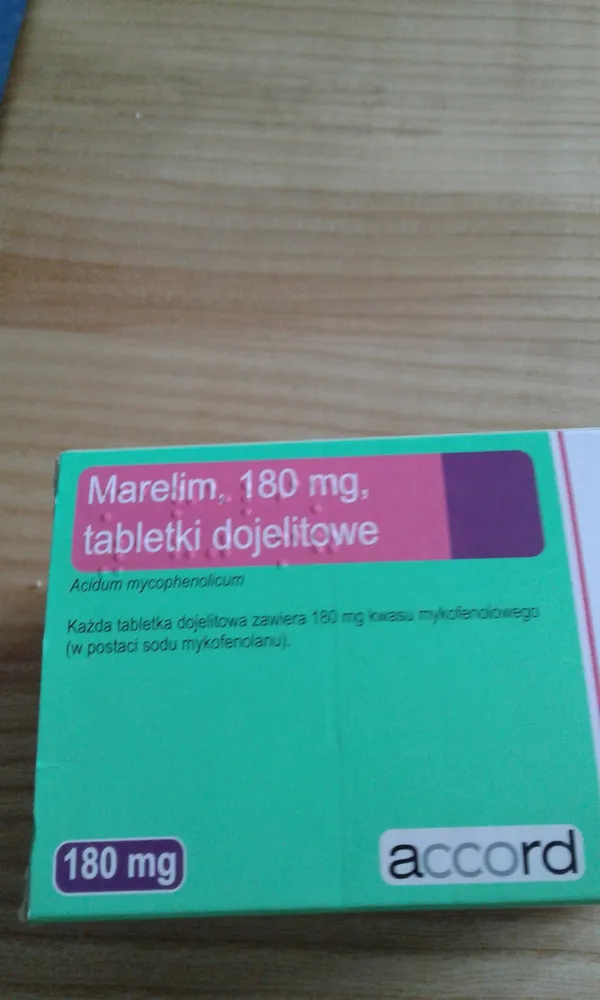
Table of Contents
Patient Information Leaflet: Information for the User
Marelim, 180 mg, enteric-coated tablets
Acidum mycophenolicum
Please read all of this leaflet carefully before taking this medicine, as it contains important information for you.
- Keep this leaflet, as you may need to read it again.
- If you have any further questions, please ask your doctor, pharmacist, or nurse.
- This medicine has been prescribed for a specific individual. Do not pass it on to others. It may harm them even if their symptoms are the same.
- If you experience any adverse reactions, including any not listed in this leaflet, inform your doctor, pharmacist, or nurse. See section 4.
Contents of the leaflet:
- What Marelim is and what it is used for
- What you need to know before taking Marelim
- How to take Marelim
- Possible side effects
- How to store Marelim
- Contents of the pack and other information
1. What Marelim is and what it is used for
Marelim contains a substance called mycophenolic acid. It belongs to a group of medicines known as immunosuppressants.
Marelim is used to prevent rejection of a transplanted kidney by suppressing the activity of the immune system. It is used in combination with other medicines containing cyclosporine and corticosteroids.
2. Important information before taking Marelim
WARNING
Mycophenolic acid causes congenital malformations and miscarriage. Female patients who may become pregnant must
provide a negative pregnancy test result before starting treatment and must follow the contraception advice given by their physician.
The doctor will speak with the patient and provide written materials specifically addressing the effects of
mycophenolic acid on the unborn child. These materials must be carefully read and the instructions followed.
If the information provided is not fully understood, the patient should ask their physician for further clarification before taking mycophenolate. See also further information in this section under "Warnings and precautions" and "Pregnancy and breastfeeding".
When not to take Marelim
- if the patient is allergic to mycophenolic acid, sodium mycophenolate, mycophenolate mofetil, or any of the other ingredients of this medicine (listed in section 6);
- if the patient may become pregnant and has not provided a negative pregnancy test result before
the first administration of the medicine, because mycophenolate causes congenital malformations and miscarriage;
- if the patient is pregnant or plans to become pregnant, or thinks she may be pregnant;
- if the patient is not using effective contraceptive methods (see also section "Contraception in women and men");
- if the patient is breastfeeding (see also section "Pregnancy and breastfeeding").
If any of the above points apply to the patient, they must inform their doctor before taking Marelim.
Warnings and precautions
Before starting treatment with Marelim, the patient should discuss the following with their doctor, pharmacist, or nurse:
- if the patient has or has ever had severe gastrointestinal disorders, such as peptic ulcer;
- if the patient has a rare inherited deficiency of the enzyme hypoxanthine-guanine phosphoribosyltransferase (HGPRT), such as Lesch-Nyhan syndrome or Kelley-Seegmiller syndrome.
The patient should be aware that:
- Marelim weakens the body's immune defenses when exposed to sunlight. Therefore, the risk of developing skin cancer is increased. Exposure to sunlight and ultraviolet (UV) radiation should be limited by wearing protective clothing and regularly applying high-protection sunscreen. The patient should consult their doctor regarding sun protection.
- If the patient has previously had hepatitis B or C, Marelim may increase the risk of reactivation of these diseases. The doctor may order blood tests and monitor for symptoms of these conditions. If any symptoms occur (yellowing of the skin or eyes, nausea, loss of appetite, dark urine), the patient must inform their doctor immediately.
- If the patient develops a persistent cough or shortness of breath, especially if they are taking other immunosuppressive medicines, they must inform their doctor immediately.
- The doctor may order blood tests to measure antibody levels during treatment with Marelim, particularly in case of recurrent infections, especially if the patient is also taking other immunosuppressive medicines. Based on test results, the doctor will decide whether treatment with Marelim should continue.
- If the patient develops any signs of infection (such as fever or sore throat) or unexpected bruising or bleeding, they must contact their doctor immediately.
- The doctor may order blood tests to monitor white blood cell counts during treatment with Marelim and will inform the patient whether they can continue taking Marelim.
- The active substance, mycophenolic acid, is not the same as other substances with similar-sounding names, such as mycophenolate mofetil. These should not be used interchangeably without medical advice.
- Taking Marelim during pregnancy may harm the fetus (see also section "Pregnancy and breastfeeding") and increase the risk of spontaneous abortion.
Children and adolescents
The use of Marelim in children and adolescents is not recommended due to lack of data.
Elderly patients
Marelim may be used in elderly patients (65 years or older) without the need to adjust the usual recommended dose.
Marelim and other medicines
The patient must inform their doctor or pharmacist about all medicines currently taken or recently taken, as well as any medicines they plan to take, including over-the-counter medicines.
In particular, the patient must inform their doctor if they are taking any of the following medicines:
- another immunosuppressive medicine, such as azathioprine or tacrolimus;
- medicines used to treat high blood cholesterol levels, such as cholestyramine;
- activated charcoal, used to treat gastrointestinal disorders such as diarrhoea, stomach upset, and gas;
- medicines that neutralize gastric acid, containing magnesium and aluminium;
- antiviral medicines, such as acyclovir or ganciclovir.
The patient should also inform their doctor if they plan to receive any vaccines.
Patients must not donate blood during treatment with mycophenolic acid or for at least 6 weeks after treatment ends. Men must not donate sperm during treatment with mycophenolic acid or for at least 90 days after treatment ends.
Marelim with food, drink, and alcohol
Marelim may be taken with or without food. The patient should choose one method and continue taking the medicine in the same way every day to ensure consistent absorption.
Pregnancy and breastfeeding
If the patient is pregnant or breastfeeding, thinks she may be pregnant, or plans to have a child, she must consult her doctor or pharmacist before taking this medicine. The doctor will discuss the risks associated with pregnancy and alternative methods to prevent organ transplant rejection if:
- the patient plans to become pregnant;
- the patient has stopped menstruating or thinks she has stopped menstruating, or has had unusual menstrual bleeding, or suspects she is pregnant;
- the patient has had sexual intercourse without using effective contraception. If the patient becomes pregnant while taking mycophenolate, she must inform her doctor immediately. However, the patient should continue taking Marelim until she contacts her doctor.
Pregnancy
Mycophenolate causes frequent miscarriages (50%) and severe congenital malformations (23–27%)
in unborn children. Reported congenital malformations included abnormalities of the ears, eyes, face (cleft lip/palate), fingers, heart, oesophagus (the tube connecting the throat to the stomach), kidneys, or nervous system (e.g. spina bifida (a condition in which the spinal bones do not form properly)). One or more of these malformations may occur in the patient's child.
Female patients who may become pregnant must provide a negative pregnancy test result before starting treatment and must follow the contraception advice given by their physician. The doctor may request more than one test to confirm that the patient is not pregnant before starting treatment.
Breastfeeding
Marelim must not be taken if the patient is breastfeeding, because a small amount of the medicine may pass into breast milk.
Contraception in women taking Marelim
Women who may become pregnant should use an effective method of contraception together with Marelim. This applies during:
- before starting treatment with Marelim;
- throughout the entire duration of treatment with Marelim;
- for 6 weeks after stopping treatment with Marelim.
The patient should discuss with her doctor the best contraceptive method for her individual situation. The choice of contraceptive method depends on the patient's individual circumstances. It is best for the patient to use two methods of contraception, as this reduces the risk of unintended pregnancy. The patient should contact her doctor as soon as possible if she thinks her contraceptive method may have failed or if she forgot to take her contraceptive pill.
A woman is considered unable to become pregnant if any of the following apply:
- the patient is postmenopausal, i.e. is at least 50 years old and her last menstrual period occurred more than one year ago (if the patient stopped menstruating due to cancer treatment, there is still a possibility of becoming pregnant);
- the patient has undergone surgical removal of both fallopian tubes and both ovaries (bilateral salpingo-oophorectomy);
- the patient has undergone surgical removal of the uterus (hysterectomy);
- the patient's ovaries have ceased functioning (premature ovarian failure, confirmed by a specialist gynaecologist);
- the patient has one of the following rare, congenital disorders that prevent pregnancy: XY genotype, Turner syndrome, or uterine agenesis;
- the patient is a child or adolescent who has not yet started menstruating.
Contraception in men taking Marelim
Available data do not indicate an increased risk of miscarriage or congenital malformations in children fathered by men taking mycophenolate. However, this risk cannot be completely ruled out.
As a precautionary measure, it is recommended that the patient or his partner use effective contraception during treatment and for at least 90 days after stopping treatment with Marelim.
If the patient plans to have a child, he should discuss the potential risks with his doctor.
Driving and using machines
Marelim has a minor influence on the ability to drive and use machines.
Marelim contains sodium
One enteric-coated tablet contains 13.9 mg of sodium (the main component of table salt). This corresponds to 0.7% of the recommended maximum daily intake of sodium for an adult.
3. How to take Marelim
This medicine should always be taken as directed by the doctor. If in doubt, consult a doctor or pharmacist. Marelim should only be prescribed by physicians experienced in the treatment of transplant patients.
What dose to take
The recommended daily dose of Marelim is 1440 mg (8 tablets of Marelim 180 mg), administered as two separate doses of 720 mg each (4 tablets of Marelim 180 mg).
The tablets should be taken in the morning and in the evening.
The first 720 mg dose should be taken within 72 hours after transplantation.
In case of severe renal impairment
The daily dose should not exceed 1440 mg (8 tablets of Marelim 180 mg).
Administration of Marelim
The tablets should be swallowed whole with a glass of water.
Do not break or crush the tablets.
Do not use tablets that have been crushed or divided.
Treatment should continue as long as immunosuppression is needed to prevent rejection of the transplanted organ by the body.
Accidental overdose of Marelim
If more Marelim tablets have been taken than prescribed, or if someone else has taken the medicine, contact a doctor immediately or go to the nearest hospital. Medical assistance may be required. Take the tablets with you and show them to the doctor or hospital staff. If the patient no longer has the tablets, the empty packaging should be brought instead.
Missed dose of Marelim
If the patient forgets to take Marelim, they should take it as soon as possible, unless it is almost time for the next dose. In that case, return to the regular dosing schedule. Consult the doctor. Do not take a double dose to make up for a missed dose.
Stopping treatment with Marelim
Do not stop taking Marelim unless instructed by the doctor. Discontinuing treatment with Marelim may increase the risk of rejection of the transplanted kidney by the body.
If you have any further questions about the use of this medicine, consult your doctor, pharmacist, or nurse.
4. Possible side effects
Like all medicines, this medicine can cause side effects, although not everybody gets them.
In elderly patients, more side effects may occur due to weakened immune system function.
Immunosuppressive medicines, including Marelim, weaken the patient's body defences by suppressing rejection of the transplanted organ. As a result, the body cannot fight infections as effectively as under normal conditions. Therefore, when taking Marelim, the patient is at increased risk of infections such as infections of the brain, skin, mouth, stomach and intestines, lungs, and urinary tract.
The treating physician will order regular blood tests to monitor any changes in blood cell counts or blood levels of substances such as glucose, fats, and cholesterol.
Serious side effects may include:
-
signs of infection including fever, chills, excessive sweating, feeling tired, drowsiness, or lack of energy. If the patient is taking Marelim, they may be more susceptible than usual to infections. This may affect various body systems, most commonly the kidneys, bladder, and/or upper and/or lower respiratory tract;
-
vomiting blood, black or bloody stools, stomach or intestinal ulcer;
-
swollen lymph nodes, new skin lumps or enlargement of existing skin lumps, or changes in existing moles. Since this occurs in patients taking immunosuppressive medicines, a very small number of patients treated with Marelim may develop skin cancer or lymph node cancer.
If any of the above symptoms occur after taking Marelim, contact a doctor immediately.
Other side effects, including:
Very common ( occurring in more than 1 in 10 patients )
- diarrhoea
- low white blood cell count
- low blood calcium levels (hypocalcaemia)
- low blood potassium levels (hypokalaemia)
- high blood uric acid levels (hyperuricaemia)
- high blood pressure (hypertension)
- joint pain (arthralgia)
- anxiety
Common ( occurring in less than 1 in 10 patients )
- low red blood cell count, which may cause fatigue, shortness of breath, and paleness (anaemia)
- low platelet count, which may cause unexpected bleeding and bruising (thrombocytopenia)
- headache
- cough
- abdominal or stomach pain, inflammation of the stomach lining, bloating, constipation, indigestion, bloating with gas, loose stools, nausea, vomiting
- fatigue, fever
- abnormal kidney or liver function test results
- respiratory tract infections
- high blood potassium levels (hyperkalaemia)
- low blood magnesium levels (hypomagnesaemia)
- dizziness
- low blood pressure (hypotension)
- shortness of breath (dyspnoea)
- acne
- weakness (asthenia)
- muscle pain (myalgia)
- swelling of hands, ankles or feet (peripheral oedema)
- itching
Uncommon ( occurring in less than 1 in 100 patients )
-
fast heartbeat (tachycardia) or irregular heartbeat (extra ventricular contractions), fluid in the lungs (pulmonary oedema)
-
development of a fluid-filled ( lymph ) cyst (lymphocele)
-
tremor, difficulty sleeping
-
redness and swelling of the eyes (conjunctivitis), blurred vision
-
wheezing
-
belching, bad breath, intestinal obstruction, lip ulceration, heartburn, discolouration of the tongue, dry mouth, gum inflammation, pancreatitis leading to severe upper abdominal pain, salivary duct blockage, peritonitis
-
bone, blood and skin infections
-
blood in urine, kidney damage, pain and difficulty urinating
-
hair loss, skin bruising
-
joint inflammation, back pain, muscle cramps
-
loss of appetite, increased lipid levels (hyperlipidaemia), increased blood sugar (diabetes), increased cholesterol (hypercholesterolaemia), or decreased blood phosphate levels (hypophosphataemia)
-
flu-like symptoms (such as fatigue, chills, sore throat, joint and muscle pain), swelling of ankles and feet, pain, tremor, increased thirst or weakness
-
unusual dreams, hallucinations
-
inability to achieve or maintain erection
-
cough, difficulty breathing, painful breathing (possible symptoms of interstitial lung disease)
Frequency not known ( frequency cannot be estimated from available data )
- fever, sore throat, frequent infections with possible signs of low white blood cell count in blood (agranulocytosis)
- rash, itching, hives, shortness of breath or difficulty breathing, wheezing or cough, feeling faint, dizziness, changes in level of consciousness, hypotension with or without mild generalised itching, skin redness, and swelling of the face and/or throat (symptoms of severe allergic reaction)
Other side effects reported for drugs similar to Marelim
Additionally, the following side effects have been reported in the group of medicines to which Marelim belongs: colitis (inflammation of the large intestine), cytomegalovirus-induced gastritis, intestinal wall perforation causing severe abdominal pain with possible bleeding, gastric or duodenal ulcers, low count of specific white blood cells or all blood cells, severe infections such as infection of the heart and its valves and of the membrane covering the brain and spinal cord (meningitis), shortness of breath, cough, which may be due to bronchiectasis (a condition in which the airways are abnormally widened), and other less common bacterial infections usually causing severe lung diseases ( tuberculosis and infection caused by atypical mycobacteria Mycobacterium ). If persistent cough or shortness of breath occurs, contact a doctor.
Reporting of side effects
If any side effects occur, including any not listed in this leaflet, tell your doctor, pharmacist, or nurse. Side effects can be reported directly to the Department of Monitoring Adverse Drug Reactions of the Office for Registration of Medicinal Products, Medical Devices and Biocidal Products at the following address:
Al. Jerozolimskie 181C
PL-02-222 Warszawa
Tel.: + 48 22 49 21 301
Fax: + 48 22 49 21 309
Website: https://smz.ezdrowie.gov.pl
Side effects can also be reported to the marketing authorisation holder.
Reporting side effects helps provide more information on the safety of this medicine.
5. How to store the medicinal product Marelim
Keep the medicinal product out of the sight and reach of children.
Do not use this medicinal product after the expiry date stated on the carton.
The expiry date refers to the last day of the stated month.
There are no special requirements regarding storage temperature.
Store in the original packaging to protect from light.
Do not use this medicinal product if the packaging appears damaged.
Medicinal products must not be disposed of via wastewater or household waste. Ask your pharmacist how to dispose of medicinal products no longer required. This will help protect the environment.
6. Contents of the packaging and other information
What Marelim contains
- The active substance is mycophenolic acid (in the form of sodium mycophenolate). Each Marelim tablet contains 180 mg of mycophenolic acid.
- Other ingredients are:
- Tablet core: microcrystalline cellulose, sodium croscarmellose, povidone K30, talc, colloidal anhydrous silica, magnesium stearate.
- Enteric coating Acryl-Eze Green 93O510003: copolymer of methacrylic acid and ethyl acrylate (1:1), talc, titanium dioxide (E 171), triethyl citrate, colloidal anhydrous silica, sodium bicarbonate, yellow iron oxide (E 172), indigo carmine, lake (E 132), sodium lauryl sulfate.
- Printing ink Opacode Black S-1-17823: shellac, black iron oxide (E 172), propylene glycol, ammonia.
What Marelim looks like and contents of the pack
Marelim is yellow-green, round, biconvex enteric-coated tablets with bevelled edges, printed with "M1" in black on one side and plain on the other.
Marelim is available in packs containing 20, 50, 100, 120 or 250 tablets in blister packs.
Marketing Authorisation Holder
Accord Healthcare Polska Sp. z o.o.
Taśmowa Street 7
02-677 Warsaw
Tel: +48 22 577 28 00
Manufacturer / Importer
STADA Arzneimittel AG
Stadastraße 2-18
61118 Bad Vilbel
Germany
Pharmadox Healthcare Limited
KW20A Kordin Industrial Park,
Paola PLA 3000, Malta
Accord Healthcare Polska Sp. z o.o.,
Lutomierska Street 50, 95-200 Pabianice, Poland
Accord Healthcare B.V.
Winthontlaan 200
3526 KV Utrecht
The Netherlands
Accord Healthcare Single Member S.A.
64th Km National Road Athens,
Lamia, Schimatari, 32009
Greece
This medicinal product is authorised in the European Economic Area and the United Kingdom (Northern Ireland) under the following names:
| Member State | Trade name |
| Austria | Mycophenolsäure Accord 180mg magensaftresistente Tabletten |
| Bulgaria | Mycophenolic acid Accord 180mg gastro-resistant tablets |
| Cyprus | Mycophenolic acid Accord 180mg gastro-resistant tablets |
| Czech Republic | Mycophenolic acid Accord 180mg Enterosolventní tablety |
| Denmark | Mycophenolsyre Accord |
| Spain | Ácido micofenólico Stada 180mg comprimidos gastrorresistentes EFG |
| Netherlands | Mycofenolzuur Accord 180 mg, maagsapresistente tabletten |
| Iceland | Mycofenolsýra Accord 180 mg sýruþolnar töflur |
| Germany | Mycophenolsäure Accord 180 mg magensaftresistente Tabletten |
| Norway | Mykofenolsyre Accord |
| Poland | Marelim |
| Portugal | Mycophenolic acid Accord |
| Sweden | Mykofenolsyra Accord 180 mg enterotabletter |
| United Kingdom (Northern Ireland) | Mycophenolic acid 180 mg gastro-resistant tablets |
| Italy | Acido micofenolico Accord 180 mg compresse gastroresistenti |