Lopacut
Poland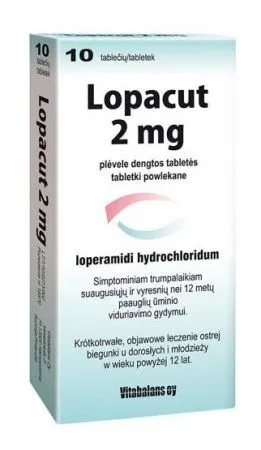
Table of Contents
Package leaflet: Information for the user
Lopacut 2 mg coated tablets
Loperamidi hydrochloridum
Please read all of this leaflet carefully before taking this medicine because it contains
important information for you.
This medicine should always be taken exactly as described in this patient leaflet or as directed by
your doctor, pharmacist, or nurse.
- Keep this leaflet so that you can read it again if necessary.
- If you need advice or further information, please consult your pharmacist.
- If you experience any side effects, including any possible side effects not listed in this leaflet, tell your doctor, pharmacist, or nurse. See section 4.
- If there is no improvement after 2 days or if you feel worse, contact your doctor.
Contents of the leaflet
- What Lopacut is and what it is used for
- Important information before taking Lopacut
- How to take Lopacut
- Possible side effects
- How to store Lopacut
- Contents of the pack and other information
1. What Lopacut is and what it is used for
Lopacut contains loperamide hydrochloride. It belongs to a group of medicines called antidiarrhoeals.
Lopacut is used:
- to relieve symptoms of sudden, short-term diarrhoea (acute diarrhoea) in adults and adolescents over 12 years of age.
Lopacut makes the stools firmer and reduces the frequency of bowel movements.
Your doctor may prescribe this medicine for other conditions as well.
If there is no improvement after 2 days or if you feel worse, consult your doctor.
2. Important information before using Lopacut
When not to use Lopacut
- If the patient is allergic to loperamide or any of the other ingredients of this medicine (listed in section 6).
- If there is blood in the stool or if diarrhoea is accompanied by high fever.
- If the patient has inflammation of the large intestine (ulcerative colitis or pseudomembranous colitis following antibiotic treatment).
- If the patient has bacterial infection of the small intestine and colon caused by pathogenic bacteria of the genus Salmonella, Shigella, and Campylobacter.
- If the patient has slowed gastrointestinal transit, e.g. if constipation or abdominal distension is present.
- If the patient has chronic diarrhoea (long-lasting diarrhoea).
Warnings and precautions
- Use of Lopacut may mask symptoms of sudden worsening of long-term inflammation of the stomach and intestines (chronic colitis).
- Lopacut relieves symptoms but does not treat the underlying cause of diarrhoea. Therefore, the disease causing diarrhoea should first be diagnosed before starting long-term treatment for diarrhoea.
- If diarrhoea does not resolve within 2 days of treatment, stop using the medicine and consult a doctor.
- If symptoms of constipation or other signs of intestinal obstruction occur, discontinue use of the medicine and consult a doctor.
- If the patient has impaired liver function, he/she should consult a doctor before using Lopacut.
- Diarrhoea may lead to significant fluid loss, which must be replenished by drinking more fluids than usual.
- If the patient has AIDS, he/she should discontinue use of Lopacut at the first signs of abdominal swelling.
- Do not take this product for uses other than those indicated (see section 1) or in doses higher than recommended (see section 3). In patients taking excessively high doses of loperamide (the active substance in Lopacut), severe cardiac disorders (including rapid or irregular heartbeat) have been reported.
Children
Lopacut is not indicated for use in children under 12 years of age.
Lopacut and other medicines
Tell your doctor or pharmacist about all medicines the patient is currently taking or has recently taken, as well as any medicines the patient plans to use.
Some medicines may affect Lopacut, and Lopacut may also affect other medicines when used concomitantly. Examples include:
- cholestyramine (reduces serum cholesterol levels) may reduce absorption of Lopacut.
- quinidine (used to correct heart rhythm)
- verapamil (lowers blood pressure)
- ritonavir (used in the treatment of HIV/AIDS)
- cyclosporine (immunosuppressive medicine)
- erythromycin and clarithromycin (antibiotics)
- itraconazole and ketoconazole (antifungal medicines)
- desmopressin (used in the treatment of diabetes insipidus and nocturnal enuresis)
- anticholinergic medicines (used in the treatment of Parkinson's disease and asthma) may enhance the effect of Lopacut by slowing gastric and intestinal emptying.
If the patient is taking any of the above medicines, he/she should consult a doctor before using Lopacut.
Pregnancy, breastfeeding and fertility
If the patient is pregnant or breastfeeding, suspects she may be pregnant, or is planning to have a baby, she should consult a doctor or pharmacist before using this medicine.
There is insufficient data on the use of loperamide during pregnancy; therefore, medical advice is necessary before using the medicine if the patient is pregnant.
Loperamide passes into breast milk and therefore is not recommended for use in breastfeeding mothers. Consult a doctor before using Lopacut if the patient is breastfeeding.
Driving and operating machinery
During treatment with Lopacut, fatigue, dizziness, and drowsiness may occur.
The patient should personally assess whether he/she is able to drive or perform tasks requiring increased concentration. One of the factors that may impair the ability to drive and operate machinery is the effect or side effects of medicines being used.
A description of the medicine's effects and side effects can be found in other sections of this leaflet. Read the entire leaflet carefully to know how to act. If the patient feels that the medicine impairs his/her concentration, he/she should not drive or operate machinery.
If the patient has any doubts, he/she should consult a doctor or pharmacist.
3. How to use Lopacut
This medicine should always be taken exactly as described in the patient leaflet or as directed by a doctor or pharmacist. If in doubt, consult a doctor or pharmacist.
Use in adults and adolescents over 12 years of age
Initially, take 2 tablets, then 1 tablet after each loose bowel movement, but not sooner than 2–3 hours after the initial dose. The maximum daily dose should not exceed 6 tablets in adults (maximum daily dose is 12 mg) and 4 tablets in adolescents (maximum daily dose is 8 mg). Lopacut should not be used for longer than 2 days without consulting a doctor.
Taking more Lopacut than recommended
If a patient has taken too much Lopacut, seek immediate medical advice from a doctor or hospital. The following symptoms may occur: increased heart rate, irregular heartbeat, changes in heart rhythm (these effects may have serious, life-threatening consequences), muscle stiffness, uncoordinated movements, drowsiness, difficulty urinating, and shallow breathing.
In children, the reaction to taking large amounts of Lopacut is stronger than in adults. If a child takes too high a dose of the medicine or develops any of the symptoms listed above, contact a doctor immediately.
Missing a dose of Lopacut
Do not take a double dose to make up for a missed dose.
If you have any further questions about the use of this medicine, consult your doctor or pharmacist.
4. Possible adverse reactions
Like any medicine, this medicine can cause adverse reactions, although not everyone will experience them.
You must immediately stop using Lopacut and consult a doctor if any of the following symptoms occur:
- swelling of the face, lips, tongue or throat, difficulty swallowing and breathing (angioedema) and (or) hives
- severe irritation, redness or blistering of the skin, lips, eyelids and genital organs (bullous rash, including Stevens-Johnson syndrome, erythema multiforme and toxic epidermal necrolysis)
- upper abdominal pain, abdominal pain radiating to the back, abdominal tenderness, fever, rapid heartbeat, nausea, vomiting, which may be symptoms of inflammation of the pancreas (acute pancreatitis).
The list below refers to reported adverse reactions, listed according to frequency of occurrence.
Common (may occur in less than 1 in 10 people)
- constipation
- bloating with passage of gas
- abdominal cramps and colic
- nausea
- dizziness
- headache
Uncommon (may occur in less than 1 in 100 people)
- drowsiness
- dry mouth
- abdominal pain
- abdominal discomfort
- upper abdominal pain
- vomiting
- indigestion
- rash
Rare (may occur in less than 1 in 1,000 people)
- loss of consciousness
- lack of critical cognitive functions and reduced level of consciousness (stupor)
- decreased level of consciousness
- increased muscle tone (hypertonia)
- coordination disturbances
- pupil constriction (miosis)
- difficulty passing urine (urinary retention)
- intestinal obstruction
- abdominal distension
- dilated colon (toxic megacolon)
- allergic reactions (hypersensitivity)
- hives
- itching
- rapidly progressing swelling of the face, lips, tongue and throat (angioedema)
- severe form of skin and mucous membrane lesions (bullous rash)
- fatigue
Not known (frequency cannot be estimated from available data)
- drowsiness
- acute pancreatitis
Reporting of adverse reactions
If any adverse reactions occur, including any adverse reactions not listed in this leaflet, inform your doctor, pharmacist or nurse. Adverse reactions can be reported directly to the Department of Monitoring of Adverse Drug Reactions of the Office for Registration of Medicinal Products, Medical Devices and Biocidal Products
Al. Jerozolimskie 181C
02 222 Warsaw
Tel.: +48 22 49 21 301
Fax: +48 22 49 21 309
Website: https://smz.ezdrowie.gov.pl
Adverse reactions can also be reported to the marketing authorization holder.
Reporting adverse reactions helps provide more information on the safety of this medicine.
5. How to store Lopacut
Keep this medicine out of sight and reach of children.
No special storage instructions apply to this medicine.
Do not use this medicine after the expiry date stated on the blister and carton following EXP.
The expiry date refers to the last day of the stated month.
Do not use this medicine if you notice damage to the tablets or if they appear abnormal.
Medicines must not be disposed of via wastewater or household waste. Ask your pharmacist how to dispose of medicines no longer required. This will help protect the environment.
6. Contents of the pack and other information
What Lopacut contains
The active substance is loperamide hydrochloride, 2 mg in one tablet.
The other ingredients are:
Tablet core: microcrystalline cellulose, pregelatinized starch, sodium croscarmellose, colloidal
anhydrous silica and magnesium stearate.
Tablet coating: Opadry OY-S-28703: polidextrose, hypromellose, titanium dioxide (E 171) and
macrogol 4000.
What Lopacut looks like and contents of the pack
Appearance:
Tablets are white, round and convex with the logo “6”. Diameter 8 mm.
Pack sizes:
8 and 10 film-coated tablets in a blister pack (PVC/Aluminium).
Marketing Authorisation Holder and Manufacturer
Vitabalans Oy
Varastokatu 8
FI-13500 Hämeenlinna
FINLAND
Tel: +358 (3) 615600
Fax: +358 (3) 6183130
This medicinal product is authorised in the Member States of the European Economic Area under the following names:
Lopacut (CZ, DE, DK, EE, FI, HU, LT, LV, NO, PL, SE, SI, SK)