Lirra gem
Poland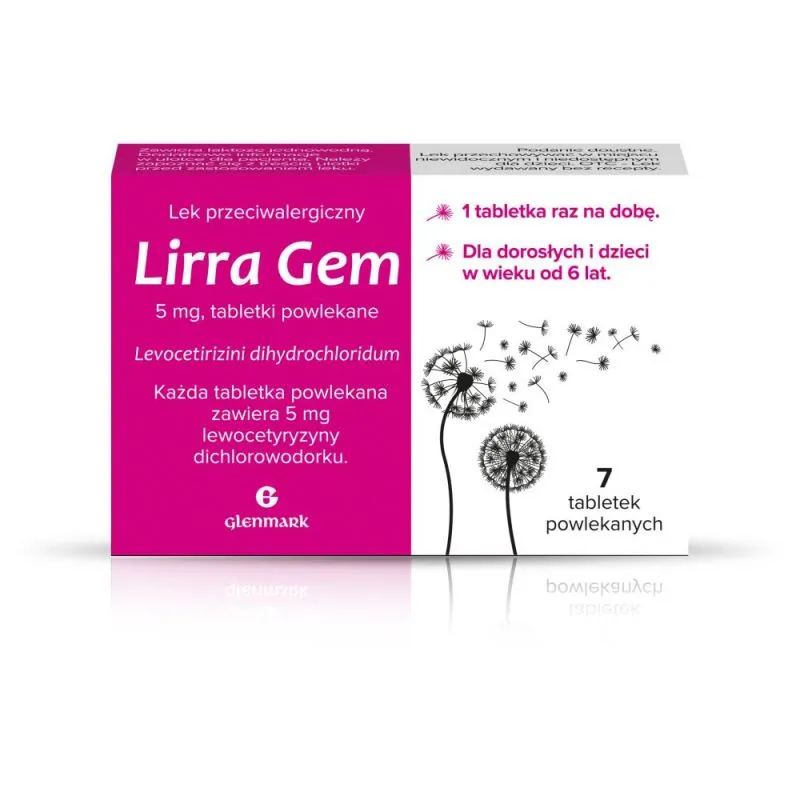
Table of Contents
Package leaflet: Information for the user
Lirra Gem, 5 mg, coated tablets
Levocetirizini dihydrochloridum
For adults and children aged 6 years and older
Please read all of this leaflet carefully before taking this medicine because it contains
important information for you.
This medicine should always be used exactly as described in this patient leaflet or as directed by
your doctor or pharmacist.
- Keep this leaflet as you may need to read it again.
- If you need advice or further information, consult your pharmacist.
- If you experience any adverse reactions, including any not listed in this leaflet, inform your doctor or pharmacist. See section 4.
- If there is no improvement after 3 days, or if you feel worse, contact your doctor.
Contents of the leaflet
- What Lirra Gem is and what it is used for
- What you need to know before taking Lirra Gem
- How to take Lirra Gem
- Possible side effects
- How to store Lirra Gem
- Contents of the pack and other information
1. What Lirra Gem is and what it is used for
Lirra Gem is an antiallergic medicine.
It is used to treat symptoms associated with:
- allergic rhinitis (including chronic allergic rhinitis),
- urticaria.
If there is no improvement after 3 days, or if you feel worse, contact your doctor.
2. Important information before using Lirra Gem
When not to use Lirra Gem:
- if the patient is allergic to levocetirizine dihydrochloride, cetirizine, hydroxyzine, or any of the other ingredients of this medicine (listed in section 6),
- if the patient has severe kidney disease requiring dialysis.
Warnings and precautions
Before starting treatment with Lirra Gem, consult a doctor or pharmacist.
If the patient has difficulty emptying the bladder (in conditions such as spinal cord injury or benign prostatic hyperplasia), medical advice should be sought.
Lirra Gem may increase the frequency of epileptic seizures; therefore, consult a doctor if the patient has epilepsy or is at risk of seizures.
If the patient has planned allergy testing, ask the doctor whether the patient should stop taking Lirra Gem several days before the tests. Lirra Gem may affect the results of allergy tests.
Children
Lirra Gem coated tablets are not recommended for children under 6 years of age, as appropriate dose adjustment is not possible with this formulation.
Lirra Gem and other medicines
Tell the doctor or pharmacist about all medicines the patient is currently taking or has recently taken, including those obtained without a prescription, as well as any medicines the patient plans to take.
Lirra Gem with food, drink and alcohol
Exercise caution when taking Lirra Gem together with alcohol or other substances affecting brain function.
In susceptible patients, concomitant use of Lirra Gem with alcohol or other substances affecting brain function may additionally reduce alertness and reaction ability.
Lirra Gem may be taken during or between meals.
Pregnancy, breastfeeding and fertility
If the patient is pregnant or breastfeeding, suspects she may be pregnant, or is planning to become pregnant, she should consult a doctor or pharmacist before using this medicine.
Driving and operating machinery
Some patients may experience drowsiness, somnolence, fatigue, or exhaustion during treatment with Lirra Gem. Exercise caution when driving or operating machinery until the patient's response to the medicine is known. However, specific tests conducted in healthy subjects receiving levocetirizine at the recommended dose did not show any effect of the medicine on attention, reaction ability, or driving performance.
Lirra Gem contains monohydrate lactose
The tablets of this medicine contain monohydrate lactose. If the patient has previously been diagnosed with intolerance to certain sugars, the patient should contact the doctor before taking this medicine.
3. How to take Lirra Gem
This medicine should always be taken exactly as described in this patient information leaflet or as directed by a doctor. If in doubt, consult a doctor or pharmacist.
Do not use this medicine for longer than 10 days without consulting a doctor.
The recommended dose for adults and children aged 6 years and older is one tablet per day.
Dosage in special patient groups:
Renal and hepatic impairment
In patients with impaired kidney function, dose reduction may be necessary depending on the severity of renal disease. In children, the dose should also be adjusted according to body weight. The doctor will determine the appropriate dose.
Lirra Gem must not be used in patients with severe renal disease requiring dialysis.
Patients with hepatic impairment only should usually receive the recommended dose.
In patients with both hepatic and renal impairment, a lower dose may be required depending on the severity of renal disease, and in children the dose should also be adjusted according to body weight. The doctor will determine the appropriate dose.
Elderly patients (65 years and older)
Dose adjustment is not necessary in elderly patients if renal function is normal.
Use in children
In children aged 6 years and older, the dose should also be adjusted according to body weight. The doctor will determine the appropriate dose.
Lirra Gem is not recommended for children under 6 years of age (see section 2 Warnings and precautions). An alternative formulation containing levocetirizine is available for children under 6 years of age. Consult a doctor or pharmacist.
How and when to take Lirra Gem
Lirra Gem is intended for oral use only.
Lirra Gem tablets should be swallowed whole with water. The medicine may be taken during or between meals.
How long to take Lirra Gem
Do not use Lirra Gem for longer than 10 days without consulting a doctor.
Taking more Lirra Gem than recommended
In adults, taking more than the recommended dose of Lirra Gem may cause drowsiness. In children, initial symptoms may include excitation and restlessness, especially motor restlessness, followed by drowsiness.
If a patient suspects an overdose of Lirra Gem, they should immediately contact a doctor, who will decide what actions to take.
If you miss a dose of Lirra Gem
If a dose of Lirra Gem is missed or a lower than recommended dose is taken, do not take a double dose to make up for the missed dose.
In such a case, take the next dose at the usual time.
Stopping Lirra Gem
Stopping treatment with Lirra Gem should not cause harmful effects. However, in rare cases, itching (intense pruritus) may occur after discontinuation of Lirra Gem, even if these symptoms were not present before starting treatment. These symptoms may resolve spontaneously. In some cases, symptoms may be severe and treatment may need to be resumed. Symptoms should resolve upon resumption of treatment.
If you have any further questions about the use of this medicine, consult your doctor or pharmacist.
4. Possible adverse reactions
Like all medicines, this medicine can cause adverse reactions, although not everyone will experience them.
Common adverse reactions (may occur in fewer than 1 in 10 patients)
- Dry mouth
- Headache
- Fatigue
- Drowsiness/sleepiness
Uncommon adverse reactions (may occur in fewer than 1 in 100 patients)
- Feeling of exhaustion
- Abdominal pain
Frequency not known: cannot be estimated from the available data
Other adverse reactions reported include palpitations, increased heart rate, convulsions, tingling, dizziness, fainting, tremor, taste disturbances (altered sense of taste), sensation of spinning or swaying, visual disturbances, blurred vision, rotatory eye movements (uncontrolled circular eye movements), painful or difficult urination, inability to completely empty the bladder, swelling, itching, rash, urticaria (skin swelling, redness and itching), skin eruptions, shortness of breath, weight gain, muscle pain, joint pain, agitation and aggressive behaviour, hallucinations, depression, insomnia, recurrent suicidal thoughts or suicidal ideation, nightmares, hepatitis, abnormal liver function, vomiting, increased appetite, nausea and diarrhoea.
Itching (intense pruritus) after discontinuation of the medicine.
If the first symptoms of hypersensitivity reactions occur, treatment with Lirra Gem should be discontinued and the doctor should be informed immediately. Symptoms of hypersensitivity reactions may include: swelling of the lips, tongue, face and/or throat, breathing or swallowing difficulties (chest tightness or wheezing), urticaria, sudden drop in blood pressure leading to collapse or shock, which may lead to death.
Reporting of adverse reactions
If any adverse reactions occur, including any adverse reactions not listed in this leaflet, inform a doctor or pharmacist. Adverse reactions can be reported directly to:
Department of Monitoring Adverse Reactions of Medicinal Products
Office for Registration of Medicinal Products, Medical Devices and Biocidal Products
Al. Jerozolimskie 181C, 02-222 Warsaw; tel.: +48 22 49 21 301; fax: +48 22 49 21 309
website: https://smz.ezdrowie.gov.pl.
Adverse reactions can also be reported to the marketing authorisation holder.
Reporting adverse reactions helps to provide more information on the safety of this medicine.
5. How to store Lirra Gem
Keep this medicine out of the sight and reach of children.
Do not use this medicine after the expiry date stated on the cardboard box after:
Expiry date (EXP) and on the blister after the abbreviation: EXP. The expiry date refers to the last day of the stated month.
No special storage conditions are required.
Medicines must not be disposed of via wastewater or household waste. Ask your pharmacist how to dispose of medicines no longer in use. Such measures will help protect the environment.
6. Contents of the pack and other information
What Lirra Gem contains
- The active substance is levocetirizine dihydrochloride. Each coated tablet contains 5 mg of levocetirizine dihydrochloride.
- Other ingredients are: microcrystalline cellulose, lactose monohydrate, colloidal anhydrous silica, magnesium stearate, hypromellose (E 464), titanium dioxide (E 171), and macrogol 400.
What Lirra Gem looks like and contents of the pack
The 5 mg coated tablets are white, oval-shaped, biconvex, with two letters "G" imprinted on one side separated by a division line, and smooth on the other side.
The tablets are packed in aluminium/aluminium blisters or in PVC/PVDC/aluminium blisters in a cardboard box.
Available pack sizes
7 or 10 coated tablets
Not all pack sizes may be marketed.
Marketing Authorisation Holder
Glenmark Pharmaceuticals s.r.o.
Hvězdova 1716/2b
140 78 Prague 4
Czech Republic
Manufacturer
Glenmark Pharmaceuticals s.r.o.
Fibichova 143
566 17 Vysoké Mýto
Czech Republic
For further information on this medicinal product, please contact the local representative of the Marketing Authorisation Holder:
Glenmark Pharmaceuticals Sp. z o.o.
Dziekonińskiego 3
00-728 Warsaw
Email: [email protected]