Lipancrea 8000
Poland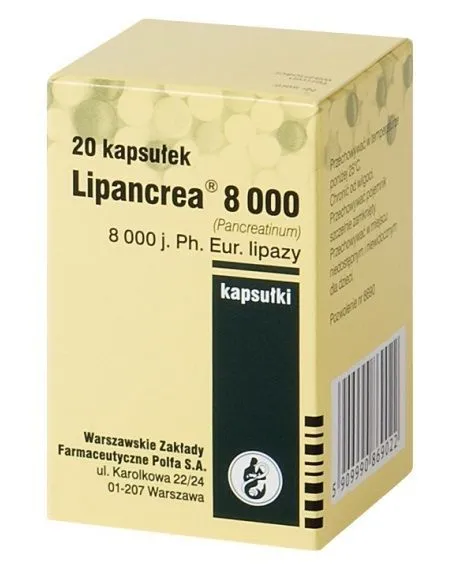
Table of Contents
Package leaflet: Information for the patient
LIPANCREA 8000
8,000 Ph. Eur. units of lipase, capsules
Pancreatinum
Please read carefully all of this leaflet before taking the medicine, as it contains
important information for the patient.
This medicine should always be taken exactly as described in this patient leaflet or as directed by
your doctor or pharmacist.
- Keep this leaflet, as you may need to read it again.
- If you need advice or further information, please consult your pharmacist.
- If you experience any adverse reactions, including any not listed in this leaflet, tell your doctor or pharmacist. See section 4.
- If your symptoms do not improve or if you feel worse, you should contact your doctor.
Leaflet contents
- What Lipancrea 8000 is and what it is used for
- Important information before taking Lipancrea 8000
- How to take Lipancrea 8000
- Possible side effects
- How to store Lipancrea 8000
- Contents of the package and other information
1. What Lipancrea 8000 is and what it is used for
What is Lipancrea 8000?
- Lipancrea 8000 contains a mixture of digestive enzymes called "pancreatin".
- Pancreatin helps digest food. The enzymes are derived from porcine pancreas.
- Lipancrea 8000 contains small granules that slowly release pancreatin in the intestine (acid-resistant granules, known as pellets).
What Lipancrea 8000 is used for
Lipancrea 8000 is used in children, adolescents, and adults with digestive disorders due to
exocrine pancreatic insufficiency. This is a condition in which the pancreas does not produce
sufficient amounts of digestive enzymes. This condition commonly occurs in patients with the
following diseases:
- Cystic fibrosis (a rare genetic disorder)
- Obstruction of the pancreatic or biliary ducts
- Following an episode of acute pancreatitis. Lipancrea 8000 may be started when the patient resumes oral feeding.
- Chronic pancreatitis
- Pancreatic cancer
- Absence of the pancreas or partial pancreatectomy
- Gastrectomy or partial gastrectomy
- Gastroenterostomy
- Shwachman-Diamond syndrome (a very rare genetic disorder)
Exocrine pancreatic insufficiency may also occur in other clinical conditions not listed above.
How Lipancrea 8000 works
The enzymes in Lipancrea 8000 act by digesting food passing through the small intestine. Treatment significantly reduces the symptoms of exocrine pancreatic insufficiency, such as abdominal pain, bloating, frequency of bowel movements, and improves stool consistency, regardless of the underlying disease. Lipancrea 8000 should be taken during or immediately after main meals or snacks to ensure thorough mixing of the enzymes with food.
2. Information before using Lipancrea 8000
When not to use Lipancrea 8000
- If the patient is allergic to pancreatin, pork protein, or any of the other ingredients of this medicine (listed in section 6).
If in doubt, consult a doctor or pharmacist.
Warnings and precautions
Before starting treatment with Lipancrea 8000, discuss it with your doctor or pharmacist.
A rare bowel disorder called fibrosing colonopathy, which causes narrowing of the large intestine, has been reported in patients with cystic fibrosis who were taking high doses of pancreatin.
Therefore, if you have cystic fibrosis and are taking pancreatin at a dose exceeding 10,000 Ph. Eur. units of lipase per kg body weight per day, and you experience any worrying gastrointestinal symptoms or changes in your usual symptoms, contact your doctor.
Lipancrea 8000 with food and drink
Lipancrea 8000 should be taken during or immediately after a meal or snack, with each capsule swallowed with liquid.
For detailed instructions, see section 3 of the leaflet, "How to take Lipancrea 8000".
Pregnancy and breastfeeding
If the patient is pregnant or breastfeeding, suspects she might be pregnant, or is planning to have a baby, she should consult her doctor or pharmacist before using this medicine.
If you are pregnant or suspect you may be pregnant, contact your doctor before taking Lipancrea 8000. Your doctor will decide whether the medicine can be used and, if so, at what dose.
Lipancrea 8000 may be used during breastfeeding.
Driving and operating machinery
Lipancrea 8000 has no effect or has a negligible effect on the ability to drive and operate machinery.
3. How to use Lipancrea 8000
This medicine should always be taken exactly as described in this patient leaflet or as directed by your doctor or pharmacist. If in doubt, consult your doctor or pharmacist.
The dosage is measured in lipase units. Lipase is one of the enzymes in pancreatin.
The dose should be adjusted according to the individual patient's needs and depends on:
- the type of disease
- body weight
- diet
- the amount of fat present in the stool. If fatty stools or gastrointestinal symptoms persist, consult your doctor, as the dose may need adjustment.
Dosage
Dosage should be individually determined based on the patient's requirement for pancreatic enzymes.
Cystic fibrosis
The usual starting dose in children under 4 years of age is 1,000 lipase units/kg body weight/meal.
The usual starting dose in children aged 4 years and older, adolescents, and adults is 500 lipase units/kg body weight/meal.
In most patients, the dose should be lower than or not exceed 10,000 lipase units/kg body weight/day or 4,000 lipase units per gram of ingested fat.
Other pancreatic disorders
The usual dose is 25,000 to 80,000 lipase units (3 to 10 capsules of Lipancrea 8000) with each main meal (breakfast, lunch, dinner).
For snacks, the usual dose is half the dose taken with a main meal (1 to 5 capsules of Lipancrea 8000).
Method of administration
- Lipancrea 8000 should be taken orally during or immediately after a meal or snack, with each capsule swallowed whole and accompanied by a drink. The capsule must be swallowed whole; do not chew or crush it.
- If you have difficulty swallowing the capsule or need to administer a lower enzyme dose, the capsule may be carefully opened. The contents should be sprinkled onto a teaspoon, mixed with an acidic soft food that does not require chewing (such as apple puree or yoghurt), or mixed with an acidic liquid, e.g. apple, orange, or pineapple juice (do not mix with milk or milk-based formulas). The pellet mixture must be swallowed immediately without chewing or biting and followed with water or juice. The mixture must not be stored.
- Do not retain the medicine or capsule contents in the mouth.
- Drink plenty of fluids throughout the day.
- It is not necessary to administer the medicine with light meals consisting of fruits, vegetables, fruit juices, and other fat-free foods.
- Administration of the medicine with food close to neutral or alkaline pH (pH higher than 5.5—e.g. eggs, chicken, veal, green peas) may reduce its effectiveness. Under these conditions, premature release of the active substance from the pellets may occur (before the medicine reaches the duodenum), potentially leading to enzyme inactivation in the gastric lumen and irritation of the oral mucosa.
Use of a higher than recommended dose of Lipancrea 8000
If an excessive dose of Lipancrea 8000 is taken, drink plenty of fluids and seek advice from your doctor or pharmacist.
Very high doses of pancreatin may occasionally increase uric acid levels in urine and blood.
Missed dose of Lipancrea 8000
If a dose of Lipancrea 8000 is missed, take the next dose at the usual time with the next meal. Do not take a double dose to make up for the missed dose.
If you have any further questions about the use of this medicine, consult your doctor or pharmacist.
4. Possible adverse reactions
Like all medicines, this medicine can cause adverse reactions, although not everyone experiences them.
If the patient experiences allergic reactions, including rash, swelling of the face, lips, tongue, and (or)
throat, which may cause difficulty in breathing or swallowing, or other serious
adverse reactions occur, treatment with Lipancrea 8000 must be discontinued and medical help must be sought immediately from a doctor or the nearest hospital Emergency Department.
Adverse reactions that may occur during treatment with this medicine:
Very common (affecting more than 1 in 10 patients)
- abdominal pain
Common (affecting less than 1 in 10 patients)
- nausea
- vomiting
- constipation
- bloating
- diarrhoea
These effects may be due to the underlying disease for which treatment with Lipancrea 8000 is indicated. During clinical trials, the number of patients taking pancreatin who experienced abdominal pain or diarrhoea was similar to or lower than that in patients not taking pancreatin.
Uncommon (affecting less than 1 in 100 patients)
- rash
Frequency not known (cannot be estimated from the available data)
- itching and urticaria
- pancreatin may cause hypersensitivity reactions, including anaphylactic reactions manifesting as difficulty in breathing or swelling of the lips
- stricture of the ileocaecal region and large intestine (fibrosing colonopathy) has been reported in patients with cystic fibrosis of the pancreas who were taking high doses of pancreatin-containing medicines. If severe abdominal pain and problems with bowel movements (constipation), nausea or vomiting occur, medical advice must be sought immediately.
Hypersensitivity reactions, mainly affecting the skin but not limited exclusively to it, have been observed and reported after the medicine was placed on the market.
Reporting of adverse reactions
If any adverse reactions occur, including any adverse reactions not listed in this leaflet, inform a doctor or pharmacist. Adverse reactions can be reported directly to the Department of Monitoring Adverse Drug Reactions at the Office for Registration of Medicinal Products, Medical Devices and Biocidal Products
Al. Jerozolimskie 181C
02-222 Warsaw
Phone: +48 22 49 21 301
Fax: +48 22 49 21 309
Website: https://smz.ezdrowie.gov.pl
Adverse reactions can also be reported to the marketing authorization holder.
Reporting adverse reactions helps provide more information on the safety of the medicine.
5. How to store Lipancrea 8000
Store below 25°C. Protect from moisture.
Keep the medicine in a place out of sight and reach of children.
Do not use this medicine after the expiry date stated on the packaging. The expiry date refers to the last day of the stated month.
Medicines must not be disposed of via wastewater or household waste. Ask your pharmacist how to dispose of medicines no longer required. These measures will help protect the environment.
6. Contents of the packaging and other information
What Lipancrea 8000 contains
- The active substance is pancreatin. Each capsule contains pancreatin with the following activity: lipase 8,000 Ph. Eur. units, amylase 5,750 Ph. Eur. units, protease 450 Ph. Eur. units (1 Ph. Eur. unit = 1 FIP unit).
- Other ingredients are: methacrylic acid-ethyl acrylate copolymer (1:1); simethicone emulsion 30%; triethyl citrate; talc; gelatin; iron oxide red (E172); titanium dioxide (E171).
What Lipancrea 8000 looks like and contents of the pack
Lipancrea 8000 is in the form of capsules filled with pellets.
The medicine is available in polyethylene containers or in aluminium/PVC/PVdC blisters containing 20 or 50 capsules. The container or blister pack with capsules is placed in a cardboard box.
Not all pack sizes may be marketed.
Marketing Authorisation Holder
Zakłady Farmaceutyczne POLPHARMA S.A.
ul. Pelplińska 19, 83-200 Starogard Gdański
tel. + 48 22 364 61 01
Manufacturer
Zakłady Farmaceutyczne POLPHARMA S.A.
Production Site in Nowa Dęba
ul. Metalowca 2, 39-460 Nowa Dęba