Lioton 1000
Poland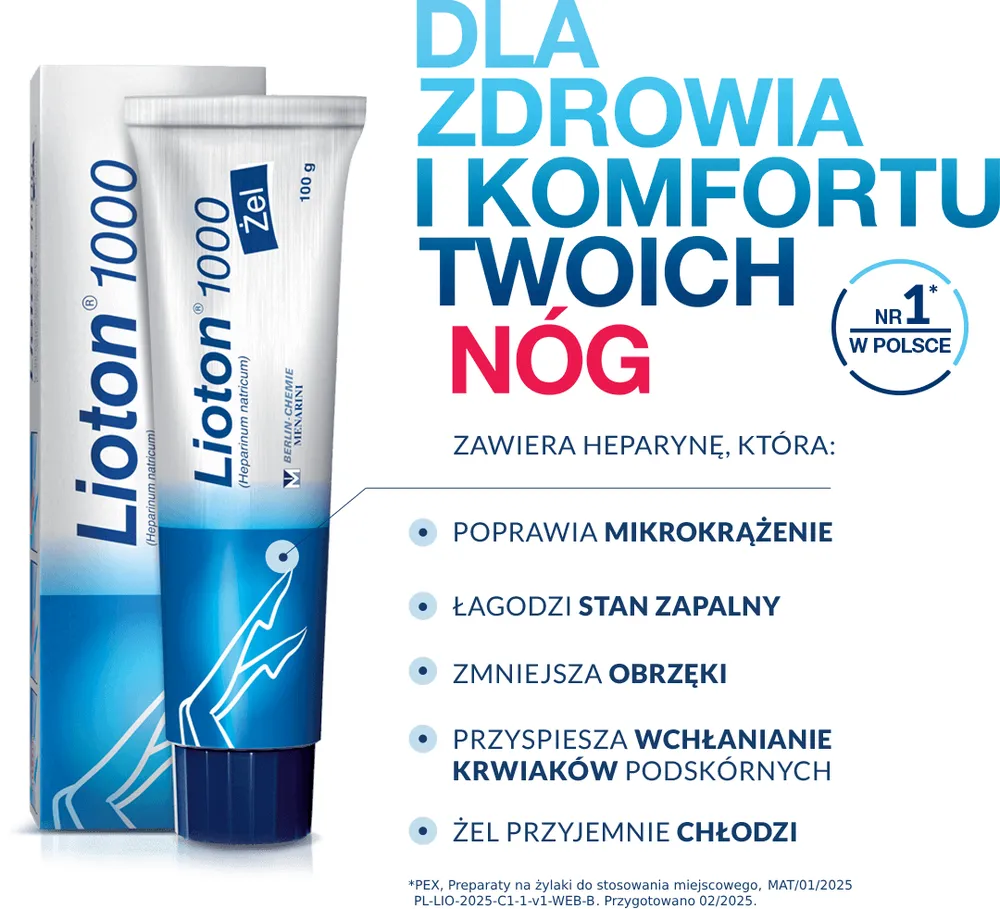
Table of Contents
Warning! Keep the leaflet! Information on the immediate packaging in a foreign language.
Lioton 1000 (Lioton 1000 SV/g gels), 8.5 mg (1000 IU)/g, gel
Heparinum natricum
Lioton 1000 and Lioton 1000 SV/g gels are different trade names for the same medicinal product.
Please read the leaflet carefully before use, as it contains
important information for the patient.
This medicine should always be used exactly as described in this patient leaflet or as directed by a
physician or pharmacist.
- Keep this leaflet for future reference.
- If advice or further information is needed, consult a pharmacist.
- If any adverse reactions occur, including any possible adverse reactions not listed in this leaflet, inform your doctor, pharmacist, or nurse. See section 4.
- If symptoms do not improve or worsen, consult your doctor.
Table of contents of the leaflet:
- What Lioton 1000 is and what it is used for
- Important information before using Lioton 1000
- How to use Lioton 1000
- Possible side effects
- How to store Lioton 1000
- Contents of the pack and other information
1. What Lioton 1000 is and what it is used for
Lioton 1000 is a topical gel containing heparin, with local antithrombotic, anti-edematous, and anti-inflammatory effects.
Indications
Supportive treatment in:
- superficial venous disorders such as phlebitis, thrombophlebitis, varicose veins of the lower limbs;
- subcutaneous hematomas, contusions, and edema.
2. Important information before using Lioton 1000
When not to use Lioton 1000
Lioton 1000 must not be used in case of known hypersensitivity to heparin or any of the excipients of the medicine (due to the presence of methyl and propyl hydroxybenzoates as excipients, the medicine must not be used in individuals allergic to parabens).
The medicine must not be applied to open wounds or weeping skin lesions. Do not apply near the eyes, nose, or mouth.
Lioton 1000 must not be used in the presence of bleeding.
The medicine must not be taken orally.
Warnings and precautions
Sodium heparin in gel form is generally well tolerated, but prolonged use of the medicine may cause skin hypersensitivity reactions in some individuals. If redness, rash, or itching occurs, discontinue use immediately and initiate appropriate treatment.
Particular caution is advised in patients with a history of bleeding disorders.
Lioton 1000 and other medicines
Inform your doctor about all medicines you are currently taking, including those obtained without a prescription.
Applying heparin over large skin areas or during concomitant anticoagulant therapy, e.g. when taking anticoagulant drugs or acetylsalicylic acid, increases the risk of bleeding.
Children
Due to lack of data on efficacy and safety in children under 12 years of age, Lioton 1000 should not be used in this age group.
Pregnancy and breastfeeding
There are insufficient studies on the use of the medicine during pregnancy or breastfeeding. Consult your doctor before using the medicine.
Driving and operating machinery
Lioton 1000 has no effect on the ability to drive or operate machinery.
Lioton 1000 contains methyl parahydroxybenzoate (E 218), propyl parahydroxybenzoate (E 216), neroli fragrance, and lavender oil.
This medicine contains methyl parahydroxybenzoate (E 218) and propyl parahydroxybenzoate (E 216) as preservatives. These may cause allergic reactions (including delayed-type reactions).
This medicine contains neroli fragrance and lavender oil, which contain citral, citronellol, coumarin, d-limonene, farnesol, geraniol, and linalool. Citral, citronellol, coumarin, d-limonene, farnesol, geraniol, and linalool may cause allergic reactions.
Lioton 1000 contains 96% ethanol
This medicine contains 243 mg of alcohol (96% ethanol) per gram of gel. 96% ethanol may cause stinging on damaged skin.
3. How to use Lioton 1000
Lioton 1000 is intended for topical use on the skin. The medicine should be applied 1 to 3 times daily by applying a gel strip 3–10 cm in length to the affected skin area and gently massaging until fully absorbed.
In cases of post-traumatic swelling, treatment with the medicine is recommended for up to 10 days; for the treatment of superficial venous disorders, treatment should last 1 to 2 weeks.
4. Possible adverse reactions
Like all medicines, Lioton 1000 may cause adverse reactions, although not everybody experiences them.
In isolated cases, symptoms of allergic reactions (redness and itching of the skin) or symptoms of pseudoallergic reactions may occur. In such cases, treatment should be discontinued. In some patients who initially have erythema ab igne, skin changes may appear after local application of heparin in gel form.
If any of the adverse reactions worsen or if any adverse reactions not listed in this leaflet occur, inform your doctor or pharmacist.
Reporting of adverse reactions
If any adverse reactions occur, including any not listed in this leaflet, tell your doctor, pharmacist or nurse. Adverse reactions can be reported directly to the Department of Monitoring Adverse Drug Reactions of the Office for Registration of Medicinal Products, Medical Devices and Biocidal Products, Al. Jerozolimskie 181C, 02-222 Warsaw, tel.: + 48 22 49 21 301, fax: + 48 22 49 21 309, website: https://smz.ezdrowie.gov.pl.
Reporting adverse reactions enables continued monitoring of the medicine's safety and helps provide more information on the safe use of the medicine.
5. How to store Lioton 1000
No special storage instructions are required.
Keep the medicine out of the reach and sight of children.
Do not use Lioton 1000 after the expiry date stated on the packaging.
The expiry date refers to the last day of the stated month.
Check the expiry date on the packaging before using the medicine.
Use within 6 months after first opening the tube.
Medicines must not be disposed of via wastewater or household waste. Ask your pharmacist
how to dispose of medicines no longer required. This will help protect the environment.
6. Contents of the package and other information
What Lioton 1000 contains
The active substance is sodium heparin (Heparinum natricum). 1 g of gel contains 8.5 mg (1000 IU) of sodium heparin.
Other ingredients are: purified water, 96% ethanol, carbomers, triethanolamine, neroli fragrance (containing linalool, d-limonene, geraniol, citral, citronellol and farnesol), lavender essential oil (containing linalool, d-limonene, geraniol and coumarin), preservatives: methyl parahydroxybenzoate (E 218), propyl parahydroxybenzoate (E 216).
What Lioton 1000 looks like and contents of the pack
Aluminium tube with a cap made of polypropylene, containing 50 g or 100 g of gel, in a cardboard box.
Aluminium tube with a cap made of polyethylene, containing 50 g or 100 g of gel, in a cardboard box.
For more detailed information, please contact the responsible party or parallel importer.
Marketing Authorisation Holder in Latvia, country of export:
A. Menarini Industrie Farmaceutiche Riunite S.r.l.
Via Sette Santi 3, Florence, Italy
Manufacturer:
A. Menarini Manufacturing Logistics and Services s.r.l.
Via Sette Santi 3, Florence, Italy
Parallel importer:
InPharm Sp. z o.o.
ul. Strumykowa 28/11
03-138 Warsaw, Poland
Repackaged in:
InPharm Sp. z o.o. Services sp. k.
ul. Chełmżyńska 249
04-458 Warsaw, Poland
Marketing Authorisation Number in Latvia, country of export: 98-0117
Parallel Import Authorisation Number: 148/25