Linola
Poland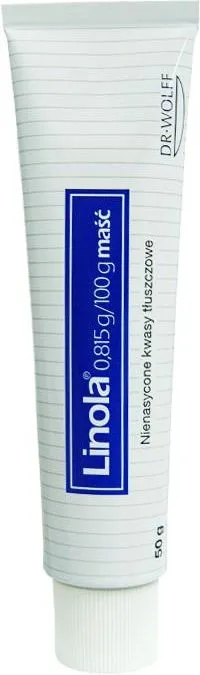
Table of Contents
Package leaflet: Information for the user
Linola 0.815 g/100 g ointment
Unsaturated fatty acids
Please read all of this leaflet carefully before using this medicine, because it contains
important information for you.
This medicine should always be used exactly as described in this patient leaflet or as directed by
your doctor or pharmacist.
- Keep this leaflet, as you may need to read it again.
- If you need advice or more information, please consult your pharmacist.
- If you experience any adverse reactions, including any possible side effects not listed in this leaflet, inform your doctor or pharmacist. See section 4.
- If there is no improvement or if you feel worse, you should contact your doctor.
Table of contents
- What Linola ointment is and what it is used for
- Important information before using Linola ointment
- How to use Linola ointment
- Possible side effects
- How to store Linola ointment
- Contents of the pack and other information
1. What Linola ointment is and what it is used for
The medicine contains the active substance – unsaturated fatty acids, which, when applied to the skin, exert a local anti-inflammatory effect.
Indications:
Adjunctive treatment of mild to moderate forms of atopic dermatitis (neurodermatitis) in the subacute to chronic phase.
2. Important information before using Linola ointment
When not to use Linola ointment:
- if you are allergic to unsaturated fatty acids or to any of the other ingredients of this medicine (listed in section 6).
Warnings and precautions
Before starting treatment with Linola ointment, discuss it with your doctor or pharmacist.
The tensile strength and effectiveness of condoms may be reduced when this medicine is used in the anal or genital area.
Linola ointment and other medicines
Tell your doctor or pharmacist if you are using, have recently used, or plan to use any other medicines.
Pregnancy and breastfeeding
If you are pregnant or breastfeeding, think you may be pregnant, or are planning to have a baby, you should consult your doctor or pharmacist before using this medicine.
During breastfeeding, the medicine should not be applied to the breast area due to the risk of ingestion by infants during breastfeeding.
Driving and operating machinery
No effects of the medicine on the ability to drive or operate machinery have been observed.
Linola ointment contains:
- cetostearyl alcohol, which may cause local skin reactions (e.g. contact dermatitis),
- anhydrous lanolin (butylhydroxytoluene), which may cause local skin reactions (e.g. contact dermatitis) or irritation of eyes and mucous membranes,
- peanut oil (from peanuts). If you are allergic to peanuts or soy, this medicine should not be used.
3. How to use Linola ointment
This medicine should always be used exactly as described in the patient leaflet or as directed by a doctor or pharmacist. If in doubt, consult a doctor or pharmacist.
This medicine is intended for topical use on the skin.
Apply the ointment evenly to the skin, usually several times a day, depending on need.
Generally, applying the medicine twice a day is sufficient.
Duration of use:
Continue treatment until improvement of the skin condition is observed and (or) as directed by a doctor.
The medicine has been shown to be generally well tolerated when used for up to 4 weeks.
Use of more than the recommended dose of Linola ointment
If more ointment is applied than recommended, continue treatment according to the recommended dosage and method of application.
Missed dose of Linola ointment
Do not apply a double dose to make up for a missed dose.
Stopping treatment with Linola ointment
Consult a doctor regarding further management if the success of treatment may be compromised.
If you have any further questions about the use of this medicine, consult your doctor or pharmacist.
4. Possible adverse reactions
Like all medicines, this medicine can cause adverse reactions, although not everyone will experience them.
If any adverse reactions occur, including any possible adverse reactions not listed in this leaflet,
consult a doctor or pharmacist.
In rare cases (in less than 1 in 1,000 but more than 1 in 10,000 treated patients),
peanut oil contained in the medicine may cause local skin reactions (e.g. contact dermatitis) or severe allergic reactions.
Common adverse reactions (in less than 1 in 10 but more than 1 in 100 patients) are
local skin reactions (e.g. contact dermatitis) with redness and stinging or itching of the skin.
An adverse reaction for which frequency cannot be estimated from the available data is skin swelling.
Reporting of adverse reactions
If any adverse reactions occur, including any not listed in this leaflet, inform a doctor or pharmacist.
Adverse reactions can be reported directly to the Department of Monitoring Adverse Reactions of Medicinal Products at the Office for Registration of Medicinal Products, Medical Devices and Biocidal Products
{current address, telephone and fax numbers of the above Department}, e-mail: [email protected].
Reporting adverse reactions allows further information on the safety of the medicine to be collected.
5. How to store Linola ointment
Keep the medicine out of the sight and reach of children.
Do not use this medicine after the expiry date stated on the carton and (or) tube.
Store in the original packaging at a temperature below 30°C. Do not freeze.
Shelf life after first opening of the container – 12 months.
The expiry date refers to the last day of the stated month.
Medicines must not be disposed of via wastewater or household waste. Ask your pharmacist how to dispose of medicines no longer required. Such measures will help protect the environment.
6. Contents of the pack and other information
What Linola ointment contains
- The active substances are unsaturated fatty acids.
- The other ingredients are: white wax, hardened fat, sorbitan monostearate, cetostearyl alcohol, hardened arachis oil, refined arachis oil, lanolin alcohols, liquid paraffin, solid paraffin, decyl oleate (liquid wax), beta-carotene 30% (E 160), 2(4-tert-butylbenzyl) propionaldehyde, purified water, permulgin, containing: microcrystalline wax, magnesium stearate, solid paraffin, aluminium stearate, anhydrous lanolin.
What Linola ointment looks like and contents of the pack
Linola ointment is an ointment for topical application. The pack contains a tube (50 g, 75 g, 100 g, 150 g, 250 g) or a can (700 g) and a leaflet.
Marketing Authorisation Holder and Manufacturer:
Dr. August Wolff GmbH & Co. KG Arzneimittel
Sudbrackstraße 56
33611 Bielefeld, Germany
Tel.: +49 521 8808-05
Fax: +49 521 8808-334
For further information, please contact the representative of the Marketing Authorisation Holder:
Solpharm Sp. z o.o.
Zwycięzców 42/93
03-938 Warsaw, Poland
Tel.: +48 /22/ 616 28 08
E-mail: [email protected]
www.solpharm.pl