Levofree
Poland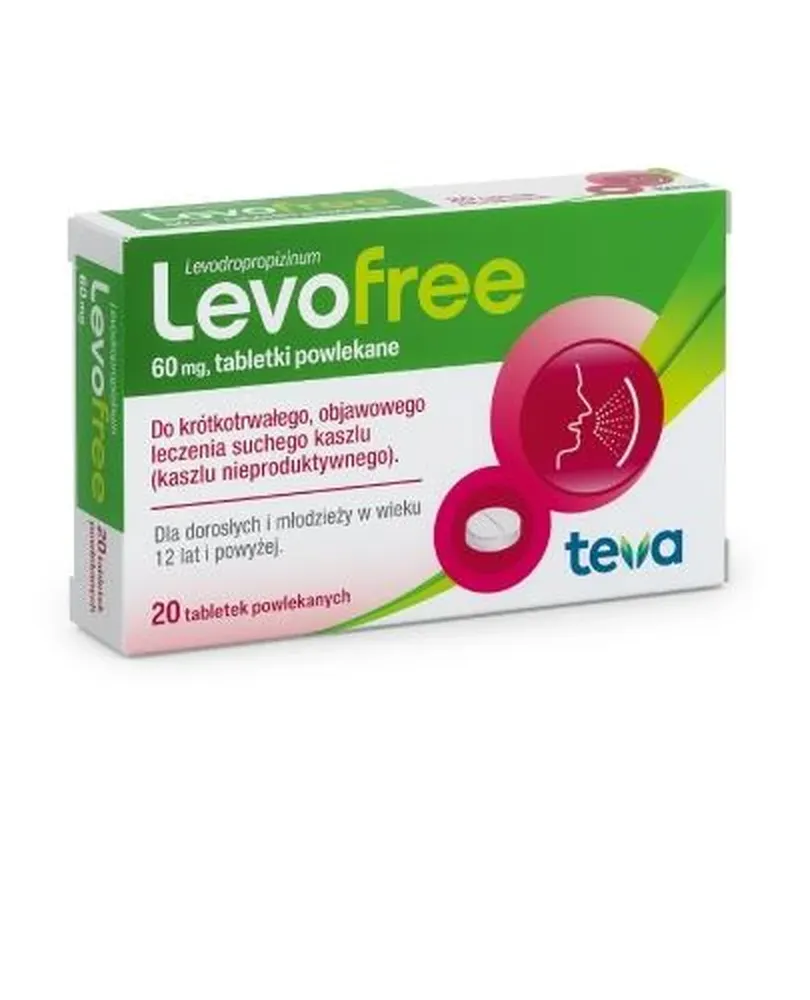
Table of Contents
Package leaflet: Information for the user
Levofree, 60 mg, coated tablets
Levodropropizinum
Please read all of this leaflet carefully before taking this medicine, because it contains
important information for you.
This medicine should always be taken exactly as described in this patient leaflet or as directed
by your doctor or pharmacist.
- Keep this leaflet so that you can read it again if necessary.
- If you need advice or further information, please consult your pharmacist.
- If you experience any adverse reactions, including any not listed in this leaflet, inform your doctor or pharmacist. See section 4.
- If there is no improvement after 7 days, or if you feel worse, consult your doctor.
Contents of the leaflet:
- What Levofree is and what it is used for
- What you need to know before taking Levofree
- How to take Levofree
- Possible side effects
- How to store Levofree
- Contents of the pack and other information
1. What Levofree is and what it is used for
Levofree contains the active substance levodropropizine, which belongs to a group of medicines
known as antitussives (cough suppressants).
Levofree is used for the short-term, symptomatic treatment of dry cough (non-productive cough).
Levofree is indicated for use in adults and adolescents aged 12 years and older.
If there is no improvement after 7 days, or if you feel worse, you should consult your doctor.
2. Important information before using Levofree
When not to use Levofree
- if the patient is allergic to levodropropizine or to any of the other ingredients of this medicine (listed in section 6);
- if the patient has productive cough (cough with mucus/phlegm);
- if the patient has certain respiratory disorders characterized by reduced ability to eliminate mucus (Kartagener's syndrome, ciliary dyskinesia);
- if the patient has severe liver function disorders;
- if the patient is pregnant or breastfeeding.
Warnings and precautions
Before starting treatment with Levofree, consult a doctor or pharmacist.
Exercise caution when dosing Levofree in elderly patients due to increased sensitivity to multiple drugs in this population.
If the patient has severe renal impairment, Levofree should be used only after consultation with a doctor.
In particularly sensitive individuals, caution is advised when using Levofree concomitantly with sedative medications, due to the possibility of enhanced sedative effects.
Children
Do not use Levofree 60 mg, coated tablets, in children under 12 years of age, see section 3.
Levofree with other medicines
Inform your doctor or pharmacist about all medicines currently taken, recently taken, or planned for use.
Although no interactions with benzodiazepines were reported in clinical studies, caution should be exercised when using Levofree concomitantly with sedatives in particularly sensitive patients, due to the potential for enhanced sedative effects.
Pregnancy and breastfeeding
If the patient is pregnant or breastfeeding, suspects she may be pregnant, or is planning to become pregnant, she should consult a doctor or pharmacist before using this medicine.
Do not use Levofree during pregnancy or breastfeeding, as animal studies have shown that the active substance crosses the placental barrier and has also been detected in breast milk.
Driving and operating machinery
Exercise caution when driving or operating machinery. Levofree may cause drowsiness (see section 4. Possible side effects). If the patient feels drowsy after taking the medicine, he or she should not drive or operate machinery. Even when used as directed, Levofree may alter reaction time, thereby impairing the ability to drive or operate machinery.
Levofree contains sodium
This medicine contains less than 1 mmol (23 mg) of sodium per tablet, meaning the medicine is considered "sodium-free".
3. How to take Levofree
This medicine should always be taken exactly as described in this patient information leaflet or as directed by a doctor or pharmacist. If in doubt, consult a doctor or pharmacist.
Recommended dose:
Adults and adolescents aged 12 years and above
1 coated tablet three times daily, with at least 6 hours between doses.
Use in children
Due to the strength of the active substance and the recommended dosage, Levofree 60 mg coated tablets are not recommended for children under 12 years of age.
For children under 12 years of age, other strengths/formulations are available.
Method of administration
Levofree is intended for oral use.
It is recommended to take the medicine between meals with a glass of water.
The break line on the tablet is intended only to facilitate breaking the tablet if the patient has difficulty swallowing it whole.
Duration of treatment:
For short-term use only. The medicine should be taken until cough subsides, but Levofree should not be used for longer than 7 days. If cough persists or worsens, consult a doctor.
Taking more Levofree than recommended
In case of overdose, contact a doctor immediately. If symptoms of overdose occur, the doctor will decide on the necessary measures.
If you forget to take Levofree
If a dose of Levofree is missed, take the next dose at the usual time.
Do not take a double dose to make up for the missed dose.
If you have any further doubts concerning the use of this medicine, consult a doctor or pharmacist.
4. Possible adverse reactions
Like all medicines, this medicine can cause adverse reactions, although not everyone will experience them.
The following adverse reactions may occur:
Very rare (may affect fewer than 1 in 10,000 people):
- urticaria, skin redness, rash, itching, angioedema (swelling occurring in various parts of the body, face, respiratory mucous membranes, and gastrointestinal tract), skin reactions.
- one fatal case of epidermal detachment (separation of the outer layer of skin with blister formation) has been reported.
- abdominal pain, nausea, vomiting, diarrhoea.
- one case of glossitis and one case of aphthous ulceration (small, shallow lesions developing on soft tissues in the mouth or at the base of the gums) have been reported.
- cholestatic hepatitis (a form of jaundice) and hypoglycemic coma (loss of consciousness due to low blood sugar levels) have been reported in women concurrently taking medications that reduce blood glucose levels.
- hypersensitivity and acute allergic reactions.
- isolated cases of generalized edema (swelling) of the entire body and general weakness have been reported.
- dizziness, vertigo, fainting, tremor, paraesthesia, somnolence, headache.
- one case of seizures and one case of minor epileptic seizure has been reported.
- palpitations, tachycardia, hypotension.
- one case of cardiac arrhythmia has been reported.
- irritability, somnolence, depersonalization/derealization (feeling detached or disconnected from oneself/environment).
- breathing difficulties, cough, respiratory tract edema.
- general fatigue and muscle weakness.
Reporting of adverse reactions
If any adverse reactions occur, including any adverse reactions not listed
in this leaflet, inform your doctor or pharmacist.
Adverse reactions can be reported directly to the Department of Monitoring Adverse Drug Reactions at the Office for Registration of Medicinal Products, Medical Devices and Biocidal Products: Al. Jerozolimskie 181C, 02-222 Warsaw,
Tel.: +48 22 4921301, Fax: +48 22 4921309, website: https://smz.ezdrowie.gov.pl
Adverse reactions can also be reported to the marketing authorization holder.
Reporting adverse reactions helps to provide more information on the safety of the medicine.
5. How to store Levofree medicine
Keep this medicine out of the sight and reach of children.
Do not use this medicine after the expiry date stated on the carton and blister after "Expiry date (EXP):" or "EXP". The expiry date refers to the last day of the stated month.
No special storage instructions apply.
Medicines must not be disposed of via wastewater or household waste. Ask your pharmacist how to dispose of medicines no longer in use. Such measures will help protect the environment.
6. Contents of the pack and other information
What Levofree contains
- The active substance is levodropropizine. Each coated tablet contains 60 mg of levodropropizine.
- Other ingredients are:
Tablet core: mannitol (E 421), microcrystalline cellulose (E 460), sodium carboxymethyl starch (type A), colloidal anhydrous silica (E 551), magnesium stearate (E 470b)
Coating: polyvinyl alcohol (E 1203), titanium dioxide (E 171), macrogol 3350 (E 1521), talc (E 553b)
What Levofree looks like and contents of the pack
Levofree is white or almost white, biconvex, round coated tablets with a score line on both sides.
Levofree is available in cardboard boxes containing 10 or 20 coated tablets in PVC/PVDC/Al blisters.
Not all pack sizes may be marketed.
Marketing Authorisation Holder
Teva BV, Swensweg 5, 2031 GA Haarlem, The Netherlands
For further information about this medicinal product, please contact the local representative of the Marketing Authorisation Holder:
Teva Pharmaceuticals Polska Sp. z o.o., ul. Emilii Plater 53, 00-113 Warsaw, Poland, tel.: (22) 345 93 00
Manufacturer
- Teva Operations Poland Sp. z o.o., ul. Mogilska 80, 31-546 Kraków, Poland
- Merckle GmbH, Graf-Arco-Str. 3, 89079 Ulm, Germany
This medicinal product is authorised in the European Economic Area countries under the following names:
Czech Republic: Dituzdin
Germany: Levodrop-ratiopharm Hustenstiller
Luxembourg: Levodrop-ratiopharm Hustenstiller
Poland: Levofree
Portugal: Tussilib
Slovakia: Ditustat Neo filmom obalené tablety