Lecicarbon junior
PolandTable of Contents
Patient leaflet: information for the user
Lecicarbon Junior, 250 mg + 340 mg, suppositories
Natrii hydrogenocarbonas + Natrii dihydrogenophosphas
For use in children
Please read carefully the entire leaflet before using the medicine, as it contains
important information for the patient.
This medicine should always be used exactly as described in this patient leaflet or as directed by the
physician or pharmacist.
Keep this leaflet, as you may need to read it again.
If you need advice or further information, please consult your pharmacist.
If any adverse reactions occur, including any possible adverse reactions not listed in this leaflet,
inform your doctor or pharmacist.
See section 4.
If there is no improvement after 3 days, or if the patient feels worse, contact your doctor.
Leaflet contents
- What Lecicarbon Junior is and what it is used for
- Important information before using Lecicarbon Junior
- How to use Lecicarbon Junior
- Possible side effects
- How to store Lecicarbon Junior
- Further information
1. What Lecicarbon Junior is and what it is used for
Lecicarbon Junior is used in various forms of constipation, for example, those caused by consuming
foods low in dietary fibre, lack of physical activity, or in diseases requiring easy bowel movements.
Lecicarbon Junior is also used for bowel emptying prior to surgery or diagnostic procedures involving the rectum.
2. Important information before using Lecicarbon Junior
When not to use Lecicarbon Junior
if the patient is allergic (hypersensitive) to sodium bicarbonate, sodium dihydrogen phosphate, or
any of the other ingredients of this medicine (listed in section 6).
in case of intestinal obstruction.
Warnings and precautions
In the event of toxic megacolon (pathological dilation of the end of the large intestine due to various causes), this medicine should be used only after obtaining explicit approval from the attending physician.
Lecicarbon Junior and other medicines
Lecicarbon Junior may be used while taking other medicines.
You should inform your doctor or pharmacist about all medicines the patient is currently taking or has recently taken, as well as any medicines the patient intends to take, including those available without a prescription.
Lecicarbon Junior with food and drink
No special precautions are required.
Pregnancy, breastfeeding and fertility
Pregnancy:
Lecicarbon Junior may be used during pregnancy after consultation with the attending physician.
Breastfeeding:
Lecicarbon Junior may be used during breastfeeding.
Fertility:
There are no data available on the effect of Lecicarbon Junior on human fertility. The impact on male and female fertility has not been evaluated in animal studies.
Before using any medicine, you should consult a doctor or pharmacist.
Driving and operating machinery
Lecicarbon Junior has no influence on the ability to drive or operate machinery.
Please note that a bowel movement (defecation) is expected 15–30 minutes after administration.
Lecicarbon Junior contains (3-sn-phosphatidyl)choline (from soybean oil, lecithin)
Do not use if hypersensitivity to peanuts or soy has been diagnosed.
3. How to use Lecicarbon Junior
This medicine should always be used exactly as described in this patient leaflet or as directed by a doctor or pharmacist. If in doubt, consult a doctor or pharmacist.
Unless otherwise prescribed, insert one suppository into the rectum when necessary. If needed, the dose may be repeated after 30–60 minutes.
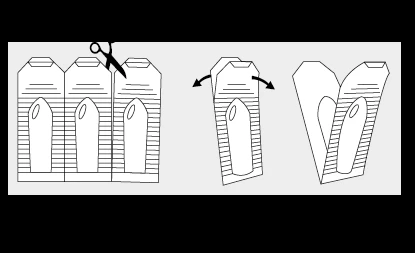
Before using Lecicarbon Junior, remove the suppository from the packaging by detaching one suppository from the strip at the perforation. Hold the plastic ends with both hands and pull in opposite directions. Insert the suppository into the rectum. Briefly immersing it in water beforehand may ease insertion. In children, it may be necessary to gently press the child's buttocks together to prevent immediate expulsion of the suppository.
Onset of action occurs within 15–30 minutes.
Do not use oil or petroleum jelly as a lubricant.
Lecicarbon Junior is suitable for use in children under 12 years of age. Lecicarbon Junior is not suitable for use in adults.
Lecicarbon Junior is safe for long-term use and does not lead to habituation. However, in cases of chronic constipation, medical advice should always be sought.
Use of a higher than recommended dose of Lecicarbon Junior
The usual dose is one suppository. If necessary, administration may be repeated after 30–60 minutes. Exceeding this dose poses no danger, but administering more than two suppositories is not beneficial.
Missed dose of Lecicarbon Junior
Lecicarbon Junior is used only when needed.
Stopping treatment with Lecicarbon Junior
Lecicarbon Junior is used only when needed.
If you have any further questions about the use of this medicine, consult your doctor or pharmacist.
4. Possible adverse reactions
Like all medicines, this medicine can cause adverse reactions, although not everybody will experience them.
Lecicarbon Junior usually does not cause any problems (adverse reactions).
Insertion of the suppository may occasionally, in rare cases, cause a slight burning sensation,
which quickly subsides.
If any of the adverse reactions worsen or if any adverse reactions not listed in this leaflet occur,
inform a doctor or pharmacist.
Reporting of adverse reactions
If any adverse reactions occur, including any adverse reactions not listed in this leaflet, inform a doctor or pharmacist.
Adverse reactions can be reported directly to the Department of Monitoring Adverse Drug Reactions of the Office for Registration of Medicinal Products, Medical Devices and Biocidal Products: Al. Jerozolimskie 181C,
02-222 Warsaw, tel.: +48 22 49 21 301, fax: +48 22 49 21 309, Website:
https://smz.ezdrowie.gov.pl
Adverse reactions can also be reported to the marketing authorization holder.
Reporting adverse reactions helps to provide more information on the safety of the medicine.
5. How to store Lecicarbon Junior
Store and transport in a refrigerated condition (2°C – 8°C).
Keep the medicine out of the reach and sight of children.
Do not use this medicine after the expiry date stated on the carton and blister pack after:
"Expiry date (EXP)". The expiry date refers to the last day of the stated month.
Medicines should not be disposed of via wastewater or household waste. Ask your pharmacist how to dispose of medicines no longer required. This will help protect the environment.
6. Contents of the package and other information
What Lecicarbon Junior contains
The active substances in this medicine are sodium hydrogen carbonate and sodium dihydrogen phosphate.
Other components are: (3-sn-phosphatidyl)choline (= soya lecithin, phosphatides), hard fat,
and anhydrous colloidal silicon dioxide.
What Lecicarbon Junior looks like and contents of the pack
Lecicarbon Junior is a cream-colored, homogeneous torpedo-shaped suppository, packed
in PVC/PE blisters with five suppositories per blister, with the batch number and expiry date embossed.
It is available in packs containing 10 suppositories and in hospital packs containing 5x10 suppositories.
Not all pack sizes may be marketed.
Marketing Authorisation Holder and Manufacturer
Marketing Authorisation Holder
athenstaedt GmbH & Co KG
Am Beerberg 1
D-35088 Battenberg (Eder)
Germany
Tel. +49 6452 92 942-0
Fax. +49 6452 92 942-15
Manufacturer:
Haupt Pharma Livron S.A.S.
1 Rue Comte de Sinard
F-26250 Livron-Sur-Drôme
France
Tel.: +33-4-75 61 02 00
Fax: +33-4-75 61 02 10
This medicine is authorised in the following names in the member countries of the European Economic Area:
Germany: Lecicarbon E/K CO2-Laxans zwei/drei
Hungary: Lecicarbon Felnött végbélkúp / Lecicarbon Gyermek végbélkúp
Luxembourg: Lecicarbon E/K
Slovenia: Lecicarbon za odrasle 500 mg/680 mg svečke / Lecicarbon® za otroke 250 mg/340 mg svečke
Slovakia: Lecicarbon Pediatrickí pacienti 0,250 g/0,340 g čapíky