Lappoxo
PolandTable of Contents
Package leaflet: Information for the user
Lappoxo, 10 mg/15 mL, oral solution
Lappoxo, 20 mg/15 mL, oral solution
Omeprazolum
Please read this entire leaflet carefully before taking this medicine, as it contains important information for you.
- Keep this leaflet, as you may need to read it again.
- If you have any further questions, please consult your doctor or pharmacist.
- This medicine has been prescribed for a specific individual. Do not pass it on to others. This medicine may harm others, even if their symptoms are the same.
- If you experience any adverse reactions, including any not listed in this leaflet, inform your doctor or pharmacist. See section 4.
Table of contents
- What Lappoxo is and what it is used for
- Important information before taking Lappoxo
- How to take Lappoxo
- Possible side effects
- How to store Lappoxo
- Contents of the pack and other information
1. What Lappoxo is and what it is used for
Lappoxo is an oral solution containing the active substance omeprazole. It belongs to a group of medicines called "proton pump inhibitors". These medicines work by reducing the amount of acid produced by the stomach.
Lappoxo is used to treat the following conditions:
In adults:
- "Gastro-oesophageal reflux disease" (GERD) – a condition in which stomach acid flows back into the oesophagus (the tube connecting the throat to the stomach), causing pain, inflammation, and heartburn.
- Ulcers in the upper part of the intestine (duodenal ulcer) or in the stomach (gastric ulcer).
- Ulcers infected with bacteria called Helicobacter pylori. In such cases, your doctor may also prescribe antibiotics to eradicate the infection and allow the ulcer to heal.
- Ulcers caused by non-steroidal anti-inflammatory drugs (NSAIDs). Lappoxo may also be used to prevent ulcers while taking NSAIDs.
In children:
Children over 1 month of age:
- "Gastro-oesophageal reflux disease" (GERD) and reflux oesophagitis – a condition in which stomach acid flows back into the oesophagus, causing pain, inflammation, and heartburn. In children, symptoms may include regurgitation of stomach contents into the mouth, vomiting, and poor weight gain.
Children aged over 4 years and adolescents:
- Ulcers infected with bacteria called Helicobacter pylori. If your child has this condition, your doctor may also prescribe antibiotics to treat the infection and allow the ulcer to heal.
2. Important information before taking Lappoxo
Do not take Lappoxo if:
- You are allergic to omeprazole or any of the other ingredients of this medicine (listed in section 6).
- You are allergic to other proton pump inhibitors (e.g. pantoprazole, lansoprazole, rabeprazole, esomeprazole).
- You are taking a medicine containing nelfinavir (used in the treatment of HIV infection).
Do not take Lappoxo if any of the above apply to you.
If in doubt, speak to your doctor or pharmacist before starting treatment with Lappoxo.
Warnings and precautions
Talk to your doctor or pharmacist before taking Lappoxo.
Severe skin reactions, including Stevens-Johnson syndrome, toxic epidermal necrolysis, drug reaction with eosinophilia and systemic symptoms (DRESS syndrome), and acute generalized exanthematous pustulosis (AGEP), have been reported during treatment with omeprazole. If you notice any symptoms of serious skin reactions described in section 4, stop taking Lappoxo immediately and contact your doctor without delay.
Lappoxo may mask symptoms of other diseases. Therefore, if you experience any of the following symptoms before or during treatment with Lappoxo, contact your doctor immediately:
- Unexplained and significant weight loss or difficulty swallowing;
- Abdominal pain or indigestion;
- Vomiting blood or food;
- Black (tarry) stools (faeces containing blood);
- Severe or persistent diarrhoea, as omeprazole use is associated with a slightly increased risk of infectious diarrhoea;
- Severe liver function disorders;
- A skin reaction (at any time) after taking a medicine similar to Lappoxo that reduces stomach acid;
- Before undergoing a specific blood test (chromogranin A levels).
If you are taking Lappoxo for a long time (more than 1 year), your doctor may recommend regular health check-ups. During each visit, report any new or unusual symptoms or circumstances.
Long-term use (especially longer than one year) of proton pump inhibitors such as Lappoxo may slightly increase the risk of fractures of the hip, wrist, or spine. Inform your doctor if you have osteoporosis or are taking corticosteroids (which may increase the risk of osteoporosis).
If you develop a skin rash, especially in sun-exposed areas, inform your doctor as soon as possible, as treatment with Lappoxo may need to be discontinued. Also inform your doctor about any other adverse effects, such as joint pain.
This medicine may affect the absorption of vitamin B12 in the body, particularly if taken for a prolonged period. Contact your doctor if you experience any of the following symptoms, which may indicate low vitamin B12 levels:
- Extreme fatigue or lack of energy
- Tingling or numbness ("pins and needles")
- Tongue pain or redness, mouth ulcers
- Muscle weakness
- Vision disturbances
- Memory problems, confusion, depression
Kidney inflammation may occur during omeprazole treatment. Symptoms may include reduced urine volume or blood in the urine and/or hypersensitivity reactions such as fever, rash, and joint stiffness. Report such symptoms to your doctor.
Children
Some children with chronic conditions may require long-term treatment, although this is not generally recommended. Do not give this medicine to children under 1 month of age.
Lappoxo with other medicines
Tell your doctor or pharmacist about all medicines you are currently taking, have recently taken, or plan to take, including those obtained without a prescription. This is because Lappoxo may affect the action of certain medicines, and some medicines may affect the action of Lappoxo.
Do not take Lappoxo if you are taking a medicine containing nelfinavir (used in the treatment of HIV infection).
Tell your doctor or pharmacist if you are taking any of the following medicines:
- Ketoconazole, itraconazole, posaconazole, or voriconazole (used to treat fungal infections)
- Digoxin (used to treat heart disorders)
- Diazepam (used to treat anxiety, reduce muscle tension, or treat epilepsy)
- Phenytoin (used to treat epilepsy). If you are taking phenytoin, your doctor may need to monitor your treatment when starting or stopping Lappoxo.
- Medicines used to thin the blood, such as warfarin or other vitamin K antagonists. Your doctor may need to monitor your treatment when starting or stopping Lappoxo.
- Rifampicin (used to treat tuberculosis)
- Atazanavir (used to treat HIV infection)
- Tacrolimus (used in organ transplantation)
- St. John’s wort (Hypericum perforatum) (used to treat mild depression)
- Cilostazol (used to treat intermittent claudication)
- Saquinavir (used to treat HIV infection)
- Clopidogrel (used to prevent blood clots)
- Erlotinib (used to treat malignant tumours)
- Methotrexate (a chemotherapeutic agent used in high doses to treat malignant tumours) – if you are taking high-dose methotrexate, your doctor may temporarily discontinue Lappoxo treatment
If your doctor has prescribed the antibiotics amoxicillin and clarithromycin together with Lappoxo to treat ulcers caused by Helicobacter pylori infection, it is very important to inform your doctor about all other medicines you are taking.
Taking Lappoxo with food and drink
For information on how to take this medicine in relation to meals, see section 3.
Pregnancy, breastfeeding, and fertility
Omeprazole may be used during pregnancy. However, if you are pregnant, breastfeeding, think you may be pregnant, or are planning to have a baby, consult your doctor or pharmacist before using this medicine.
Omeprazole passes into human milk, but it is unlikely to affect the breastfed infant when used at therapeutic doses. Your doctor will decide whether you can take Lappoxo while breastfeeding.
Driving and using machines
Lappoxo is unlikely to affect your ability to drive or operate tools or machines. However, side effects such as dizziness and visual disturbances may occur (see section 4). In such cases, do not drive or operate machinery.
Lappoxo contains propylene glycol
The 10 mg/15 mL oral solution of Lappoxo contains 8.9 mg of propylene glycol in 15 mL, equivalent to 0.593 mg/mL. The 20 mg/15 mL oral solution of Lappoxo contains 6.7 mg of propylene glycol in 15 mL, equivalent to 0.447 mg/mL.
Lappoxo contains sodium
Both the 10 mg/15 mL and 20 mg/15 mL oral solutions of Lappoxo contain 9.14 mg of sodium (the main component of table salt) per mL, or 137 mg of sodium per 15 mL dose. A 15 mL dose corresponds to 6.85% of the maximum recommended daily dietary sodium intake for adults.
3. How to take Lappoxo
This medicine should always be taken as directed by a doctor or pharmacist. If in
doubt, consult a doctor or pharmacist.
The doctor will inform you how much of the solution to take and for how long. This will depend on
the patient's health condition and age.
Dosing recommendations are provided below:
Use in adults
In the treatment of GERD symptoms such as heartburn and regurgitation of acidic stomach contents into the oesophagus:
- If the doctor determines that the tube connecting the throat to the stomach (oesophagus) has been slightly damaged, the recommended dose is 20 mg once daily for 4–8 weeks. The doctor may recommend a dose of 40 mg for an additional 8 weeks if the oesophagus has not yet healed.
- The recommended dose after healing of the oesophagus is 10 mg once daily.
- If the oesophagus has not been damaged, the usual dose is 10 mg once daily.
In the treatment of ulcers in the upper part of the intestine (duodenal ulcer):
- The recommended dose is 20 mg once daily for 2 weeks. The doctor may recommend continuing the same dose for another 2 weeks if the ulcer has not yet healed.
- If the ulcer does not heal completely, the dose may be increased to 40 mg once daily for 4 weeks.
In the treatment of stomach ulcers (gastric ulcer):
- The recommended dose is 20 mg once daily for 4 weeks. The doctor may recommend continuing the same dose for another 4 weeks if the ulcer has not yet healed.
- If the ulcer does not heal completely, the dose may be increased to 40 mg once daily for 8 weeks.
In preventing recurrence of duodenal and gastric ulcers:
- The recommended dose is 10 mg or 20 mg once daily. The doctor may increase the dose to 40 mg once daily.
In the treatment of duodenal and gastric ulcers caused by NSAIDs (non-steroidal anti-inflammatory drugs):
- The recommended dose is 20 mg once daily for 4 to 8 weeks.
In preventing duodenal and gastric ulcers in patients taking NSAIDs:
- The recommended dose is 20 mg once daily.
In the treatment of ulcers caused by Helicobacter pylori infection and preventing their recurrence:
- The recommended dose is 20 mg of Lappoxo twice daily for one week.
- The doctor will also prescribe two antibiotics from the following: amoxicillin, clarithromycin, and metronidazole.
Use in children and adolescents
In the treatment of GERD symptoms and reflux oesophagitis, such as heartburn and regurgitation of acidic stomach contents:
- Children above 1 month of age may take Lappoxo. The dose for children depends on the child's body weight, and the doctor will decide the appropriate dose based on the information below:
| Age | Body weight | Dosage |
|---|---|---|
| From 1 month to 1 year of age | 1 mg/kg body weight once daily. | |
| ≥ 1 year of age | 10-20 kg | 10 mg once daily. If necessary, the dose may be increased to 20 mg once daily. |
| ≥ 2 years of age | >20 kg | 20 mg once daily. If necessary, the dose may be increased to 40 mg once daily. |
For children aged from 1 month to 1 year, the appropriate formulation is Lappoxo oral solution with a strength of 10 mg/15 mL. The physician will prescribe the appropriate dose.
Below is the dosing for children under 1 year of age and weighing ≤ 10 kg using the Lappoxo oral solution with a strength of 10 mg/15 mL:
| Body weight in kg | Recommended dose of omeprazole | Volume in mL of prepared oral solution of L appoxo 10 mg/mL |
| 3 kg | 3 mg | 4.5 mL |
| 4 kg | 4 mg | 6 mL |
| 5 kg | 5 mg | 7.5 mL |
| 6 kg | 6 mg | 9 mL |
| 7 kg | 7 mg | 10.5 mL |
| 8 kg | 8 mg | 12 mL |
| 9 kg | 9 mg | 13.5 mL |
| 10 kg | 10 mg | 15 mL |
In the treatment of ulcers caused by Helicobacter pylori infection and prevention of their
recurrence:
- Children above 4 years of age may take Lappoxo. The dose for children depends on the child's body weight, and the doctor will determine the appropriate dose.
- The doctor will also prescribe two antibiotics for the child: amoxicillin and clarithromycin.
Taking this medicine
- Lappoxo 10 mg/15 mL should be used in children aged from 1 month to 1 year of age and for doses of 10 mg. For doses of 20 mg or 40 mg, Lappoxo 20 mg/15 mL is appropriate.
- This medicine should be taken orally.
- It is recommended to take the medicine in the morning.
- The medicine should be taken on an empty stomach, at least 30 minutes before a meal.
- For measuring the correct dose in children aged from 1 month to 1 year of age, use the dosing pipette supplied with the 10 mg/15 mL oral solution (see Preparation and administration of the oral solution).
- This medicine may also be administered via nasogastric (NG) tube or percutaneous endoscopic gastrostomy (PEG).
- Instructions for administration via NG tube or PEG: 1) Before administration, ensure that the enteral feeding tube is patent. 2) Flush the enteral feeding tube with 5 mL of water. 3) Administer the required dose of Lappoxo using an appropriate dosing device within 20 minutes of preparing the ready-to-use solution. 4) Flush the enteral feeding tube with at least 20 mL of water.
This medicine may be used with polyurethane nasogastric (NG) tubes and tubes used for percutaneous endoscopic gastrostomy (PEG) ranging in size from 6 Fr to 15 Fr.
For the smallest tubes (6 Fr), a reduced flushing volume of 3 mL may be used to facilitate administration in very young children where fluid restriction may be important.
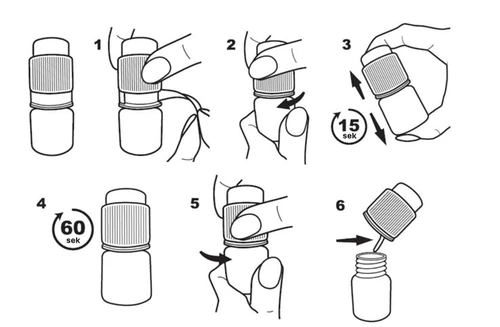
Preparation and administration of the oral solution
The container is a dual-chamber system containing solution both in the cap and in the bottle.
Both solutions must first be mixed together before administration to the patient.
After opening, the oral solution is ready to use. No further dilution of the product is required.
The product should be used within 20 minutes after mixing.
Instructions for preparing the ready-to-use oral solution:
- Remove the safety ring.
- Press and turn the cap clockwise until it is fully screwed onto the threaded neck.
- Shake well for at least 15 seconds to mix the solutions.
- Allow the oral solution to stand for 60 seconds to stabilize the mixture.
- Remove the plastic cap by turning it counterclockwise.
- Ensure that the bottom surface of the cap has been punctured and is open.
- Administer the solution directly from the bottle.
Lappoxo, 10 mg/15 mL
The final ready-to-use solution will be a viscous, white to pale yellow solution with a menthol odour.
Lappoxo, 20 mg/15 mL
The final ready-to-use solution will be a viscous, white to pale yellow solution with a menthol and lemon odour.
For doses ≤ 10 mg (used in children under 1 year of age and with body weight ≤10 kg), use the pipette supplied with the 10 mg/15 mL solution:
- Remove the safety ring.
- Press and turn the cap clockwise until it is fully screwed onto the threaded neck.
- Shake well for at least 15 seconds to mix both solutions.
- Allow the oral solution to stand for 5 minutes before using the pipette to stabilize the mixture.
- Remove the pipette cap.
- Place the bottle on a hard, flat surface and insert the pipette into it.
- Slowly draw back the pipette plunger to the mark on the pipette scale corresponding to the dose in millilitres (mL) prescribed by the doctor.
- Remove the pipette from the bottle.
- Ensure the child is supported in an upright position.
- Place the tip of the pipette into the child's mouth and slowly depress the pipette plunger so that the medicine flows out gently.
- Allow the child some time to swallow the medicine.
- After use, wash the pipette with warm water and leave it to dry.
- Discard the used bottle with any remaining solution.
If more Lappoxo has been taken than recommended
If more Lappoxo has been taken than prescribed by the doctor, contact a doctor or pharmacist immediately.
If a dose of Lappoxo is missed
If the patient forgets to take a dose, it should be taken as soon as remembered.
However, if it is nearly time for the next dose, the missed dose should be skipped. Do not take a double dose to make up for a missed dose.
Stopping Lappoxo treatment
Do not stop taking Lappoxo without first consulting a doctor or pharmacist.
If you have any further questions about the use of this medicine, consult your doctor or pharmacist.
4. Possible adverse reactions
Like all medicines, this medicine can cause adverse reactions, although not everyone will experience them.
If any of the following rare (may affect up to 1 in 1,000 people) or very rare (may affect up to 1 in 10,000 people), but serious adverse reactions occur, stop taking Lappoxo immediately and contact your doctor straight away:
- Sudden wheezing, swelling of the lips, tongue or throat, or entire body, rash, fainting or difficulty swallowing (severe allergic reaction) (rare).
- Redness of the skin with blistering or peeling. Large blisters and bleeding from the lips, eyes, mouth, nose or genitals may also occur. These may be symptoms of Stevens-Johnson syndrome or toxic epidermal necrolysis (very rare).
- Widespread rash, high fever and swollen lymph nodes (DRESS syndrome or drug hypersensitivity syndrome) (rare).
- Red, peeling widespread rash with subcutaneous nodules and blisters, accompanied by fever. Symptoms usually appear at the beginning of treatment (acute generalised exanthematous pustulosis) (rare).
- Yellowing of the skin, dark urine and fatigue, which may be signs of liver function disorders (rare).
Other adverse reactions include:
Common adverse reactions (may affect up to 1 in 10 people):
- Headache.
- Effects on the stomach or intestines: diarrhoea, stomach pain, constipation, bloating with passing wind.
- Nausea or vomiting.
- Mild polyps in the stomach.
Uncommon adverse reactions (may affect up to 1 in 100 people):
- Swelling of the feet and ankles.
- Sleep disturbances (insomnia).
- Dizziness, tingling sensation like “pins and needles”, drowsiness.
- Sensation of spinning (dizziness).
- Changes in blood tests checking liver function.
- Skin rash, hives (urticaria) and itching of the skin.
- Fractures of the hip, wrist or spine.
- General feeling of being unwell and lack of energy.
Rare adverse reactions (may affect up to 1 in 1,000 people):
- Blood disorders such as reduced number of white blood cells or platelets. This may cause weakness, easy bruising or increase the likelihood of infection.
- Low blood sodium levels. This may cause weakness, vomiting and muscle cramps.
- Feeling agitated, confusion or depression.
- Changes in taste.
- Vision problems such as blurred vision.
- Sudden wheezing or shortness of breath (bronchospasm).
- Dryness of the mouth.
- Inflammation of the mouth.
- A fungal infection called “thrush”, which may affect the intestines.
- Liver function disorders, including jaundice, which may cause yellowing of the skin, dark urine and fatigue.
- Hair loss (alopecia).
- Skin rash after exposure to sunlight.
- Joint pain (arthralgia) or muscle pain (myalgia).
- Severe kidney function disorders (interstitial nephritis).
- Excessive sweating.
Very rare adverse reactions (may affect up to 1 in 10,000 people):
- Changes in blood cell counts, including agranulocytosis (lack of white blood cells).
- Aggression.
- Seeing, feeling or hearing things that are not there (hallucinations).
- Severe liver function disorders leading to liver failure and encephalopathy.
- Erythema multiforme.
- Muscle weakness.
- Enlargement of the breasts in men.
Frequency not known (cannot be estimated from the available data):
- Inflammation of the intestines (leading to diarrhoea).
- If the patient takes Lappoxo for longer than three months, blood magnesium levels may decrease. Low magnesium levels may present as: fatigue, involuntary muscle contractions, disorientation, seizures, dizziness or rapid heartbeat. If any of these symptoms occur, inform your doctor immediately. Low magnesium levels may also lead to decreased potassium or calcium levels in the blood. Your doctor may decide to perform regular blood tests to monitor magnesium levels.
- Rash possibly accompanied by joint pain.
Lappoxo may, in very rare cases, affect the number of white blood cells, leading to immunodeficiency.
If an infection occurs with symptoms such as fever accompanied by a significant deterioration in the patient's general condition, or fever with signs of local infection such as neck, throat or mouth pain, or difficulty urinating, consult a doctor as soon as possible so that a blood test can rule out lack of white blood cells (agranulocytosis). It is important to inform the doctor that you are taking this medicine in such cases.
Reporting of adverse reactions
If any adverse reactions occur, including any not listed in this leaflet, inform your doctor or pharmacist. Adverse reactions can be reported directly to the Department of Monitoring Adverse Reactions of Medicinal Products, Office for Registration of Medicinal Products, Medical Devices and Biocidal Products, Al. Jerozolimskie 181C, 02-222 Warsaw
Tel.: +48 22 49 21 301
Fax: +48 22 49 21 309
Website: https://smz.ezdrowie.gov.pl
Adverse reactions can also be reported to the marketing authorisation holder.
Reporting adverse reactions helps provide more information on the safety of this medicine.
5. How to store Lappoxo
Keep this medicine out of the sight and reach of children.
Do not use this medicine after the expiry date stated on the label and carton following EXP.
The expiry date refers to the last day of the stated month.
Store in a refrigerator (2°C – 8°C).
Keep in the original packaging to protect from light.
The unopened product may be removed from the refrigerator (2°C–8°C) and stored for up to 28 days at a temperature below 25°C.
After reconstitution, use within 20 minutes. Any unused portion must be discarded.
Do not dispose of medicines via wastewater or household waste. Ask your pharmacist how to dispose of medicines no longer required. These measures will help protect the environment.
6. Contents of the packaging and other information
What Lappoxo contains
The active substance is omeprazole.
After mixing, each 15 mL of oral solution contains 10 mg of omeprazole.
After mixing, each 15 mL of oral solution contains 20 mg of omeprazole.
The other ingredients are: glycerol, xanthan gum, polysorbate 80, disodium edetate, acetylcysteine,
sodium dihydrogen phosphate dihydrate, sodium hydroxide, sodium carboxymethylcellulose, simethicone emulsion 30%,
sucralose, sodium bicarbonate, domiphen bromide, purified water, menthol flavour, flavouring to mask taste (containing propylene glycol), lemon flavour (for the 20 mg/15 mL strength).
What Lappoxo looks like and contents of the pack
Lappoxo 10 mg/15 mL is a viscous oral solution, white to slightly yellowish in colour, with a menthol odour.
Lappoxo 20 mg/15 mL is a viscous oral solution, white to slightly yellowish in colour, with a menthol and lemon odour.
Dual-chamber immediate packaging for Lappoxo 10 mg/15 mL.
The 15 mL pack consists of the following connected components:
- a closure made of HDPE with a tamper-evident ring, plunger made of PP and PE membrane, containing 5 mL of omeprazole solution at a concentration of 2 mg/mL;
- an HDPE bottle with a neck filled with 10 mL of diluent for preparation of Lappoxo oral solution at a strength of 10 mg/15 mL.
Dual-chamber immediate packaging for Lappoxo 20 mg/15 mL.
The 15 mL pack consists of the following connected components:
- a closure made of HDPE with a tamper-evident ring, plunger made of PP and PE membrane, containing 5 mL of omeprazole solution at a concentration of 4 mg/mL;
- an HDPE bottle with a neck filled with 10 mL of diluent for preparation of Lappoxo oral solution at a strength of 20 mg/15 mL.
A cardboard box containing 14 single-dose, dual-chamber HDPE bottles placed on a PVC tray, and a patient leaflet.
The cardboard box for Lappoxo 10 mg/15 mL contains a 15 mL dosing syringe with a plunger made of PS, and a barrel and cap made of LDPE, graduated in 0.5 mL increments.
Marketing Authorisation Holder
INN-FARM d.o.o.
Maleševa ulica 14
1000 Ljubljana
Slovenia
Tel.: +386 70 390 711
Fax: +386 5191 116
e-mail: [email protected]
Manufacturer/Importer:
ALKALOID-INT d.o.o.
Šlandrova ulica 4
1231 Ljubljana-Črnuče
Slovenia
This medicinal product is authorised in the European Economic Area under the following names:
| Austria | Appizmit 10 mg/15 mL oral solution Appizmit 20 mg/15 mL oral solution |
| Belgium | Lappoxo 10 mg/15 mL oral solution / drink / oral solution Lappoxo 20 mg/15 mL oral solution / drink / oral solution |
| Denmark | Lappoxo |
| Estonia | Lappoxo |
| Finland | Appizmit 10 mg/15 mL oral solution Appizmit 20 mg/15 mL oral solution |
| Greece | Lappoxo 10 mg/15 mL πόσιμο διάλυμα Lappoxo 20 mg/15 mL πόσιμο διάλυμα |
| Ireland | Appizped 10 mg/15 mL oral solution Appizped 20 mg/15 mL oral solution |
| Lithuania | Lappoxolo 10 mg/15 mL oral solution Lappoxolo 20 mg/15 mL oral solution |
| Latvia | Lappoxo 10 mg/15 mL solution for oral use Lappoxo 20 mg/15 mL solution for oral use |
| Germany | Appizmit 10 mg/15 mL oral solution Appizmit 20 mg/15 mL oral solution |
| Norway | Lappoxo |
| Poland | Lappoxo |
| Czech Republic | Lappoxo |
| Slovakia | Lappoxo 10 mg/15 mL oral solution Lappoxo 20 mg/15 mL oral solution |
| Sweden | Appizmit 10 mg/15 mL oral solution Appizmit 20 mg/15 mL oral solution |
| Italy | Appizmit |