Kopiryna - tablets for headache
Poland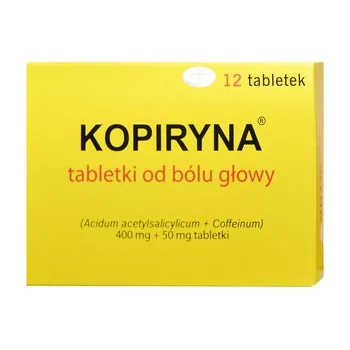
Table of Contents
Package leaflet: Information for the patient
K –
Acetylsalicylic acid + Caffeine
400 mg + 50 mg, tablets
Please read all of this leaflet carefully before taking this medicine, because it contains
important information for you.
This medicine should always be used exactly as described in this patient leaflet or as directed
by your doctor or pharmacist.
- Keep this leaflet, so that you can read it again if necessary.
- If you need advice or further information, please consult your pharmacist.
- If you experience any adverse reactions, including any possible side effects not listed in this leaflet, inform your doctor or pharmacist. See section 4.
Table of contents
- What K – is and what it is used for
- What you need to know before taking K –
- How to take K –
- Possible side effects
- How to store K –
- Contents of the pack and other information
1. What K – is and what it is used for
This medicine contains two active substances: acetylsalicylic acid, which has analgesic, antipyretic, and anti-inflammatory effects. Caffeine is believed to enhance the effect of acetylsalicylic acid in headache, and oral caffeine administered with analgesics may reduce fatigue and fluid retention associated with menstruation.
This medicine is used to treat mild to moderate pain, such as headache, muscle pain, menstrual pain, and fever.
2. Important information before using medicine K –
When not to use medicine K –
- if the patient is allergic to the active substances, other salicylates, other non-steroidal anti-inflammatory drugs, or to any of the other components of this medicine (listed in section 6);
- if the patient has: severe liver, kidney, or heart function disorders; severe uncontrolled hypertension; active peptic ulcer of the stomach or duodenum; gastrointestinal bleeding; haemorrhagic diathesis (general tendency to bleed);
- if the patient has previously experienced bronchial asthma attacks induced by administration of salicylates or substances with similar action, particularly non-steroidal anti-inflammatory drugs;
- during pregnancy and breastfeeding;
- if the patient is taking methotrexate at doses of 0.15 mg/kg body weight per week or higher;
- in children under 12 years of age during viral infections due to the risk of Reye's syndrome;
- at least 5 days before a surgical procedure.
Warnings and precautions
Medicine K – should be used with caution and only under a doctor’s supervision in the following cases:
- bronchial asthma, chronic respiratory diseases, hay fever, nasal mucosal polyps, or allergic reactions;
- blood coagulation disorders (due to vitamin K deficiency);
- anaemia (deficiency of red blood cells);
- high blood pressure;
- heart function disorders;
- gout (a disease associated with elevated levels of uric acid in the blood);
- liver and kidney function disorders;
- concomitant use of anticoagulant drugs;
- history of peptic ulcer of the stomach or duodenum, or gastrointestinal bleeding;
- glucose-6-phosphate dehydrogenase deficiency (an enzyme involved in red blood cell metabolism).
Concomitant use of medicine K – with alcohol increases the risk of gastrointestinal bleeding.
Prolonged use of painkillers, especially those containing multiple active substances, may lead to permanent kidney damage.
Acetylsalicylic acid may impair fertility. If a patient plans to become pregnant or has difficulty becoming pregnant, she should inform her doctor.
K – and other medicines
You should tell your doctor or pharmacist about all medicines the patient is currently taking or has recently taken, as well as any medicines the patient plans to take.
Do not use medicine K – with the following medicines:
- methotrexate (used in oncological, rheumatic diseases, psoriasis);
- coumarin derivatives, heparin, ticlopidine (anticoagulant drugs);
- other non-steroidal anti-inflammatory drugs (used to combat fever, pain, and inflammatory conditions);
- glucocorticosteroids, except hydrocortisone (used, among others, in inflammatory conditions, allergies);
- digoxin (used in heart failure);
- medicines used for diabetes;
- valproic acid (used in epilepsy);
- sympathomimetics (used e.g. in asthma, colds, glaucoma, hypertension);
- thyroxine (used in hypothyroidism);
- substances with ephedrine-like action (used in hypotension, inflammatory conditions of mucous membranes);
- barbituric acid derivatives (used, among others, as sedatives);
- benzbromarone, probenecid (used in gout);
- diuretics (e.g. spironolactone, furosemide – used in hypertension);
- angiotensin-converting enzyme inhibitors (used in hypertension);
- antihistamines (used in allergies);
- theophylline (used in bronchial asthma);
- cimetidine (used in peptic ulcer disease of the stomach and duodenum);
- gyrase inhibitors from the quinolone carboxylic acid derivatives group (used in bacterial infections);
- disulfiram (used in alcoholism);
- oral contraceptives.
Medicine K – should also not be used with alcohol or tobacco.
Pregnancy, breastfeeding, and effects on fertility
If the patient is pregnant or breastfeeding, suspects she may be pregnant, or is planning to have a child, she should consult a doctor or pharmacist before using this medicine.
If pregnancy occurs during long-term use of this medicine, the doctor should be informed.
Driving and operating machinery
This medicine does not affect the ability to drive or operate machinery.
3. How to use medicine K –
This medicine should always be used exactly as described in the patient leaflet or as directed by a doctor or pharmacist. If in doubt, consult a doctor or pharmacist.
The usual dose of medicine K – is as follows:
Adults: 1 to 2 tablets up to 3 times a day
Children over 12 years of age: ½ to 1 tablet 3 times a day
The tablets should be swallowed with a large amount of water.
Taking a higher than recommended dose of medicine K –
If more than the recommended dose has been taken, consult a doctor or pharmacist immediately.
Missing a dose of medicine K –
Do not take a double dose to make up for a forgotten dose.
Stopping treatment with medicine K –
This medicine is not intended for long-term use. If you have any further doubts regarding the use of this medicine, consult a doctor or pharmacist.
4. Possible adverse effects
Like all medicines, this medicine can cause adverse effects, although not everyone experiences them.
The following may occur:
- stomach and abdominal pain, heartburn, nausea, vomiting, indigestion, gastrointestinal inflammation and bleeding (bleeding symptoms include coffee-ground vomiting, black tarry stools; bleeding becomes more frequent with higher doses), peptic ulcer of the stomach or duodenum, perforation (perforation of the gastrointestinal wall), gastrointestinal disturbances;
- transient disturbances in liver function;
- headache during long-term use;
- dizziness and tinnitus, usually after administration of a dose higher than recommended;
- increased risk of bleeding, haemorrhages (postoperative, nose, gum, genitourinary tract), bruising, prolonged bleeding time, thrombocytopenia. Bleeding may lead to anaemia.
- intracerebral haemorrhage (particularly in patients with uncontrolled high blood pressure and/or those concurrently using other anticoagulant medicines); transient increase in blood pressure;
- renal damage has been reported after long-term use of high doses of acetylsalicylic acid;
- allergic reactions: asthma, mild to moderate skin reactions (e.g. rash, urticaria), breathing difficulties, cardiac disturbances, swelling, and very rarely severe allergic reactions, including anaphylactic shock (facial and eyelid swelling, swelling of the tongue and larynx with airway narrowing, difficulty breathing, shortness of breath up to asthma attacks, rapid heartbeat, sudden drop in blood pressure; if any of these symptoms occur, immediate professional medical help must be sought);
- insomnia, restlessness;
- palpitations, increased heart rate.
Reporting of adverse effects
If any adverse effects occur, including those not listed in this leaflet, inform a doctor or pharmacist. Adverse effects can be reported directly to the Department of Monitoring of Adverse Drug Reactions of the Office for Registration of Medicinal Products, Medical Devices and Biocidal Products:
Al. Jerozolimskie 181C
02-222 Warsaw
Tel.: + 48 22 49 21 301
Fax: + 48 22 49 21 309
Website: https://smz.ezdrowie.gov.pl
Adverse effects can also be reported to the marketing authorization holder.
Reporting adverse effects helps to provide more information on the safety of this medicine.
5. How to store medicine K –
Store below 25°C.
Keep in a place out of sight and reach of children.
Do not use this medicine after the expiry date stated on the packaging after EXP.
The expiry date refers to the last day of the stated month.
6. Contents of the packaging and other information
What the medicine contains
- The active substances in the medicine are: acetylsalicylic acid and caffeine.
- Another component of the medicine is potato starch.
What the medicine looks like and contents of the packaging
Blister made of PP foil or Aluminium/PVC in a cardboard box.
6 pcs (1 blister with 6 pcs)
12 pcs (2 blisters with 6 pcs each or 1 blister with 12 pcs)
Marketing Authorisation Holder
MEDICOFARMA S.A. Sopharma Warszawa Sp. z o.o.
Al. Jerozolimskie 1136, ul. Sokołowska 9 lok. 19
02-305 01-142 Warsaw
Tel. 22 613 39 30
Manufacturer
Medicofarma S.A.
Tarnobrzeska 13
26-613 Radom
„MARCMED” Sp. z o.o.
ul. Zamenhofa 29-31
20-435 Lublin