Kamiren
Poland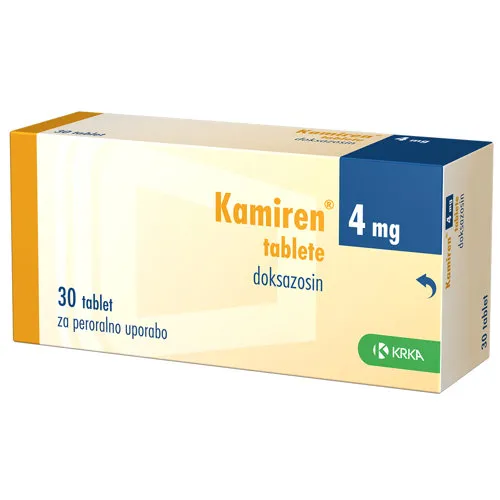
Table of Contents
Package leaflet: Information for the patient
Kamiren, 2 mg, tablets
Kamiren, 4 mg, tablets
Doxazosinum
Please read the entire leaflet carefully before using the medicine, as it contains
important information for the patient.
- Keep this leaflet, as you may need to read it again.
- If you have any questions, please consult your doctor or pharmacist.
- This medicine has been prescribed for a specific individual. Do not pass it on to others. The medicine may harm someone else, even if their symptoms are identical.
- If you experience any adverse reactions, including any not listed in this leaflet, inform your doctor or pharmacist. See section 4.
Table of contents of the leaflet
- What Kamiren is and what it is used for
- Important information before taking Kamiren
- How to take Kamiren
- Possible side effects
- How to store Kamiren
- Contents of the package and other information
1. What Kamiren is and what it is used for
Kamiren belongs to a group of medicines known as alpha-adrenolytic agents. It acts by dilating blood vessels, thereby reducing arterial blood pressure due to decreased peripheral vascular resistance.
Kamiren is also an antagonist of alpha-adrenergic receptors located in the prostate gland and urinary bladder. It reduces symptoms associated with impaired urine flow and improves urodynamic test results (related to urine flow).
Kamiren is indicated for the treatment of:
- essential hypertension,
- clinical symptoms caused by benign prostatic hyperplasia (BPH).
The medicine may be used as monotherapy (as the only treatment) or in combination with other antihypertensive medicines, such as thiazide diuretics, beta-adrenergic receptor blockers, calcium antagonists, or angiotensin-converting enzyme inhibitors.
2. Important information before using Kamiren
When not to use Kamiren
- if the patient is allergic to doxazosin, other quinazoline derivatives (prazosin, terazosin), or any of the other ingredients of this medicine (listed in section 6),
- in patients with enlarged prostate gland (benign prostatic hyperplasia) and low blood pressure,
- in patients who previously experienced orthostatic hypotension, i.e. low blood pressure causing dizziness or fainting upon standing up,
- in patients with enlarged prostate gland and urinary tract obstruction of any type, long-term urinary tract infection, or bladder stones,
- in patients with overflow incontinence (without urge to urinate) or anuria (lack of urine excretion), with or without kidney function disorders.
Warnings and precautions
Before starting treatment with Kamiren, consult a doctor or pharmacist.
In particular, inform your doctor about:
- liver function disorders (doxazosin is not recommended in patients with established liver impairment),
- heart conditions (pulmonary edema caused by aortic stenosis or mitral stenosis, heart failure with high ejection volume, right ventricular heart failure due to pulmonary embolism or pericardial effusion, left ventricular heart failure with low filling pressure); rapid and significant reduction in blood pressure may worsen angina symptoms,
- concomitant use of other medicines, e.g. sildenafil, tadalafil, vardenafil (medicines used for erectile dysfunction), as symptomatic hypotension may occur.
Patients undergoing cataract surgery (clouding of the lens) should inform the ophthalmologist before surgery whether they are currently or recently taking Kamiren. This way, the doctor can apply appropriate precautions or surgical techniques if surgical complications related to Kamiren occur.
Prolonged, painful erections (priapism) may very rarely occur. In such a case, contact a doctor immediately.
Before starting treatment with Kamiren, the doctor may perform tests to rule out other diseases, including prostate cancer, which may cause symptoms similar to those of benign prostatic hyperplasia.
At the beginning of taking Kamiren, fainting or dizziness due to low blood pressure may occur when standing up suddenly. If fainting or dizziness occurs, sit or lie down until symptoms subside and avoid situations where falls or injuries may occur. The doctor may recommend regular blood pressure monitoring at the beginning of treatment to reduce the risk of such symptoms.
Children and adolescents
Kamiren is not recommended for use in children and adolescents under 18 years of age due to lack of data on safety and efficacy.
Kamiren and other medicines
Inform your doctor or pharmacist about all medicines you are currently taking or have recently taken, as well as any medicines you plan to take.
Ask your doctor or pharmacist before using Kamiren if you are taking any of the following medicines, as they may affect the action of Kamiren:
- In some patients taking alpha-adrenergic blockers to lower high blood pressure or treat prostate enlargement, dizziness or a feeling of "emptiness in the head" due to sudden drop in blood pressure may occur. Similar symptoms may also occur in some patients taking medicines for erectile dysfunction (impotence) concomitantly with alpha-adrenergic blockers. To reduce the likelihood of such symptoms, patients should be on a stable daily dose of alpha-adrenergic blockers before starting treatment with erectile dysfunction medicines. Kamiren may further lower blood pressure in patients taking other antihypertensive medicines concomitantly.
- Medicines used to treat bacterial or fungal infections, e.g. clarithromycin, itraconazole, ketoconazole, telithromycin, voriconazole.
- Medicines used to treat HIV infection, e.g. indinavir, nelfinavir, ritonavir, saquinavir.
- Nefazodone, a medicine used to treat depression.
- Vasodilators or nitrates (medicines used for heart diseases).
The blood pressure-lowering effect of doxazosin may be reduced by:
- NSAIDs (non-steroidal anti-inflammatory drugs),
- estrogens,
- sympathomimetics.
Doxazosin may reduce the effects of dopamine, ephedrine, epinephrine, metaraminol, methoxamine, and phenylephrine on blood pressure and blood vessels. As there are no data on interactions with drugs affecting hepatic metabolism (e.g. cimetidine), particular caution is advised when co-administering such drugs with doxazosin.
In vitro studies have shown that doxazosin does not affect the protein binding of digoxin, warfarin, phenytoin, or indomethacin in plasma.
In clinical studies, no interactions were observed between doxazosin and thiazide diuretics, furosemide, beta-blockers, non-steroidal anti-inflammatory drugs, antibiotics, oral hypoglycemic agents (used in diabetes), uricosuric agents, or anticoagulants.
Doxazosin may increase plasma renin activity and urinary excretion of vanillylmandelic acid. This should be taken into account when interpreting laboratory test results.
Kamiren enhances the blood pressure-lowering effects of other alpha-adrenergic blockers and other antihypertensive medicines.
Clinical studies have shown that doxazosin has a beneficial effect on lipids, significantly reducing total triglyceride, total cholesterol, and LDL cholesterol fractions in plasma. Treatment with doxazosin favorably affects hypertension and lipid levels, thereby reducing the risk of coronary artery disease.
Taking Kamiren with food and drink
Kamiren can be taken regardless of meals.
Pregnancy and breastfeeding
If the patient is pregnant or breastfeeding, suspects she may be pregnant, or plans to become pregnant, she should consult a doctor or pharmacist before using this medicine.
The safety of doxazosin use during pregnancy has not been established.
The doctor may prescribe Kamiren during pregnancy only if the potential benefits to the mother outweigh the risks to the fetus.
Doxazosin passes into human milk in small amounts. Breastfeeding women should not use this medicine unless otherwise decided by the doctor.
Driving and operating machinery
Due to the possibility of dizziness, especially at the beginning of treatment with Kamiren, after dose increase, switching to another medicine, or when consuming alcohol, driving and operating machinery are not recommended.
Kamiren contains lactose and sodium
If the patient has previously been diagnosed with intolerance to certain sugars, they should consult a doctor before taking this medicine.
This medicine contains less than 1 mmol (23 mg) of sodium per tablet, meaning the medicine is considered "sodium-free".
3. How to use Kamiren
This medicine should always be taken exactly as prescribed by your doctor or pharmacist. If in doubt,
consult your doctor or pharmacist.
Your doctor will determine the dose individually for each patient.
Essential hypertension
Treatment is initiated at a dose of 1 mg once daily. In individual cases, after 1 to 2 weeks, your doctor may increase the dose to 2 mg once daily, then to 4 mg once daily, and finally up to 8 mg of doxazosin once daily.
The usual maintenance dose is generally 2 mg to 4 mg of doxazosin once daily.
The maximum recommended daily dose is 16 mg.
The following dosing schedule is recommended at the start of treatment:
Day 1–8: 1 mg of doxazosin in the morning
Day 9–14: 2 mg of doxazosin in the morning
Thereafter, the dose may be increased gradually to an effective maintenance dose, as determined by your doctor.
Benign prostatic hyperplasia
Treatment is initiated at a dose of 1 mg once daily. After 1 to 2 weeks, if necessary, your doctor may increase the dose to 2 mg once daily, then to 4 mg once daily, depending on the patient's response.
The maximum recommended daily dose is 8 mg.
The following dosing schedule is recommended at the start of treatment:
Day 1–8: 1 mg of doxazosin once daily
Day 9–14: 2 mg of doxazosin once daily
Thereafter, the dose may be individually increased to an effective maintenance dose.
The tablets should be swallowed with water.
Your doctor will determine the duration of treatment.
If you feel that the effect of Kamiren is too strong or too weak, consult your doctor.
Use in children and adolescents
Kamiren is not recommended for use in children and adolescents under 18 years of age.
Use in patients with renal impairment
Dose reduction is not necessary in patients with impaired renal function. However, the dose should be as low as possible, and any dose increase should be performed under strict medical supervision.
Use in patients with hepatic impairment
Extreme caution is advised. There is no clinical experience with the use of this medicine in patients with severe hepatic impairment.
Elderly patients
Dose adjustment is not necessary in elderly patients. However, the dose should be as low as possible, and any dose increase should be performed under strict medical supervision.
Taking more Kamiren than recommended
Overdose of Kamiren may result in symptomatic hypotension. Seek immediate medical attention; your doctor will provide symptomatic treatment. Dialysis is not effective, as doxazosin is almost completely bound to plasma proteins.
Missing a dose of Kamiren
If you forget to take a dose of Kamiren, take it as soon as possible, unless it is almost time for the next dose. In that case, take the next dose at the scheduled time. Do not take a double dose to make up for a missed dose.
If you have any further questions about the use of this medicine, consult your doctor or pharmacist.
4. Possible adverse effects
Like all medicines, this medicine can cause adverse effects, although not everybody will experience them.
Common adverse effects (may occur in up to 1 in 10 patients):
- respiratory tract infections, urinary tract infections,
- drowsiness, dizziness, headache,
- accommodation disorders, peripheral (vestibular) vertigo,
- palpitations, increased heart rate (tachycardia), chest pain,
- low blood pressure (hypotension) or decreased blood pressure upon sudden standing (orthostatic hypotension),
- oedema, bronchitis, cough, dyspnoea, nasal mucosal irritation,
- abdominal pain, dyspepsia, dryness of the oral mucosa, nausea,
- itching,
- back pain, muscle pain,
- cystitis, urinary incontinence, feeling of increased need to urinate, urinary frequency,
- general weakness, chest pain, influenza-like symptoms, generalized oedema, peripheral oedema.
Uncommon adverse effects (may occur in up to 1 in 100 patients):
- allergic reactions to the medicine,
- anorexia, gout (deposition of uric acid crystals, especially in joints), thirst, increased appetite, anorexia,
- agitation, depression, anxiety, insomnia, nervousness, emotional lability,
- cerebrovascular incident, hypoaesthesia, fainting, tremor, apathy, lacrimation, photophobia,
- tinnitus,
- angina pectoris (chest pain due to reduced blood flow to the heart muscle), myocardial infarction, fainting, peripheral ischaemia,
- nosebleed, pharyngitis,
- constipation, bloating with flatulence, vomiting, gastroenteritis, diarrhoea,
- abnormal liver function test results, increased liver enzyme activity,
- skin rash,
- joint pain,
- painful urination, frequent urination, blood in urine,
- impotence,
- pain, fever, chills, facial oedema, hot flushes, pallor, hypokalaemia,
- weight gain, hypokalaemia.
Rare adverse effects (may occur in up to 1 in 1,000 patients):
- cerebrovascular disorders, laryngeal oedema, hypoglycaemia, muscle cramps, muscle weakness, polyuria.
Very rare adverse effects (may occur in up to 1 in 10,000 patients):
- low white blood cell count (leukopenia), low platelet count which may lead to easy bruising or increased tendency to bleed (thrombocytopenia),
- dizziness caused by decreased blood pressure upon rapid standing, spontaneous abnormal sensations (paraesthesia),
- anaemia, hypersensitivity, muscle stiffness, taste disturbances, nightmares, memory loss, orthostatic dizziness,
- blurred vision,
- slow heart rate (bradycardia), heart rhythm disorders,
- hot flushes,
- bronchospasm,
- bile stasis (cholestasis), hepatitis, yellowing of the skin or eyes (jaundice),
- urticaria, alopecia, bleeding into the skin (purpura),
- increased urination, micturition disorders, nocturia, increased creatinine concentration in urine and plasma,
- breast enlargement in men (gynaecomastia),
- prolonged, painful erection (priapism) – urgent medical advice must be sought,
- feeling of fatigue, general malaise, decreased body temperature in elderly patients.
Adverse effects with unknown frequency (frequency cannot be estimated from the available data):
- eye disorders which may occur during cataract surgery (clouding of the eye lens), see "Warnings and precautions",
- retrograde ejaculation into the bladder during ejaculation (retrograde ejaculation).
Reporting of adverse effects
If any adverse effects occur, including any adverse effects not listed in this leaflet, please inform your doctor or pharmacist. Adverse effects can be reported directly to the Department of Monitoring Adverse Drug Reactions of the Office for Registration of Medicinal Products, Medical Devices and Biocidal Products:
Al. Jerozolimskie 181C, 02-222 Warsaw
Tel.: + 48 22 49 21 301
Fax: + 48 22 49 21 309
Website: https://smz.ezdrowie.gov.pl
Adverse effects can also be reported to the marketing authorisation holder.
Reporting adverse effects helps to provide more information on the safety of the medicine.
5. How to store Kamiren
The medicine should be stored in a place inaccessible and out of sight of children.
Store below 30°C.
Do not use this medicine after the expiry date stated on the packaging following the abbreviation
"EXP". The expiry date refers to the last day of the stated month.
The batch number is indicated on the packaging following the abbreviation "Lot".
Medicines must not be disposed of via wastewater or household waste. Ask your
pharmacist how to dispose of medicines no longer required. This will help protect
the environment.
6. Contents of the pack and other information
What Kamiren contains
- The active substance is doxazosin. Each tablet contains 2 mg or 4 mg of doxazosin in the form of doxazosin mesylate.
- The other ingredients are microcrystalline cellulose, sodium carboxymethyl starch, magnesium stearate, sodium lauryl sulfate, lactose monohydrate. See section 2 "Kamiren contains lactose and sodium".
What Kamiren looks like and contents of the pack
Kamiren 2 mg: white, round, flat tablets with a score line on one side. The tablet can be divided into equal doses.
Kamiren 4 mg: white, round, flat tablets with a score line on one side. The tablet can be divided into equal doses.
Pack: 30 tablets in blister packs within a cardboard box.
Marketing Authorisation Holder and Manufacturer
KRKA, d.d., Novo mesto, Šmarješka cesta 6, 8501 Novo mesto, Slovenia
For further information about this medicine, please contact the local representative of the Marketing Authorisation Holder:
KRKA-POLSKA Sp. z o.o.
ul. Równoległa 5
02-235 Warsaw, Poland
Tel. 22 57 37 500