Potassium effervescens sugar-free
Poland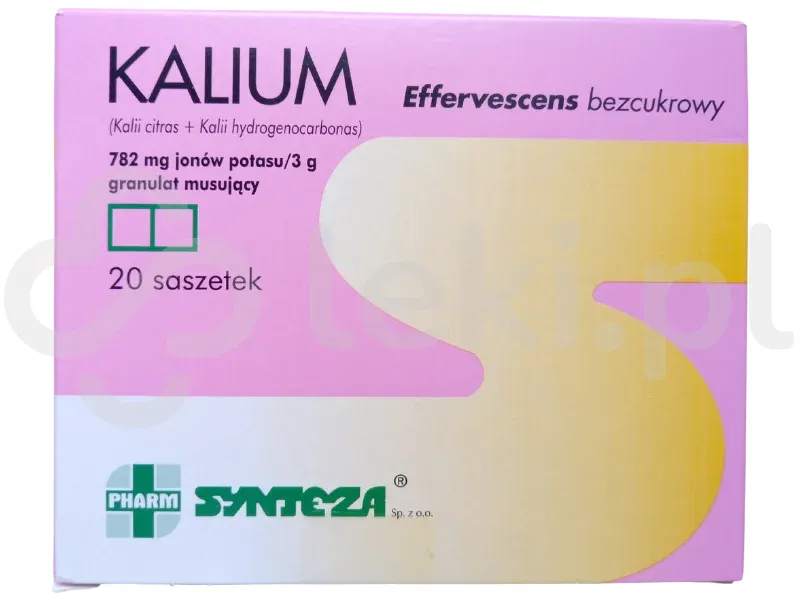
Table of Contents
- Package leaflet: Information for the patient
- 1. What Kalium effervescens bezcukrowy is and what it is used for
- 2. Important information before using Kalium effervescens bezcukrowy
- 3. How to use Kalium effervescens bezcukrowy
- 4. Possible adverse effects
- 5. How to store Kalium effervescens bezcukrowy
- 6. Contents of the package and other information
Package leaflet: Information for the patient
Kalium effervescens bezcukrowy,
782 mg potassium ions/3 g, effervescent granules
Potassium citrate + Potassium hydrogen carbonate
Please read this leaflet carefully before using the medicine, as it contains important information for the patient.
- Keep this leaflet, as you may need to read it again.
- If you have any questions, please consult your doctor or pharmacist.
- This medicine has been prescribed for a specific individual. Do not pass it on to others. The medicine may harm another person, even if their symptoms are the same.
- If you experience any adverse reactions, including any not listed in this leaflet, inform your doctor or pharmacist. See section 4.
Contents of the leaflet
- What Kalium effervescens bezcukrowy is and what it is used for
- Important information before taking Kalium effervescens bezcukrowy
- How to take Kalium effervescens bezcukrowy
- Possible side effects
- How to store Kalium effervescens bezcukrowy
- Contents of the pack and other information
1. What Kalium effervescens bezcukrowy is and what it is used for
Kalium effervescens bezcukrowy is a medicine containing 782 mg of potassium ions per sachet.
Potassium is the main cation of intracellular fluid and one of the most important elements
present in body fluids. It participates in numerous enzymatic reactions and physiological processes,
including proper functioning of the nervous and muscular systems, and in carbohydrate metabolism.
Together with sodium and chloride ions, it influences the body's water balance and contributes to maintaining acid-base balance and osmotic pressure.
This medicine is prescribed to correct potassium deficiency regardless of cause, in conditions such as diabetes, prolonged diarrhoea, intestinal fistulas, and during treatment with medicines that may lead to hypokalaemia, e.g. certain diuretics, steroid hormones, or cardiac glycosides.
Kalium effervescens bezcukrowy may be used by patients with diabetes, as it does not contain sugar.
2. Important information before using Kalium effervescens bezcukrowy
When not to use Kalium effervescens bezcukrowy:
- if the patient is allergic to the active substances or any of the other ingredients of this medicine (listed in section 6);
- in phenylketonuria, when the medicine contains a source of phenylalanine and may be harmful for patients with phenylketonuria;
- if the patient has increased potassium levels in the blood (hyperkalemia);
- in oliguria, anuria and uremia in acute renal failure;
- in uremia in chronic renal failure;
- in adrenal insufficiency;
- when used concomitantly with potassium-sparing diuretics;
- in ventricular arrhythmias;
- in Addison's disease;
- in acute dehydration;
- in extensive tissue destruction associated with severe burns.
Warnings and precautions
Before starting treatment with Kalium effervescens bezcukrowy, consult a doctor or pharmacist.
If severe nausea, vomiting or intense abdominal pain occurs, discontinue use of Kalium effervescens bezcukrowy.
Children
Kalium effervescens bezcukrowy must not be used in children under 12 years of age.
Precautions in certain patient groups using Kalium effervescens bezcukrowy
Before and during treatment, the doctor will recommend regular monitoring of blood potassium levels, heart function (ECG), and kidney function. In some patients, potassium deficiency may be accompanied by magnesium deficiency; therefore, the doctor may also order blood magnesium level tests.
Patients with impaired kidney function
Patients with impaired kidney function should use Kalium effervescens bezcukrowy with particular caution due to the risk of dangerous increase in blood potassium levels. Before and during treatment, the doctor will recommend regular monitoring of blood potassium levels and heart and kidney function.
Elderly patients (over 65 years of age)
Due to the risk of overdose and the frequent presence of renal impairment, this medicine should be used with caution in this age group. Before and during treatment, the doctor will recommend regular monitoring of blood potassium levels and heart function.
Patients with impaired heart function
Due to the risk of overdose and life-threatening cardiac arrhythmias, this medicine should be used with caution in these patients. Before and during treatment, the doctor will recommend regular monitoring of blood potassium levels and heart function.
Additionally, particular caution should be exercised when using Kalium effervescens bezcukrowy:
- in muscle cramps caused by working in high temperatures;
- when used concomitantly with other medicines containing potassium or affecting its concentration;
- in individuals prone to allergies, due to the presence of carmine red, which may cause allergic reactions.
Interaction of Kalium effervescens bezcukrowy with other medicines
Inform your doctor about all medicines currently taken or recently taken, as well as any medicines planned for future use.
In particular, inform your doctor if you are taking the following medicines:
Antihypertensive medicines:
- potassium-sparing diuretics (e.g. spironolactone, triamterene, amiloride);
- angiotensin-converting enzyme inhibitors (e.g. captopril, enalapril, lisinopril);
- angiotensin II receptor antagonists (e.g. losartan, valsartan, irbesartan);
- β-blockers (e.g. propranolol, bisoprolol).
Concomitant use of Kalium effervescens bezcukrowy with the above-mentioned medicines may lead to a dangerous, life-threatening increase in blood potassium levels. Patients with renal impairment and elderly patients are especially at risk.
Cardiac glycosides:
- digitalis glycosides (e.g. digoxin).
Concomitant use of cardiac glycosides with Kalium effervescens bezcukrowy may lead to cardiac dysfunction due to increased blood potassium levels.
Anti-inflammatory medicines:
- non-steroidal anti-inflammatory drugs (NSAIDs) (e.g. indomethacin, ibuprofen, diclofenac).
Concomitant use of Kalium effervescens bezcukrowy with the above-mentioned medicines may lead to a dangerous increase in blood potassium levels.
Other medicines:
- immunosuppressive agents (medicines that suppress immune system activity, e.g. cyclosporine, tacrolimus);
- heparin (a medicine preventing blood clotting);
- other medicines or products containing potassium.
Concomitant use of Kalium effervescens bezcukrowy with the above-mentioned medicines may lead to a dangerous increase in blood potassium levels. - glucocorticosteroids (anti-inflammatory medicines).
Concomitant use of Kalium effervescens bezcukrowy with glucocorticosteroids may lead to disturbances in blood potassium levels.
Citrate contained in the medicine alkalizes urine, which may alter the excretion of many drugs such as salicylates, barbiturates, tetracyclines, as well as the half-life of sympathomimetic agents and stimulant medicines.
Use of Kalium effervescens bezcukrowy with food and drink
Note that a diet high in sodium chloride (table salt) increases potassium excretion and thus reduces the effectiveness of Kalium effervescens bezcukrowy.
Pregnancy and breastfeeding
If the patient is pregnant or breastfeeding, suspects she may be pregnant, or is planning to have a child, she should consult a doctor before using this medicine.
Particular caution should be exercised, especially during the first trimester of pregnancy. Kalium effervescens bezcukrowy should be taken only on explicit medical advice and at doses prescribed by the doctor.
Particular caution should also be exercised during breastfeeding. Kalium effervescens bezcukrowy should be taken only on explicit medical advice and at doses prescribed by the doctor.
Driving and operating machinery
The use of Kalium effervescens bezcukrowy has no effect or negligible effect on the ability to drive vehicles and operate machinery.
3. How to use Kalium effervescens bezcukrowy
This medicine should always be used according to the doctor's instructions. In case of doubt, consult your doctor or pharmacist.
The recommended dose is 1 or 2 sachets as the initial dose, followed by 1 to 2 sachets per day, depending on the potassium deficiency.
Method of administration
Dissolve the contents of a sachet in 1/3 glass of lukewarm water and drink the slightly effervescent liquid.
To minimize gastrointestinal side effects (such as nausea, vomiting, diarrhea), it is recommended to take Kalium effervescens bezcukrowy during or at the end of a meal.
Taking more Kalium effervescens bezcukrowy than recommended
If you take more Kalium effervescens bezcukrowy than recommended, contact your doctor or pharmacist immediately.
Prolonged use of Kalium effervescens bezcukrowy in doses higher than prescribed by the doctor may lead to hyperkalemia (increased potassium concentration in blood), which may manifest as: apathy, confusion, fatigue, muscle weakness, tingling in the extremities, paralysis, shortness of breath, cardiac arrhythmia, irregular heartbeat, conduction block, or cardiac arrest.
If any of the above symptoms of overdose occur, discontinue the medicine and contact your doctor.
Missing a dose of Kalium effervescens bezcukrowy
If you miss a dose, take it as soon as possible.
If it is almost time for your next dose, wait and take the next dose at the scheduled time.
Do not take a double dose to make up for a missed dose.
4. Possible adverse effects
The medicinal product Kalium effervescens bezcukrowy is generally well tolerated.
Like any medicinal product, however, it may cause adverse effects, although these do not occur in everyone.
The adverse effects listed below are classified according to system organ classes and frequency of occurrence. The frequency within each organ system is defined as follows:
- very common: (may occur in more than 1 in 10 people);
- common: (may occur in 1 to 10 in 100 people);
- uncommon: (occurs in 1 to 10 in 1,000 people);
- rare: (may occur in 1 to 10 in 10,000 people);
- very rare: (occurs in less than 1 in 10,000 people);
- not known: frequency cannot be estimated from available data.
Gastrointestinal disorders
Frequency not known: nausea, vomiting, diarrhoea, flatulence, abdominal discomfort.
Metabolism and nutrition disorders
Frequency not known: increased blood potassium concentration, so-called hyperkalaemia.
Cardiac disorders
Frequency not known: cardiac arrhythmias, atrioventricular conduction disturbances.
Reporting of adverse effects
If any adverse effects occur, including any adverse effects not listed in this leaflet, inform your doctor, pharmacist, or nurse. Adverse effects can be reported directly to the Department of Monitoring Adverse Drug Reactions of the Office for Registration of Medicinal Products, Medical Devices and Biocidal Products: Al. Jerozolimskie 181C, 02-222 Warsaw, tel.: 22 49-21-301, fax: 22 49-21-309, e-mail: [email protected]
Adverse effects may also be reported to the marketing authorization holder.
Reporting of adverse effects enables continued collection of information on the safety of the medicinal product.
5. How to store Kalium effervescens bezcukrowy
Store below 25°C. Protect from moisture.
Keep the medicine in a place out of sight and out of reach of children.
Do not use this medicine after the expiry date stated on the packaging. The expiry date refers to the last day of the stated month.
Medicines must not be disposed of via wastewater or household waste. Ask your pharmacist how to dispose of medicines no longer in use. This will help protect the environment.
6. Contents of the package and other information
What Kalium effervescens bezcukrowy contains
- The active substance is potassium ions in the form of potassium citrate (Kalii citras) and potassium hydrogen carbonate (Kalii hydrogenocarbonas). Each sachet contains 782 mg of potassium ions.
- Other ingredients are: citric acid, macrogol 6000, anhydrous colloidal silicon dioxide, lemon flavouring, aspartame (E 951), carmine red (E 124).
What Kalium effervescens bezcukrowy looks like and contents of the pack
20 sachets, each containing 3 g of granulate, in a cardboard box.
Marketing Authorisation Holder and Manufacturer
Przedsiębiorstwo Farmaceutyczno-Chemiczne „Synteza” Sp. z o.o.
ul. Św. Michała 67/71
61-005 Poznań
tel. 61 879-20-81
fax 61 876-51-79
For more detailed information, please contact the local representative of the Marketing Authorisation Holder:
Poland
Przedsiębiorstwo Farmaceutyczno-Chemiczne „Synteza” Sp. z o.o.
ul. Św. Michała 67/71
61-005 Poznań
tel. 61 879-20-81