Invitaxon
Poland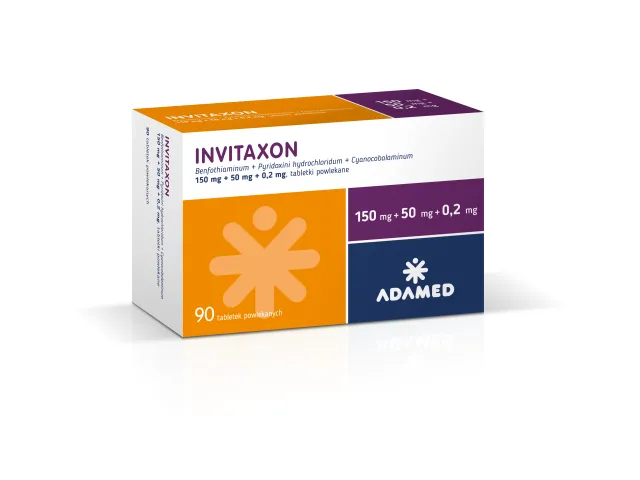
Table of Contents
Package leaflet: Information for the patient
Invitaxon, 150 mg + 50 mg + 0.20 mg, film-coated tablets
Benfothiamine + Pyridoxine hydrochloride + Cyanocobalamin
Please read all of this leaflet carefully before taking this medicine, because it contains
important information for the patient.
- Keep this leaflet, as you may need to read it again.
- If you have any further questions, please ask your doctor, pharmacist or nurse.
- This medicine has been prescribed for a specific individual. Do not pass it on to others. It may harm someone else, even if their symptoms are the same.
- If you experience any adverse reactions, including any not listed in this leaflet, please inform your doctor, pharmacist or nurse. See section 4.
Contents of the leaflet:
- What Invitaxon is and what it is used for
- What you need to know before taking Invitaxon
- How to take Invitaxon
- Possible side effects
- How to store Invitaxon
- Contents of the pack and other information
1. What Invitaxon is and what it is used for
Invitaxon contains vitamins B1, B6 and B12, which are particularly important for maintaining normal metabolism in nerve cells. Like other vitamins, they are essential nutrients that cannot be synthesized by the body.
In the treatment of nervous system disorders, B-complex vitamins act by correcting associated deficiencies of vitamin B1 and by stimulating natural regeneration processes in nerve tissue.
There is evidence indicating analgesic (pain-relieving) effects of vitamin B1.
Invitaxon is used as supportive treatment in peripheral nerve disorders of various origins, such as polyneuropathy, nerve pain (neuralgia) and peripheral neuritis.
2. Important information before using Invitaxon
When not to use Invitaxon
- if the patient is allergic to benfotiamine/thiamine (vitamin B\textsubscript{1}), pyridoxine hydrochloride (vitamin B\textsubscript{6}), cyanocobalamin (vitamin B\textsubscript{12}), or any of the other ingredients of this medicine (listed in section 6).
- in children and adolescents (under 18 years of age) due to the high dose of vitamins contained in the medicine.
Warnings and precautions
Before starting treatment with Invitaxon, discuss this with your doctor or pharmacist.
If the daily dose of vitamin B\textsubscript{6} taken over a prolonged period exceeds 50 mg, or if the daily dose of vitamin B\textsubscript{6} taken over a shorter period exceeds 1 g, a sensation of pricking and tingling in the hands or feet may occur (symptoms of peripheral sensory neuropathy or paraesthesiae). If the patient experiences pricking, tingling, or any other adverse reactions, contact the doctor, who will adjust the dosage or recommend discontinuation of the medicine.
Children and adolescents
Invitaxon should not be used in children and adolescents (under 18 years of age) due to the high doses of active substances contained in the medicine.
Invitaxon with other medicines
Inform your doctor or pharmacist about all medicines currently used or recently used, as well as any medicines the patient plans to use.
- Vitamin B\textsubscript{6} may become ineffective if taken simultaneously with the cytostatic drug 5-fluorouracil (a medicine used in cancer treatment).
- Antacids (used for gastric hyperacidity) reduce the absorption of vitamin B\textsubscript{1} by the body.
- Long-term use of certain diuretics (e.g., furosemide) may lead to vitamin B\textsubscript{1} deficiency due to increased excretion of vitamin B\textsubscript{1} in urine.
- Concurrent use of L-dopa (a medicine used in Parkinson's disease) with vitamin B\textsubscript{6} may reduce the effectiveness of L-dopa.
- If Invitaxon is used simultaneously with medicines that reduce vitamin B\textsubscript{6} levels in the body (so-called pyridoxine antagonists such as isoniazid, hydralazine, penicillamine, or cycloserine), the requirement for vitamin B\textsubscript{6} may increase.
- Vitamin B\textsubscript{6} may reduce the effectiveness of altretamine (an anticancer medicine).
- The absorption of vitamin B\textsubscript{12} may be impaired by proton pump inhibitors (e.g., omeprazole), histamine H\textsubscript{2} receptor antagonists (e.g., cimetidine - a medicine that inhibits gastric acid secretion), aminosalicylic acid (an anti-inflammatory medicine), colchicine (a medicine used in the treatment of gout), and neomycin (an antibiotic).
- Vitamin B\textsubscript{12} levels may be significantly reduced by metformin (an antidiabetic medicine).
Invitaxon with food and drink
Food increases the absorption of vitamin B\textsubscript{1} from the gastrointestinal tract; therefore, tablets should be taken after a meal, with a small amount of liquid.
The absorption of vitamin B\textsubscript{1} is reduced by alcohol and tea.
If vitamin B\textsubscript{1} is taken together with beverages containing sulfites (e.g., wine), it may degrade and thus lose its properties.
Pregnancy and breastfeeding
If the patient is pregnant or breastfeeding, suspects she may be pregnant, or is planning to become pregnant, she should consult her doctor or pharmacist before using this medicine.
Invitaxon should not be taken during pregnancy or breastfeeding.
During pregnancy and while breastfeeding, daily vitamin requirements should be met through a balanced diet. Due to the high dose of vitamins contained in the medicine, Invitaxon is intended for use only in cases of vitamin deficiency and should be used solely on a doctor's prescription, after careful consideration of potential benefits and risks.
Vitamins B\textsubscript{1}, B\textsubscript{6}, and B\textsubscript{12} pass into human milk. High doses of vitamin B\textsubscript{6} may reduce milk secretion.
The doctor will decide whether, in special cases, Invitaxon may be used during pregnancy or breastfeeding.
Driving and operating machinery
Invitaxon has no influence on the ability to drive vehicles or operate machinery.
This medicine contains:
- mannitol: the medicine may have a mild laxative effect,
- sorbitol: the medicine contains 15 mg of sorbitol in each tablet.
3. How to use Invitaxon
This medicine should always be used according to the doctor's instructions. If in doubt, consult your
doctor or pharmacist.
The recommended dose is 1 tablet once daily.
In individual cases, the dose may be increased to 1 tablet three times daily. Tablets should be swallowed
whole, taken after meals with a small amount of liquid.
Use in children and adolescents
Invitaxon should not be used in children and adolescents under 18 years of age.
Taking more Invitaxon than recommended
Vitamin B
Long-term intake of doses exceeding 50 mg of vitamin B per day (longer than 6–12 months) or doses
exceeding 1 g of vitamin B per day over a shorter period (more than 2 months) may lead to nerve damage
(neurotoxic effects). Intake of more than 2 g per day may cause nerve damage, which may be experienced
as motor disturbances, sensory disturbances (tingling, numbness), convulsions, and, very rarely, changes
in blood test results as well as inflammatory skin reactions.
Vitamin B
In very rare cases, following very high doses, allergic reactions, skin rash, and mild acne have been observed.
Missed dose of Invitaxon
Do not take a double dose to make up for a missed dose. Take the next dose at the correct time.
If in doubt about the use of this medicine, consult your doctor or pharmacist.
4. Possible adverse effects
Like all medicines, Invitaxon may cause adverse effects, although not everyone experiences them.
The following adverse effects have been reported with short-term or long-term use of Invitaxon:
Rare (may affect less than 1 in 1,000 patients):
- nausea,
- headache.
Very rare (may affect less than 1 in 10,000 people):
- hypersensitivity reactions such as sweating, rapid heartbeat, and skin reactions such as itching and urticaria.
Frequency not known (cannot be estimated from the available data):
- Taking doses greater than 50 mg of vitamin B per day for a prolonged period (longer than 6–12 months) may lead to the development of peripheral neuropathy (including sensory neuropathy) (nerve damage causing tingling or numbness).
Reporting of adverse effects
If any adverse effects occur, including any adverse effects not listed in this leaflet, inform your doctor or pharmacist. Adverse effects can be reported directly to the Department of Monitoring Adverse Drug Reactions, Office for Registration of Medicinal Products, Medical Devices and Biocidal Products,
Al. Jerozolimskie 181 C
02-222 Warsaw
Phone: +48 22 49 21 301
Fax: +48 22 49 21 309
Website: https://smz.ezdrowie.gov.pl
Adverse effects can also be reported to the marketing authorization holder.
Reporting adverse effects helps to provide more information on the safety of the medicine.
5. How to store Invitaxon
Do not store above 30ºC.
Keep the medicine in a place invisible and inaccessible to children.
Do not use this medicine after the expiry date stated on the blister or carton after EXP.
The expiry date refers to the last day of the specified month.
Medicines must not be disposed of via the sewage system or household waste. Ask your pharmacist
how to dispose of medicines no longer in use. This will help protect the environment.
6. Contents of the packaging and other information
What Invitaxon contains
- The active substances in the medicine are: benfotiamine (vitamin B1), pyridoxine hydrochloride (vitamin B6), and cyanocobalamin (vitamin B12).
Each film-coated tablet contains:
vitamin B1 150 mg
vitamin B6 50 mg
vitamin B12 0.20 mg
- Other ingredients are:
Tablet core: mannitol; microcrystalline cellulose type 101; sorbitol; povidone K-30; microcrystalline cellulose type 102; crospovidone type A; magnesium stearate; colloidal anhydrous silica.
Coating: partially hydrolyzed polyvinyl alcohol; calcium carbonate; macrogol 4000; talc; iron oxide red (E 172).
What Invitaxon looks like and contents of the pack
Red or reddish, round, biconvex film-coated tablet with a diameter of 12 mm.
Blister packs made of PVC/PE/PVDC/Aluminium in cardboard boxes.
Pack sizes: 30, 45, 60, 90, 100, 105 or 120 film-coated tablets.
Marketing Authorisation Holder and Manufacturer
Marketing Authorisation Holder
Adamed Pharma S.A.
Pieńków, ul. M. Adamkiewicza 6A
05-152 Czosnów
tel.: +48 22 732 77 00
Manufacturer
Adamed Pharma S.A.
ul. Marszałka Józefa Piłsudskiego 5
95-200 Pabianice