Hyzaar
Poland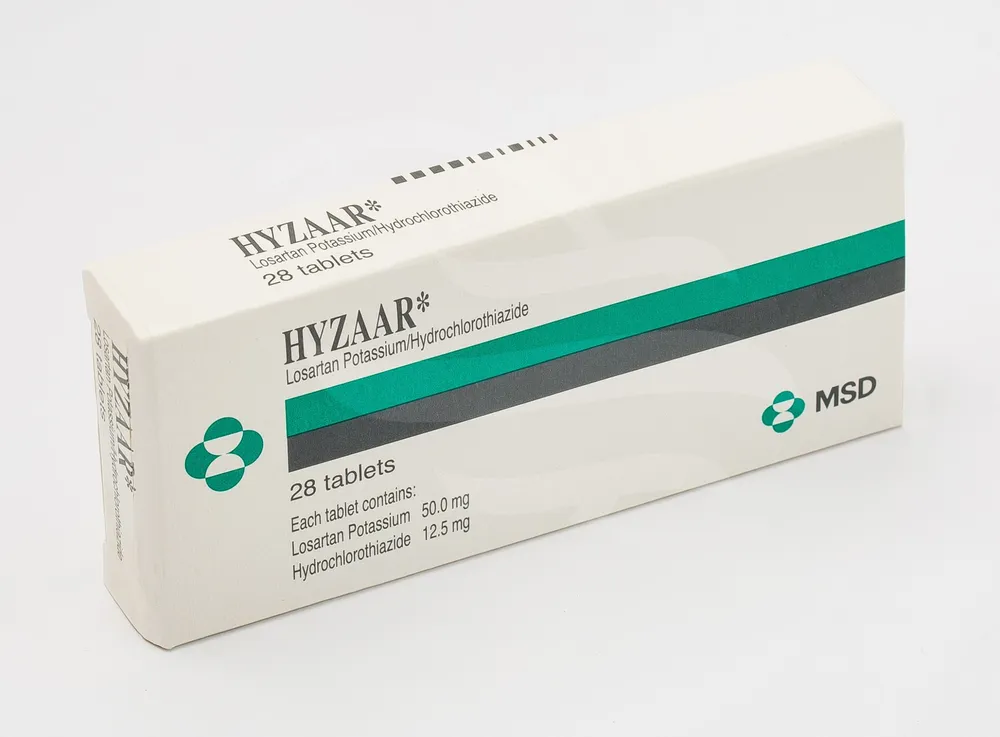
Table of Contents
- Package leaflet: Information for the patient
- 1. What Hyzaar and Hyzaar Forte are and what they are used for
- 2. Important information before using Hyzaar or Hyzaar Forte
- 3. How to use Hyzaar or Hyzaar Forte
- 4. Possible adverse effects
- 5. How to store Hyzaar and Hyzaar Forte
- 6. Contents of the pack and other information
Package leaflet: Information for the patient
HYZAAR, 50 mg + 12.5 mg, film-coated tablets
HYZAAR, 100 mg + 12.5 mg, film-coated tablets
HYZAAR Forte, 100 mg + 25 mg, film-coated tablets
losartan potassium + hydrochlorothiazide
Please read this leaflet carefully before taking this medicine, as it contains
important information for the patient.
- Keep this leaflet so that you can read it again if necessary.
- If you have any questions, please consult your doctor, pharmacist, or nurse.
- This medicine has been prescribed for a specific individual. Do not share it with others. This medicine may harm other people, even if their symptoms are the same.
- If you experience any adverse reactions, including any not listed in this leaflet, inform your doctor, pharmacist, or nurse. See section 4.
Table of contents of the leaflet
- What Hyzaar and Hyzaar Forte are and what they are used for
- Important information before taking Hyzaar or Hyzaar Forte
- How to take Hyzaar or Hyzaar Forte
- Possible side effects
- How to store Hyzaar and Hyzaar Forte
- Contents of the pack and other information
1. What Hyzaar and Hyzaar Forte are and what they are used for
Hyzaar and Hyzaar Forte are combination medicines containing an angiotensin II receptor antagonist (losartan) and a diuretic (hydrochlorothiazide). Angiotensin II is a substance produced in the body that binds to receptors in blood vessel walls, causing them to constrict. This leads to increased blood pressure. Losartan prevents angiotensin II from binding to these receptors, resulting in blood vessel dilation and consequently lowering blood pressure. Hydrochlorothiazide works by increasing the excretion of water and salts through the kidneys. This also helps reduce blood pressure.
Hyzaar and Hyzaar Forte are indicated for the treatment of essential hypertension (high blood pressure).
2. Important information before using Hyzaar or Hyzaar Forte
When not to use Hyzaar or Hyzaar Forte
- if the patient is allergic to losartan, hydrochlorothiazide, or any of the other ingredients of this medicine (listed in section 6),
- if the patient is allergic to sulfonamide-derived substances (e.g. other thiazide diuretics, certain antibacterial medicines such as co-trimoxazole; consult your doctor if in doubt),
- if the patient has severe liver dysfunction,
- if the patient has low blood potassium, low blood sodium, or high blood calcium levels that cannot be corrected by treatment,
- if the patient has gout,
- after the third month of pregnancy (It is also advisable to avoid using Hyzaar and Hyzaar Forte during early pregnancy – see section “Pregnancy”),
- if the patient has severe kidney dysfunction or if the kidneys are not producing urine,
- if the patient has diabetes or kidney dysfunction and is being treated with a blood pressure-lowering medicine containing aliskiren.
Warnings and precautions
Before starting treatment with Hyzaar or Hyzaar Forte, consult your doctor,
pharmacist, or nurse.
If the patient experiences worsening of vision or eye pain, these may be symptoms of fluid accumulation
in the vascular layer surrounding the eye (excessive fluid accumulation between the choroid and sclera)
or increased intraocular pressure — these may occur within hours to weeks after taking Hyzaar or Hyzaar Forte.
Untreated symptoms may lead to permanent vision loss. Patients who previously experienced allergy to penicillin
or sulfonamides may be at higher risk of developing these symptoms.
Inform your doctor if you suspect (or are planning) pregnancy. Use of Hyzaar and Hyzaar Forte is not recommended
during early pregnancy and must not be used after the third month of pregnancy, as it may seriously harm the unborn child
(see section “Pregnancy”).
Before starting treatment with Hyzaar or Hyzaar Forte, inform your doctor:
- If in the past, after taking hydrochlorothiazide, the patient experienced breathing or lung problems (including pneumonia or fluid accumulation in the lungs). If the patient develops severe shortness of breath or difficulty breathing after taking Hyzaar or Hyzaar Forte, seek immediate medical help.
- if the patient has previously experienced angioedema (swelling of the face, lips, throat, and/or tongue) (see also section 4 “Possible side effects”);
- if the patient is taking diuretic medicines;
- if the patient is on a low-salt diet;
- if the patient has had or currently has severe vomiting and/or diarrhoea;
- if the patient has heart failure;
- if the patient has liver dysfunction (see section 2 “When not to use Hyzaar or Hyzaar Forte”);
- if the patient has narrowing or blockage of the blood vessels leading to the kidneys (renal artery stenosis), or if the patient has only one functioning kidney, or if the patient has recently undergone kidney transplantation;
- if the patient has arterial narrowing (arteriosclerosis), angina pectoris (chest pain due to impaired heart function);
- if the patient has “aortic or mitral valve stenosis” (narrowing of heart valves) or “hypertrophic cardiomyopathy” (a disease causing weakening of the heart muscle);
- if the patient has diabetes;
- if the patient has had gout;
- if the patient has had or currently has allergies, asthma, or symptoms causing joint pain, skin rash, and fever (systemic lupus erythematosus);
- if the patient has high blood calcium or low blood potassium levels, or if the patient is on a low-potassium diet;
- if the patient requires anaesthesia (even at the dentist) or is undergoing surgery, or if the patient is scheduled for parathyroid function testing, the patient must inform the doctor or medical staff about taking tablets containing potassium losartan and hydrochlorothiazide;
- if the patient has primary hyperaldosteronism (a condition associated with increased aldosterone hormone excretion by the adrenal glands due to adrenal abnormalities);
- if the patient is taking any of the following medicines used to treat high blood pressure: an angiotensin-converting enzyme (ACE) inhibitor (e.g. enalapril, lisinopril, ramipril), particularly if the patient has kidney dysfunction related to diabetes, or aliskiren.
Your doctor may recommend regular monitoring of kidney function, blood pressure, and blood electrolyte levels
(e.g. potassium).
See also the section “When not to use Hyzaar or Hyzaar Forte”.
- if the patient is taking other medicines that may increase serum potassium levels (see section 2 “Hyzaar or Hyzaar Forte with other medicines”).
- if the patient has previously had skin cancer or if unexpected skin changes occur during treatment. Treatment with hydrochlorothiazide, especially at high doses over a long period, may increase the risk of certain types of skin and lip cancers (non-melanoma skin cancer). While taking Hyzaar or Hyzaar Forte, protect the skin from sunlight and UV radiation.
Children and adolescents
There is no experience with the use of Hyzaar or Hyzaar Forte in children. Therefore, Hyzaar or Hyzaar Forte should not be used in children.
Hyzaar or Hyzaar Forte with other medicines
Inform your doctor or pharmacist about all medicines currently taken or recently taken, as well as any medicines the patient plans to take.
Inform your doctor about potassium supplements, potassium-containing salt substitutes, potassium-sparing medicines, or other medicines that may increase serum potassium levels (e.g. medicines containing trimethoprim), as concomitant use with Hyzaar or Hyzaar Forte is not recommended.
Diuretics such as hydrochlorothiazide contained in Hyzaar and Hyzaar Forte may interact with other medicines.
Do not take lithium-containing preparations without close medical supervision.
Special precautions (e.g. blood tests) may be appropriate if the patient is taking other diuretics, certain laxatives, medicines used to treat gout, medicines used to control heart rhythm, or diabetes medicines (oral medicines or insulin).
It is also important for your doctor to know if the patient is taking:
- other blood pressure-lowering medicines;
- steroids;
- anticancer medicines;
- painkillers;
- medicines used to treat fungal infections;
- medicines used to treat arthritis;
- cholesterol-lowering resins such as cholestyramine;
- muscle relaxants;
- sleeping tablets;
- opioid medicines such as morphine;
- vasoactive amines that increase blood pressure, such as adrenaline or other medicines from the same group;
- oral antidiabetic medicines or insulin.
Your doctor may recommend dose adjustment and/or additional precautions:
- if the patient is taking an ACE inhibitor or aliskiren (see also sections “When not to use Hyzaar or Hyzaar Forte” and “Warnings and precautions”).
Also inform your doctor about using Hyzaar or Hyzaar Forte before planned administration of iodinated contrast agents.
Hyzaar or Hyzaar Forte with food, drink, and alcohol
It is recommended that the patient does not drink alcohol while taking these tablets: alcohol and Hyzaar or Hyzaar Forte tablets may enhance each other's effects.
Excessive dietary salt intake may counteract the effect of Hyzaar and Hyzaar Forte tablets.
Hyzaar or Hyzaar Forte may be taken regardless of meals.
Avoid drinking grapefruit juice while taking Hyzaar and Hyzaar Forte tablets.
Pregnancy and breastfeeding
Pregnancy
Inform your doctor if you suspect (or are planning) pregnancy. Your doctor will usually recommend discontinuing Hyzaar or Hyzaar Forte before planned pregnancy or as soon as pregnancy is confirmed, and will recommend an alternative medicine instead of Hyzaar or Hyzaar Forte.
Use of Hyzaar or Hyzaar Forte is not recommended during pregnancy and must not be used after the third month of pregnancy, as it may seriously harm the unborn child.
Breastfeeding
Inform your doctor if you are breastfeeding or intend to breastfeed. Use of Hyzaar or Hyzaar Forte is not recommended during breastfeeding. If the patient wishes to breastfeed, the doctor may recommend alternative treatment.
Elderly patients
Hyzaar and Hyzaar Forte work equally well and are similarly well tolerated in most elderly and younger adult patients. Most elderly patients require the same dosage as younger patients.
Driving and operating machinery
When starting treatment with this medicine, the patient should not perform tasks requiring special attention (e.g. driving a car or operating dangerous machinery) until it is known how the patient tolerates this medicine.
Hyzaar and Hyzaar Forte contain lactose monohydrate
Hyzaar and Hyzaar Forte contain lactose monohydrate. If you have intolerance to certain sugars, consult your doctor before taking this medicine.
3. How to use Hyzaar or Hyzaar Forte
This medicine should always be taken exactly as instructed by your doctor or pharmacist. If in
doubt, consult your doctor or pharmacist. Your doctor will decide the appropriate dose of
Hyzaar or Hyzaar Forte, depending on your condition and other medicines you are taking.
It is important to continue taking Hyzaar or Hyzaar Forte for as long as your doctor recommends
in order to maintain consistent blood pressure control.
High blood pressure
The usual dose for most patients with high blood pressure is 1 tablet of Hyzaar 50 mg + 12.5 mg
once daily to control blood pressure for up to 24 hours. Your doctor may increase the dose to
2 tablets of Hyzaar 50 mg + 12.5 mg once daily or switch you to 1 tablet of Hyzaar Forte 100 mg + 25 mg
once daily (higher dose). The maximum daily dose is 2 tablets of Hyzaar 50 mg + 12.5 mg once daily
or 1 tablet of Hyzaar Forte 100 mg + 25 mg once daily.
Administration
The tablets should be swallowed whole with a glass of water.
Taking more Hyzaar or Hyzaar Forte than prescribed
In case of overdose, contact your doctor immediately so that appropriate measures can be taken
without delay. Overdose may cause low blood pressure, palpitations, slow pulse, changes in blood
composition, and dehydration.
If you miss a dose of Hyzaar or Hyzaar Forte
Try to take Hyzaar or Hyzaar Forte every day as directed by your doctor. However, if you miss a dose,
do not take a double dose. Return to your regular dosing schedule.
4. Possible adverse effects
Like all medicines, this medicine can cause adverse effects, although not everyone will experience them.
If any of the adverse effects listed below occur, stop taking
the medicine Hyzaar or Hyzaar Forte and immediately consult a doctor or go to the emergency department of the nearest hospital:
Severe allergic reactions (rash, itching, swelling of the face, lips, mouth or throat, which may
cause difficulty in swallowing or breathing).
This is a serious, but rare adverse effect occurring in more than 1 in 10,000
patients, but in less than 1 in 1,000 patients. Urgent medical intervention or hospitalization may be required.
Very rare (may affect up to 1 in 10,000 people):
- acute respiratory failure (symptoms include severe shortness of breath, fever, muscle weakness and confusion).
Other possible adverse effects:
Common (may affect up to 1 in 10 people taking the medicine):
- cough, upper respiratory tract infection, nasal congestion, sinusitis, sinus disorders;
- diarrhoea, abdominal pain, nausea, indigestion;
- muscle pain or cramps, leg pain, back pain;
- insomnia, headache, dizziness;
- weakness, fatigue, chest pain;
- increased potassium levels in the blood (which may cause heart rhythm disturbances), decreased haemoglobin levels in the blood;
- kidney function disorders, including kidney failure;
- low blood sugar (hypoglycaemia).
Uncommon (may affect up to 1 in 100 people taking the medicine):
- anaemia, red or brown spots on the skin (sometimes mainly on feet, legs, arms and buttocks with joint pain, swelling of hands and feet, and stomach pain), bruising, decreased number of white blood cells in the blood, coagulation disorders, decreased number of platelets;
- loss of appetite, increased uric acid levels or gout flare-up, increased blood sugar levels, disturbed electrolyte levels in the blood;
- anxiety, nervousness, panic disorders (recurrent panic attacks), disorientation, depression, unusual dreams, sleep disturbances, drowsiness, memory disturbances;
- tingling and numbness, limb pain, tremors, migraine, fainting;
- blurred vision, burning or stinging sensation in the eye, conjunctivitis, decreased visual acuity, yellow vision;
- sensation of ringing, buzzing, noise or crackling in the ears, vertigo;
- low blood pressure, which may be related to postural changes (feeling of emptiness in the head or weakness upon standing), angina (chest pain), irregular heartbeat, stroke (‘mini-stroke’), heart attack, palpitations;
- inflammation of blood vessels, often associated with skin rash or purpura;
- sore throat, shortness of breath, bronchitis, pneumonia, presence of fluid in the lungs (causing breathing difficulties), nosebleeds, runny nose, congestion;
- constipation, inability to pass stools, flatulence, upset stomach, stomach cramps, vomiting, dry mouth, sialadenitis, toothache;
- jaundice (yellowing of eyes and skin), pancreatitis;
- urticaria, itching, skin inflammation, rash, skin redness, photosensitivity, dry skin, hot flushes with redness, sweating, hair loss;
- pain in arms, shoulders, hips, knees or other joints, joint inflammation, swelling, stiffness, muscle weakness;
- frequent urination, including at night, kidney function disorders, including nephritis, urinary tract infection, presence of sugar in urine;
- decreased libido, impotence;
- facial swelling, localized swelling, fever.
Rare (may affect up to 1 in 1,000 people):
- hepatitis, altered liver function test results.
Unknown (frequency cannot be estimated from available data):
- influenza-like symptoms;
- unexplained muscle pain with accompanying dark (tea-coloured) urine (rhabdomyolysis);
- low sodium levels in the blood (hyponatraemia);
- general malaise;
- taste disturbances;
- skin and lip malignancies (non-melanoma skin cancers);
- worsening of vision or eye pain due to increased pressure (possible symptoms of fluid accumulation in the vascular layer surrounding the eye (excessive accumulation of fluid between choroid and sclera) or acute angle-closure glaucoma).
Reporting of adverse effects
If any adverse effects occur, including any adverse effects not listed
in this leaflet, inform your doctor, pharmacist or nurse. Adverse effects
can be reported directly to the Department of Monitoring Adverse Drug Reactions of the Office for Registration of Medicinal Products, Medical Devices and Biocidal Products:
Al. Jerozolimskie 181C, 02-222 Warsaw, Tel.: + 48 22 49 21 301, Fax: + 48 22 49 21 309, Website: https://smz.ezdrowie.gov.pl .
Adverse effects can also be reported to the marketing authorization holder.
Reporting adverse effects helps to provide more information on the safety of the medicine.
5. How to store Hyzaar and Hyzaar Forte
Keep this medicine out of sight and reach of children.
Do not use this medicine after the expiry date stated on the carton. The expiry date refers to the last day of the specified month.
Blister packs
Store Hyzaar and Hyzaar Forte in the original packaging to protect from light and moisture. Do not store blister packs at temperatures above 30°C.
Bottle
Store in the original packaging to protect from light. Keep the bottle tightly closed to protect from moisture. Do not store the bottle at temperatures above 25°C.
Medicines must not be disposed of via the sewage system or household waste. Ask your pharmacist how to dispose of medicines no longer required. Such measures help protect the environment.
6. Contents of the pack and other information
What Hyzaar or Hyzaar Forte contains
- The active substances are losartan potassium and hydrochlorothiazide.
Hyzaar 50 mg + 12.5 mg contains 50 mg of losartan potassium and 12.5 mg of hydrochlorothiazide as
active substances.
Hyzaar 100 mg + 12.5 mg contains 100 mg of losartan potassium and 12.5 mg of hydrochlorothiazide as
active substances.
Hyzaar Forte 100 mg + 25 mg contains 100 mg of losartan potassium and 25 mg of hydrochlorothiazide as
active substances.
- The other components are: microcrystalline cellulose (E460), lactose monohydrate, maize starch, magnesium stearate (E572), hydroxypropylcellulose (E463), hypromellose (E464).
Hyzaar 50 mg + 12.5 mg contains 4.24 mg (0.108 mEq) of potassium. Hyzaar 100 mg + 12.5 mg and
Hyzaar Forte 100 mg + 25 mg contain 8.48 mg (0.216 mEq) of potassium.
Hyzaar 50 mg + 12.5 mg and Hyzaar Forte 100 mg + 25 mg also contain titanium dioxide (E171),
quinoline yellow aluminium lake (E104), and carnauba wax (E903).
Hyzaar 100 mg + 12.5 mg also contains titanium dioxide (E171) and carnauba wax (E903).
What Hyzaar and Hyzaar Forte look like and contents of the pack
Hyzaar 50 mg + 12.5 mg is available as yellow, oval, film-coated tablets marked "717" on one side and smooth or with a dividing line on the other side.
The break line on the tablet is not intended for splitting the tablet.
Hyzaar 100 mg + 12.5 mg is available as white, oval, film-coated tablets marked "745" on one side and smooth on the other side.
Hyzaar Forte 100 mg + 25 mg is available as light yellow, oval, film-coated tablets marked "747" on one side and smooth on the other side.
The following pack sizes of Hyzaar and Hyzaar Forte are available:
Hyzaar 50 mg + 12.5 mg – PVC/PE/PVDC blisters with aluminium foil backing in cartons containing 4, 7, 10, 14, 20, 28, 30, 50, 56, 84, 98, or 280 tablets, and unit packs of 28, 56 and 98 tablets for hospital use. HDPE bottles of 100 tablets.
Hyzaar 100 mg + 12.5 mg – PVC/PE/PVDC blisters with aluminium foil backing in cartons containing 14, 15, 28, 30, 50, 56, 84, 90, 98 or 280 tablets. HDPE bottles of 100 tablets.
Hyzaar Forte 100 mg + 25 mg – PVC/PE/PVDC blisters with aluminium foil backing in cartons containing 7, 14, 28, 30, 50, 56, 84, 90, 98 or 280 tablets, and unit packs of 28, 56 and 98 tablets for hospital use. HDPE bottles of 100 tablets.
Not all pack sizes may be marketed.
Marketing Authorisation Holder and Manufacturer
Marketing Authorisation Holder
Organon Polska Sp. z o.o.
ul. Marszałkowska 126/134
00-008 Warszawa
Tel.: +48 22 105 50 01
[email protected]
Manufacturer
Merck Sharp & Dohme B.V.
PO Box 581, Waarderweg 39
2031 BN Haarlem, The Netherlands
Organon Heist bv
Industriepark 30
2220 Heist-op-den-Berg
Belgium
This medicinal product is authorised in the European Economic Area countries and in the United Kingdom (Northern Ireland) under the following names:
| Country | Product Name | |--------|--------------| | Belgium | COZAAR PLUS 50 mg/12.50 mg comprimés pelliculés | | Belgium | COZAAR PLUS 100 mg/12.50 mg comprimés pelliculés | | Belgium | COZAAR PLUS FORTE 100 mg/25 mg comprimés pelliculés | | Denmark | Cozaar Comp. | | Denmark | Cozaar Comp 100 mg / 12.5 mg | | Denmark | Cozaar Comp Forte | | Finland | COZAAR Comp | | Finland | COZAAR Comp Forte | | France | FORTZAAR 100 mg/25 mg, comprimé pelliculé | | France | HYZAAR 50 mg/12.5 mg, comprimé pelliculé | | France | FORTZAAR 100 mg/12.5 mg, comprimé pelliculé | | Germany | LORZAAR PLUS 50/12.5 mg Filmtabletten | | Germany | LORZAAR PLUS forte 100/12.5 mg Filmtabletten | | Germany | FORTZAAR 100/25 mg Filmtabletten | | Greece | HYZAAR | | Greece | HYZAAR Forte | | Greece | HYZAAR Extra Forte | | Hungary | HYZAAR | | Iceland | Cozaar Comp | | Iceland | Cozaar Comp 100 mg/12.5 mg | | Iceland | Cozaar Comp Forte | | Ireland | COZAAR Comp 50mg/12.5mg film-coated tablets | | Ireland | COZAAR Comp 100mg/12.5mg film-coated tablets | | Ireland | COZAAR Comp 100mg/25mg film-coated tablets | | Italy | HIZAAR 50 mg + 12.5 mg compresse rivestite con film | | Italy | HIZAAR 100 mg + 25 mg compresse rivestite con film | | Italy | FORZAAR 100 mg + 25 mg compresse rivestite con film | | Luxembourg | COZAAR PLUS 50 mg/12.50 mg comprimés pelliculés | | Luxembourg | COZAAR PLUS 100 mg/12.50 mg comprimés pelliculés | | Luxembourg | COZAAR PLUS FORTE 100 mg/25 mg comprimés pelliculés | | The Netherlands | HYZAAR 50/12.5 | | The Netherlands | COZAAR Plus 100/12.5 | | The Netherlands | FORTZAAR 100/25 | | Norway | Cozaar Comp | | Norway | Cozaar Comp Forte | | Poland | HYZAAR | | Poland | HYZAAR FORTE | | Portugal | Cozaar Plus | | Portugal | Fortzaar | | Spain | COZAAR Plus 50 mg/12.5 mg comprimidos recubiertos con película | | Spain | FORTZAAR 100 mg/25 mg comprimidos recubiertos con película | | Sweden | COZAAR Comp 50 mg/12.5 mg filmdragerade tabletter | | Sweden | COZAAR Comp 100 mg/12.5 mg filmdragerade tabletter | | Sweden | COZAAR Comp Forte 100 mg/25 mg filmdragerade tabletter | | United Kingdom (Northern Ireland) | COZAAR COMP 50mg/12.5mg film-coated tablets | | United Kingdom (Northern Ireland) | COZAAR Comp 100mg/12.5mg film-coated tablets | | United Kingdom (Northern Ireland) | COZAAR Comp 100mg/25mg film-coated tablets |