Human albumin 200 g/l takeda
Poland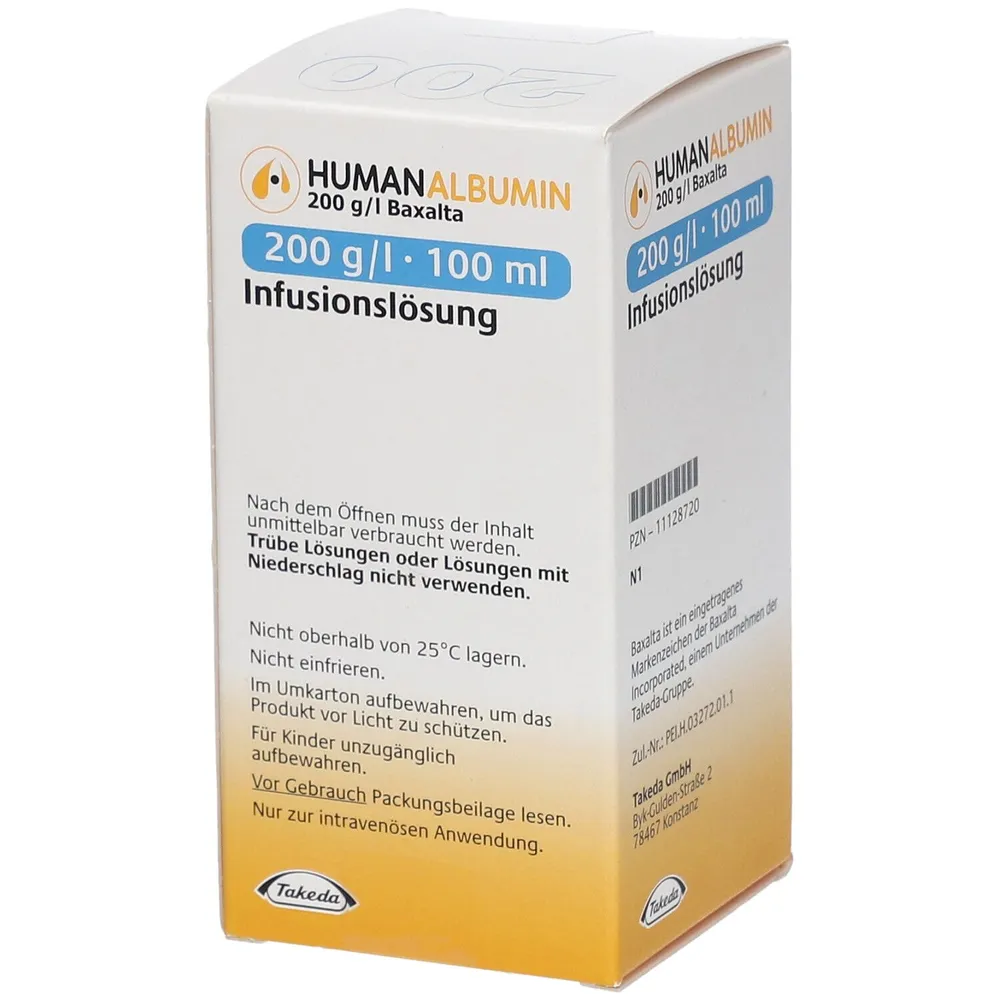
Table of Contents
- Package leaflet: Information for the user
- 1. What Human Albumin 200 g/l Takeda is and what it is used for
- 2. Important information before using Human Albumin 200 g/l Takeda
- 3. How to use Human Albumin 200 g/l Takeda
- 4. Possible adverse reactions
- 5. How to store Human Albumin 200 g/l Takeda
- 6. Contents of the package and other information
- Information intended exclusively for healthcare professionals:
Package leaflet: Information for the user
Human Albumin 200 g/l Takeda
concentrate for solution for infusion
human albumin
Please read all of this leaflet carefully before this medicine is administered, because it contains
important information for the patient.
- Keep this leaflet, as you may need to read it again.
- If you have any further questions, ask your doctor, pharmacist, or nurse. This medicine has been prescribed for a specific patient. Do not pass it on to others. It may harm other people, even if their symptoms are the same.
- If you experience any side effects, including any not listed in this leaflet, tell your doctor, pharmacist, or nurse. See section 4.
Contents of the leaflet
- What Human Albumin 200 g/l Takeda is and what it is used for
- What you need to know before receiving Human Albumin 200 g/l Takeda
- How Human Albumin 200 g/l Takeda is given
- Possible side effects
- How to store Human Albumin 200 g/l Takeda
- Contents of the pack and other information
1. What Human Albumin 200 g/l Takeda is and what it is used for
Human Albumin 200 g/l Takeda contains a protein called albumin, which is naturally present in the liquid part of blood (plasma), and belongs to a group of medicines known as "plasma substitutes and plasma protein fractions". It is manufactured from human blood collected from blood donors.
The 50 ml vial contains 10 g of human albumin.
The 100 ml vial contains 20 g of human albumin.
Human albumin is used to restore and maintain circulating blood volume in patients who have lost blood or fluid due to certain medical conditions.
The decision to use albumin instead of an artificial colloidal fluid and the required dose will depend on the individual patient's clinical condition.
2. Important information before using Human Albumin 200 g/l Takeda
When not to use Human Albumin 200 g/l Takeda
- if the patient is allergic to human albumin or any of the other ingredients of this medicine (listed in section 6).
Warnings and precautions
Before starting treatment with Human Albumin 200 g/l Takeda, discuss it with your doctor,
pharmacist or nurse.
- if an allergic reaction is suspected during treatment, with symptoms such as difficulty breathing, feeling faint or other symptoms. In such a case, contact your doctor or nurse immediately, as the infusion must be stopped without delay and standard treatment for shock may be required.
- if the patient has any of the following conditions:
- uncompensated heart failure;
- hypertension;
- esophageal varices (dilated veins in the esophagus);
- pulmonary edema (fluid in the lungs);
- tendency to spontaneous bleeding;
- severe anemia (lack of red blood cells);
- absence of urine production. If any of these conditions apply to the patient, inform the doctor so that appropriate precautions can be taken.
When medicinal products derived from human blood or plasma are used, specific measures are applied to prevent transmission of infections. These include careful selection of blood and plasma donors to exclude individuals who may transmit infection, as well as testing of individual donations and pooled plasma to detect viruses (infections). Manufacturers of such products also include steps in the manufacturing process to inactivate or remove viruses. Nevertheless, the possibility of transmitting infectious agents cannot be completely excluded. This includes unknown or newly emerging viruses and other types of infections.
There have been no reports of transmission of viral infections through albumins produced by manufacturing processes compliant with the specifications of the European Pharmacopoeia.
It is strongly recommended that each time Human Albumin 200 g/l Takeda is administered to a patient, the name and batch number of the product should be recorded to maintain traceability of the batches used.
Human Albumin 200 g/l Takeda and other medicines
- Inform your doctor or pharmacist about all medicines the patient is currently taking or has recently taken, as well as any medicines the patient plans to take.
- There are currently no known complications associated with the concomitant use of human albumin with other medicines.
Pregnancy, breastfeeding and fertility
If the patient is pregnant or breastfeeding, suspects she may be pregnant, or is planning to have a child, she should consult her doctor. The doctor will decide whether Human Albumin 200 g/l Takeda can be used during pregnancy or breastfeeding.
Driving and operating machinery
No effects on the ability to drive or operate machinery have been observed.
Human Albumin 200 g/l Takeda contains sodium
Vial 50 ml:
This medicine contains 115 – 149.5 mg of sodium (main component of table salt) per vial. This corresponds to 5.8 – 7.5% of the maximum daily dietary sodium intake of 2 g recommended by WHO for adults.
Vial 100 ml:
This medicine contains 230 – 299 mg of sodium (main component of table salt) per vial. This corresponds to 11.5 – 15% of the maximum daily dietary sodium intake of 2 g recommended by WHO for adults.
3. How to use Human Albumin 200 g/l Takeda
Human Albumin 200 g/l Takeda is a medicinal product intended for use in a hospital setting.
Therefore, it will be administered in a hospital by qualified medical personnel. The treating physician
will determine the dose to be administered, the frequency of administration, and the duration of
treatment, depending on the individual patient's condition. During administration of Human Albumin,
the physician will continuously monitor the patient's condition by measuring blood pressure and
pulse, as well as performing blood tests, to ensure that the patient does not receive an excessive dose.
If headache, difficulty breathing, or increased blood pressure occurs, the physician should be notified.
Administration of a higher than recommended dose of Human Albumin 200 g/l Takeda
In case of suspected administration of an excessive dose of Human Albumin 200 g/l Takeda, the
physician or pharmacist should be informed immediately.
4. Possible adverse reactions
Like all medicines, this medicine can cause adverse reactions, although not everyone experiences them.
If any of the adverse reactions listed below occur, the infusion must be stopped immediately and appropriate treatment initiated:
- Anaphylactic shock (very rare: may affect less than 1 in 10,000 patients)
- Hypersensitivity/allergic reactions (unknown frequency: based on available data, frequency cannot be estimated)
The following adverse reactions have also been reported:
Rare: may affect less than 1 in 1,000 patients
- Nausea (feeling of sickness)
- Sudden flushing
- Skin rash
- Fever
Unknown frequency: frequency cannot be determined from available data
- Headache
- Altered taste sensation
- Myocardial infarction
- Irregular heartbeat
- Rapid heartbeat
- Abnormal low blood pressure
- Fluid accumulation in the lungs
- Breathlessness or breathing discomfort
- Vomiting
- Urticaria
- Itching
- Chills
If any adverse reactions occur, including any possible adverse reactions not listed in this leaflet, consult a doctor or pharmacist.
Reporting of adverse reactions
If any adverse reactions occur, including adverse reactions not listed in this leaflet, inform a doctor, pharmacist, or nurse. Adverse reactions can be reported directly to the Department of Monitoring Adverse Drug Reactions, Office for Registration of Medicinal Products, Medical Devices and Biocidal Products
Al. Jerozolimskie 181 C
02-222 Warsaw
Tel.: +48 22 49 21 301
Fax: +48 22 49 21 309
Website: https://smz.ezdrowie.gov.pl
Adverse reactions can also be reported to the Marketing Authorisation Holder.
Reporting adverse reactions helps provide more information on the safety of the medicine.
5. How to store Human Albumin 200 g/l Takeda
Keep this medicine out of the sight and reach of children.
Do not use this medicine after the expiry date stated on the label after: EXP. The expiry date refers to the last day of the stated month.
Do not store above 25°C.
Do not freeze.
Store glass vials in their cardboard packaging to protect from light.
The contents must be used immediately after opening the packaging.
Do not use this medicine if the solution appears cloudy or contains insoluble particles.
6. Contents of the package and other information
What Human Albumin 200 g/l Takeda contains
- The active substance is: human albumin. Each 100 ml contains 20 g of total protein, of which at least 95% is human albumin.
- Other components are: sodium chloride, sodium caprylate, sodium N-acetyltryptophanate, water for injections.
Total sodium ion content: 100–130 mmol/l
What Human Albumin 200 g/l Takeda looks like and contents of the pack
Human Albumin 200 g/l Takeda is a clear, slightly viscous liquid; it is almost colourless, yellow, amber, or green. It is a sterile solution for intravenous infusion supplied in 50 ml or 100 ml glass vials.
Marketing Authorisation Holder and Manufacturer
Marketing Authorisation Holder
Takeda Pharma Sp. z o.o.
ul. Prosta 68
00-838 Warsaw
Manufacturer
Takeda Manufacturing Austria AG
Industriestrasse 67
1221 Vienna
Austria
This medicinal product is authorised in the Member States of the European Economic Area and in Great Britain (Northern Ireland) under the following names:
| Country | Brand Name |
| Austria | Human Albumin Takeda 200 g/l |
| Bulgaria, Cyprus, Germany, Greece, Slovakia | Human Albumin 200 g/l Baxalta |
| Czech Republic | Human Albumin Baxalta |
| Denmark, Estonia, Finland, Iceland, Latvia, Lithuania, Norway, Sweden | Albumin Baxalta 200 g/l |
| Ireland, Malta, United Kingdom (Northern Ireland) | Human Albumin Baxalta 200 g/l |
| Italy | Albumina Baxalta 200 g/l |
| Netherlands | Humaan Albumine 200 g/l Baxalta |
| Poland | Human Albumin 200 g/l Takeda |
| Romania | Albumină Umană Baxalta 200 g/l solution for infusion |
| Slovenia | HUMANI ALBUMIN 200 g/l BAXALTA |
Information intended exclusively for healthcare professionals:
- Human Albumin 200 g/l Takeda solution must be administered intravenously by direct infusion of the contents of the container.
- Do not dilute albumin solutions with water for injections, as this may cause hemolysis in patients receiving the medicinal product.
- Do not use if the closure is damaged. If leakage is observed, the preparation should be discarded.
- The solution should be clear, slightly viscous, almost colorless, yellow, amber, or green. Do not use turbid solutions or those containing precipitate, as this may indicate protein instability or contamination of the solution. The contents should be used immediately after opening the container.
- Infusion should be administered intravenously using a single-use, sterile, and pyrogen-free infusion set. Before connecting the infusion set to the vial stopper, disinfect the stopper using an appropriate antiseptic agent. After connecting the infusion set to the vial, begin infusion immediately. Any unused product residue should be disposed of in accordance with local regulations.
- The infusion rate should be adjusted according to the individual patient's condition and indication.
- During plasma exchange, the infusion rate should be adjusted to match the removal rate.
- When administering large volumes, the product should be warmed to room temperature or body temperature prior to use.
- When administering albumin concentrates, ensure adequate hydration of the patient. The patient's condition should be appropriately monitored to prevent circulatory overload and overhydration.
- During albumin administration, monitor the patient's electrolyte levels and take appropriate measures to restore or maintain electrolyte balance.
- Ensure adequate replacement of other blood components (clotting factors, electrolytes, platelets, and erythrocytes).
- For safety reasons, record the batch number of the administered Human Albumin 200 g/l Takeda.
- Human albumin must not be mixed with other medicinal products, whole blood, or red blood cell concentrates. Human albumin should also not be mixed with protein hydrolysates (e.g. parenteral nutrition) or solutions containing alcohol, as such combinations may cause protein precipitation.
- If the dose or infusion rate is too high, overhydration may occur. In the event of early clinical signs of circulatory overload (headache, dyspnea, jugular vein distension) or increased blood pressure, elevated central venous pressure, or pulmonary edema, the infusion must be stopped immediately and the patient's hemodynamic parameters closely monitored.