Hascovir control max
Poland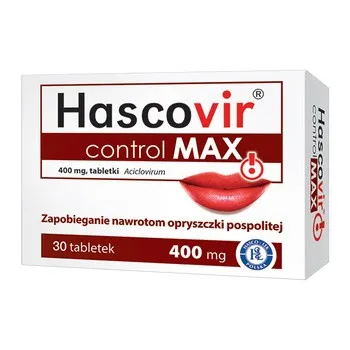
Table of Contents
Package leaflet: Information for the user
Hascovir control MAX
400 mg, tablets
Aciclovirum
Please read all of this leaflet carefully before taking this medicine, because it contains
important information for you.
This medicine should always be taken exactly as described in this patient leaflet or as directed by
your doctor or pharmacist.
- Keep this leaflet so that you can read it again if necessary.
- If you need advice or further information, please contact your pharmacist.
- If you experience any adverse reactions, including any not listed in this leaflet, inform your doctor or pharmacist. See section 4.
- If your condition does not improve or worsens, consult your doctor.
Table of contents
- What Hascovir control is and what it is used for
- Important information before taking Hascovir control
- How to take Hascovir control
- Possible side effects
- How to store Hascovir control
- Contents of the pack and other information
1. What Hascovir control is and what it is used for
The active substance in Hascovir control is aciclovir, which inhibits the replication of human pathogenic viruses from the Herpes group.
Hascovir control is used for:
- Prevention of recurrent herpes simplex in immunocompetent adults. If there is no improvement after 1 month, or if symptoms worsen, consult your doctor.
- Treatment of recurrent herpes labialis and facial or external genital herpes caused by herpes simplex virus (Herpes simplex) in adults. If there is no improvement after 5 days, or if symptoms worsen, consult your doctor. In cases of recurrent infections, it is particularly important to start treatment during the prodromal phase, when early symptoms such as itching, burning, or tingling occur.
Hascovir control may only be used in patients who have previously been diagnosed with herpes simplex virus infection.
2. Important information before using Hascovir control
When not to use Hascovir control
- If the patient is allergic to aciclovir, valaciclovir, or any of the other ingredients of this medicine (listed in section 6).
Warnings and precautions
Before starting treatment with Hascovir control, discuss this with your doctor or pharmacist.
Do not use Hascovir control without prior consultation with a doctor:
- in patients with impaired kidney function;
- in patients taking other medicines that may damage the kidneys;
- in elderly patients (aged 65 years or older);
- in pregnant or breastfeeding women;
- in patients who have experienced particularly severe recurrent herpes labialis or particularly severe recurrent genital herpes;
- if frequent recurrences of herpes (more than 6 per year) occur, lasting longer than before (no positive treatment effect after 5 days of therapy), with more severe clinical symptoms (e.g. when new lesions develop after 3–4 days of treatment). This may indicate immunodeficiency or impaired absorption requiring diagnosis and a different dosage regimen.
During treatment, drink plenty of fluids to avoid the risk of kidney damage.
Hascovir control should not be used by individuals with weakened immune systems (e.g. after bone marrow transplantation, or infected with HIV). Patients with weakened immunity should consult a doctor regarding treatment of any infection.
Patients who develop herpes while taking Hascovir control for prophylaxis should consult a doctor.
Children and adolescents
Hascovir control should not be used in children and adolescents under 18 years of age.
Hascovir control and other medicines
Tell your doctor or pharmacist about all medicines you are currently taking, have recently taken, or plan to take, especially if you are using:
- probenecid – a medicine used for gout;
- cimetidine – a medicine mainly used for peptic ulcer disease;
- mycophenolate mofetil – a medicine used after organ transplantation.
Taking Hascovir control with food and drink
Taking the medicine with food does not affect the absorption of Hascovir control.
Hascovir control may be taken with or without food.
Drink plenty of fluids while taking this medicine.
Pregnancy and breastfeeding
If the patient is pregnant or breastfeeding, suspects she may be pregnant, or is planning to have a child, she should consult her doctor before using this medicine.
Do not use this medicine during pregnancy unless the doctor considers that the benefit to the mother outweighs the potential risk to the fetus.
The medicine passes into human milk; therefore, caution should be exercised when using it during breastfeeding. The medicine may be used only after consultation with a doctor.
Driving and operating machinery
There are no data on the effect of the medicine on the ability to drive or operate machinery.
However, the possibility of adverse effects of aciclovir such as dizziness, confusion, and seizures should be taken into account.
Hascovir control contains lactose and sodium
If the patient has previously been diagnosed with intolerance to certain sugars, they should contact their doctor before taking this medicine.
The medicine contains less than 1 mmol (23 mg) of sodium per tablet, i.e. it is considered "sodium-free".
3. How to use Hascovir control
This medicine should always be taken exactly as described in this patient information leaflet or as directed by your doctor or pharmacist. If in doubt, consult your doctor or pharmacist.
Adults
Hascovir control may only be used in patients who have previously been diagnosed with herpes simplex virus infection.
Prevention of recurrent herpes
The medicine should be taken orally at a dose of 400 mg (1 tablet) twice daily, every 12 hours.
Without prior consultation with a doctor, this medicine may be used for a maximum period of 1 month, especially during periods of exposure to factors triggering herpes recurrences (e.g. increased exposure to sunlight, stress, fever).
Treatment of recurrent herpes of the lips and face or external genital organs
The medicine should be administered orally at a dose of 200 mg (half a tablet) five times daily, every 4 hours (with a night break), for 5 days.
In cases of recurrent infections, it is particularly important to start treatment during the prodromal phase (early warning symptoms) or immediately after the first lesions appear.
Use in children and adolescents
Hascovir control should not be used in children and adolescents under 18 years of age.
Use in patients with renal function impairment
During treatment with Hascovir control, patients with impaired renal function should drink large amounts of fluids (see also section 2 "Warnings and precautions").
In patients with severe renal function impairment, with creatinine clearance less than 10 ml/min, dosage of acyclovir must be determined exclusively by a doctor.
Use in elderly patients
In elderly patients, impaired renal function should be taken into consideration.
In patients with severe renal function impairment, with creatinine clearance less than 10 ml/min, the dosage of acyclovir must be determined exclusively by a doctor, who will adjust the dose accordingly (see above: "Use in patients with renal function impairment"). During treatment, patients should drink plenty of fluids.
Use of a higher than recommended dose of Hascovir control
Acyclovir is only partially absorbed from the gastrointestinal tract. Single ingestion of acyclovir up to 20 g usually does not cause toxic symptoms. Accidental, repeated overdose of orally administered acyclovir over a period of 7 days has been associated with gastrointestinal symptoms (nausea, vomiting) and neurological symptoms (headache, confusion).
If a higher than recommended dose of the medicine is taken, seek immediate advice from your doctor or pharmacist.
Missed dose of Hascovir control
Take the missed dose as soon as possible.
Do not take a double dose to make up for a missed dose.
If you have any further doubts concerning the use of this medicine, consult your doctor or pharmacist.
4. Possible adverse reactions
Like all medicines, this medicine can cause adverse reactions, although not everyone experiences them.
You should contact your doctor immediately or go to the nearest hospital emergency department if any of the following occur:
- Anaphylactic reaction (a potentially life-threatening allergic reaction, with symptoms such as: itching, hives, difficulty breathing, drop in blood pressure, rapid heartbeat) – occurs rarely (in no more than 1 in 1,000 people);
- Angioedema (swelling of soft tissues of the face, lips, tongue, sometimes with concurrent swelling of the larynx, which may impair breathing) – occurs rarely (in no more than 1 in 1,000 people).
Other adverse reactions may also occur during treatment with Hascovir control:
Common (occurs in no more than 1 in 10 people):
- Headache and dizziness;
- Nausea, vomiting, diarrhoea, abdominal pain;
- Itching, rash (including rash appearing after exposure to sunlight);
- Fatigue, fever.
Uncommon (occurs in no more than 1 in 100 people):
- Skin reactions: urticaria, hair loss.
Rare (occurs in no more than 1 in 1,000 people):
- Increased blood urea and creatinine levels, transient increase in bilirubin levels and liver enzyme activity in blood.
Very rare (occurs in fewer than 1 in 10,000 people):
- Anaemia, decreased white blood cell count, thrombocytopenia (low platelet count);
- Agitation, disorientation, tremors, ataxia (lack of coordination), speech disorders, hallucinations, psychotic symptoms, seizures, somnolence, encephalopathy (brain damage), coma;
- Hepatitis, jaundice;
- Acute kidney failure.
Reporting of adverse reactions
If any adverse reactions occur, including any adverse reactions not listed
in this leaflet, inform your doctor or pharmacist. Adverse reactions can
be reported directly to the Department of Monitoring of Adverse Drug Reactions of the Office for Registration of Medicinal Products, Medical Devices and Biocidal Products:
Aleje Jerozolimskie 181C, 02-222 Warsaw
Tel.: +48 22 49 21 301, Fax: +48 22 49 21 309
Website: https://smz.ezdrowie.gov.pl
Adverse reactions can also be reported to the marketing authorization holder.
Reporting adverse reactions helps to provide more information on the safety of the medicine.
5. How to store Hascovir control
Keep this medicine out of the sight and reach of children.
Do not use this medicine after the expiry date stated on the packaging.
The expiry date refers to the last day of the stated month.
No special storage conditions apply for this medicine.
Medicines must not be disposed of via wastewater or household waste. Ask your pharmacist how to dispose of medicines no longer required. Such measures will help protect the environment.
6. Contents of the pack and other information
What Hascovir control contains
- The active substance is aciclovir. One tablet contains 400 mg of aciclovir.
- The other ingredients (excipients) are: monohydrate lactose, microcrystalline cellulose, sodium carboxymethyl starch (type A), potato starch, magnesium stearate.
What Hascovir control looks like and contents of the pack
White, biconvex, round tablets with a diameter of 12 mm, uncoated, with a smooth surface and a break line on both sides.
The tablet can be divided into equal doses.
One pack contains 30 or 60 tablets.
Marketing Authorisation Holder and Manufacturer
"PRZEDSIĘBIORSTWO PRODUKCJI FARMACEUTYCZNEJ HASCO-LEK" S.A.
51-131 Wrocław, ul. Żmigrodzka 242 E
Medicinal product information
tel.: (22) 742 00 22
e-mail: [email protected]