Gynalgin
Poland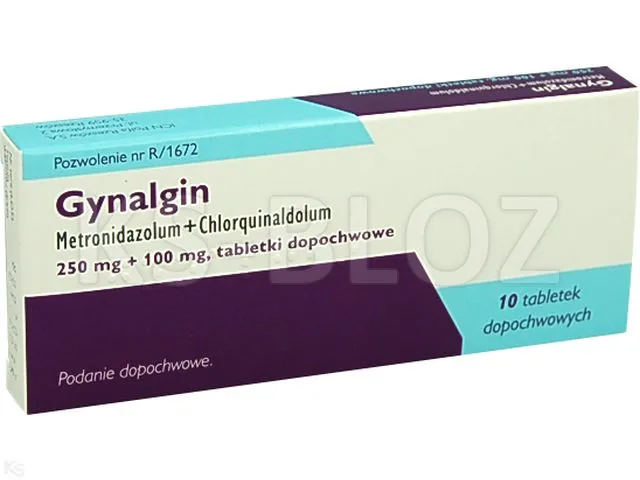
Table of Contents
Package leaflet: Information for the user
Warning! Keep this leaflet! Information on the immediate packaging is in a foreign language.
Gynalgin
250 mg + 100 mg, vaginal tablets
Metronidazolum + Chlorquinaldolum
Please read this leaflet carefully before using the medicine, as it contains
important information for the patient.
- Keep this leaflet so that you can read it again if necessary.
- If you have any doubts, please consult your doctor or pharmacist.
- This medicine has been prescribed for a specific individual. Do not pass it on to others. The medicine may harm someone else, even if their symptoms are the same.
- If the patient experiences any adverse reactions, including any adverse reactions not listed in this leaflet, inform your doctor, pharmacist, or nurse. See section 4.
Table of contents
- What Gynalgin is and what it is used for
- Important information before using Gynalgin
- How to use Gynalgin
- Possible side effects
- How to store Gynalgin
- Contents of the pack and other information
1. What Gynalgin is and what it is used for
Gynalgin is a combination medicine containing two active substances: metronidazole and chlorquinaldol. Metronidazole belongs to a group of medicines with antibacterial (mainly against anaerobic bacteria) and antiprotozoal activity, without affecting the physiological bacterial flora of the vagina. Chlorquinaldol, on the other hand, has antibacterial, antifungal, and antiprotozoal properties. The combination of these two substances results in a medicine with broad-spectrum antibacterial, antifungal, and antiprotozoal activity.
Gynalgin is used in the treatment of vaginal infections caused by susceptible bacteria and by the protozoan Trichomonas vaginalis.
Gynalgin is effective in treating inflammatory conditions of the vagina caused by a simultaneous presence of bacteria, Trichomonas vaginalis, and fungi.
2. Important information before using Gynalgin
When not to use Gynalgin
- Do not use Gynalgin if the patient is allergic to metronidazole, chlorquinaldol, or any of the other ingredients of this medicine (listed in section 6). Warnings and precautions Before starting treatment with Gynalgin, discuss with your doctor or pharmacist:
- If the patient has severe liver impairment or current or past blood morphology disorders, she should inform the doctor before starting treatment.
- Do not use the medicine for prolonged periods. When large doses of chlorinated quinoline derivatives (including chlorquinaldol) are used long-term, disturbances in sensation, muscle weakness, pain, and visual disturbances (symptoms of so-called subacute myelooptic neuropathy) may occur.
- This medicine is intended for vaginal use only. Do not take it orally.
- Avoid using the medicine during menstruation.
- Abstain from sexual intercourse both during infection and throughout treatment.
- During treatment of vaginal infection, it is recommended that the patient's partner also receives appropriate treatment. In patients with Cockayne syndrome, severe hepatotoxicity (acute liver failure), including fatal cases, has been reported during treatment with metronidazole-containing medicines. In patients with Cockayne syndrome, liver function should be monitored by the physician during and after treatment with metronidazole. If the patient experiences any of the following symptoms, the doctor should be informed immediately and metronidazole should be discontinued:
- abdominal pain, loss of appetite, nausea, vomiting, fever, malaise, fatigue, jaundice, dark urine, pale or loose stools, or skin itching.
Gynalgin and other medicines
Inform your doctor about all medicines currently or recently taken, as well as any medicines planned for future use.
- If the patient is taking any of the following medicines, she should inform her doctor, as special caution may be required:
- disulfiram (used in alcohol dependence) – when used concomitantly with metronidazole, may cause psychotic reactions and confusion;
- warfarin (used to treat blood clots);
- lithium (used to treat depression);
- cyclosporine (used after organ transplantation);
- 5-fluorouracil (used in cancer treatment);
- metallic compounds and iodine – reduce the effectiveness of chlorquinaldol;
- If the patient is due to undergo blood laboratory tests, she should inform the doctor about using Gynalgin, as it may affect the results of certain tests (determinations of AlAT, AspAT, lactic acid, triglycerides, and glucose hexokinase).
- Alcohol consumption may cause an alcohol intolerance reaction (so-called disulfiram-like reaction). The likelihood of such reactions during use of Gynalgin is low, because serum concentrations of metronidazole achieved after vaginal administration are minimal.
Gynalgin and alcohol
Do not drink alcohol during treatment with Gynalgin, as an alcohol intolerance reaction may occur.
Pregnancy, breastfeeding, and fertility
If the patient is pregnant or breastfeeding, suspects she may be pregnant, or is planning to become pregnant, she should consult her doctor before using this medicine.
Gynalgin should not be used during pregnancy unless absolutely necessary. Caution is advised when using the medicine during breastfeeding.
Driving and operating machinery
Gynalgin has no effect or a negligible effect on the ability to drive motor vehicles and operate machinery.
3. How to use the medicine Gynalgin
This medicine should always be used as recommended by the doctor. In case of doubts, consult
your doctor.
This medicine is intended for vaginal use only. It should not be taken orally.
Recommended dose
Adults
One tablet deeply into the vagina once daily, preferably at bedtime.
Treatment should begin 2 to 4 days after the end of menstruation and continue for 10 days. If necessary,
the doctor may recommend repeating the treatment cycle.
Children and adolescents under 18 years of age
Use of the medicine is not recommended.
Elderly patients
No dose adjustment is necessary.
Patients with impaired liver or kidney function
No dose adjustment is necessary.
Use of a higher than recommended dose of Gynalgin
No cases of overdose have been reported so far.
In case of accidental or mistaken oral ingestion of the medicine, consult a doctor immediately.
Treatment consists of removing the medicine from the body (inducing vomiting, gastric lavage).
Metronidazole can be removed from blood serum by hemodialysis or peritoneal dialysis.
Missed dose of Gynalgin
If a dose is missed at the scheduled time, it should be administered as soon as possible. However, if
the time for the next dose is approaching, the missed dose should be skipped. Do not use a double
dose to make up for the missed dose.
Discontinuation of Gynalgin treatment
If treatment with Gynalgin is discontinued, symptoms of vaginitis may worsen.
If you have any further doubts regarding the use of this medicine, consult your doctor or pharmacist.
4. Possible adverse reactions
Like all medicines, this medicine may cause adverse reactions, although not everybody gets them.
The frequency of the adverse reactions listed below is unknown (cannot be determined from the available data).
-
Pain and dizziness, abnormal sensory sensations in the limbs.
-
Depression, sleep disorders.
-
Cramping abdominal pain, discomfort in the abdominal cavity, nausea, vomiting, unpleasant taste in the mouth, diarrhoea, constipation, bloating, dryness of the oral cavity.
-
Dark discolouration of urine.
-
Itching, irritation and burning in the vagina, pelvic discomfort, vaginal discharge, swelling of the labia, menstrual disorders, vaginal bleeding, spotting.
-
Itching of the skin.
-
Muscle cramps.
-
Feeling of excessive fatigue, increased irritability.
-
Leakage of the preparation from the vagina.
-
Decreased appetite.
-
Symptoms of subacute myelooptic neuropathy (sensory disturbances, muscle weakness, pain, visual disturbances). Reporting of adverse reactions If any adverse reactions occur, including any adverse reactions not listed in this leaflet, inform your doctor, pharmacist or nurse. Adverse reactions can be reported directly to the Department of Monitoring Adverse Drug Reactions at the Office for Registration of Medicinal Products, Medical Devices and Biocidal Products: Al. Jerozolimskie 181C, 02-222 Warsaw, tel.: +48 22 49 21 301, fax: +48 22 49 21 309, website: https://smz.ezdrowie.gov.pl. Adverse reactions can also be reported to the marketing authorisation holder or parallel importer. Reporting adverse reactions helps to provide more information on the safety of the medicine.
5. How to store Gynalgin
Store below 25°C.
Keep in the original packaging.
Keep the medicine out of the sight and reach of children.
Do not use this medicine after the expiry date stated on the packaging. The expiry date refers to the last day of the stated month.
Medicines must not be disposed of via wastewater or household waste. Ask your pharmacist how to dispose of medicines no longer required. This will help protect the environment.
6. Contents of the packaging and other information
What Gynalgin contains
- The active substances are metronidazole and clioquinol. Each vaginal tablet contains 250 mg of metronidazole and 100 mg of clioquinol.
- Other components: citric acid, monohydrate lactose, rice starch, sodium carboxymethyl starch (type C), macrogol 6000, magnesium stearate.
What Gynalgin looks like and contents of the pack
Beige-colored, smooth, elongated tablets with a marbled surface and engraved with the letter G.
The medicine is available in a pack containing 10 tablets (2 blisters of Al/OPA/Al/PVC with 5 tablets each, in a cardboard box).
For more detailed information, please contact the responsible entity or parallel importer.
Marketing Authorisation Holder in Bulgaria, country of export:
Mylan EOOD
Office building „Serdika Offices”
Sitnyakovo Blvd. 48, fl. 7
1505 Sofia
Bulgaria
Manufacturer:
ICN Polfa Rzeszów S.A.
Przemysłowa Street 2
35-959 Rzeszów
Poland
Parallel Importer:
Allpharm Sp. z o.o. sp.k.
M. Zdziechowskiego Street 11/4
02-659 Warsaw
Repackaged in:
CEFEA Sp. z o.o. Sp. Synoptis Industrial Sp. z o.o. Shiraz Productions Sp. z o.o.
sp. k. Forteczna Street 35-37 Tymiankowa Street 24/28
Działkowa Street 56 87-100 Toruń 95-054 Ksawerów
02-234 Warsaw
Marketing Authorisation Number in Bulgaria, country of export: 9800185
Parallel Import Licence Number: 87/25