Gripex
Poland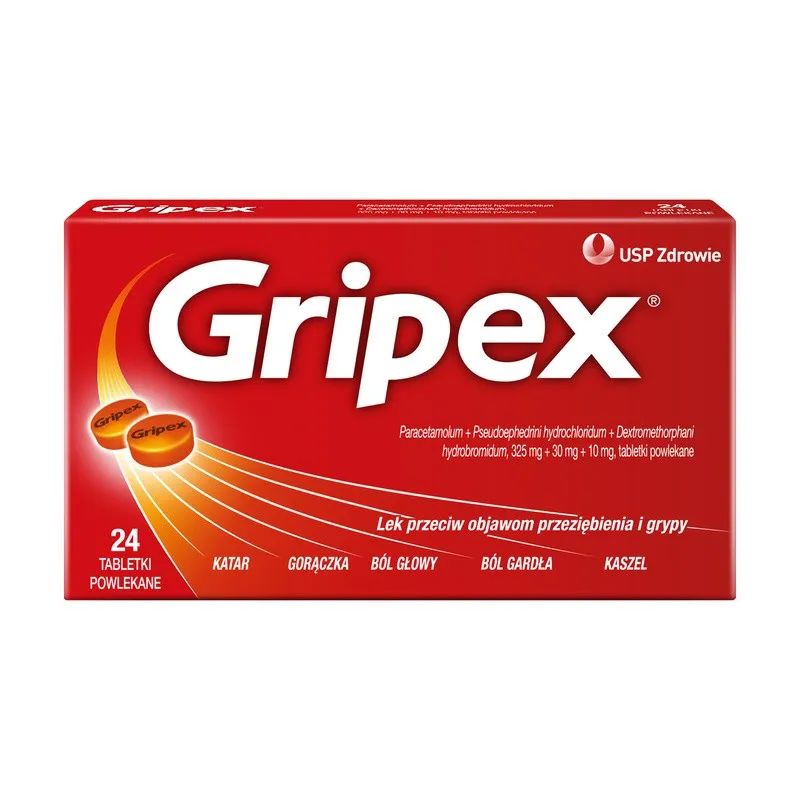
Table of Contents
Package leaflet: Information for the patient
GRIPEX, 325 mg + 30 mg + 10 mg, coated tablets
Paracetamolum + Pseudoephedrini hydrochloridum + Dextromethorphani hydrobromidum
Please read the entire leaflet carefully before using this medicine, as it contains
important information for the patient.
This medicine should always be used exactly as described in this patient leaflet or as directed
by a doctor or pharmacist.
- Keep this leaflet, so that you can read it again if necessary.
- If you need advice or further information, please consult your pharmacist.
- If you experience any adverse reactions, including any possible adverse reactions not listed in this leaflet, inform your doctor or pharmacist. See section 4.
- If there is no improvement after 3 days, or if you feel worse, you should contact your doctor.
Table of contents
- What Gripex is and what it is used for
- Important information before taking Gripex
- How to take Gripex
- Possible side effects
- How to store Gripex
- Contents of the pack and other information
1. What Gripex is and what it is used for
Gripex is a combination medicine intended for short-term, symptomatic relief of cold and flu symptoms. It contains three active substances: paracetamol, pseudoephedrine, and dextromethorphan.
It acts as an analgesic, antipyretic, antitussive, decongestant, reduces mucus secretion, and alleviates nasal mucosa congestion and swelling. Gripex is intended for use in adults, adolescents, and children above 6 years of age.
The indication for using Gripex is the temporary relief of symptoms associated with the common cold, influenza, influenza-like conditions, and acute sinusitis (fever, nasal congestion, cough, headache, sore throat, muscle and joint pain).
2. Important information before using Gripex
Use of this medicine may lead to dependence. Therefore, treatment should be short-term.
When not to use Gripex:
- if the patient is allergic to paracetamol, hydrochloride of pseudoephedrine,
bromide of dextromethorphan, or any of the other ingredients of this medicine
(listed in section 6); - if the patient is taking other medicines containing paracetamol;
- if the patient is taking medicines from the group of MAO inhibitors (medicines used, among others, in depression), as well as within 2 weeks after discontinuation of such treatment;
- in patients with congenital deficiency of glucose-6-phosphate dehydrogenase;
- in case of severe liver failure;
- if the patient has very high blood pressure (severe arterial hypertension) or arterial hypertension that cannot be controlled with medication;
- if the patient has severe acute (sudden) or chronic (long-term) kidney disease or kidney failure;
- in case of ischemic heart disease;
- in patients with alcoholic disease;
- in patients with bronchial asthma;
- during pregnancy and breastfeeding;
- in children under 6 years of age.
Warnings and precautions
Before starting to use Gripex, discuss this with your doctor or pharmacist.
Gripex contains paracetamol. Do not take a dose higher than recommended. Overdose of paracetamol may lead to severe liver damage or even death.
This medicine should not be used simultaneously with other medicines containing paracetamol, such as painkillers, antipyretics, or medicines used to treat symptoms of flu and colds.
Use of this medicine in patients with liver impairment, alcohol abusers, or those who are fasting increases the risk of liver damage.
Do not drink alcohol while taking this medicine.
This medicine should not be used for chronic cough with sputum production.
During treatment with Gripex, immediately inform your doctor if the patient has serious conditions, including severe kidney function disorders or sepsis (when bacteria and their toxins circulate in the blood, leading to organ damage), malnutrition, chronic alcoholism, or if the patient is also taking flucloxacillin (an antibiotic). In these situations, patients have been reported to develop a serious condition called metabolic acidosis (an imbalance in blood and body fluids) when taking paracetamol at standard doses over a prolonged period, or when taking paracetamol together with flucloxacillin. Symptoms of metabolic acidosis may include: severe breathing difficulties, including rapid deep breathing, drowsiness, nausea, and vomiting.
Use with caution in patients with kidney failure, arterial hypertension, cardiac arrhythmias, pulmonary emphysema, increased intraocular pressure, benign prostatic hyperplasia, hyperthyroidism, diabetes, respiratory insufficiency, bronchial asthma, and in patients at risk of respiratory failure, as well as in those taking anxiolytics, tricyclic antidepressants, other sympathomimetic medicines (i.e., those reducing congestion, suppressing appetite, and psychostimulants similar to amphetamines), or anticoagulants.
Due to reported cases of dextromethorphan abuse, particular caution should be exercised when using Gripex in adolescents, young adults, and patients who abuse drugs or psychoactive substances.
Special caution is required in patients who are poor metabolizers via the CYP2D6 enzyme or those taking substances that inhibit the activity of the CYP2D6 enzyme (listed in section “Gripex and other medicines”). If taking medicines that inhibit CYP2D6 activity, consult your doctor before using this medicine. If simultaneous use of CYP2D6-inhibiting medicines and dextromethorphan is necessary, the patient must be under strict medical supervision. A dose reduction of dextromethorphan may be required.
In patients who are poor metabolizers of this enzyme and in patients concurrently taking medicines that inhibit CYP2D6 activity, enhanced and/or prolonged effects of dextromethorphan may occur. Concurrent use of strong inhibitors of this enzyme increases the risk of dextromethorphan poisoning, manifesting as excitation, disorientation, tremor, insomnia, diarrhea, and respiratory depression. It may also lead to the development of a life-threatening condition called serotonin syndrome (rapid heartbeat, disorientation, profuse sweating, hallucinations, involuntary muscle movements, chills, tremors). If the above symptoms occur after taking Gripex, discontinue treatment and seek immediate medical advice.
If the patient develops fever with generalized skin redness and blistering rash, discontinue use of Gripex and contact a doctor or seek immediate medical help. See section 4.
If the patient is taking medicines such as certain antidepressants or antipsychotics, Gripex may interact with them, causing changes in mental state (e.g., excitation, hallucinations, coma) and other symptoms such as body temperature above 38°C, increased heart rate, unstable blood pressure, exaggerated reflexes, muscle stiffness, lack of coordination, and/or gastrointestinal symptoms (e.g., nausea, vomiting, diarrhea).
While taking Gripex, sudden abdominal pain or rectal bleeding due to inflammation of the large intestine (ischemic colitis) may occur. If such gastrointestinal symptoms occur, discontinue use of Gripex and immediately seek medical advice or medical help. See section 4.
While taking Gripex, reduced blood flow in the optic nerve may occur. If sudden vision loss occurs, discontinue use of Gripex and immediately contact a doctor or seek medical help. See section 4.
Cases of posterior reversible encephalopathy syndrome (PRES) and reversible cerebral vasoconstriction syndrome (RCVS) have been reported after using medicines containing pseudoephedrine. PRES and RCVS are rare conditions that may be associated with reduced blood flow to the brain.
If symptoms occur that may indicate PRES or RCVS, immediately discontinue use of Gripex and seek immediate medical help (symptoms, see section 4 “Possible side effects”).
Consult your doctor even if the above warnings relate to conditions that occurred in the past.
If symptoms worsen or do not improve after 3 days, contact your doctor.
Children
This medicine should not be used in children under 6 years of age.
Gripex and other medicines
Inform your doctor or pharmacist about all medicines currently or recently taken, as well as any medicines you plan to take.
The interaction of Gripex with other medicines results from the effects of the active substances contained in the medicine:
Paracetamol
- Do not take this medicine simultaneously with other medicines containing paracetamol.
- Medicines that accelerate gastric emptying (e.g., metoclopramide) speed up the absorption of paracetamol.
- Medicines that delay gastric emptying (e.g., propantheline) may delay the absorption of paracetamol.
- Concurrent use of paracetamol with MAO inhibitors (used in the treatment of, among others, depression) and within 2 weeks after discontinuation of such treatment may cause a state of excitation and fever.
- Concurrent use of paracetamol with zidovudine (AZT, a medicine used in HIV infection) may enhance the toxic effect of zidovudine on bone marrow.
- Paracetamol may enhance the effect of anticoagulant medicines (coumarin derivatives).
- Concurrent use of paracetamol with medicines that increase liver metabolism, such as certain sedatives or antiepileptic medicines (e.g., phenobarbital, phenytoin, carbamazepine), as well as rifampicin (used in the treatment of, among others, tuberculosis), may lead to liver damage, even when recommended doses of paracetamol are used.
- Drinking alcohol during paracetamol treatment leads to the formation of a toxic metabolite causing necrosis of liver cells, which may subsequently lead to liver failure.
- Concurrent administration with chloramphenicol (a broad-spectrum antibacterial antibiotic) may increase chloramphenicol plasma concentration. Inform your doctor or pharmacist if the patient is taking flucloxacillin (an antibiotic), due to the serious risk of blood and body fluid disorders (called metabolic acidosis), which require urgent treatment (see section 2). These disorders may occur particularly in patients with severe kidney function disorders, sepsis (a condition where bacteria and their toxins circulate in the blood, leading to organ damage), malnutrition, chronic alcoholism, and in patients taking maximum daily doses of paracetamol.
- Concurrent use with albuterol (used, among others, in asthma treatment) may enhance vasoconstrictive effects.
- Do not use simultaneously with amitriptyline (used, among others, in depression) and sympathomimetics (used in bronchospasm treatment, e.g., in asthma).
- Concurrent use with other sympathomimetics, i.e., medicines reducing congestion, suppressing appetite, or substances with psychostimulant effects similar to amphetamines, may cause increased blood pressure.
- Ammonium chloride, by alkalinizing urine, increases renal reabsorption of pseudoephedrine metabolites and prolongs its duration of action.
- Antacids (used to relieve heartburn and indigestion) may increase the absorption of pseudoephedrine.
- MAO inhibitors (used in depression treatment) cause slower elimination of pseudoephedrine from the body and increase its bioavailability.
- Pseudoephedrine reduces the effect of antihypertensive medicines and may modify the action of cardiac glycosides (used in heart failure).
- Do not use simultaneously with furazolidone (an antibacterial medicine).
Dextromethorphan
- Do not use with MAO inhibitors (medicines used in depression treatment).
- Concurrent use with medicines that inhibit the CYP2D6 enzyme, such as: fluoxetine, paroxetine, quinidine, terbinafine, amiodarone, flecainide, propafenone, sertraline, bupropion, methadone, cinacalcet, haloperidol, perphenazine, and thioridazine, may increase blood levels of dextromethorphan.
Gripex with food, drink, or alcohol
Food does not significantly affect the absorption of the medicine.
Do not drink alcohol during treatment with this medicine.
Pregnancy and breastfeeding
Use of Gripex during pregnancy and breastfeeding is contraindicated.
Driving and operating machinery
Exercise caution while driving and operating machinery when taking Gripex.
Gripex contains Sunset Yellow (E 110) and Allura Red AC (E 129)
This medicine may cause allergic reactions.
3. How to use Gripex
This medicine should always be taken exactly as described in the patient leaflet or as directed by a doctor or pharmacist. If in doubt, consult a doctor or pharmacist.
Gripex should be taken orally.
Recommended dose
Adults and adolescents over 12 years of age: 1 to 2 tablets, 3–4 times daily.
Do not take more than 8 tablets per day.
Children aged 6 to 12 years: 1 tablet 3–4 times daily. Do not exceed 4 tablets per day.
Taking more Gripex than recommended
Overdose in children may lead to serious adverse effects, including neurological disturbances. Caregivers must not administer a higher dose than recommended.
Seek immediate medical advice from a doctor or pharmacist. The medicine contains three active substances.
Symptoms of overdose may result from the effect of one or all of the active substances.
In every case of ingestion of a dose higher than recommended, immediate medical advice must be sought, even if the patient feels well and no symptoms of poisoning are observed, due to the risk of delayed, severe liver damage, which may result in liver transplantation or death.
Accidental or intentional overdose may cause, within several or up to a dozen hours, symptoms such as nausea, vomiting, excessive sweating, drowsiness, general weakness, restlessness, tremor, involuntary muscle contractions, agitation, confusion, disturbances of consciousness, coordination disorders, psychosis with visual hallucinations, and increased excitability.
Nystagmus, cardiac disorders (rapid heartbeat), elevated blood pressure, and difficulty urinating may also occur.
Symptoms of severe overdose may include coma, serious breathing difficulties, and seizures.
These symptoms may subside the next day, despite the onset of liver damage, which subsequently manifests as upper abdominal discomfort, recurrence of nausea, and jaundice.
If any of the above symptoms occur, seek immediate medical attention or go to hospital.
Treatment should be carried out in hospital and consists of accelerating the elimination of the drug components from the body and supporting vital functions. In case of paracetamol overdose, an antidote such as N-acetylcysteine and/or methionine may be required. Elimination of pseudoephedrine can be accelerated by forced diuresis or dialysis.
To reverse the toxic effects of dextromethorphan on the central nervous system, the doctor may administer naloxone.
Missed dose of Gripex
Gripex is intended for short-term relief of symptoms of cold, flu, and flu-like conditions.
If a dose is missed and symptoms persist, take the next dose of Gripex as scheduled. Do not take a double dose to make up for a missed dose.
4. Possible adverse reactions
Like any medicine, this product may cause adverse reactions, although not everyone experiences them.
You must immediately stop taking Gripex and seek immediate medical help
if symptoms indicating posterior reversible encephalopathy syndrome (PRES) or reversible cerebral vasoconstriction syndrome (RCVS) occur. These include:
- sudden, severe headache,
- nausea,
- vomiting,
- confusion,
- seizures,
- visual disturbances.
Adverse reactions occurring not commonly (in 1 to 10 out of 1,000 patients taking the medicine):
- fatigue, dizziness;
- nausea and vomiting.
Adverse reactions occurring rarely (in 1 to 10 out of 10,000 patients taking the medicine):
- type I hypersensitivity reactions: allergic swelling (i.e. swelling of the skin and soft tissues, often affecting the face, e.g. lips, tongue, eyelids), anaphylactic reaction (i.e. shortness of breath, sweating, drop in blood pressure up to shock symptoms);
- skin allergic reactions, skin redness, rash.
Adverse reactions occurring very rarely (less than 1 in 10,000 patients taking the medicine):
- blood cell production disorders: granulocytopenia (reduced number of granulocytes in blood), agranulocytosis (absence of granulocytes in blood), thrombocytopenia (reduced number of platelets in blood);
- bronchial asthma attack;
- liver damage, most commonly occurring due to overdose;
- renal colic, renal papillary necrosis, acute kidney failure, urolithiasis;
- hallucinations.
Adverse reactions with unknown frequency (frequency cannot be estimated from available data):
- severe conditions affecting cerebral blood vessels, known as posterior reversible encephalopathy syndrome (PRES) and reversible cerebral vasoconstriction syndrome (RCVS);
- somnolence;
- increased heart rate (tachycardia);
- slight increase in blood pressure; urinary disorders, urine retention, especially in patients with benign prostatic hyperplasia;
- colitis caused by inadequate blood supply (ischemic colitis);
- sudden fever, skin redness, or numerous small pustules (possible symptoms of acute generalized pustular exanthema – AGEP) may occur within the first 2 days of taking Gripex. See section 2. If such symptoms occur, discontinue use of Gripex and contact a doctor or seek immediate medical help;
- reduced blood flow in the optic nerve (ischemic optic neuropathy);
- serious condition that may cause blood acidification (so-called metabolic acidosis) in patients with severe illness taking paracetamol (see section 2).
Reporting of adverse reactions
If any adverse reactions occur, including any not listed in this leaflet, inform your doctor or pharmacist. Adverse reactions can be reported directly to the Department of Monitoring Adverse Drug Reactions at the Office for Registration of Medicinal Products, Medical Devices and Biocidal Products
Al. Jerozolimskie 181C
02-222 Warsaw
Tel.: +48 22 49 21 301
Fax: +48 22 49 21 309
Website: https://smz.ezdrowie.gov.pl/
Adverse reactions can also be reported to the marketing authorization holder.
Reporting adverse reactions helps provide more information on the safety of the medicine.
5. How to store Gripex
Do not store above 25°C.
Keep the medicine out of sight and reach of children.
Do not use this medicine after the expiry date stated on the outer packaging and immediate
container (month/year). The expiry date refers to the last day of the indicated month.
Blister pack labelling: EXP - expiry date, Lot - batch number.
Medicines must not be disposed of via wastewater or household waste. Ask your pharmacist
what to do with medicines no longer in use. This will help protect the environment.
6. Contents of the packaging and other information
What Gripex contains:
Active substances: paracetamol, pseudoephedrine hydrochloride,
and dextromethorphan hydrobromide. Each coated tablet contains: 325 mg paracetamol,
30 mg pseudoephedrine hydrochloride, and 10 mg dextromethorphan hydrobromide.
Other ingredients:
Tablet core:
microcrystalline cellulose, pregelatinized starch, colloidal silicon dioxide, stearic acid, povidone,
crospovidone.
Coating:
(Opadry II Orange Y-22-13204): hypromellose, titanium dioxide (E 171), macrogol, polidextrose,
triacetin, sunset yellow (E 110), Allura red AC (E 129).
Printing ink:
(Opacode Black S-1-17823): shellac, iron oxide black (E 172), n-butyl alcohol, isopropyl alcohol,
ammonium hydroxide, propylene glycol.
What Gripex looks like and contents of the pack
Orange, round coated tablets with black print "Gripex" on one side.
Available pack sizes:
PVC/PVDC/Aluminium blisters in cardboard cartons.
10 tablets (1 blister with 10 tablets)
12 tablets (1 blister with 12 tablets)
24 tablets (2 blisters with 12 tablets each)
Not all pack sizes may be marketed.
Marketing Authorisation Holder and Manufacturer
US Pharmacia Sp. z o.o.
Ziębicka 40
50 - 507 Wrocław
For further information on this medicinal product, please contact:
USP Zdrowie Sp. z o.o.
Poleczki 35
02 - 822 Warszawa
tel.: +48 (22) 543 60 00