Glucardiamid
Poland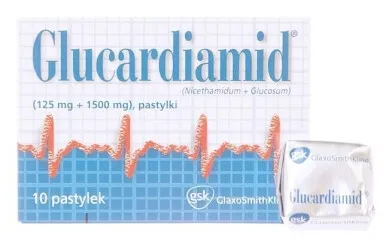
Table of Contents
Package leaflet: Information for the patient
GLUCARDIAMID, 125 mg + 1500 mg, tablets
Nicethamidum + Glucosum
Please read the following leaflet carefully before taking this medicine, as it contains
important information for the patient.
This medicine should always be taken exactly as described in this patient leaflet or as directed by
the physician or pharmacist.
- Keep this leaflet for future reference.
- If advice or further information is needed, consult a pharmacist.
- If the patient experiences any adverse reactions, including any possible side effects not listed in this leaflet, inform a doctor or pharmacist. See section 4.
Table of contents
- What G is and what it is used for
- Important information before taking G
- How to take G
- Possible side effects
- How to store G
- Contents of the package and other information
1. What G is and what it is used for
G contains as active substances nicethamidum and glucose.
Nicethamidum exerts a stimulant effect on the central nervous system. It increases the sensitivity of the respiratory centre to carbon dioxide, raises tidal volume and enhances respiratory rate. By increasing heart rate, cardiac output and pulmonary arterial pressure, it elevates blood pressure, especially in patients with hypotension.
The glucose contained in G serves as an energy source for the body.
G may be used as an adjunct:
- in conditions of intense and prolonged physical exertion;
- in conditions of chronic weakness and fatigue.
2. Important information before taking medicine G
When not to take medicine G
- if the patient is allergic to nikethamide or glucose, or to any of the other ingredients of this medicine (listed in section 6);
- in patients with tachycardia (accelerated heart rate) and severe cardiac arrhythmias;
- in patients with unstable angina pectoris;
- in children under 12 years of age.
Warnings and precautions
Before starting treatment with G, discuss it with your doctor or pharmacist.
Use with caution (only under medical supervision):
- in severe bronchial asthma, as the medicine may cause significant bronchoconstriction;
- in arterial hypertension;
- in hyperthyroidism;
- in epilepsy, as it may provoke seizures;
- in diabetes.
Nikethamide is included in the list of drugs recognized as doping agents by the Anti-Doping Commission. It may lead to positive results in certain anti-doping tests.
Children and adolescents
Do not use in children under 12 years of age.
G and other medicines
Inform your doctor or pharmacist about all medicines currently or recently taken, as well as any medicines you plan to take.
No interactions between medicine G and other drugs have been observed at recommended doses.
Medicine G should be used cautiously in patients receiving sympathomimetic drugs and monoamine oxidase inhibitors, as well as when used concomitantly with muscle relaxants.
Pregnancy and breastfeeding
If the patient is pregnant or breastfeeding, suspects she might be pregnant, or is planning to have a child, she should consult her doctor or pharmacist before using this medicine. Use of medicine G during pregnancy and breastfeeding is not recommended due to lack of studies confirming safety.
Driving and operating machinery
This medicine does not impair psycho-physical performance, ability to drive or operate machinery.
G contains glucose and sucrose
If the patient has previously been diagnosed with intolerance to certain sugars, he or she should consult a doctor before taking this medicine. The medicine may have harmful effects on teeth.
G contains quinoline yellow (E 104)
The medicine may cause allergic reactions.
G contains butylated hydroxyanisole (E 320) and butylated hydroxytoluene (E 321)
The medicine may cause local irritation of mucous membranes.
3. How to use G
This medicine should always be taken exactly as described in this patient information leaflet or as directed by a doctor or pharmacist. If in doubt, consult a doctor or pharmacist.
Oral administration.
Recommended dose:
Suck 4 to 6 tablets per day.
Use of a higher than recommended dose of medicine G
G is released slowly even when many tablets are swallowed whole, and a significant portion of the medicine is excreted during this time.
Significant overdose may cause: rapid breathing, nausea, vomiting, excessive sweating, itching, sneezing, restlessness, epileptic-like seizures. Other symptoms include: dizziness and headache, anxiety, disorientation, flushing, rash, high fever, sweating, paresthesia, and sensation of warmth. More severe symptoms of overdose include: increased blood pressure, muscular spasticity, sinus tachycardia and other arrhythmias, epileptic-like seizures.
Missed dose of medicine G
Continue taking the medicine as prescribed without increasing the next dose.
Do not take a double dose to make up for a missed dose.
4. Possible adverse effects
Like any medicine, this medicine may cause adverse effects, although not everyone experiences them.
Adverse effects may manifest as: lowered seizure threshold, persistent cough,
bronchospasm, and headache.
A more serious adverse effect is the triggering of symptoms of porphyria, a disease
characterized by episodic abdominal pain and neurological and psychiatric disturbances.
Reporting adverse effects
If any adverse effects occur, including any adverse effects not listed
in this leaflet, inform your doctor or pharmacist. Adverse effects can be reported
directly to the Department of Monitoring Adverse Drug Reactions of the Office for Registration of Medicinal Products, Medical Devices and Biocidal Products:
Al. Jerozolimskie 181C
02-222 Warsaw
Phone: +48 22 49 21 301
Fax: +48 22 49 21 309
Website: https://smz.ezdrowie.gov.pl
Adverse effects may also be reported to the responsible entity.
Reporting adverse effects helps to collect further information on the safety of using the medicine.
5. How to store Glucardiamid
Keep this medicine out of the sight and reach of children.
Store below 25°C.
Keep in the original packaging to protect from moisture.
Do not use this medicine after the expiry date stated on the carton after "Expiry date". The expiry date refers to the last day of the stated month.
Medicines must not be disposed of via wastewater or household waste. Ask your pharmacist how to dispose of medicines no longer required. These measures will help protect the environment.
6. Contents of the packaging and other information
What G contains
- The active substances are nikethamide and glucose.
- The other ingredients are: liquid glucose, sucrose, solid fat, monohydrate citric acid, sorbitan monooleate, white wax, quinoline yellow (E 104), butylated hydroxyanisole, butylated hydroxytoluene.
What G looks like and contents of the pack
Tablets in the form of flat squares made of a transparent yellow mass, individually packed in a laminate
Aluminium/paper/PE, in a cardboard box.
The pack contains 10 or 20 tablets.
Marketing Authorisation Holder and Manufacturer
Marketing Authorisation Holder:
POLPHARMA Pharmaceutical Works S.A.
Pelplinska Street 19, 83-200 Starogard Gdanski
tel. + 48 22 364 61 01
Manufacturer:
EWA Production and Trading Enterprise S.A.
Zamkowy Folwark Street 9
63-700 Krotoszyn