Ginkoflav med
Poland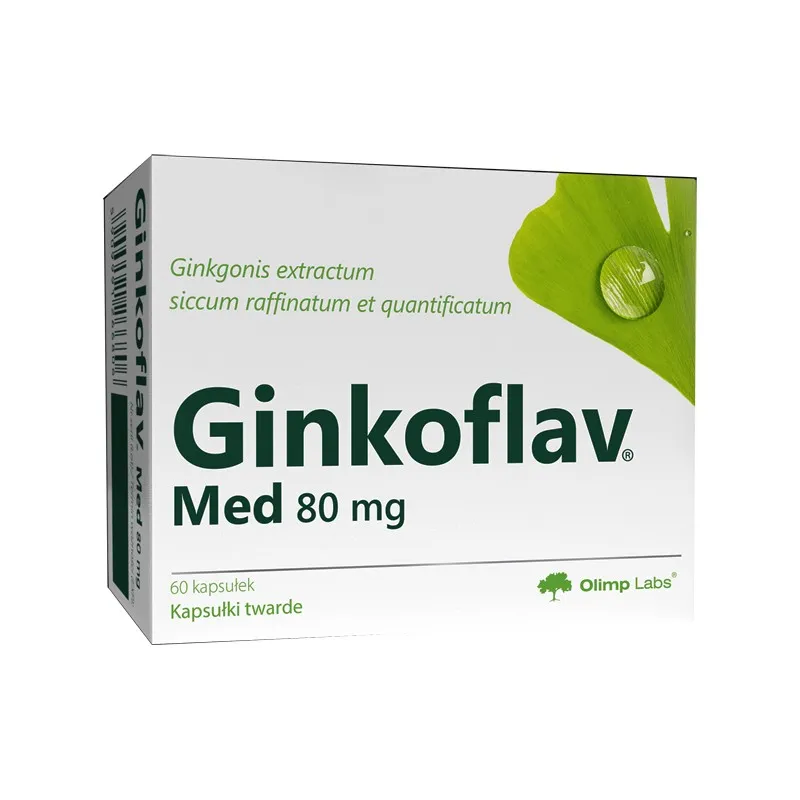
Table of Contents
Package leaflet: Information for the user
Ginkoflav Med, 80 mg, hard capsules
Ginkgonis extractum siccum raffinatum et quantificatum
Please read all of this leaflet carefully before taking this medicine because it contains important information for you.
This medicine should always be taken exactly as described in this patient leaflet or as directed by your doctor or pharmacist.
- Keep this leaflet, as you may need to read it again.
- If you need advice or further information, consult your pharmacist.
- If you experience any side effects, including any not listed in this leaflet, inform your doctor or pharmacist. See section 4.
- If there is no improvement or if your condition worsens after 3 months, consult your doctor.
Table of contents
- What Ginkoflav Med is and what it is used for
- What you need to know before taking Ginkoflav Med
- How to take Ginkoflav Med
- Possible side effects
- How to store Ginkoflav Med
- Contents of the pack and other information
1. What Ginkoflav Med is and what it is used for
Ginkoflav Med contains a standardized dry extract of Ginkgo biloba leaves, which dilates blood vessels, improves blood flow in the brain, and reduces platelet aggregation.
The active components of the Ginkgo biloba leaf extract are considered to be flavonoid glycosides, ginkgolides, and bilobalide.
Indications:
- To improve cognitive function in elderly patients (age-related decline in mental performance and memory impairment),
- As an adjunctive treatment to improve quality of life in mild dementia.
This medicine is intended for adults.
If there is no improvement or if your condition worsens after 3 months, consult your doctor.
2. Information before using Ginkoflav Med
When not to use Ginkoflav Med
- if the patient is allergic to the extract of Ginkgo biloba leaves or to any of the other ingredients of this medicine (listed in section 6),
- during pregnancy (see section "Pregnancy, breastfeeding and fertility").
Warnings and precautions
Before starting treatment with Ginkoflav Med, consult a doctor or pharmacist if:
- the patient has blood clotting disorders, e.g. haemorrhagic diathesis,
- the patient is taking antiplatelet drugs, e.g. acetylsalicylic acid, or anticoagulants, e.g. warfarin (Ginkoflav Med should not be used without consulting a doctor due to the inability to exclude the effect of the medicine on the occurrence of bleeding),
- the patient has a planned surgical procedure (the doctor should be informed about the use of Ginkoflav Med; additionally, it is recommended to discontinue the medicine at least 3–4 days before the planned procedure).
The influence of products containing Ginkgo biloba extract on the risk of seizures in patients with epilepsy cannot be excluded.
Concomitant use of products containing Ginkgo biloba and products containing efavirenz (an antiviral medicine) is not recommended – see section "Ginkoflav Med and other medicines".
Children and adolescents
The medicine is not intended for use in children and adolescents (under 18 years of age).
Ginkoflav Med and other medicines
Inform your doctor or pharmacist about all medicines currently used or recently used, as well as any medicines you plan to use.
Due to the inability to exclude interactions with the medicines listed below, particular caution should be exercised when using Ginkoflav Med:
- When used concomitantly with anticoagulants (e.g. acenocoumarol and warfarin) or antiplatelet drugs (e.g. clopidogrel, acetylsalicylic acid, and other non-steroidal anti-inflammatory drugs), the effect of these medicines may be enhanced.
- Available studies do not indicate interactions with warfarin; however, particular caution is recommended when initiating Ginkgo biloba treatment, changing dosage, or switching between products containing Ginkgo biloba extract in patients taking warfarin.
- Studies indicate that Ginkgo biloba may inhibit P-glycoprotein (P-gp) in intestinal cells (a protein involved in transporting substances out of cells). This may enhance the effect of medicines that are significantly transported by P-gp in the intestine, such as dabigatran. Caution is advised when using dabigatran concomitantly with Ginkgo biloba extract.
- Interaction studies with nifedipine indicated a potential increase in the maximum blood concentration of this medicine by Ginkgo biloba extract. In some study participants, a twofold increase in the maximum nifedipine concentration was observed, leading to dizziness and worsening of symptoms such as hot flushes.
- Concomitant use of products containing Ginkgo biloba extract and products containing efavirenz (an antiviral medicine) is not recommended. Plasma concentrations of efavirenz may decrease due to induction of the CYP3A4 enzyme, which may reduce antiviral efficacy (see also section "Warnings and precautions").
If any of the above-mentioned medicines are being used, consult a doctor or pharmacist before taking Ginkoflav Med.
Ginkoflav Med with food, drink and alcohol
Ginkoflav Med can be taken independently of meals. Alcohol consumption with this medicine is not recommended.
Pregnancy, breastfeeding and fertility
If the patient is pregnant or breastfeeding, suspects she may be pregnant, or is planning to become pregnant, she should consult a doctor or pharmacist before using this medicine.
Ginkoflav Med should not be used during pregnancy (the medicine is contraindicated in pregnancy and may increase the risk of bleeding).
Due to insufficient data, use during breastfeeding is not recommended.
There are no data on the effect on fertility in humans.
Driving and operating machinery
No direct studies on the effect of Ginkgo biloba extract on the ability to drive or operate machinery have been conducted.
3. How to use Ginkoflav Med
This medicine should always be used exactly as described in this patient leaflet or as directed by a doctor or pharmacist. If in doubt, consult a doctor or pharmacist.
The recommended dose for adults and elderly patients is 1 capsule three times a day.
The capsule should be taken with liquid.
Treatment should last at least 8 weeks.
If there is no improvement after 3 months, or if the patient feels worse, a doctor should be consulted.
After 3 months, consult a doctor to determine whether therapy should be continued.
Use in children and adolescents
There is no data available on safety and efficacy in children and adolescents.
This medicine is not intended for use in children and adolescents (under 18 years of age).
Taking more Ginkoflav Med than recommended
If you have taken more medicine than recommended, consult a doctor or pharmacist. No cases of poisoning have been reported.
Missing a dose of Ginkoflav Med
Do not take a double dose to make up for a missed dose.
Take the missed dose as soon as possible, unless it is almost time for the next dose. In that case, skip the missed dose.
If you have any further doubts about the use of this medicine, consult your doctor or pharmacist.
4. Possible adverse reactions
Like all medicines, this medicine can cause adverse reactions, although not everybody will experience them.
The following adverse reactions may occur during treatment with this medicine:
Very common (in more than 1 in 10 people taking the medicine)
headaches
Common (in 1 to 10 people out of 100 taking the medicine)
dizziness, vomiting, nausea, abdominal pain, diarrhoea
Frequency not known (frequency cannot be estimated from the available data)
bleeding in the nose, gastrointestinal tract, eye, intracranial haemorrhage, hypersensitivity reactions such as erythema, swelling, itching, rash, anaphylactic shock. In case of occurrence of such adverse reactions, the next dose of the medicine should not be taken. The patient should immediately contact a physician or the emergency department of the nearest hospital.
Reporting of adverse reactions
If any adverse effects occur, including any adverse effects not listed in this leaflet, inform your doctor or pharmacist. Adverse reactions can be reported directly to the Department of Monitoring Adverse Drug Reactions at the Office for Registration of Medicinal Products, Medical Devices and Biocidal Products, Al. Jerozolimskie 181C, 02-222 Warsaw; tel: +48 22 492 13 01; fax: +48 22 492 13 09; website: https://smz.ezdrowie.gov.pl
Adverse reactions can also be reported to the marketing authorization holder.
By reporting adverse reactions, additional information on the safety of the medicine can be collected.
5. How to store Ginkoflav Med
Keep this medicine out of sight and reach of children.
Do not store above 25°C.
Do not use this medicine after the expiry date stated on the carton and blister pack (after the symbol EXP). The expiry date refers to the last day of the stated month.
Medicines must not be disposed of via wastewater or household waste. Ask your pharmacist how to dispose of medicines no longer required. This will help protect the environment.
6. Contents of the pack and other information
What Ginkoflav Med contains
- The active substance in the medicine is an extract from leaves of Ginkgo biloba. Each capsule contains 80 mg of quantified dry extract from leaves of Ginkgo biloba L., folium (35-67:1), corresponding to: 17.6–21.6 mg flavonoids expressed as flavonoid glycosides; 2.2–2.7 mg ginkgolides A, B and C; 2.1–2.6 mg bilobalide. Extraction solvent: acetone 65% (v/v).
- Other ingredients (excipients): microcrystalline cellulose, magnesium stearate, capsule shell (gelatin, titanium dioxide (E 171), purified water).
What Ginkoflav Med looks like and contents of the pack
30, 60, 90 or 120 hard capsules in a cardboard box containing 2, 4, 6 or 8 blisters with 15 capsules in each blister.
Not all pack sizes may be marketed.
Marketing Authorisation Holder
OLIMP Laboratories Sp. z o.o.
Pustynia 84F
39-200 Dębica
Manufacturer
OLIMP Laboratories Sp. z o.o.
Nagawczyna 109c
39-200 Dębica
OLIMP Laboratories Sp. z o.o.
Pustynia 84F
39-200 Dębica
{OLIMP Laboratories Logo}