Geloplasma
Poland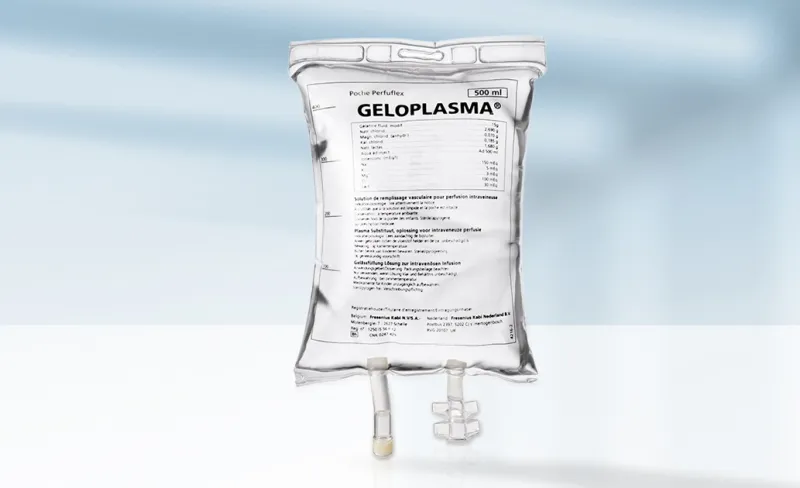
Table of Contents
Package leaflet: Information for the user
GELOPLASMA, infusion solution
Combination product
Please read carefully the entire leaflet before using this medicine, as it contains
important information for the patient.
- Keep this leaflet, as you may need to read it again.
- If you have any doubts, please consult your doctor, pharmacist, or nurse.
- This medicine has been prescribed for a specific individual. Do not pass it on to others. This medicine may harm other people, even if their symptoms are the same.
- If the patient experiences any adverse reactions, including any not listed in this leaflet, inform your doctor, pharmacist, or nurse. See section 4.
Contents of the leaflet
- What Geloplasma is and what it is used for
- Important information before using Geloplasma
- How to use Geloplasma
- Possible side effects
- How to store Geloplasma
- Contents of the package and other information
1. What Geloplasma is and what it is used for
Geloplasma is an intravenous infusion solution. It contains gelatin, which belongs to a group of medicines known as plasma volume expanders. Plasma volume expanders work by increasing the fluid volume in the bloodstream, thereby exerting a stabilizing effect on circulation and blood pressure.
This medicine is used in rapid, emergency medical treatment to restore circulating blood volume in the following situations:
- Haemorrhage (bleeding), dehydration, capillary leak (increased capillary permeability), burns;
- Vasogenic shock (dilation of blood vessels) of traumatic, surgical, infectious, or toxic origin.
The medicine is also used in the treatment of hypotension (low blood pressure) caused by vasodilating drugs, particularly during anaesthesia.
2. Information before using Geloplasma
When not to use Geloplasma:
- if the patient is allergic to gelatin or any of the other ingredients of this medicine (listed in section 6);
- if the patient is allergic to a substance called galactose-alpha-1,3-galactose (alpha-Gal) or to red meat (mammalian meat) and offal;
- if the patient has excess fluid in the body;
- if the patient has hyperkalaemia (increased potassium levels in the blood);
- if the patient has significant accumulation of alkaline substances (e.g. bicarbonates, lactates) in the blood and body fluids;
- in pregnant women towards the end of pregnancy (during childbirth): see section "Pregnancy, breastfeeding and fertility".
Warnings and precautions
Before starting treatment with Geloplasma, discuss this with your doctor, pharmacist or nurse.
- The solution must not be administered by intramuscular injection.
- The solution may cause accumulation of alkaline substances in the blood, as it contains lactate ions.
- The solution may not have an alkalizing effect in patients with impaired liver function, due to possible disturbances in lactate metabolism.
- Geloplasma must not be administered simultaneously with blood or blood products (red blood cell concentrates, plasma and plasma components); two separate infusion sets must be used.
- Blood grouping and all laboratory blood tests may be performed in patients who have received up to 2 litres of liquid gelatin; however, it is recommended that samples for these tests be taken before infusion of this solution.
- Due to the possibility of allergic reactions, appropriate monitoring of the patient's condition is necessary. If an allergic reaction occurs, the infusion must be stopped immediately and appropriate treatment initiated.
- Due to the possibility of cross-reactions, Geloplasma must not be administered in the following cases:
- if the patient is allergic to red meat (mammalian meat) or offal;
- if the patient has tested positive for antibodies (IgE) against the alpha-Gal allergen.
- During administration of the solution, the patient's condition must be clinically and laboratory monitored:
- blood pressure and, if possible, central venous pressure (measured via a catheter placed in the vein leading directly to the heart);
- urine output;
- haematocrit (blood volume) and electrolytes (ions present in the blood). This is particularly important if the patient has:
- congestive heart failure (a condition in which the heart cannot supply sufficient blood volume to other organs);
- respiratory dysfunction;
- severe kidney dysfunction;
- oedema with fluid and/or salt retention;
- circulatory overload with fluids (excess intravascular fluid);
- treatment with corticosteroids or their derivatives;
- coagulation disorders.
Geloplasma and other medicines
- Concomitant intravenous administration of other medicines with Geloplasma is not recommended.
- Since the solution contains potassium ions, it is advisable to avoid administering potassium-containing preparations and drugs that may increase potassium concentration in the blood.
You must tell your doctor or pharmacist about all medicines currently or recently taken, as well as any medicines you plan to take.
Geloplasma with food and drink
Not applicable.
Pregnancy, breastfeeding and fertility
If the patient is pregnant or breastfeeding, suspects she may be pregnant, or is planning to have a child, she should consult her doctor or pharmacist before using this medicine.
Pregnancy
There is no or only limited data on the use of this medicine in pregnant women. Therefore, Geloplasma should be used only if clearly clinically justified. The physician will assess the benefit-risk ratio for the unborn child.
Breastfeeding
It is not known whether Geloplasma passes into human milk. A risk to the breastfed infant cannot be excluded.
Fertility
There are no data on the effect of Geloplasma on fertility in humans or animals.
Driving and using machines
Geloplasma has negligible influence on the ability to drive and use machines.
Geloplasma contains potassium and sodium
This medicine contains 5 mmol of potassium per litre. This should be taken into account in patients with reduced kidney function or those controlling potassium intake in their diet.
This medicine contains 150 mmol of sodium per litre. This should be taken into account in patients controlling sodium intake in their diet.
3. How to use Geloplasma
This medicine should always be used as prescribed by the physician. In case of doubts, please consult
your doctor or pharmacist.
The medicine will be administered to the patient as an infusion (intravenous drip). The infusion rate may
be increased by using an infusion pump.
The volume and rate of the infusion depend on the patient's needs.
The average administered volume is from 500 to 1000 ml (1 to 2 bags), and in some cases more.
As a general rule, for adult patients and children with body weight above 25 kg, 500 ml (1 bag) is
administered at a rate depending on the patient's condition.
In case of blood or fluid loss exceeding 1.5 litres in an adult patient, blood and Geloplasma should
usually be administered.
During treatment, blood pressure, blood parameters, and coagulation system should be monitored.
Use of a higher than recommended dose of Geloplasma
Higher doses of the medicine may lead to circulatory overload.
Increased pulmonary arterial pressure may cause fluid leakage into extravascular spaces and may
result in pulmonary oedema (shortness of breath).
If overdose occurs, the physician will immediately stop the infusion and administer a fast-acting
diuretic (a medicine increasing urine excretion from the body).
In case of any further doubts regarding the use of this medicine, please consult your doctor,
pharmacist, or nurse.
4. Possible adverse reactions
Like any medicine, this medicine may cause adverse reactions, although not everyone experiences them.
Rare (less than 1 in 1,000 patients):
- anaphylactic shock (severe allergic reaction);
- allergic skin reaction.
If any of the above adverse reactions occur, you must immediately inform your doctor or nurse. The infusion will be immediately stopped and appropriate treatment initiated (see section “Important information before using Geloplasma”, particularly regarding allergy related to the allergen galactose-alpha-1,3-galactose (alpha-Gal), red meat (mammalian meat), and offal).
Very rare (less than 1 in 10,000 patients):
- hypotension;
- bradycardia;
- breathing difficulties;
- fever, chills.
Reporting of adverse reactions
If any adverse reactions occur, including those not listed in this leaflet, you should inform your doctor, pharmacist, or nurse. Adverse reactions can also be reported directly to the Department of Monitoring Adverse Drug Reactions, Office for Registration of Medicinal Products, Medical Devices and Biocidal Products,
Al. Jerozolimskie 181C
02-222 Warsaw
Phone: +48 22 4921 301
Fax: +48 22 4921 309
Email: [email protected].
Adverse reactions can also be reported to the responsible entity.
Reporting adverse reactions enables better assessment of the medicine’s safety profile.
5. How to store Geloplasma
Keep this medicine out of sight and reach of children.
Do not use this medicine after the expiry date stated on the container. The expiry date refers to the last day of the stated month.
Do not store above 25°C.
Do not freeze.
Do not store in the refrigerator.
After opening: use immediately; any unused solution must be discarded.
Do not use this medicine if:
- the packaging is damaged;
- the solution is not clear;
- part of the liquid has already been removed.
Medicines must not be disposed of via the sewage system or household waste. Ask your pharmacist how to dispose of medicines no longer required. This will help protect the environment.
6. Contents of the pack and other information
What Geloplasma contains
- The active substances are: Gelatin, modified liquid gelatin*, amount expressed as anhydrous gelatin 3.0000 g
Sodium chloride 0.5382 g
Magnesium chloride hexahydrate 0.0305 g
Potassium chloride 0.0373 g
Sodium (S)-lactate, solution, amount expressed as sodium (S)-lactate 0.3360 g
in 100 ml of infusion solution
* partially hydrolyzed and succinylated
- Other components: sodium hydroxide, succinic anhydride (in the form of succinic acid), hydrochloric acid concentrated, water for injections.
Ion content:
Sodium: 150 mmol/l
Potassium: 5 mmol/l
Magnesium: 1.5 mmol/l
Chloride: 100 mmol/l
Lactate: 30 mmol/l
Total osmolality: 295 mOsm/kg
pH: 5.8 to 7.0
What Geloplasma looks like and contents of the pack
Geloplasma is available in a plasticized PVC bag or in a free*flex (polyolefin) bag,
with a capacity of 500 ml, in an outer bag.
Available pack sizes: 15 plasticized PVC bags of 500 ml each, in outer bags,
or 20 free*flex (polyolefin) bags of 500 ml each, in outer bags.
Not all pack sizes may be marketed.
Marketing authorization holder and manufacturer
Marketing authorization holder
Fresenius Kabi Polska Sp. z o.o.
Al. Jerozolimskie 134
02-305 Warsaw
Poland
Manufacturer
Fresenius Kabi France
6 rue du Rempart 27400 Louviers
France
For further information, contact the marketing authorization holder:
Fresenius Kabi Polska Sp. z o.o.
Al. Jerozolimskie 134
02-305 Warsaw
Poland
Tel.: +48 22 345 67 89
This medicinal product is authorized in the European Economic Area countries under the following names:
Austria: GELOPLASMA Infusionslösung
Czech Republic: Geloplasma, infuzní roztok
Estonia: Geloplasma, infusioonilahus
Finland: GELOPLASMA infuusioneste, liuos
France: PLASMION, solution pour perfusion
Spain: Geloplasma, solución para perfusión
Ireland: GELOPLASMA, solution for infusion
Lithuania: GELOPLASMA infuzinis tirpalas
Latvia: Geloplasma šķīdums infūzijām
Germany: Geloplasma Infusionslösung
Norway: Geloplasma infusjonsvæske, oppløsning
Poland: GELOPLASMA
Portugal: Geloplasma, Solução para perfusão
Romania: Geloplasma 3 g/100 ml soluție perfuzabilă
Slovakia: GELOPLASMA, infúzny roztok
Slovenia: Geloplasma raztopina za infundiranje
Hungary: Geloplasma oldatos infúzió
United Kingdom: GELOPLASMA, solution for infusion
Italy: Infuplas soluzione per infusione
Information intended exclusively for healthcare professionals:
Dosage and method of administration
Dosage
The volume and rate of administration of the solution depend on the patient's condition, circumstances, and response to vascular space repletion.
Modified liquid gelatin should be administered by intravenous infusion. The infusion rate may be increased using an infusion pump.
The dose and infusion rate depend on the patient's requirements, the volume of blood being replaced, and the patient's hemodynamic status.
The average administered dose is 500 to 1000 ml (1 to 2 bags), more in some cases.
As a general rule, for adult patients and children with body weight above 25 kg, 500 ml (1 bag) is administered at a rate dependent on the patient's condition. The infusion rate may be increased in case of severe hemorrhage.
In cases of blood and/or fluid loss exceeding 1.5 liters in an adult patient (i.e., more than 20% of blood volume), blood and Geloplasma should usually be administered. Hemodynamic, hematological, and coagulation parameters should be monitored.
Children and adolescents
See above.
Method of administration
Intravenous administration.
Special warnings and precautions for use
Warnings
This medicinal product must not be administered by intramuscular injection.
Liquid gelatin solution must not be administered simultaneously with blood or blood products (packed red cells, plasma, plasma components); two separate infusion sets must be used.
Blood group determination, testing for uncommon antigens, and any laboratory blood tests may be performed in patients who have received up to 2 liters of liquid gelatin. However, due to the hemodilution effect (blood dilution) on test result interpretation, it is recommended to collect blood samples for testing before initiating liquid gelatin infusion.
Precautions
During administration of this solution, clinical and laboratory monitoring must be performed for:
- Blood pressure and, if possible, central venous pressure;
- Urine output;
- Hematocrit and electrolytes.
This is particularly important if the patient has:
- Congestive heart failure;
- Pulmonary dysfunction;
- Severe renal impairment;
- Edema with fluid and salt retention;
- Circulatory overload;
- Treatment with corticosteroids and their derivatives;
- Severe coagulation disorders.
Hematocrit should not fall below 25%; in elderly patients, not below 30%.
Coagulation disorders caused by dilution of coagulation factors should be avoided.
If more than 2000 to 3000 ml of Geloplasma has been administered before or during surgery, postoperative plasma protein concentration should be checked, especially if symptoms of tissue edema occur.
Overdose
In case of overdose, infusion should be discontinued and a fast-acting diuretic administered.
In case of overdose, symptomatic treatment should be applied and electrolyte concentrations monitored.
Special precautions for disposal and preparation of the medicinal product for administration
The solution should be handled under aseptic conditions.
Before use, check that the packaging is intact and the solution is clear.
Any container that is damaged or from which part of the solution has been withdrawn should be discarded.
Under no circumstances should any remaining solution after infusion be reused.
Any unused medicinal product or waste material should be disposed of in accordance with local regulations.