Fokusin
Poland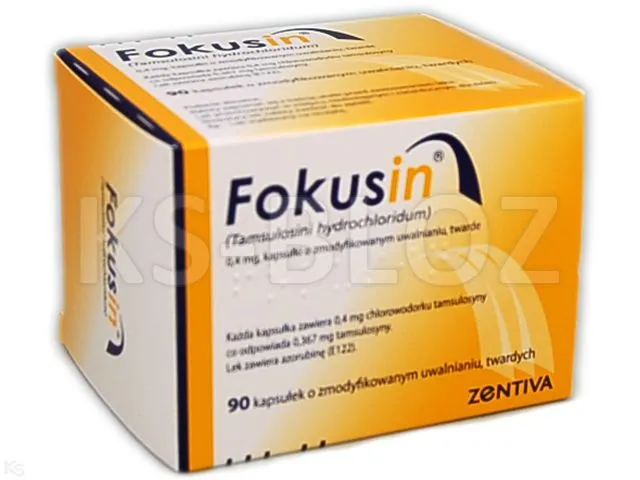
Table of Contents
Package leaflet: Information for the patient
WARNING: Keep the leaflet. Information on the outer packaging is in a foreign language.
FOKUSIN, 0.4 mg, modified-release capsules, hard
Tamsulosini hydrochloridum
Please read the entire leaflet carefully before using the medicine, as it contains
important information for the patient.
- Keep this leaflet, so that you can read it again if necessary.
- If you have any doubts, please consult your doctor or pharmacist.
- This medicine has been prescribed for a specific individual. Do not pass it on to others. The medicine may harm another person, even if their symptoms are identical.
- If you experience any adverse reactions, including any possible adverse reactions not listed in this leaflet, inform your doctor or pharmacist. See section 4.
Table of contents:
- What Fokusin is and what it is used for
- What you need to know before taking Fokusin
- How to take Fokusin
- Possible side effects
- How to store Fokusin
- Contents of the pack and other information
1. What Fokusin is and what it is used for
Fokusin contains the active substance tamsulosin, which reduces the tone of smooth muscles in the prostate and urethra. This results in improved urine flow through the urethra and consequently easier urination.
Fokusin is used in men for the treatment of symptoms associated with benign prostatic hyperplasia, such as difficulty in urinating, dribbling urination, strong sensation of sudden urge to urinate, and frequent urination both during the day and at night.
2. Important information before using Fokusin
When not to use Fokusin
- if the patient is allergic to the active substance or to any of the other ingredients of this medicine (listed in section 6),
- in case of angioedema (vascular swelling occurring during an allergic reaction) experienced after taking certain medicines,
- in case of severe hepatic insufficiency,
- in case of dizziness upon changing position from lying down to standing or sitting,
- if the patient has felt unwell during or after urination (micturition syncope).
Warnings and precautions
Before starting treatment with Fokusin, consult your doctor or pharmacist.
Regular medical monitoring is required during long-term treatment.
Rarely, a decrease in blood pressure has been reported during treatment with Fokusin.
If dizziness occurs, the patient should sit or lie down until symptoms subside.
Caution is advised in patients with severe renal insufficiency due to insufficient clinical data on patients with severe renal impairment.
Rarely, angioedema (vascular swelling occurring during an allergic reaction) has been reported during treatment with tamsulosin (the active substance in Fokusin). If angioedema occurs, the patient should immediately contact a doctor for assistance and discontinue Fokusin. The medicine should not be used again.
If cataract surgery is planned, inform the doctor about current or recent use of Fokusin.
Children and adolescents
This medicine should not be given to children or adolescents under 18 years of age, as it is ineffective in this population.
Fokusin with other medicines
Inform your doctor or pharmacist about all medicines currently or recently taken, as well as any medicines planned for future use.
Tamsulosin may affect other medicines, and other medicines may affect the action of tamsulosin.
Tamsulosin may interact with:
- diclofenac, a pain-relieving and anti-inflammatory medicine. This medicine may accelerate the elimination of tamsulosin from the body, thereby shortening its duration of action.
- warfarin, a medicine used to prevent blood clots. This medicine may accelerate the elimination of tamsulosin from the body, thereby shortening its duration of action.
- other α-adrenergic receptor antagonists. Combination may lower the patient's blood pressure, causing dizziness and a sensation of "emptiness" in the head.
- medicines that may delay the elimination of Fokusin from the body (e.g. ketoconazole, erythromycin).
Fokusin with food and drink
The capsule should be taken after breakfast or after the first meal of the day. The capsule should be swallowed whole, while remaining in a sitting or standing position, and taken with a glass of water. Do not open, crush, or chew the capsule.
Pregnancy, breastfeeding and fertility
Pregnancy and breastfeeding
Fokusin is intended exclusively for the treatment of men; therefore, information regarding pregnancy and breastfeeding is not relevant.
Fertility
Ejaculation difficulties have been reported in connection with the use of tamsulosin (see section 4).
Driving and using machines
Dizziness may occur during treatment. For this reason, activities requiring high concentration should only be performed after obtaining approval from a doctor.
3. How to use Fokusin
This medicine should always be taken exactly as directed by your doctor or pharmacist. If you have any doubts,
consult your doctor or pharmacist.
The recommended dose is 1 capsule once daily. The capsule should be taken after breakfast or after the first
meal of the day. The capsule must be swallowed whole, while sitting or standing, and taken with a glass of water. Do not open, crush, or chew the capsule.
Taking more Fokusin than recommended
Overdose may result in low blood pressure. Blood pressure and heart rate should return to normal values
after placing the patient in a lying position.
If you have taken more capsules than prescribed, or if a child has accidentally ingested the medicine,
seek immediate medical advice from a doctor.
Missing a dose of Fokusin
If you miss a dose of Fokusin, take it as soon as possible on the same day. If you realize the missed dose
on the following day, resume your regular dosing schedule. Do not take a double dose to make up for
a missed dose.
Stopping Fokusin treatment
Do not stop taking this medicine before the recommended treatment period ends, without consulting
your doctor.
If you have any further questions about the use of this medicine, consult your doctor or pharmacist.
4. Possible adverse reactions
Like all medicines, this medicine can cause adverse reactions, although not everyone will experience them.
If dizziness or weakness occurs, sit or lie down until
symptoms subside.
You should stop taking this medicine and seek immediate medical help
if you experience:
- hypersensitivity reactions with purple spots or patches on the skin, skin blistering, skin peeling, (high) fever, joint pain and (or) eye inflammation (Stevens-Johnson syndrome)*, severe allergic reaction causing swelling of the face or larynx (angioedema)**
The adverse reactions that may occur are listed below, grouped according to frequency:
Common (may affect up to 1 in 10 people): dizziness (may occur especially with sudden change in body position – changing from lying to sitting or standing), difficulty in ejaculation, low volume or absence of ejaculate, cloudy urine after intercourse.
Uncommon (may affect up to 1 in 100 people): headache, sensation of heart pounding (palpitations), feeling of "emptiness" in the head or fainting (orthostatic hypotension), nasal swelling and irritation (rhinitis), constipation, diarrhoea, nausea, vomiting, rash, itching, urticaria, feeling of weakness (asthenia).
Rare (may affect up to 1 in 1,000 people): brief loss of consciousness (fainting), angioedema**.
Very rare (may affect up to 1 in 10,000 people): painful, prolonged unwanted erection requiring immediate treatment (priapism), Stevens-Johnson syndrome*.
Not known (frequency cannot be estimated from available data): visual disturbances, blurred vision, nosebleeds (epistaxis), rash with red irregular spots (erythema multiforme), skin redness and peeling (exfoliative dermatitis), irregular heart rhythm (atrial fibrillation, cardiac arrhythmia, tachycardia), breathing difficulties (dyspnoea), dry mouth.
During eye surgery, a condition called Intraoperative Floppy Iris Syndrome (IFIS) may occur: the pupil may dilate poorly and the iris (the coloured circular part of the eye) may become floppy during the procedure. For more information, see section 2.
Reporting of adverse reactions
If any adverse reactions occur, including any adverse reactions not listed in this leaflet, inform your doctor or pharmacist. Adverse reactions can be reported directly to the Department of Monitoring Adverse Drug Reactions of the Office for Registration of Medicinal Products, Medical Devices and Biocidal Products, Al. Jerozolimskie 181C, 02-222 Warsaw, phone: 22 49-21-301, fax: 22 49-21-309, website: https://smz.ezdrowie.gov.pl
Adverse reactions can also be reported to the marketing authorization holder.
Reporting adverse reactions helps provide more information on the safety of the medicine.
5. How to store Fokusin
Keep this medicine out of sight and reach of children.
Do not use this medicine after the expiry date stated on the packaging. The expiry date refers to the last day of the stated month.
Store below 25°C.
Medicines must not be disposed of via wastewater or household waste. Ask your pharmacist how to dispose of medicines no longer required. Such measures will help protect the environment.
6. Contents of the pack and other information
What Fokusin contains
The active substance is tamsulosin hydrochloride, 0.4 mg in each capsule, corresponding to 0.367 mg of tamsulosine.
The other ingredients are: Capsule contents: microcrystalline cellulose, methacrylic acid-ethyl acrylate copolymer (1:1) dispersion 30% (containing sodium lauryl sulfate, polysorbate 80), dibutyl sebacate, colloidal anhydrous silica, polysorbate 80, calcium stearate. Capsule shell: gelatin, titanium dioxide (E 171), yellow iron oxide (E 172), red iron oxide (E 172), black iron oxide (E 172), indigotine – FD&C Blue No. 2 (E 132).
What Fokusin looks like and contents of the pack
Fokusin modified-release hard capsules are hard gelatin capsules, size 3, with an orange body and an olive cap, containing white or almost white pellets.
Pack sizes: 10, 20, 30, 50, 90, 100 capsules.
For more detailed information, please contact the responsible party or the parallel importer.
Marketing Authorisation Holder in Lithuania, country of export:
Zentiva, k.s., U kabelovny 130, Dolní Měcholupy, 102 37, Prague 10, Czech Republic
Manufacturer
S.C. ZENTIVA S.A., B-dul Theodor Pallady nr. 50, sector 3, 032266 Bucharest, Romania
Parallel importer:
PharmaVitae Sp. z o.o. sp. k., ul. E. Orzeszkowej 3/35, 59-820 Leśna
Repackaged in:
Pharma Innovations Sp. z o.o., ul. Jagiellońska 76, 03-301 Warsaw
LABOR Pharmaceutical-Chemical Enterprise Sp. z o.o., ul. Długosza 49, 51-162 Wrocław
CEFEA Sp. z o.o. sp. komandytowa, ul. Działkowa 56, 02-234 Warsaw
IVA Pharm Sp. z o.o., ul. Drawska 14/1, 02-202 Warsaw
Medezin Sp. z o.o., ul. Zbąszyńska 3, 91-342 Łódź
CANPOLAND JOINT STOCK COMPANY, ul. Beskidzka 190, 91-610 Łódź
Marketing Authorisation numbers in Lithuania, country of export:
LT/1/ 06/0480/004
LT/1/ 06/0480/005
LT/1/ 06/0480/001
LT/1/ 06/0480/006
LT/1/ 06/0480/002
LT/1/ 06/0480/003
Parallel import authorisation number: 88/22