Flegamina fast
Poland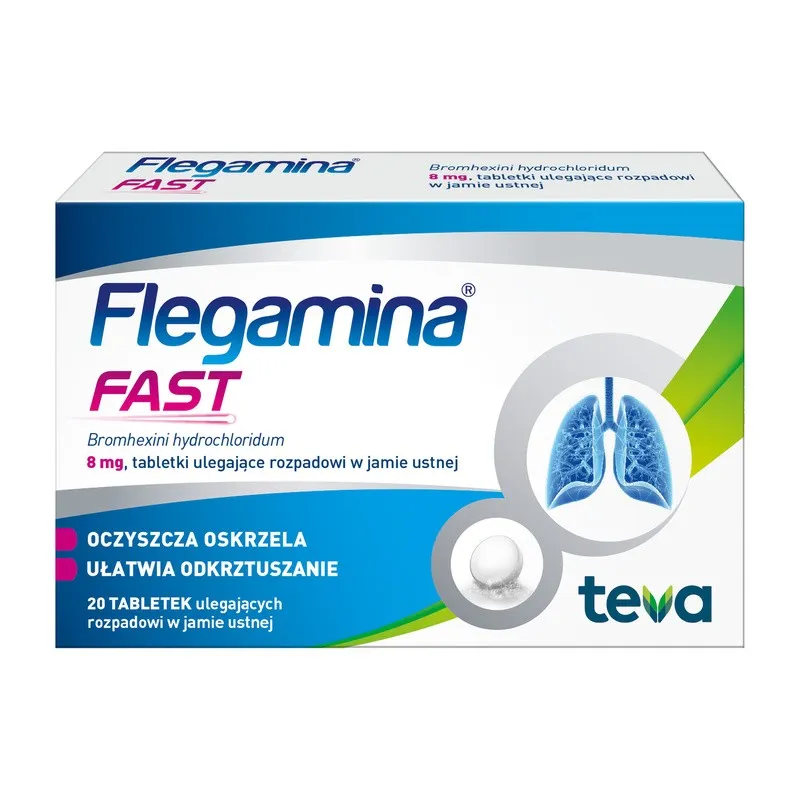
Table of Contents
Patient Information Leaflet
Flegamina Fast, 8 mg, orodispersible tablets
Bromhexini hydrochloridum
Please read this leaflet carefully before taking the medicine, as it contains
important information for the patient.
This medicine should always be used exactly as described in this patient leaflet or
as directed by the physician or pharmacist.
- Keep this leaflet so that it can be consulted again if necessary.
- If advice or additional information is needed, please contact a pharmacist.
- If any adverse reactions occur, including any adverse reactions not listed in this leaflet, inform a physician or pharmacist. See section 4.
- If there is no improvement after 5 days of treatment in adults or after 3 days of treatment in adolescents aged over 12 years, or if the patient feels worse, medical advice should be sought from a physician.
Table of contents of the leaflet :
- What Flegamina Fast is and what it is used for
- Important information before taking Flegamina Fast
- How to take Flegamina Fast
- Possible side effects
- How to store Flegamina Fast
- Contents of the pack and other information
1. What Flegamina Fast is and what it is used for
Flegamina Fast contains bromhexine hydrochloride as the active substance, which acts as an expectorant by liquefying respiratory tract secretions. This facilitates the cilia (tiny hairs lining the respiratory tract) in transporting bronchial mucus and removing it from the lungs.
Bromhexine facilitates expectoration and relieves cough.
This medicine is indicated for acute and chronic respiratory tract disorders associated with impaired mucus expectoration and clearance in adults and adolescents aged over 12 years.
If there is no improvement after 5 days of treatment in adults or after 3 days of treatment in adolescents aged over 12 years, or if the patient feels worse, medical advice should be sought from a physician.
2. Information before taking Flegamina Fast
When not to take Flegamina Fast
- if the patient is allergic (hypersensitive) to bromhexine or any of the other ingredients of this medicine (listed in section 6),
- in children under 12 years of age.
Warnings and precautions
Before starting treatment with Flegamina Fast, consult a doctor or pharmacist if:
-
the patient has inflammatory respiratory conditions associated with bacterial infection.
Flegamina Fast should be taken simultaneously with antibiotics and bronchodilators prescribed by a doctor. During treatment, it is important to drink plenty of fluids, especially when fever is present. Adequate hydration helps liquefy bronchial secretions and facilitates expectoration. -
the patient has a history of peptic ulcer disease of the stomach and duodenum, or active peptic ulcer disease of the stomach and duodenum, as bromhexine may exacerbate symptoms.
-
the patient has asthma.
-
the patient has impaired bronchial motility, e.g. a condition known as ciliary dyskinesia.
-
the patient has impaired liver or kidney function.
-
the patient has difficulty expectorating.
-
severe skin reactions associated with bromhexine use have been reported. If a rash occurs (including blisters or mucosal lesions, e.g. in the oral cavity, throat, nose, eyes, or genital organs), discontinue Flegamina Fast immediately and contact a doctor without delay (see section 4).
Children
Do not use in children under 12 years of age.
Before starting treatment with Flegamina Fast, consult a doctor or pharmacist.
For children aged 2 to 12 years, Flegamina Fast Junior at a dose of 4 mg is recommended.
Flegamina Fast and other medicines
Inform your doctor or pharmacist about all medicines currently used, recently taken, or planned for use.
Flegamina Fast should be used with caution together with atropine and other anticholinergic drugs, as they may cause dryness of mucous membranes.
Flegamina Fast should not be taken simultaneously with antitussive medicines, e.g. those containing codeine or its derivatives, as this may lead to dangerous accumulation of bronchial secretions due to suppressed cough reflex.
Bromhexine may intensify the irritating effect of salicylates and other non-steroidal anti-inflammatory drugs (NSAIDs) on the gastrointestinal mucosa.
Concomitant use of bromhexine and antibiotics (medicines used to treat infections: erythromycin, doxycycline, amoxicillin, cefuroxime) may increase antibiotic concentration in the lungs.
Pregnancy, breastfeeding, and fertility
If the patient is pregnant or breastfeeding, suspects she may be pregnant, or is planning to have a child, she should consult a doctor or pharmacist before using this medicine.
The use of Flegamina Fast is not recommended during the first trimester of pregnancy. During the remainder of pregnancy, the medicine may be used only if, in the opinion of the doctor, the benefit to the mother outweighs the potential risk to the fetus.
If the patient is breastfeeding, she should consult a doctor before using this medicine.
Bromhexine passes into human milk. There is insufficient information on the effects of bromhexine on newborns and infants. Use of the medicine during breastfeeding is not recommended.
There are no data on the effect of bromhexine on human fertility.
Driving and operating machinery
No studies have been conducted on the effects of bromhexine on the ability to drive or operate machinery. Caution is advised, as headache, dizziness, or drowsiness may occur.
Flegamina Fast contains sodium
This medicine contains less than 1 mmol (23 mg) of sodium per tablet; therefore, this medicine is considered "sodium-free".
3. How to take Flegamina Fast
This medicine should always be taken exactly as described in this patient information leaflet or as advised by a doctor or pharmacist. If in doubt, consult a doctor or pharmacist.
Adults, including elderly patients
1 tablet 3 times daily.
At the beginning of treatment, the dose may need to be increased to 48 mg (maximum dose)
(2 tablets 3 times daily, corresponding to 48 mg of bromhexine).
Children and adolescents
Adolescents over 12 years of age: 1 tablet 3 times daily, up to a maximum of 6 tablets per day (corresponding to 48 mg of bromhexine).
For children aged 2 to 12 years, another medicine is recommended – Flegamina Fast Junior 4 mg.
Method of administration
Oral administration.
Do not handle Flegamina Fast tablets with wet hands, as they may disintegrate.
The orally disintegrating Flegamina Fast tablet should be placed in the mouth, where it will disperse in saliva within 30 seconds and can be easily swallowed. Immediately before administration, the tablet may be dissolved on a teaspoon in a small amount of drinking water. The dose should be taken immediately after opening the blister pack.
Do not use this medicine for longer than 7 days without consulting a doctor. If symptoms worsen or do not improve after 5 days of treatment in adults or after 3 days in adolescents over 12 years of age, consult a doctor.
The medicine should be taken at regular intervals, after meals.
Do not take the medicine immediately before bedtime.
Use in patients with hepatic or renal impairment
There is a lack of data regarding the use of bromhexine hydrochloride in patients with hepatic or renal impairment. Elimination of bromhexine or its metabolites is reduced in these patients. Patients should consult a doctor before using the medicine.
Overdose of Flegamina Fast
In case of accidental overdose, seek immediate medical attention.
Symptoms observed in accidental overdose are similar to the adverse effects of bromhexine at recommended doses and require symptomatic treatment. Excessive secretion may occur.
In case of overdose, the doctor may perform gastric lavage, administer activated charcoal, and provide symptomatic treatment.
Missed dose of Flegamina Fast
If a dose is missed, it should be taken as soon as remembered, unless it is almost time for the next dose. In that case, the missed dose should be skipped and the regular dosing schedule resumed. Do not take a double dose to make up for a missed dose.
If you have any further questions about the use of this medicine, consult your doctor or pharmacist.
4. Possible adverse reactions
Like all medicines, this medicine can cause adverse reactions, although not everyone will experience them.
You must immediately contact a doctor or go to the nearest hospital if the following occur:
- severe skin reactions (including erythema multiforme, Stevens-Johnson syndrome, toxic epidermal necrolysis, and acute generalized exanthematous pustulosis)
- allergic reactions (including rash, swelling of the face, lips, tongue and/or throat, which may cause difficulty in breathing or swallowing).
The following adverse reactions may occur:
Not common (may affect up to 1 in 100 people):
upper abdominal pain, nausea, vomiting, diarrhoea
Rare (may affect up to 1 in 1000 people):
skin rash, urticaria, hypersensitivity reactions.
Frequency unknown (frequency cannot be estimated from available data):
dyspepsia, excessive sweating, severe skin reactions (including erythema multiforme, Stevens-Johnson syndrome, toxic epidermal necrolysis, and acute generalized exanthematous pustulosis), anaphylactic reactions including anaphylactic shock, angioedema and pruritus, hypotension, increased liver enzyme activity, headache, dizziness, somnolence, bronchospasm.
Reporting of adverse reactions
If any adverse reactions occur, including any adverse reactions not listed in this leaflet, inform your doctor or pharmacist. Adverse reactions can be reported directly to the Department of Monitoring Adverse Drug Reactions of the Office for Registration of Medicinal Products, Medical Devices and Biocidal Products: Al. Jerozolimskie 181C, 02-222 Warsaw, phone: +48 22 49 21 301, fax: +48 22 49 21 309, website: https://smz.ezdrowie.gov.pl.
Adverse reactions can also be reported to the marketing authorization holder.
Reporting adverse reactions helps to provide more information on the safety of the medicine.
5. How to store Flegamina Fast
Keep this medicine out of sight and reach of children.
There are no special requirements regarding storage temperature.
Store in the original packaging to protect from light and moisture.
Do not use this medicine after the expiry date stated on the carton or blister after "Expiry date (EXP)" or "EXP". The expiry date refers to the last day of the stated month.
Medicines must not be disposed of via wastewater or household waste. Ask your pharmacist how to dispose of medicines no longer required. This will help protect the environment.
6. Contents of the pack and other information
What Flegamina Fast contains
The active substance is bromhexine hydrochloride. One orodispersible tablet contains 8 mg of bromhexine hydrochloride.
The other ingredients are: Mannitol, Crospovidone (type B), Sucralose, Colloidal anhydrous silica, Magnesium stearate, Strawberry flavour PHS-455920 containing: Natural flavouring substances, flavouring preparations, Corn maltodextrin, Sodium octenyl succinate starch (E 1450).
What Flegamina Fast looks like and contents of the pack
Flegamina Fast orodispersible tablets: white, round, biconvex with bevelled edges, 9 mm in diameter.
The pack contains 10, 20 or 40 orodispersible tablets.
Marketing Authorisation Holder
Teva B.V., Swensweg 5, 2031 GA Haarlem, The Netherlands
Manufacturer
Mako Pharma Sp. z o.o., ul. Władysława Reymonta 2, 05-092 Dziekanów Leśny