Finospir
Poland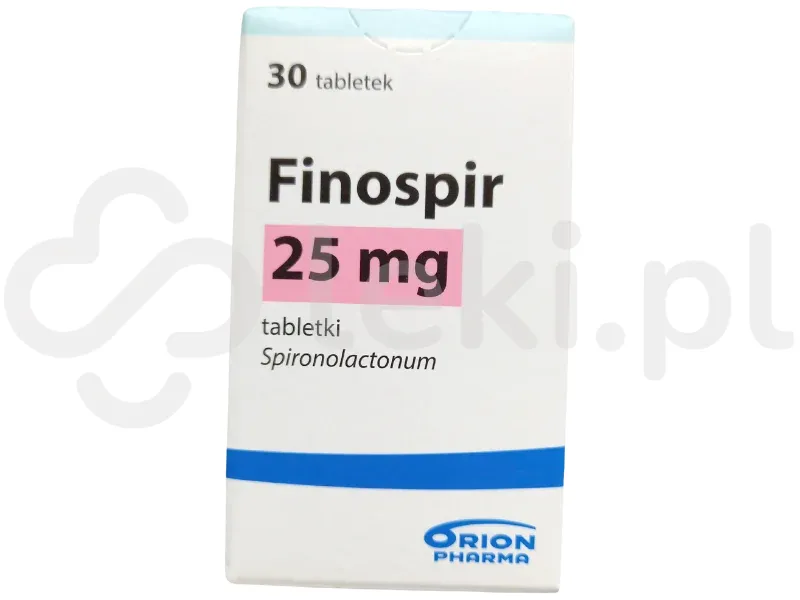
Table of Contents
Patient Information Leaflet
Finospir, 25 mg, tablets
Finospir, 50 mg, tablets
Finospir, 100 mg, tablets
Spironolactonum
Please read the entire leaflet carefully before taking this medicine, as it contains
important information for the patient.
- Keep this leaflet, as you may need to read it again.
- If you have any questions, please consult your doctor or pharmacist.
- This medicine has been prescribed specifically for you. Do not pass it on to others. This medicine may harm others, even if their symptoms are the same as yours.
- If you experience any adverse reactions, including any not listed in this leaflet, inform your doctor or pharmacist. See section 4.
Table of Contents:
- What Finospir is and what it is used for
- Important information before taking Finospir
- How to take Finospir
- Possible side effects
- How to store Finospir
- Contents of the pack and other information
1. What Finospir is and what it is used for
The active substance in Finospir, spironolactone, reduces excess fluid in the body by increasing urine output. Spironolactone differs from other diuretics in that it does not cause potassium loss in the urine.
This medicine is used to treat:
- high blood pressure or heart failure as an additional treatment in patients who do not respond adequately to other medicines
- edema (fluid retention) associated with kidney or liver diseases or other conditions when other treatments have proven ineffective
- primary hyperaldosteronism (excessive aldosterone production by the adrenal glands).
Your doctor may have prescribed this medicine for a condition other than those listed in this leaflet.
Children should only be treated under the supervision of a pediatrician.
2. Important information before using Finospir
When not to take Finospir
- if the patient is allergic (hypersensitive) to spironolactone or any of the other ingredients of this medicine (listed in section 6)
- if the patient has acute or chronic kidney failure
- if the patient has anuria (lack of urine excretion)
- if the patient has excessively high potassium levels in the blood
- if the patient has low sodium levels in the blood
- if the patient has acute adrenal insufficiency (adrenal crisis)
- if the patient has congenital disorders of hemoglobin metabolism (porphyria). This disease causes skin blisters, abdominal pain, and nervous system disorders
- Finospir must not be used in children with moderate or severe kidney impairment.
Warnings and precautions
Before starting Finospir, discuss this with your doctor or pharmacist.
- if the patient has liver or kidney impairment
- if the patient has diabetes and kidney function disorders
- if the patient has gastric or duodenal ulcers
- if the patient is pregnant.
Concurrent use of Finospir with certain medicines, potassium supplements, or potassium-rich foods may lead to severe hyperkalemia (increased potassium levels in the blood). Symptoms of severe hyperkalemia may include: muscle cramps, cardiac arrhythmias, diarrhea, nausea, dizziness, or headache.
You should also inform your doctor about any other medical conditions and allergies.
Surgical procedures
If surgery becomes necessary while taking Finospir, inform the doctor about the medicine being taken.
Children
Finospir should be used with caution in children with high blood pressure who have mild kidney impairment due to the risk of hyperkalemia (increased potassium levels in the blood).
Finospir must not be used in children with moderate or severe kidney impairment (see section "When not to use Finospir").
Finospir and other medicines
Tell your doctor or pharmacist about all medicines the patient is currently taking or has recently taken, as well as any medicines the patient plans to take. Taking certain medicines together may affect the effectiveness of these medicines or of Finospir, or may cause adverse effects.
Inform your doctor if the patient is taking mitotane for the treatment of malignant adrenal tumors. This medicine should not be used concurrently with mitotane.
It is very important to inform the doctor if the patient is taking any of the following medicines:
- medicines used to treat high blood pressure, heart failure, and kidney diseases, particularly ACE inhibitors (enalapril, captopril, lisinopril, perindopril, or ramipril) and angiotensin II receptor antagonists (e.g., irbesartan, candesartan, losartan, telmisartan, or valsartan)
- digoxin, used in the treatment of heart failure
- potassium-sparing diuretics (amiloride or triamterene)
- aldosterone antagonists
- heparin or low-molecular-weight heparins (medicines used to prevent blood clots)
- potassium supplements
- warfarin, a medicine that inhibits blood clotting
- tacrolimus, a medicine used to prevent transplant rejection
- anti-inflammatory painkillers (e.g., acetylsalicylic acid, ibuprofen, or ketoprofen) used over a prolonged period
- lithium, used in the treatment of mood disorders
- noradrenaline
- certain anesthetics
- trimethoprim and trimethoprim with sulfamethoxazole
- abiraterone, used in the treatment of prostate cancer.
Finospir with food and drink
A diet high in potassium is not recommended due to the risk of hyperkalemia.
Pregnancy, breastfeeding, and fertility
If the patient is pregnant or breastfeeding, suspects she might be pregnant, or is planning to have a child, she should consult her doctor or pharmacist before using this medicine.
Pregnancy
Limited data are available on the use of spironolactone in pregnant women. The doctor will prescribe Finospir only if the potential benefits outweigh the risks.
Breastfeeding
Finospir should not be used in women who are breastfeeding. The patient should discuss the use of Finospir with her doctor, who will advise on alternative feeding methods during treatment with this medicine.
Driving and operating machinery
Dizziness, fatigue, or other adverse effects (see section 4) may occur when starting treatment or changing the dose. These symptoms may negatively affect the ability to drive and operate machinery. At the beginning of treatment and after any dose increase, driving and operating machinery should be avoided until the patient knows how the medicine affects them.
Finospir contains lactose
The tablets contain lactose (as monohydrate lactose) in the amount of: 57 mg (25 mg tablet), 114 mg (50 mg tablet), and 228 mg (100 mg tablet). If the patient has previously been diagnosed with intolerance to certain sugars, the patient should consult a doctor before taking this medicine.
3. How to use Finospir
This medicine should always be taken according to the instructions given by your doctor or pharmacist. If in
doubt, consult your doctor or pharmacist.
The daily dose may be taken at once or divided into two doses. The tablet should be taken with a glass of water or another liquid.
The tablets should be taken with food. Please note that the medicine is better absorbed if taken during a meal.
To maintain a constant effect of the medicine, the tablets should be taken at the same time each day. Taking the medicine at a fixed time is also the best way to avoid forgetting a dose.
The dosage of Finospir is determined individually, depending on the disease and the patient's general health condition. Below are the usual recommended doses of the medicine.
During treatment, your doctor will regularly monitor the blood levels of various chemical substances (e.g. electrolytes and creatinine).
Adults:
Severe heart failure: The usual initial dose is 25 mg per day. If necessary, your doctor may decide to increase the dose to 50 mg per day or reduce it to 25 mg every other day.
High blood pressure and edema (fluid retention): The usual dose is 25 mg to 100 mg per day.
Severe edema: 200 mg to 400 mg per day for a short period.
Treatment of excessive aldosterone secretion (a hormone secreted by the adrenal glands): 100 mg to 400 mg per day before surgery. The doctor will determine the dosage individually for each patient, prescribing the lowest effective dose when surgical treatment is not indicated.
Use in elderly patients:
Dosage adjustment is usually not necessary, provided the patient does not have kidney or liver impairment.
Use in children:
The doctor will determine the dosage based on the child's body weight and the type of disease.
The tablet may be divided into equal doses.
Renal impairment:
When determining the dosage and during ongoing treatment, the doctor will take into account kidney function.
Finospir should not be used if the patient has been diagnosed with severe renal impairment.
Taking more Finospir than recommended
If a patient or another person (e.g. a child) has taken more than the recommended dose, contact a doctor or hospital immediately. Overdose may cause the following symptoms: fatigue, confusion, motor incoordination, vomiting, dizziness, skin rash, and diarrhea.
If seeking medical help, bring the medicine's packaging with you.
Missed dose of Finospir
If a dose has been missed, take it as soon as possible. If it is almost time for the next dose, do not take the missed dose. Do not take a double dose or two consecutive doses to make up for the missed dose. Before going on vacation or a trip, the patient should ensure they have an adequate supply of the medicine.
If you have any further questions concerning the use of this medicine, consult your doctor or pharmacist.
4. Possible adverse reactions
Like all medicines, this medicine can cause adverse reactions, although not everyone will experience them.
Adverse reactions occur more frequently in patients who are seriously ill and have multiple
concomitant diseases. Neurological adverse reactions, such as confusion, headache, and loss of enthusiasm
(apathy), occur mainly in patients with impaired liver function due to
long-term liver damage (liver cirrhosis).
The adverse reactions are listed below according to their frequency of occurrence:
Common (may affect up to 1 in 10 people):
- headache
- gastrointestinal disturbances
- nausea
- diarrhoea
- vomiting
- dry skin
- drowsiness
- breast enlargement in men
- breast tenderness
- menstrual disorders
- impotence
Uncommon (may affect up to 1 in 100 people):
- abnormally high potassium or low sodium levels in blood
- confusion
- unusual sensory disturbances
- skin rash
- itching
- urticaria
- leg cramps
- changes in creatinine or renin levels in blood
Rare (may affect up to 1 in 1,000 people):
- dehydration
- apathy (lack of response, loss of initiative)
- changes in sexual desire
- dizziness
- renal failure
- decreased number of white blood cells or platelets
Very rare (may affect up to 1 in 10,000 people):
- liver function disorders
- hair loss
- increased body hair growth
- benign breast tumours
Frequency not known (frequency cannot be estimated from available data):
- toxic epidermal necrolysis (TEN)
- Stevens-Johnson syndrome
- drug reaction with eosinophilia and systemic symptoms (DRESS syndrome)
- pemphigoid (a disease characterized by the appearance of fluid-filled blisters on the skin)
Reporting of adverse reactions
If any adverse reactions occur, including any not listed in this leaflet, inform your doctor or pharmacist. Adverse reactions can be reported directly to the Department of Monitoring Adverse Drug Reactions of the Office for Registration of Medicinal Products, Medical Devices and Biocidal Products, Al. Jerozolimskie 181 C, 02-222 Warsaw,
Tel.: +48 22 49 21 301, Fax: +48 22 49 21 309,
Website: https://smz.ezdrowie.gov.pl
Adverse reactions can also be reported to the marketing authorization holder.
Reporting adverse reactions helps provide more information on the safety of this medicine.
5. How to store Finospir
Keep this medicine out of the sight and reach of children.
Do not use this medicine after the expiry date stated on the carton. The expiry date refers to the last day of the stated month.
No special precautions for storage of the medicine.
Medicines must not be disposed of via wastewater or household waste. Ask your pharmacist how to dispose of medicines no longer required. This will help protect the environment.
6. Contents of the pack and other information
What Finospir contains
- The active substance is spironolactone. Each tablet contains 25 mg, 50 mg, or 100 mg of spironolactone.
- The other ingredients are: monohydrate lactose, corn starch, povidone, polysorbate 80, peppermint oil, colloidal silicon dioxide, anhydrous magnesium stearate.
What Finospir looks like and contents of the pack
25 mg tablets: white or almost white, round, flat tablets with bevelled edges and a division line, 7 mm in diameter, marked with code ORN85.
50 mg tablets: white or almost white, round, flat tablets with bevelled edges and a division line, 9 mm in diameter, marked with code ORN213.
100 mg tablets: white or almost white, round, slightly convex tablets with a division line, 11 mm in diameter, marked with code ORN352.
The tablet can be divided into equal doses.
The tablets are packed in HDPE bottles with HDPE closures.
Pack sizes contain:
25 mg: 30, 50, 100 and 250 tablets
50 mg and 100 mg: 30, 50 and 100 tablets
PVC/Aluminium foil blisters
25 mg: 30 tablets
25 mg, 50 mg and 100 mg: 30 and 60 tablets
Not all pack sizes may be marketed.
Marketing Authorisation Holder
Orion Corporation
Orionintie 1
FI-02200 Espoo
Finland
Manufacturer
Orion Corporation
Orionintie 1
FI-02200 Espoo
Finland
Orion Corporation Orion Pharma
Joensuunkatu 7
FI-24100 Salo
Finland
For further information about this medicinal product, please contact the local representative of the Marketing Authorisation Holder:
Orion Pharma Poland Sp. z o.o.
[email protected]
This medicinal product is authorised in the European Economic Area countries under the following names:
Austria: Spironolacton Orion
Czech Republic, Finland, Lithuania, Norway, Sweden, Hungary: Spironolactone Orion
Denmark: Spiron
Spain: Espironolactona Orion
Iceland: Spiron
Poland: Finospir
Slovenia: Spironolakton Orion