Fexahist allergy
Poland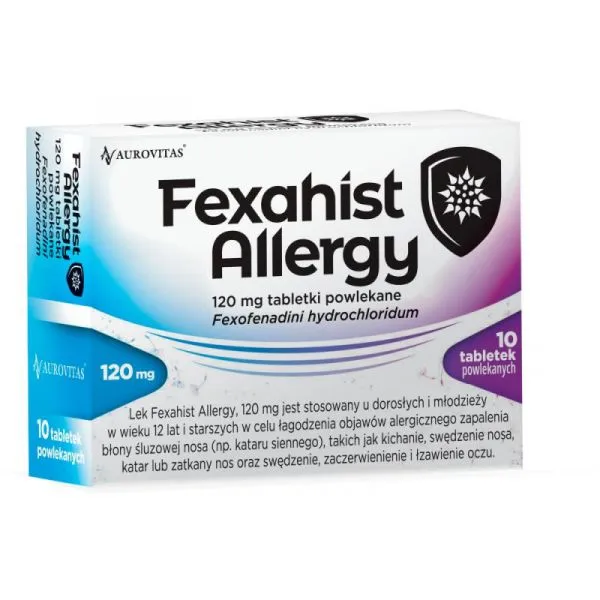
Table of Contents
Package leaflet: Information for the user
Fexahist Allergy, 120 mg, film-coated tablets
Fexofenadini hydrochloridum
Please read all of this leaflet carefully before taking this medicine because it contains
important information for you.
- This medicine should always be taken exactly as described in this patient leaflet or as directed by your doctor or pharmacist. Keep this leaflet as you may need to read it again. If you need advice or further information, please consult your pharmacist. If you experience any adverse reactions, including any not listed in this leaflet, inform your doctor or pharmacist. See section 4. If there is no improvement or if you feel worse after 7 days, contact your doctor.
Contents of the leaflet:
- What Fexahist Allergy is and what it is used for
- Important information before taking Fexahist Allergy
- How to take Fexahist Allergy
- Possible side effects
- How to store Fexahist Allergy
- Contents of the pack and other information
1. What Fexahist Allergy is and what it is used for
Fexahist Allergy contains fexofenadine hydrochloride, which is an antihistamine.
Fexahist Allergy 120 mg is used in adults and adolescents aged 12 years and older to relieve symptoms of allergic rhinitis (such as hay fever), including sneezing, runny or itchy nose, nasal congestion, as well as itchy, red and watery eyes.
If there is no improvement or if you feel worse after 7 days, consult your doctor.
2. Important information before using Fexahist Allergy
When not to use Fexahist Allergy
- if the patient is allergic to fexofenadine or any of the other ingredients of this medicine (listed in section 6).
Warnings and precautions
Before starting treatment with Fexahist Allergy, consult a doctor or pharmacist if:
- the patient has liver or kidney function disorders
- the patient has or has had heart disease, as this type of medicine may cause rapid or irregular heartbeat
- the patient is elderly.
If any of the above situations apply to the patient, or if the patient has any doubts, the patient should
inform the doctor before starting treatment with Fexahist Allergy.
Children and adolescents
Fexahist Allergy is not recommended for children under 12 years of age.
For children aged 6 to 11 years: fexofenadine hydrochloride in 30 mg tablets is the appropriate
formulation and dosage for this patient group.
Fexahist Allergy and other medicines
Tell the doctor or pharmacist about all medicines the patient is currently taking,
has recently taken, or plans to take.
If the patient is taking apalutamide (a medicine used to treat prostate cancer), the effect of fexofenadine
may be reduced.
It is especially important to talk to the doctor before taking fexofenadine if the patient
is also taking any of the following medicines:
- an antibiotic used to treat certain bacterial infections (erythromycin)
- an antifungal medicine used to treat fungal infections (ketoconazole).
These medicines increase the amount of absorbed fexofenadine.
Antacids containing aluminium and magnesium may affect the action of Fexahist Allergy by reducing the amount of medicine absorbed.
It is recommended to maintain an interval of approximately 2 hours between taking Fexahist Allergy and taking an antacid.
Pregnancy and breastfeeding
If the patient is pregnant or breastfeeding, suspects she may be pregnant, or is planning to have a
child, she should consult a doctor or pharmacist before using this medicine.
Fexahist Allergy should not be used if the patient is pregnant unless advised by a doctor.
Fexahist Allergy is not recommended during breastfeeding.
Driving and operating machinery
It is unlikely that Fexahist Allergy will affect the ability to drive or
operate machinery. However, before driving or operating machinery, the patient should
ensure that this medicine does not cause drowsiness or dizziness.
Fexahist Allergy contains lactose:
If the patient has previously been diagnosed with intolerance to certain sugars, the patient should contact
the doctor before taking this medicine.
Fexahist Allergy contains sodium:
This medicine contains less than 1 mmol (23 mg) of sodium per tablet, meaning the medicine is considered "sodium-free".
3. How to use the medicine
Dosage
This medicine should always be taken exactly as described in this patient information leaflet or as directed by a doctor or pharmacist. If in doubt, consult your doctor or pharmacist.
Adults and adolescents aged 12 years and over
The recommended dose is 1 tablet (120 mg) once daily.
The tablet should be taken before a meal, with water.
This medicine starts to relieve symptoms within 1 hour and the effect lasts for 24 hours.
Taking more Fexahist Allergy than recommended
If you have taken too many tablets, contact your doctor or pharmacist or go to the nearest hospital emergency department immediately. Symptoms of overdose in adults may include dizziness, drowsiness, fatigue, and dry mouth.
If you miss a dose of Fexahist Allergy
Do not take a double dose to make up for the missed dose. Take the next dose at the usual time, as directed.
Stopping Fexahist Allergy
If you stop taking Fexahist Allergy, symptoms may return.
If you have any further doubts about how to use this medicine, consult your doctor or pharmacist.
4. Possible adverse reactions
Like any medicine, this medicine can cause adverse reactions, although not everyone experiences them.
You should immediately consult a doctor and stop using Fexahist Allergy if the following occur:
- swelling of the face, lips, tongue or throat, and difficulty breathing – these may be symptoms of a severe allergic reaction.
The adverse reactions listed below have been reported in clinical studies, with a frequency similar to that observed in patients who did not receive the active drug (placebo).
Common adverse reactions (may occur in up to 1 in 10 people):
- headache
- drowsiness
- nausea
- dizziness
Uncommon adverse reactions (may occur in up to 1 in 100 people):
- fatigue
- lethargy
Other adverse reactions (frequency unknown: cannot be estimated based on available data) which may occur include:
- difficulty sleeping (insomnia)
- sleep disturbances
- nightmares
- nervousness
- blurred vision
- rapid or irregular heartbeat
- diarrhoea
- skin rash and itching
- urticaria
- severe allergic reactions which may include swelling of the face, lips, tongue or throat, sudden redness of the skin, chest tightness and difficulty breathing.
Reporting of adverse reactions
If any adverse reactions occur, including any adverse reactions not listed in this leaflet, inform your doctor or pharmacist. Adverse reactions can be reported directly to the Department of Monitoring Adverse Drug Reactions of the Office for Registration of Medicinal Products, Medical Devices and Biocidal Products, Al. Jerozolimskie 181C, 02-222 Warsaw, phone: +48 22 49 21 301, fax: +48 22 49 21 309, website: https://smz.ezdrowie.gov.pl
Adverse reactions can also be reported to the Marketing Authorisation Holder.
Reporting adverse reactions helps to provide more information on the safety of the medicine.
5. How to store Fexahist Allergy
Keep this medicine out of sight and reach of children.
Do not use this medicine after the expiry date stated on the carton and blister pack after: EXP.
The expiry date refers to the last day of the stated month.
No special storage conditions are required for this medicine.
Medicines must not be disposed of via wastewater or household waste. Ask your pharmacist how to dispose of medicines no longer in use. Such measures help protect the environment.
6. Contents of the pack and other information
What Fexahist Allergy contains
The active substance is fexofenadine hydrochloride.
Each film-coated tablet contains 120 mg of fexofenadine hydrochloride, equivalent to 112 mg of fexofenadine.
The other ingredients are:
Tablet core: sodium croscarmellose, lactose, monohydrate lactose, maize starch, colloidal anhydrous silica, pregelatinized starch, stearic acid.
Tablet coating: iron oxide red (E 172), iron oxide yellow (E 172), hypromellose type 2910 6 mPas (E 464), macrogol 400 (E 1521), titanium dioxide (E 171).
What Fexahist Allergy looks like and contents of the pack
Film-coated tablet
Peach-coloured, capsule-shaped, bevelled-edge, biconvex film-coated tablets, embossed with "FE" on one side and "120" on the other side.
Fexahist Allergy 120 mg film-coated tablets are available in blister packs containing 7, 10, 15, and 20 film-coated tablets, packed in a cardboard box.
Not all pack sizes may be marketed.
Marketing Authorisation Holder:
Aurovitas Pharma Polska Sp. z o.o.
ul. Sokratesa 13D lokal 27
01-909 Warszawa
e-mail: [email protected]
Manufacturer/Importer:
APL Swift Services (Malta) Ltd.
HF26, Hal Far Industrial Estate, Hal Far
Birzebbugia, BBG 3000
Malta
Generis Farmacêutica, S.A.
Rua João de Deus 19, Venda Nova
2700-487 Amadora
Portugal
Arrow Generiques
26 Avenue Tony Garnier
69007 Lyon
France
This medicinal product is authorised in the European Economic Area countries under the following names:
France: Fexofenadine Arrow 120 mg comprimé pelliculé
Germany: Fexofenadin PUREN 120 mg Filmtabletten
Netherlands: Fexofenadine HCl Aurobindo 120 mg, filmomhulde tabletten
Poland: Fexahist Allergy
Portugal: Fexofenadina Generis
Spain: Riniwel 120 mg comprimidos recubiertos con película EFG