Fervex extratabs
Poland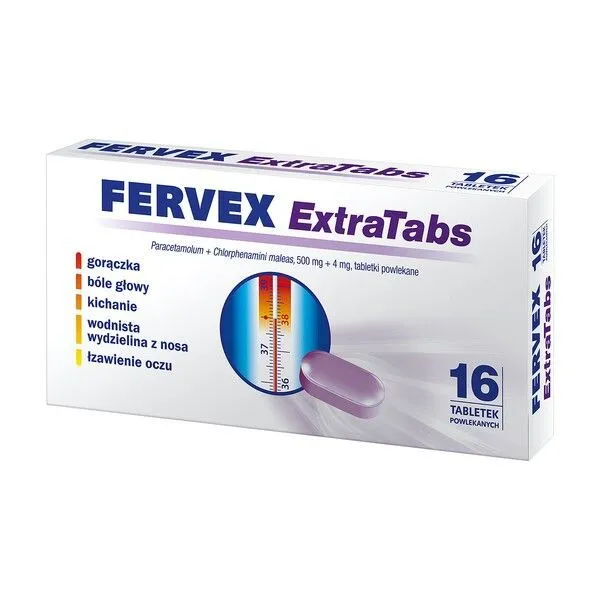
Table of Contents
Patient Information Leaflet
Fervex ExtraTabs, 500 mg + 4 mg, coated tablets
Paracetamolum + Chlorphenamini maleas
Please read this leaflet carefully before taking the medicine, as it contains important information for the patient.
This medicine should always be taken exactly as described in this patient leaflet or as directed by a doctor, pharmacist, or nurse.
- Keep this leaflet, as you may need to read it again.
- If you need advice or further information, please consult your pharmacist.
- If you experience any adverse effects, including any possible side effects not listed in this leaflet, inform your doctor, pharmacist, or nurse. See section 4.
- If you develop purulent nasal discharge, if fever or pain persists for more than 3 days, or if symptoms do not improve after 5 days, consult your doctor.
Table of Contents
- What Fervex ExtraTabs is and what it is used for
- Important information before taking Fervex ExtraTabs
- How to take Fervex ExtraTabs
- Possible side effects
- How to store Fervex ExtraTabs
- Contents of the pack and other information
1. What Fervex ExtraTabs is and what it is used for
Pharmacotherapeutic group: antipyretic, analgesic, antihistamine H-receptor antagonist, ATC code: R05X.
The medicine contains two active substances:
- paracetamol – relieves pain and reduces fever,
- chlorpheniramine maleate – reduces nasal discharge, tearing, and sneezing.
Fervex ExtraTabs is indicated for the treatment of symptoms of cold, rhinitis, inflammation of the mucous membranes of the nose and throat, and influenza-like conditions, such as:
- watery nasal discharge and tearing eyes
- sneezing
- headache
- fever.
This medicine is intended for use in adults and adolescents aged over 15 years.
For children under 15 years of age, other medicines are available; consult a doctor or pharmacist.
If there is no improvement after 5 days or if the patient feels worse, consult a doctor.
2. Important information before taking Fervex ExtraTabs
Do not take Fervex ExtraTabs if:
- you are allergic to the active substances or any of the other ingredients of this medicine (listed in section 6),
- in children under 15 years of age,
- in severe liver disease,
- in case of risk of glaucoma (increased intraocular pressure),
- in difficulty passing urine due to prostate (prostate gland) problems or other causes.
Warnings and precautions
Before starting treatment with Fervex ExtraTabs, discuss it with your doctor, pharmacist, or nurse.
In case of overdose or accidental ingestion of a higher dose than recommended, contact a doctor immediately.
If purulent nasal discharge develops, if fever or pain persists for more than 3 days, or if symptoms do not improve after 5 days, consult your doctor.
Strictly adhere to the recommended dosage, duration of treatment (5 days), and contraindications.
Related to paracetamol
Before taking this medicine, inform your doctor or pharmacist if:
- you are an adult weighing less than 50 kg,
- you have been diagnosed with kidney or liver disease,
- you are elderly,
- you regularly consume alcohol or have recently stopped drinking alcohol,
- in case of chronic malnutrition, fasting, recent weight loss, anorexia, or cachexia (low or depleted glutathione reserves in the liver),
- in case of dehydration,
- in case of glucose-6-phosphate dehydrogenase (G6PD) deficiency (may lead to hemolytic anemia),
- in case of Gilbert's syndrome (familial non-hemolytic jaundice).
In case of acute viral hepatitis, discontinue treatment and consult your doctor.
During treatment with Fervex ExtraTabs, immediately inform your doctor if you have severe conditions, including severe kidney disorders, sepsis (when bacteria and their toxins circulate in the blood, leading to organ damage), malnutrition, chronic alcoholism, or if you are also taking flucloxacillin (an antibiotic). In these situations, patients have been reported to develop a serious condition called metabolic acidosis (an imbalance in blood and body fluids) when taking paracetamol regularly for a prolonged period or when taking paracetamol together with flucloxacillin. Symptoms of metabolic acidosis may include: severe breathing difficulties, including rapid deep breathing, drowsiness, nausea, and vomiting.
Related to chlorpheniramine maleate
Discontinue treatment and contact your doctor or pharmacist immediately if one (or more) of the following adverse effects occur:
- diarrhea, vomiting, tachycardia, high body temperature (>38°C), sweating, tremor, muscle stiffness, confusion, restlessness.
Such adverse effects may be observed especially if the patient is already taking antidepressants and/or a medicine containing dextromethorphan.
Exercise caution in patients (particularly elderly patients) with prostate problems, severe liver and/or kidney insufficiency, tendency to chronic constipation, orthostatic hypotension, dizziness, or drowsiness.
Children
This medicine is indicated for use in adults and children over 15 years of age. In children and adolescents treated with paracetamol, combination with another antipyretic is not justified, except in cases of inefficacy. Persistent fever requires medical consultation.
Fervex ExtraTabs and other medicines
Inform your doctor or pharmacist about all medicines you are currently taking or have recently taken, as well as any medicines you plan to take.
This medicine contains paracetamol and chlorpheniramine maleate. Other medicines may also contain these substances.
Check whether other medicines taken by the patient contain paracetamol and/or chlorpheniramine maleate, including medicines available without a prescription.
Do not take these medicines simultaneously, to avoid exceeding the recommended daily dose.
If it is necessary to take other medicines containing the same substances, consult your doctor or pharmacist. (See section 3. How to take Fervex ExtraTabs)
Due to paracetamol content
Consult your doctor or pharmacist:
- if you are taking medicines that are potentially hepatotoxic. The toxicity of paracetamol may increase.
- if you or your child have been advised to measure blood uric acid or blood glucose levels, as this medicine may interfere with the results of these tests.
- if you are taking anticoagulant medicines (oral anticoagulants). High doses of Fervex ExtraTabs may enhance the effect of anticoagulant medicines. Your doctor may adjust the dose if necessary.
- if you are taking flucloxacillin (an antibiotic), due to the serious risk of blood and body fluid disorders (called metabolic acidosis), which require urgent treatment (see section 2).
Due to chlorpheniramine maleate content
During treatment, avoid using sodium hydroxymethylglycinate, consuming alcoholic beverages, or taking medicines containing alcohol.
Contact your doctor if you are taking other serotonergic medicines, medicines containing atropine (antispasmodics), other sedatives, acetylcholinesterase inhibitors (used in Alzheimer's disease or myopathy), or opioids (analgesics, antitussives, and medicines used in replacement therapies).
Contact your doctor if you are taking antidepressants and/or a product containing dextromethorphan.
Fervex ExtraTabs with food, drink, and alcohol
The medicine may cause drowsiness, which is intensified by alcohol:
- it is best to start treatment in the evening,
- during treatment, avoid consuming alcoholic beverages or using medicines containing alcohol.
Pregnancy, breastfeeding, and fertility
If you are pregnant or breastfeeding, think you may be pregnant, or are planning to have a child, consult your doctor or pharmacist before taking this medicine.
Pregnancy
If necessary, Fervex ExtraTabs may be used during pregnancy. Take the lowest effective dose that reduces symptoms for the shortest possible time. Consult your doctor if symptoms do not improve.
However, excessive use of the medicine towards the end of pregnancy may cause neurological symptoms in newborns. Always consult your doctor before taking this medicine and never exceed the recommended dose.
Breastfeeding
The medicine is likely to pass into breast milk. Use of this medicine during breastfeeding is not recommended due to its sedative effect in the infant (which may cause lethargy, reduced muscle tone) or, conversely, stimulation (insomnia).
Fertility
Paracetamol may affect fertility in women; however, this effect is reversible upon discontinuation of treatment.
Driving and operating machinery
Exercise particular caution when driving or operating machinery, as the medicine may cause drowsiness, especially at the beginning of treatment. If in doubt, consult your doctor or pharmacist.
This effect is intensified by consuming alcoholic beverages, using medicines containing alcohol, or taking sedative medicines. It is best to start treatment in the evening.
Fervex ExtraTabs contains sodium and carmoisine (azorubine) (E122)
The medicine contains carmoisine (azorubine as a coating agent) (E122), which may cause allergic reactions.
The medicine contains less than 1 mmol (23 mg) of sodium per tablet, meaning it is considered "sodium-free".
3. How to take Fervex ExtraTabs
This medicine should always be taken exactly as described in this patient leaflet or as directed by your doctor, pharmacist, or nurse. If in doubt, consult your doctor, pharmacist, or nurse.
This formulation is intended exclusively for adults and adolescents over 15 years of age.
Use the lowest effective dose for the shortest possible time.
| Body weight (age) | Single dose | Interval between doses | Maximum daily dose (tablets) | |-------------------|------------|--------------------------|-------------------------------| | Adults and adolescents with body weight > 50 kg (age > 15 years) | 1 tablet (500 mg paracetamol + 4 mg chlorpheniramine) | Minimum 4 hours | 4 tablets (2000 mg paracetamol + 16 mg chlorpheniramine) |
The maximum daily dose of chlorpheniramine maleate should not exceed 16 mg per day (4 tablets per day).
The maximum daily dose of paracetamol (including all other medicines containing paracetamol) should not exceed 4000 mg (4 g) per day.
Warning: To prevent the risk of overdose, check whether other medicines being used, including those available without a prescription, contain paracetamol and/or chlorpheniramine. Adhere strictly to the maximum recommended doses or the dose prescribed by your doctor: a higher dose will not relieve pain more effectively but may seriously damage the liver.
Adults weighing less than 50 kg, individuals with chronic malnutrition, dehydration, or elderly individuals: consult your doctor or pharmacist.
In case of liver impairment, chronic alcoholism, and Gilbert's syndrome: never exceed a dose of 2000 mg (2 g) paracetamol per day.
Kidney function disorders
Dosage should be adjusted according to the degree of kidney impairment. Consult your doctor before taking this medicine. If the effect of this medicine is too strong or too weak, do not exceed the recommended doses and consult your doctor or pharmacist.
Method of administration
Oral use.
Swallow the tablets whole with liquid (e.g., water, milk, fruit juice).
Due to the sedative effect of this medicine, it is best to start treatment in the evening.
Duration of treatment
Prolonged or frequent use without medical supervision is not recommended.
If fever or pain persists for more than 3 days or symptoms do not improve after 5 days, reconsider the ongoing treatment.
Taking more than the recommended dose of Fervex ExtraTabs
Discontinue treatment and contact your doctor or hospital emergency department immediately.
Overdose can be fatal.
Paracetamol overdose may cause liver damage, brain damage, coma, and even death, especially in particularly sensitive individuals such as young children and elderly patients, and in certain conditions (liver or kidney disease, chronic alcoholism, chronic malnutrition, fasting, recent weight loss, Gilbert's syndrome, and patients treated simultaneously with certain medicines). Rare cases of pancreas damage (causing severe abdominal and back pain), increased blood amylase levels, kidney failure, and simultaneous reduction in red blood cells, white blood cells, and platelets have been reported.
Within the first 24 hours, the main symptoms of poisoning are: nausea, vomiting, loss of appetite, pallor, malaise, sweating, loss of appetite, and abdominal pain.
Overdose may also lead to: coagulation disorders (bleeding and hemorrhage).
Chlorpheniramine maleate overdose may cause seizures (especially in children), loss of consciousness, and coma.
Missed dose of Fervex ExtraTabs
Do not take a double dose to make up for a missed dose.
Discontinuation of Fervex ExtraTabs
Not applicable.
If you have any further questions about the use of this medicine, consult your doctor, pharmacist, or nurse.
4. Possible adverse reactions
Like all medicines, this medicine can cause adverse reactions, although not everyone will experience them.
RELATED TO PARACETAMOL
Uncommon adverse reactions: may occur in fewer than 1 in 1,000 people
- Skin redness, rash, urticaria. Treatment must be stopped immediately, a doctor must be informed, and no further medicines containing paracetamol should be used.
- Skin bleeding spots (purpura). Treatment must be stopped immediately, and a doctor must be informed before taking any medicines containing paracetamol.
- Diarrhoea, abdominal pain.
Very rare adverse reactions: may occur in fewer than 1 in 10,000 people
- Severe skin reactions. Treatment must be stopped immediately and a doctor must be notified. Paracetamol-containing medicines must never be taken again.
- Biological changes requiring blood tests: liver function disorders, abnormally low counts of certain types of white blood cells or other types of blood cells such as platelets, which may lead to nose or gum bleeding. In such cases, consult a doctor.
Frequency not known: cannot be estimated from available data
- Rash or skin redness or allergic reaction, which may include sudden swelling of the face and neck, possibly leading to breathing difficulties (angioedema), or sudden malaise with low blood pressure (anaphylactic shock). Treatment must be stopped immediately, a doctor must be informed, and paracetamol-containing medicines must not be used again.
- Abnormal liver function test results.
- Skin rash with red, itchy patches and a burning sensation, leaving depigmented areas, which may recur in the same locations upon re-administration of the medicine (fixed drug eruption), breathing difficulties (bronchospasm), particularly if previous hypersensitivity reactions to aspirin or other non-steroidal anti-inflammatory drugs have occurred. In such cases, consult a doctor.
- Serious condition that may cause blood acidification (so-called metabolic acidosis) in patients with severe illness taking paracetamol (see section 2).
RELATED TO CHLORPHENAMINE MALEATE
Frequency not known: cannot be estimated from available data
- Abnormally low counts of certain types of white or red blood cells or other blood cells such as platelets.
- Swelling, allergic reactions with sudden swelling of the face and neck or sudden malaise with low blood pressure. Treatment must be stopped immediately and a doctor must be notified. Chlorphenamine maleate-containing medicines must never be taken again.
- Skin redness, rash, urticaria. Treatment must be stopped immediately and a doctor must be notified. Chlorphenamine maleate-containing medicines must never be taken again.
- Skin bleeding spots (purpura). Treatment must be stopped immediately. Consult a doctor before taking any medicines containing chlorphenamine maleate.
Other adverse reactions may occur:
- drowsiness, disturbances in alertness, especially at the beginning of treatment,
- drop in blood pressure when standing, which may be accompanied by dizziness,
- dry mouth, visual disturbances, urinary retention, constipation, palpitations,
- memory or concentration disturbances (especially in the elderly), confusion, balance disorders, dizziness, hallucinations,
- motor coordination disturbances, tremors,
- excitation: restlessness, nervousness, and insomnia.
Reporting of adverse reactions
If any adverse reactions occur, including any not listed in this leaflet, inform your doctor, pharmacist, or nurse. Adverse reactions can be reported directly to the Department of Monitoring Adverse Drug Reactions of the Office for Registration of Medicinal Products, Medical Devices and Biocidal Products: Al. Jerozolimskie 181C, 02-222 Warsaw, tel.: 22 49 21 301, fax: 22 49 21 309, website: https://smz.ezdrowie.gov.pl
Adverse reactions can also be reported to the marketing authorization holder.
Reporting adverse reactions helps to provide more information on the safety of the medicine.
5. How to store Fervex ExtraTabs
Keep this medicine out of sight and reach of children.
Do not use this medicine after the expiry date stated on the packaging, after EXP.
The expiry date refers to the last day of the stated month.
This medicine does not require any special storage conditions.
Medicines must not be disposed of via wastewater or household waste. Ask your pharmacist how to dispose of medicines no longer in use. This will help protect the environment.
6. Contents of the packaging and other information
What Fervex ExtraTabs contains
- The active substances are: paracetamol and chlorpheniramine maleate. Each coated tablet contains 500 mg of paracetamol and 4 mg of chlorpheniramine maleate.
- Other components are: sodium croscarmellose, hypromellose, microcrystalline cellulose, povidone K 90, glyceryl dibehenate, magnesium stearate, coating substance**.
** hypromellose (E464), carmoisine (azorubine) (E122), indigo carmine (E132), polydextrose (E1200), calcium carbonate, talc, medium-chain triglycerides
* See section 2
What Fervex ExtraTabs looks like and contents of the pack
The medicine is in the form of purple, oblong coated tablets.
The pack contains 4, 8, 12, 16, 20, 24, 28 or 32 coated tablets in a cardboard box.
Not all pack sizes may be marketed.
Marketing Authorisation Holder
UPSA SAS
3 rue Joseph Monier
92500 Rueil-Malmaison
France
Manufacturer
UPSA SAS
304, Avenue du Docteur Jean Bru
47000 Agen
France
UPSA SAS
979, Avenue des Pyrénées
47520 Le Passage
France
For further information about this medicine, please contact the local representative of the Marketing Authorisation Holder:
MagnaPharm Poland sp. z o.o.
ul. Inflancka 4
00-189 Warsaw
tel.: +48 22 570 27 00
This medicinal product is authorised in the European Economic Area member states under the following names:
Bulgaria: Ferwex nasinca i grip 500 mg/ 4 mg filmirani tabletki
Greece: Depon Cold & Flu, επικαλυμμένο με λεπτό υμένιο δισκίο, (500 + 4) mg/TAB
France: FERVEXRHUME, comprimé pelliculé
Italy: EFFERALGAN INFLUENZA E RAFFREDDORE 500 mg + 4 mg compresse rivestite con film
Romania: Fervex raceala si gripa 500 mg /4 mg comprimate filmate
Advice and health education
WHAT TO DO IN CASE OF STUFFY NOSE OR RUNNY NOSE:
This medicine is used for the treatment of cold symptoms in adults and adolescents over 15 years of age, in cases of nasal congestion, headache and (or) fever.
A cold is a very common, mild acute infection of the nasal mucosa (the inner surface of the nose). The mucous membrane secretes fluid which serves to humidify inhaled air and fight infectious agents. Irritation of the mucous membrane causes swelling and increased fluid secretion, resulting in a watery nasal discharge (runny nose).
To reduce the risk of symptom development, follow these hygiene rules as much as possible:
- Wash hands regularly, especially before meals and during food preparation,
- Cover mouth when coughing or sneezing,
- Blow nose regularly using disposable tissues (to avoid reinfection), dispose of used tissues in a bin immediately, and then wash hands,
- When using intranasal solutions, avoid sharing the same nasal applicator among family members,
- Avoid visiting postpartum women, newborns, elderly people, or individuals taking immunosuppressive medicines (e.g. corticosteroids, drugs used in blood disorders, anticancer drugs). In such cases, wearing masks is recommended.
For personal comfort, you should:
- Drink plenty of fluids,
- Moisten the nasal mucosa with appropriate solutions (physiological saline, thermal water or seawater). Avoid sharing the same nasal applicator among family members,
- Avoid smoking or exposure to smoke,
- Sleep with your head elevated to improve airflow through blocked nostrils and ensure adequate rest,
- If necessary, protect the upper lip and skin around the nostrils with a cream, as frequent nose blowing may irritate the skin,
- Avoid air conditioners, which dry the air and dehydrate the nasal mucosa; the ideal room temperature is about 18–20°C,
- Ventilate rooms regularly.
WHAT TO DO IN CASE OF FEVER:
Normal body temperature varies between individuals and ranges from 36.5°C to 37.5°C. A temperature above 38°C is considered fever.
If fever causes significant discomfort, you may take a medicine containing paracetamol, following the recommended dosage.
To prevent the risk of dehydration, remember to drink fluids frequently.
This medicine should rapidly reduce fever. However, consult a doctor immediately if:
- Other unusual symptoms appear,
- Fever persists for more than 3 days or worsens,
- Headache becomes severe or vomiting occurs.
WHAT TO DO IN CASE OF PAIN:
The intensity of pain perception and tolerance varies between individuals.
- If there is no improvement after 5 days of treatment,
- If the pain is severe, unexpected and sudden in onset (especially severe chest pain) or if pain recurs regularly,
- If pain is accompanied by other symptoms such as general malaise, fever, unusual swelling at the painful site, limb weakness, or if pain wakes you up at night, CONSULT A DOCTOR IMMEDIATELY.