Fervex d
Poland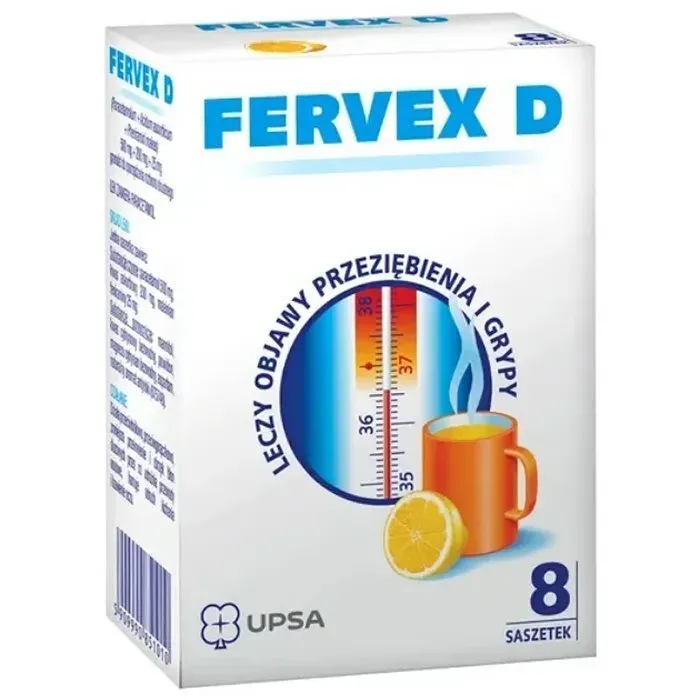
Table of Contents
Patient Information Leaflet
Warning! Keep this leaflet. The information on the immediate packaging is in a foreign language!
Fervex D (Fervex without sugar)
500 mg + 200 mg + 25 mg, effervescent granules for oral solution
Paracetamolum + Acidum ascorbicum + Pheniramini maleas
Fervex D and Fervex without sugar are different trade names of the same medicine.
Please read this leaflet carefully before taking the medicine, as it contains important information for the patient.
This medicine should always be taken exactly as described in this patient leaflet or as directed by the doctor, pharmacist, or nurse.
- Keep this leaflet, so you can read it again if necessary.
- If you need advice or further information, please consult your pharmacist.
- If you experience any adverse reactions, including any not listed in this leaflet, inform your doctor, pharmacist, or nurse. See section 4.
- If there is no improvement after 5 days, or if your condition worsens, or if fever persists beyond 3 days, consult your doctor.
Table of Contents:
- What Fervex D is and what it is used for
- Important information before taking Fervex D
- How to take Fervex D
- Possible side effects
- How to store Fervex D
- Contents of the packaging and other information
1. What Fervex D is and what it is used for
Fervex D is a combination medicine.
Paracetamol has analgesic and antipyretic effects.
Pheniramine maleate reduces mucosal congestion and swelling, thus clearing nasal passages, suppressing sneezing reflex and eye tearing.
Ascorbic acid replenishes vitamin C deficiency in the body.
Indications
Fervex D is indicated for short-term treatment of flu, cold, and flu-like symptoms (headache, fever, nasal and pharyngeal mucosa inflammation) in adults and adolescents over 15 years of age.
It may be used by patients with diabetes.
If a bacterial infection occurs, antibiotic treatment may be necessary.
If there is no improvement after 5 days, or if the patient feels worse, consult a doctor.
2. Important information before using Fervex D
When not to use Fervex D:
- if the patient is allergic to paracetamol, ascorbic acid, pheniramine maleate, or any of the other ingredients of this medicine (listed in section 6),
- if the patient has severe liver or kidney failure,
- if the patient has narrow-angle glaucoma,
- if the patient has benign prostatic hyperplasia with associated urinary retention,
- in children and adolescents under 15 years of age,
- in patients with phenylketonuria, due to the presence of aspartame (E 951).
Warnings and precautions
Before starting to use Fervex D, consult a doctor, pharmacist, or nurse.
If symptoms persist for more than 5 days or fever lasts longer than 3 days, the patient should consult a doctor. Do not use for longer than 5 days without medical advice.
The risk of dependence, mainly psychological, is mainly observed when doses higher than recommended are used or during long-term treatment.
The medicine contains paracetamol. To avoid the risk of overdose, check whether other medicines being taken also contain paracetamol. In adults with body weight over 50 kg, the TOTAL DAILY DOSE OF PARACETAMOL MUST NOT EXCEED 4 GRAMS.
Paracetamol should be used with caution in patients with glucose-6-phosphate dehydrogenase (G6PD) deficiency.
Children and adolescents
This medicine may be used in adolescents over 15 years of age.
Fervex D and other medicines:
Inform your doctor or pharmacist about all medicines currently or recently taken, as well as any medicines planned for future use.
Due to the presence of pheniramine
Not recommended combinations
Alcohol enhances the sedative effect of most antihistamines – H receptor antagonists. Impaired concentration may affect the ability to drive or operate machinery.
Avoid consuming alcoholic beverages or taking medicines containing alcohol.
Combinations requiring caution
Other medicines with sedative effects: morphine derivatives (analgesics, antitussives), neuroleptics, barbiturates, benzodiazepines, non-benzodiazepine anxiolytics (e.g. meprobamate), hypnotics, sedative antidepressants (amitriptyline, doxepin, mianserin, mirtazapine, trimipramine), sedative H -receptor blocking antihistamines, centrally acting antihypertensives, baclofen, and thalidomide.
Increased central nervous system depression and associated impairment in concentration may affect the ability to drive or operate machinery.
Other medicines with anticholinergic (atropine-like) effects: tricyclic antidepressants (structurally similar to imipramine), most antihistamines with anticholinergic properties, antiparkinsonian anticholinergics, antispasmodic drugs with atropine-like action, disopyramide, phenothiazine derivative neuroleptics, clozapine.
Additive anticholinergic adverse effects such as urinary retention, constipation, and dry mouth may occur.
Due to the presence of paracetamol
Acetanilide prolongs the elimination time of paracetamol.
Rifampicin, antiepileptic drugs, hypnotics from the barbiturate group, and other drugs inducing microsomal enzymes, when used concomitantly with paracetamol, increase the risk of liver damage.
Caffeine enhances the analgesic and antipyretic effects of paracetamol.
Concomitant use of high doses of paracetamol and nonsteroidal anti-inflammatory drugs (NSAIDs) may increase the risk of kidney function disorders.
Paracetamol enhances the effect of oral anticoagulants from the coumarin group.
Paracetamol used together with MAO inhibitors may cause a state of excitation and high fever.
Effect on laboratory test results
Paracetamol may interfere with the determination of serum uric acid concentration by the phosphotungstic acid method, as well as with the determination of glucose concentration by the oxidase-peroxidase method.
Due to the presence of ascorbic acid
Ascorbic acid may reduce the effectiveness of warfarin and lower plasma levels of fluphenazine. It also decreases urine pH, which may affect the excretion of other concurrently administered drugs.
Use of Fervex D with food and drink
No contraindications.
Use of Fervex D with alcohol
Consumption of alcoholic beverages or use of sedatives (especially barbiturates) enhances the sedative effect of antihistamines; therefore, simultaneous use should be avoided.
Particular risk of liver damage exists in patients who are fasting and in regular alcohol consumers.
Pregnancy and breastfeeding
If the patient is pregnant or breastfeeding, suspects she may be pregnant, or is planning to have a child, she should consult a doctor or pharmacist before using this medicine.
Pregnancy
Use of this medicine during pregnancy is not recommended.
Breastfeeding
Use of this medicine during breastfeeding is not recommended.
Driving and operating machinery
Drowsiness may occur during treatment, which may affect the psychomotor performance of individuals driving vehicles or operating machinery.
Warnings regarding excipients with known effects
Fervex D contains 50 mg of aspartame (E 951) per sachet.
Aspartame (E 951) is a source of phenylalanine. It may be harmful to patients with phenylketonuria.
Phenylketonuria is a rare genetic disorder in which phenylalanine accumulates in the body due to impaired excretion.
Fervex D contains 3.5 g of mannitol (E 421) per sachet.
Fervex D contains 3 mg of alcohol (ethanol) per sachet. The amount of alcohol in one sachet of this medicine is equivalent to a small amount of beer or wine (trace amounts). The small amount of alcohol in this medicine will not cause noticeable effects.
3. How to use Fervex D
This medicine should always be taken exactly as described in this patient information leaflet or as directed by your doctor, pharmacist, or nurse. If in doubt, consult your doctor, pharmacist, or nurse.
Adults and adolescents over 15 years of age: 1 sachet 2 or 3 times daily (corresponding to 1500 mg paracetamol, 75 mg pheniramine maleate, and 600 mg vitamin C).
There should be at least a 4-hour interval between doses.
Elderly patients
No contraindications.
Patients with impaired renal and/or hepatic function
Caution is advised when administering the medicine to patients with impaired renal function. In cases of renal impairment (creatinine clearance below 10 ml/min), the interval between doses should be at least 8 hours.
Method of administration
For oral use. The contents of the sachet should be dissolved in a glass of hot or cold water.
Duration of treatment
Do not use this medicine for longer than 5 days without consulting a doctor. If symptoms persist for more than 5 days or fever lasts longer than 3 days, the patient should consult a doctor.
If you feel the effect of the medicine is too strong or too weak, consult your doctor or pharmacist.
Use of a higher than recommended dose of Fervex D
Symptoms of overdose
Related to pheniramine
Pheniramine overdose may cause: convulsions (especially in children), disturbances of consciousness, coma.
Related to paracetamol
There is a particular risk of paracetamol poisoning in elderly individuals and young children (most commonly due to ingestion of doses exceeding the recommended amount or accidental poisoning); such poisonings may lead to death.
Overdose of this product may cause symptoms such as: nausea, vomiting, excessive sweating, drowsiness, and general weakness, followed the next day by upper abdominal discomfort, recurrence of nausea, and jaundice.
What to do
In case of ingestion of a higher than recommended dose, seek immediate advice from a doctor or pharmacist.
Missed dose of Fervex D
Do not take a double dose to make up for a missed dose.
Stopping Fervex D
If you have any further questions about the use of this medicine, consult your doctor or pharmacist.
4. Possible adverse reactions
Like all medicines, this medicine can cause adverse reactions, although not everyone experiences them.
Related to pheniramine
Adverse reactions of varying severity, both dose-dependent and independent, may occur:
Neurovegetative effects:
- Sedation or drowsiness, more pronounced at the beginning of treatment,
- Anticholinergic symptoms such as dry mucous membranes, constipation, accommodation disturbances, pupil dilation, palpitations, risk of urinary retention,
- Orthostatic hypotension,
- Loss of coordination, dizziness, memory or concentration disturbances, more frequent in elderly patients,
- Motor coordination disorders, tremors,
- Confusion, hallucinations,
- Less frequently, symptoms of excitation: restlessness, nervousness, insomnia.
Hypersensitivity reactions (rare):
- Erythema, itching, rash, purpura, urticaria,
- Swelling, less frequently Quincke's edema (swelling of lips, tongue or larynx),
- Anaphylactic shock (a type of immediate systemic allergic reaction with circulatory and respiratory disturbances).
Blood system disorders:
- Leukopenia (reduced white blood cell count), neutropenia (reduced granulocyte count),
- Thrombocytopenia (reduced platelet count),
- Hemolytic anemia.
Related to paracetamol
Rare cases of hypersensitivity reactions have been reported, such as: anaphylactic shock, Quincke's edema, erythema, urticaria and skin rash. If any of these symptoms occur, administration of this medicine and medicines with similar composition must be discontinued immediately.
Exceptionally rare cases of thrombocytopenia (reduced platelet count), leukopenia and neutropenia have been observed.
Reporting of adverse reactions
If any adverse reactions occur, including those not listed in this leaflet, inform your doctor, pharmacist or nurse. Adverse reactions can also be reported directly to the Department of Monitoring of Adverse Drug Reactions at the Office for Registration of Medicinal Products, Medical Devices and Biocidal Products, Al. Jerozolimskie 181C, 02-222 Warsaw, tel.: +48 22 49 21 301, fax: +48 22 49 21 309, website: https://smz.ezdrowie.gov.pl.
Reporting adverse reactions helps to provide more information on the safety of the medicine.
5. How to store Fervex D
Keep this medicine out of sight and reach of children.
Do not store above 25°C.
Do not use this medicine after the expiry date stated on the packaging. The expiry date refers to the last day of the stated month.
Medicines must not be disposed of via wastewater or household waste. Ask your pharmacist how to dispose of medicines no longer required. Such practices help protect the environment.
6. Contents of the packaging and other information
What Fervex D contains
- The active substances are: paracetamol 500 mg, ascorbic acid 200 mg, pheniramine maleate 25 mg.
- Other ingredients are: mannitol (E 421), citric acid, povidone, magnesium citrate, aspartame (E 951), lemon flavour.
Lemon flavour: flavouring components (alpha-pinene, beta-pinene, sabinene, myrcene, limonene,
gamma-terpinene, para-cymene, linalool, neral, geranial, geranyl acetate, geraniol), triacetin (E 1518),
modified corn starch (E 1450), gum arabic (E 414), ethanol.
What Fervex D looks like and contents of the pack
Paper/Al/PE sachet containing granules for oral solution, packed in a cardboard box.
The cardboard box contains 8 sachets of 4.95 g each.
For more detailed information, please contact the responsible entity or the parallel importer.
Marketing Authorisation Holder in Lithuania, country of export:
UPSA SAS
3, rue Joseph Monier
92500 Rueil-Malmaison
France
Manufacturer:
UPSA SAS
979, Avenue des Pyrénées
47520 Le Passage
France
UPSA SAS
304, avenue du Docteur Jean Bru
47000 Agen
France
Parallel importer:
Medezin Sp. z o.o.
ul. Zbąszyńska 3
91-342 Łódź
Repackaged in:
Medezin Sp. z o.o.
ul. Zbąszyńska 3
91-342 Łódź
Marketing Authorisation Number in Lithuania, country of export: LT/1/97/3290/002
Parallel Import Licence Number: 281/24