Excedrin sprint
Poland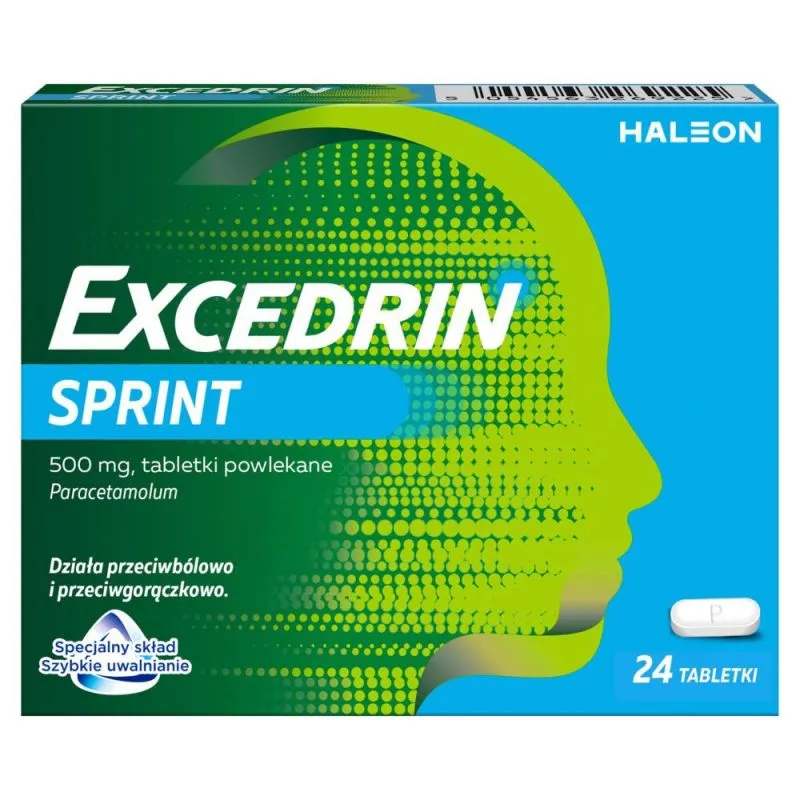
Table of Contents
Package leaflet: Information for the user
Excedrin Sprint
500 mg, coated tablets
Paracetamolum
Please read all of this leaflet carefully before taking this medicine, because it contains
important information for you.
This medicine should always be taken exactly as described in this patient leaflet or as directed by your
doctor, pharmacist, or nurse.
- Keep this leaflet so that you can read it again if necessary.
- If you need advice or further information, please consult your pharmacist.
- If you experience any adverse reactions, including any possible adverse reactions not listed in this leaflet, tell your doctor, pharmacist, or nurse. See section 4.
- If there is no improvement or if you feel worse after 3 days, consult your doctor.
Contents of the leaflet
- What Excedrin Sprint is and what it is used for
- What you need to know before taking Excedrin Sprint
- How to take Excedrin Sprint
- Possible side effects
- How to store Excedrin Sprint
- Contents of the pack and other information
1. What Excedrin Sprint is and what it is used for
Excedrin Sprint contains paracetamol, which has analgesic and antipyretic properties.
Excedrin Sprint is indicated for headaches, migraine, tension headache, toothache, neuralgia,
back pain, bone, joint and muscle pain, painful menstruation, sore throat, and symptomatic treatment of pain in mild arthritis.
Excedrin Sprint provides analgesic and antipyretic effects during colds and influenza-like conditions.
Excedrin Sprint has a special composition of excipients with disintegrant action (Optizorb™), accelerating tablet breakdown and thus enhancing the release rate compared to standard paracetamol tablets. Excedrin Sprint tablets begin to disintegrate within 5 minutes after administration.
2. Important information before using Excedrin Sprint
When not to use Excedrin Sprint
- if the patient is allergic to paracetamol or any of the other ingredients of this medicine (listed in section 6),
- in case of alcoholic disease,
- in case of severe liver or kidney failure.
Warnings and precautions
The medicine contains paracetamol. Do not use a higher dose than recommended. Overdose
of paracetamol may lead to severe liver damage.
This medicine should not be used simultaneously with other medicines containing paracetamol, such as
pain-relieving, antipyretic medicines, those used to treat flu and cold symptoms, or
those used as an aid in sleep difficulties.
The patient should read the leaflet carefully before using the medicine and follow the instructions
contained therein.
Before using the medicine, consult a doctor if:
- liver or kidney failure,
- deficiency of certain enzymes (glucose-6-phosphate dehydrogenase and methemoglobin reductase),
- patients suffering from chronic headaches,
- underweight or malnourished patients suffering from anorexia,
- patients who regularly consume alcohol (it may be necessary to completely stop taking this product or reduce the dose),
- severe infection (sepsis), which may increase the risk of metabolic acidosis. Symptoms of metabolic acidosis include:
- deep, rapid, and labored breathing,
- feeling of nausea, vomiting, and loss of appetite,
- general malaise.
Contact a doctor immediately if the patient experiences the above symptoms simultaneously.
Consult a doctor if the patient suffers from chronic headaches.
There is a particular risk of overdose leading to life-threatening liver damage in patients with alcoholic disease and in emaciated patients.
Existing liver disease increases the risk of liver damage associated with paracetamol use.
If symptoms persist, consult a doctor.
Do not exceed the recommended dose, and do not take it more often than every 4 hours.
Before taking the medicine, consult a doctor if the patient suffers from mild arthritis and needs to take pain-relieving medicines daily.
Paracetamol may cause false results in certain laboratory tests (e.g. blood glucose measurement).
If symptoms persist, consult a doctor.
Keep the medicine out of sight and reach of children.
Excedrin Sprint and other medicines
Inform your doctor or pharmacist about all medicines currently or recently taken, as well as any medicines you plan to take.
Do not use other medicines containing paracetamol simultaneously.
Consult your doctor if you are taking the following medicines:
- metoclopramide, domperidone (used against nausea and vomiting),
- cholestyramine (used to reduce high blood cholesterol levels),
- anticoagulants (such as warfarin or other coumarin-group medicines), if long-term pain-relief treatment is necessary,
- medicines increasing hepatic metabolism, i.e. certain sleeping or antiepileptic medicines (e.g. phenobarbital, phenytoin, carbamazepine), rifampicin (an anti-tuberculosis antibiotic), St. John's wort, which may lead to liver damage even when recommended doses of paracetamol are used,
- MAO inhibitors (used in the treatment of depression),
- salicylamide,
- non-steroidal anti-inflammatory drugs (including acetylsalicylic acid).
Pregnancy, breastfeeding, and fertility
If the patient is pregnant or breastfeeding, suspects she may be pregnant, or is planning to have a
child, she should consult a doctor or pharmacist before using this medicine.
Excedrin Sprint may be used during pregnancy if clinically justified. The lowest possible recommended
dose that reduces pain and (or) fever should be taken for the shortest possible duration and as infrequently as possible.
Consult a doctor if pain and (or) fever do not subside or if the patient needs to take the medicine more frequently.
Like other medicines, this medicine should be used during pregnancy only if clearly necessary.
Paracetamol passes into breast milk in clinically insignificant amounts. Available data do not indicate any contraindications to breastfeeding during treatment with this medicine. Like other medicines, this medicine should be used during breastfeeding only if clearly necessary.
Driving and operating machinery
Excedrin Sprint has no effect or has a negligible effect on the ability to drive vehicles and
operate machinery.
3. How to use Excedrin Sprint
This medicine should always be taken exactly as described in this patient information leaflet or as directed by your doctor, pharmacist, or nurse. If in doubt, consult your doctor, pharmacist, or nurse.
For oral use only.
Use in adults and adolescents over 12 years of age (body weight above 50 kg):
Orally, 1-2 tablets. The dose may be repeated if necessary no more frequently than every 4 hours, up to 4 times daily. Maximum daily dose of paracetamol: 4000 mg (8 tablets).
Children aged 6–11 years:
Orally, ½–1 tablet (250 mg–500 mg). The dose may be repeated if necessary no more frequently than every 4 hours, up to 4 times daily. Maximum daily dose of paracetamol: 60 mg/kg body weight/24 hours, administered in divided doses up to 4 times daily at 15 mg/kg body weight.
-
Do not give this medicine to children under 6 years of age.
-
Do not use this medicine regularly for more than 3 days without consulting a doctor.
-
Do not exceed the recommended dose.
-
Do not take this medicine more frequently than every 4 hours.
-
Always use the lowest effective dose for the shortest possible time.
-
Do not take simultaneously with other medicines containing paracetamol.
Overdose of Excedrin Sprint
In any case of overdose, seek immediate medical advice, even if the patient feels well and no symptoms of poisoning are observed, due to the risk of delayed, severe liver damage, which may result in liver transplantation or death. In cases of ingestion of a single dose of paracetamol of 5 g or more, and if no more than one hour has passed since ingestion, vomiting may be induced. Administer 60–100 g of activated charcoal orally, preferably mixed with water.
Paracetamol overdose may cause symptoms within a few to several hours, such as nausea, vomiting, excessive sweating, drowsiness, and general weakness. These symptoms may subside the next day, despite the onset of liver damage, which may subsequently manifest as upper abdominal discomfort, recurrence of nausea, and jaundice.
Missed dose of Excedrin Sprint
Do not take a double dose to make up for a missed dose.
4. Possible adverse reactions
Like any medicine, this medicine can cause adverse reactions, although not everyone experiences them.
You should stop using the medicine immediately and consult a doctor if any of the following occur:
- allergic reactions (hypersensitivity) such as: skin rash or itching, sometimes accompanied by difficulty breathing or swelling of the lips, tongue, throat or face,
- skin rash or severe skin reaction characterized by sudden widespread blistering rash or blisters and erosions on the skin, in the mouth, eyes and genital organs, fever and joint pain, or rupturing large subcutaneous blisters, extensive skin erosions, peeling of large sheets of epidermis, and fever,
- breathing difficulties, if similar problems occurred previously during use of acetylsalicylic acid or other nonsteroidal anti-inflammatory drugs (NSAIDs), e.g. ibuprofen,
- bruises or unexplained bleeding,
- nausea, loss of appetite, rapid weight loss, yellowing of eyes and skin.
The above reactions occur very rarely (i.e. less than 1 in 10,000 patients).
Reporting of adverse reactions
If any adverse symptoms occur, including any possible adverse reactions not listed in this leaflet, inform your doctor, pharmacist or nurse.
Adverse reactions can be reported directly to the Department of Monitoring Adverse Reactions of Medicinal Products at the Office for Registration of Medicinal Products, Medical Devices and Biocidal Products, Al. Jerozolimskie 181C, 02-222 Warsaw, phone: +48 22 4921301, fax: +48 22 4921309, website: https://smz.ezdrowie.gov.pl.
Adverse reactions can also be reported to the marketing authorization holder.
Reporting adverse reactions helps to provide more information on the safety of the medicine.
5. How to store Excedrin Sprint
Do not store above 30°C.
Keep the medicine out of the sight and reach of children.
Do not use this medicine after the expiry date stated on the blister, bottle, and outer packaging following EXP. The expiry date refers to the last day of the stated month.
Dispose of the packaging at the appropriate collection point. Medicines should not be disposed of via sewage systems or household waste. Ask your pharmacist how to dispose of medicines no longer in use. This will help protect the environment.
6. Contents of the packaging and other information
What Excedrin Sprint contains
- The active substance is paracetamol. Each coated tablet contains 500 mg of paracetamol.
- The other ingredients are: pregelatinized starch, calcium carbonate, alginic acid, crospovidone Type A, povidone K-25, magnesium stearate, colloidal anhydrous silica, purified water.
Coating: Opadry White YS-1-7003 (containing: titanium dioxide (E171), hypromellose 2910, 3 cP, hypromellose 2910, 6 cP, polyethylene glycol 400, polysorbate 80), carnauba wax, purified water.
What Excedrin Sprint looks like and contents of the pack
Excedrin Sprint is a white or almost white film-coated capsule-shaped tablet, embossed with the letter "P" on one side and a division line on the other. The tablet can be divided into equal doses.
The tablets are packed in blisters within cardboard boxes or wallet-type packs containing 6, 8, 12, 24, 48 or 96 tablets, or in high-density polyethylene bottles containing 100 tablets. Not all pack sizes may be commercially available.
Marketing Authorisation Holder
Haleon Poland Sp. z o.o.
ul. Rzymowskiego 53
02-697 Warsaw
tel. 800 702 849
Manufacturer
Haleon Italy Manufacturing S.r.l.
Via Nettunense, 90
04011 Aprilia (LT)
Italy
Haleon Ireland Dungarvan Limited
Knockbrack, Lisfennel,
Dungarvan,
Co. Waterford,
X35 RY76,
Ireland