Euvax b
Poland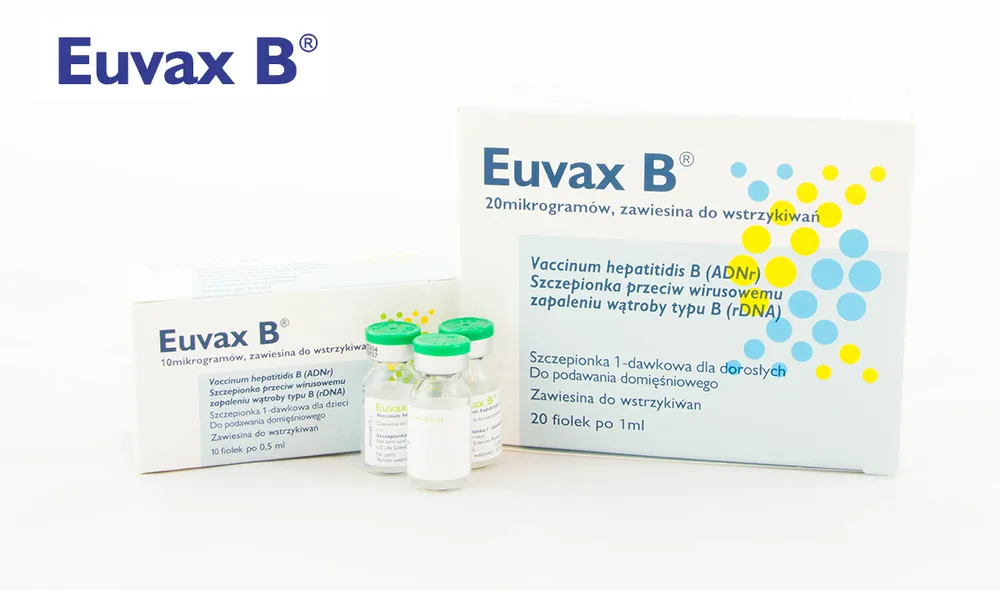
Table of Contents
Package leaflet: Information for the user
EUVAX B, 10 micrograms, suspension for injection
Vaccinum hepatitidis B (ADNr)
Hepatitis B vaccine (rDNA)
Single-dose vaccine for children
Please read the entire leaflet before receiving the vaccine, as it contains
important information for the patient.
- Keep this leaflet for future reference.
- If you have any questions, consult your doctor, pharmacist, or nurse.
- This vaccine has been prescribed for a specific individual and must not be passed on to others.
- If you or your child experience any adverse reactions, including any not listed in this leaflet, inform your doctor, pharmacist, or nurse. See section 4.
Table of contents:
- What EUVAX B vaccine is and what it is used for
- Important information before using EUVAX B vaccine
- How to use EUVAX B vaccine
- Possible side effects
- How to store EUVAX B vaccine
- Contents of the package and other information
1. WHAT EUVAX B VACCINE IS AND WHAT IT IS USED FOR
EUVAX B (10 micrograms dose in 0.5 ml) is a suspension for injection containing the hepatitis B surface antigen (HBsAg), produced by recombinant DNA technology in yeast cells (Saccharomyces cerevisiae).
The vaccine is intended for active immunization against hepatitis B (HBV) caused by all subtypes of the hepatitis B virus (HBV).
The vaccine induces the production of specific antibodies against the hepatitis B surface antigen (anti-HBs). A protective level of anti-HBs antibodies is considered to be ≥10 IU/L.
Vaccination of patients with occult or chronic hepatitis B virus infection may not affect the course of the disease.
Due to the long incubation period of the hepatitis B virus, infection may go undiagnosed and vaccination may be administered during the incubation phase of the disease. In such cases, the vaccine may not prevent the onset of illness.
The vaccine does not protect against infections caused by other viruses such as hepatitis A virus (HAV), hepatitis C virus (HCV), hepatitis E virus (HEV), or other pathogens causing liver disease.
EUVAX B 10 micrograms (paediatric dose) is indicated for use in newborns, infants, and children up to the age of 15.
2. IMPORTANT INFORMATION BEFORE ADMINISTRATION OF EUVAX B VACCINE
When not to use EUVAX B vaccine
- If the patient is allergic (hypersensitive) to the active substance or to any of the other components of EUVAX B.
- In case of acute illness with high fever. In such cases, vaccination should be postponed.
© 2024 LG Chem, Ltd. All rights reserved.
When to exercise special caution when administering EUVAX B vaccine
If adverse reactions described in section 4 or any other concerning reactions occurred after a previous dose of the vaccine.
In patients with multiple sclerosis, as any stimulation of the immune system may exacerbate the disease. In such patients, the benefit of vaccination should be weighed against the risk of disease exacerbation. As with all injectable vaccines, appropriate treatment should always be available in case of rare anaphylactic reactions following vaccination.
EUvax B vaccine must not be injected into the gluteal muscle or intradermally, as this route of administration does not ensure an optimal immune response.
Thiomersal is present (in trace amounts) in this product and it is possible that the patient may experience an allergic reaction. Inform the physician if the child has had or currently has any known allergic reactions. Also inform the physician if any health problems occurred after previous vaccination.
EUvax B vaccine and other medicines
Inform the physician about all medicines currently used or recently used, including those obtained without prescription, as well as any vaccinations.
The vaccine may be administered simultaneously with vaccines against tuberculosis, diphtheria, tetanus, pertussis, mumps, measles, rubella, and poliomyelitis. When administering multiple vaccines simultaneously, they should be given at different injection sites using separate syringes and needles.
EUvax B vaccine may be administered simultaneously with hepatitis B immunoglobulin, but at different injection sites.
Pregnancy, breastfeeding, and fertility
Consult a physician before using any medicine. The effect of HBs antigen on fetal development has not been studied. As with other inactivated vaccines, the risk is considered negligible. EUvax B may be used during pregnancy only when there is a clear indication for immunization and when benefits to the mother outweigh any potential risk to the fetus.
Consult a physician before using any medicine.
Clinical studies have not evaluated the effect of EUvax B vaccine administered to mothers on breastfed infants. There are no established contraindications to vaccinating breastfeeding women.
Driving and operating machinery
There are no data regarding the effect of the vaccine on driving and operating machinery.
3. HOW TO USE THE EUVAX B VACCINE
The Euvax B vaccine must be administered only intramuscularly, into the deltoid muscle in children, or into the anterolateral thigh muscle in newborns, infants, and younger children.
The Euvax B vaccine should not be injected into the gluteal muscle or intradermally, as these routes of administration do not guarantee an optimal immune response. The vaccine must not be administered intravenously.
The primary vaccination course consists of 3 doses:
- first dose: at the chosen time
© 2024 LG Chem, Ltd. All rights reserved.
- second dose: 1 month after the first dose
- third dose: 6 months after the first dose.
Booster vaccination
Based on study results, the World Health Organization (WHO) does not recommend administering booster doses in individuals who have adequately responded to the 3-dose vaccination series, as they are protected against disease for at least 15 years. Despite observed declines in antibody titers, vaccinated individuals remain protected against hepatitis B virus infection due to established immunological memory.
Officially valid recommendations regarding booster vaccination should be followed.
In special circumstances, to achieve a rapid and optimal immune response—for example, in newborns born to HBs antigen carrier mothers, in individuals exposed to infection (e.g., needlestick injury), or in travelers to regions with high risk of infection—the following (alternative) vaccination schedule may be used:
- first dose: at the chosen time
- second dose: 1 month after the first dose
- third dose: 2 months after the first dose.
A fourth dose should be administered 12 months after the first dose to ensure long-term protection.
Additional vaccine doses may be required for hemodialysis patients or individuals with immunodeficiency, as they may fail to develop protective antibody levels (≥10 IU/L) after primary vaccination. In these patients, antibody titer determination is recommended.
In cases of confirmed or suspected exposure to hepatitis B virus (e.g., infection through broken skin or mucous membranes; in a newborn born to an HBs antigen carrier mother), administration of human hepatitis B immunoglobulin (HBIg) is recommended simultaneously with the first dose of Euvax B. These injections must be administered at two separate sites.
Overdosage
There are no data available on adverse effects following administration of a higher than recommended dose of the Euvax B vaccine.
4. POSSIBLE ADVERSE REACTIONS
Like any medicine, the EUVAX B vaccine may cause adverse reactions, although not everyone experiences them.
The frequency of occurrence within each system is defined according to the following criteria: very common (occurs more frequently than 1 in 10 doses), common (occurs more frequently than 1 in 100 but less frequently than 1 in 10 doses), uncommon (occurs more frequently than 1 in 1,000 but less frequently than 1 in 100 doses), rare (occurs more frequently than 1 in 10,000 but less frequently than 1 in 1,000 doses), very rare (occurs less frequently than 1 in 10,000 doses, including single cases).
Very common:
Pain at the injection site, resolving within 2 days
Common:
Haematoma, induration, swelling, tenderness, inflammation at the injection site, resolving within 2 days, fever, crying without apparent cause, abdominal pain, decreased appetite, diarrhoea, vomiting, insomnia, nervousness, irritability, drowsiness, erythematous rash, erythema
Uncommon:
Neonatal jaundice, oral candidiasis (thrush), rhinitis, rash, maculopapular rash, pityriasis rosea
Rare:
Malaise, fatigue, headache and dizziness, transient increase in liver enzyme activity, myalgia, arthralgia
Very rare:
Optic neuritis, facial nerve paralysis, Guillain-Barré syndrome, exacerbation of multiple sclerosis
© 2024 LG Chem, Ltd. All rights reserved.
Adverse reactions reported after vaccine introduction to market include:
- Abscess at injection site, nasopharyngitis, rhinitis
- Lymphadenopathy, thrombocytopenia
- Hypersensitivity reactions, anaphylactic reactions
- Decreased appetite, anorexia
- Restlessness, insomnia
- Seizures, hypotonia, drowsiness, headache, dizziness, syncope
- Tachycardia
- Hypotension
- Cough
- Vomiting, diarrhoea, nausea, abdominal pain
- Erythema, urticaria, rash, pruritus, petechiae
- Myalgia, limb pain, muscle cramps, muscle and joint stiffness, arthralgia
- Injection site reactions (erythema, swelling, pain, inflammation, oedema, pruritus, haematoma, induration, sensation of warmth), fever, irritability, malaise, weakness, fatigue, chills
In preterm infants (born at or before 28 weeks of gestation), prolonged breathing pauses may occur within 2–3 days after vaccination.
Reporting of adverse reactions
If any adverse reactions occur, including any adverse reactions not listed in this leaflet, inform a doctor or pharmacist. Adverse reactions can be reported directly to the Department of Monitoring Adverse Drug Reactions of the Office for Registration of Medicinal Products, Medical Devices and Biocidal Products:
Al. Jerozolimskie 181C
02-222 Warsaw
Tel.: +48 22 49 21 301
Fax: +48 22 49 21 309
e-mail: [email protected]
Adverse reactions may also be reported to the marketing authorisation holder.
Reporting adverse reactions helps to provide more information on the safety of the medicine.
If any of the adverse effects worsen, or if any adverse effects not listed in this leaflet occur, inform a doctor.
5. HOW TO STORE EUVAX B VACCINE
Keep out of reach and sight of children.
Store at 2°C - 8°C (in a refrigerator). Do not freeze.
Do not use EUVAX B vaccine after the expiry date stated on the carton and vial.
The expiry date refers to the last day of the specified month.
Medicines should not be disposed of via wastewater or household waste. Ask your pharmacist how to dispose of medicines no longer required. This will help protect the environment.
6. OTHER INFORMATION
What EUVAX B vaccine contains
The active substance is:
Hepatitis B virus surface antigen (HBsAg)* – 10 micrograms, adsorbed on
aluminium hydroxide, hydrated – 0.25 milligrams Al
*produced by recombinant DNA technology in yeast cells (Saccharomyces cerevisiae)
© 2024 LG Chem, Ltd. All rights reserved.
The other components are: potassium dihydrogen phosphate, disodium phosphate heptahydrate, sodium chloride, water for injections.
What EUVAX B vaccine looks like and contents of the pack
Vial 0.5 ml (1 dose)
Available pack sizes:
Pack: 1, 10 or 20 vials.
Marketing Authorisation Holder
LG Chem Life Sciences Poland Sp. z o.o.
ul. Grzybowska 80/82
00-844 Warsaw
tel. 0 781 111 100
Name and address of the importer responsible for batch release
LG Chem Life Sciences Poland Sp. z o.o.
ul. Grzybowska 80/82
00-844 Warsaw
tel. 0 781 111 100
Polypharm S.A.
ul. Julianowska 41
05-500 Piaseczno
tel. 22 832 34 78
e-mail: [email protected]
‹-------------------------------------------------------------------------------------------------------------------------›
Information intended exclusively for medical personnel or healthcare workers:
During storage, a white sediment and a clear, colourless liquid above may form.
Immediately before administration, the vaccine should be thoroughly mixed and inspected for the presence of foreign particles and (or) physical changes. If any abnormalities in the appearance of the vaccine are observed, the vaccine must not be administered and direct contact with the marketing authorisation holder is recommended.
© 2024 LG Chem, Ltd. All rights reserved.