Erfin
Poland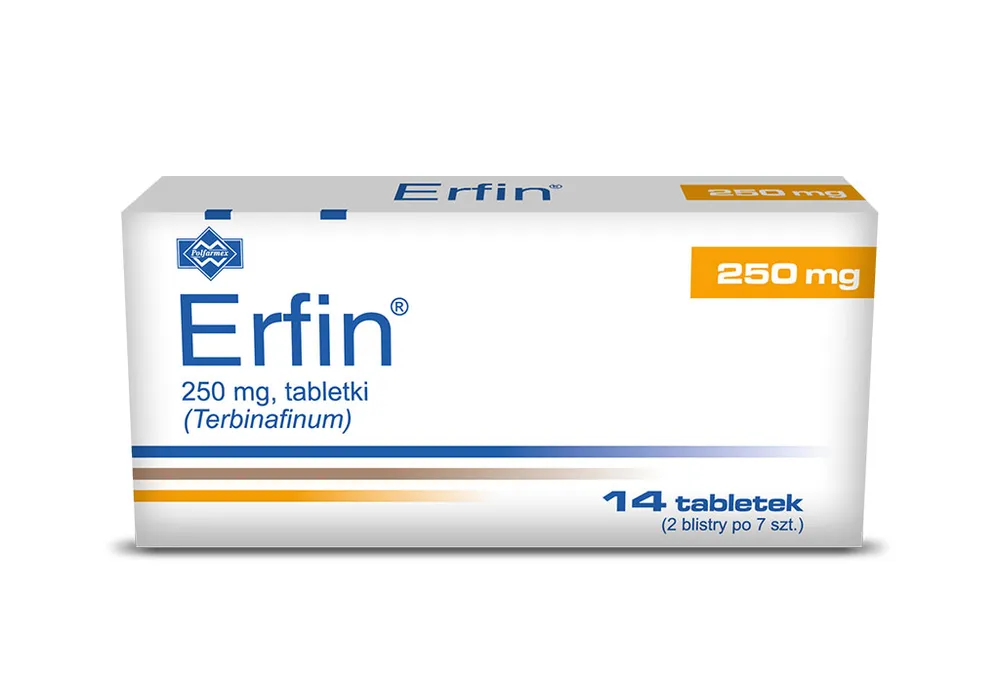
Table of Contents
ERFIN, 250 mg, tablets
(Terbinafinum)
Read the entire leaflet carefully before using this medicine.
- Keep this leaflet for future reference.
- Consult your doctor or pharmacist if you have any further questions.
- This medicine has been prescribed for a specific individual. Do not share it with others. This medicine may harm others, even if their symptoms are the same.
- If any adverse reactions worsen or if any adverse reactions not listed in this leaflet occur, inform your doctor or pharmacist immediately.
Leaflet contents:
- What Erfin is and what it is used for
- Important information before taking Erfin
- How to take Erfin
- Possible side effects
- How to store Erfin
- Other information
1. WHAT ERFIN IS AND WHAT IT IS USED FOR
Erfin is a systemic antifungal medicine containing the active substance terbinafine, belonging to the allylamine class.
Erfin is indicated for the treatment of:
- Dermatophyte skin infections (such as groin, other body areas, feet, scalp) caused by fungi of the genera Trichophyton, Microsporum canis, and Epidermophyton floccosum, when treatment is justified due to the location and extent of the infection,
- Fungal nail infections (onychomycosis) caused by dermatophytes.
Note:
Erfin is not effective in the treatment of pityriasis versicolor.
2. IMPORTANT INFORMATION BEFORE USING ERFIN
When not to use Erfin
- If the patient is allergic (hypersensitive) to the active substance or to any of the other ingredients of Erfin.
When to exercise special caution when using Erfin
If symptoms suggesting liver dysfunction occur, such as itching, unexplained nausea, loss of appetite, or feeling of fatigue, jaundice, vomiting, tiredness, abdominal pain, dark urine or pale stools, treatment with Erfin should be stopped immediately and a doctor should be consulted. The doctor will decide whether treatment with Erfin should be discontinued.
Inform your doctor about any liver diseases, as Erfin is not recommended for patients with liver disorders.
Inform your doctor about any kidney diseases. In patients with renal impairment (creatinine clearance below 50 ml/min or serum creatinine concentration above 300 µmol/l), the doctor will recommend using half the usual recommended dose.
Terbinafine should be used with caution in patients with psoriasis, as Erfin may exacerbate its course.
Consult your doctor, even if the above warnings refer to conditions that occurred in the past.
Use of other medicines
Tell your doctor or pharmacist about any medicines you are currently taking or have recently taken, including medicines obtained without a prescription.
Drugs that stimulate cytochrome P450 (e.g. rifampicin) reduce and shorten the effect of terbinafine, whereas drugs that inhibit the activity of this enzyme (e.g. cimetidine) enhance and prolong the effect of terbinafine. If the doctor considers it necessary to use terbinafine concomitantly with drugs modifying cytochrome P450 activity, the terbinafine dose will be appropriately adjusted.
Terbinafine may inhibit the metabolism of drugs such as tricyclic antidepressants, β-adrenergic receptor blockers, selective serotonin reuptake inhibitors, and MAO-B inhibitors.
Terbinafine may very slightly decrease or increase the clearance of drugs metabolized by the cytochrome P450 system (e.g. cyclosporine, tolbutamide, terfenadine, triazolam, and oral contraceptives).
Menstrual disorders such as intermenstrual bleeding and irregular menstrual cycles may occur in women taking terbinafine and oral contraceptives simultaneously.
Erfin contains sodium
This medicine contains less than 1 mmol (23 mg) of sodium per tablet, i.e. the medicine is considered "sodium-free."
Pregnancy and breastfeeding
Before using any medicine, consult your doctor or pharmacist.
Pregnancy
Erfin should not be used during pregnancy unless, in the opinion of the doctor, the potential benefits outweigh the risks.
If pregnancy occurs, the patient should stop taking the medicine and inform the doctor immediately.
Breastfeeding
Terbinafine passes into breast milk; therefore, women who are breastfeeding should not use Erfin.
Driving and operating machinery
Erfin has no influence on the ability to drive vehicles or operate machinery.
3. HOW TO USE ERFIN
Erfin should always be used according to the doctor's instructions. If in doubt, consult your doctor.
Do not change the dose or discontinue treatment without consulting your doctor, as irregular use of Erfin or premature discontinuation of treatment may result in recurrence of infection.
Adults:
Orally, 250 mg once daily.
The duration of treatment depends on the indication and severity of the infection.
Duration of treatment:
Fungal skin infections:
Interdigital, plantar/moccasin-type tinea pedis: usually 2 to 6 weeks.
Tinea corporis, tinea cruris: usually 2 to 4 weeks.
Tinea capitis: usually 4 weeks.
Fungal nail infections:
Usually 6 to 12 weeks.
Fungal nail infections of the toenails usually require longer treatment than fungal infections of the fingernails. Treatment for toenail onychomycosis for 3 months is usually sufficient; however, in some patients, 6-month or longer treatment may be necessary.
Patients with slow nail growth may require a longer treatment period.
To facilitate treatment and prevent recurrence, it is important to keep treated areas dry and not overheated, and clothing in direct contact with these areas should be changed daily.
If you feel the effect of the medicine is too strong or too weak, consult your doctor.
Children:
Oral administration of terbinafine is not recommended in children due to limited data on the use of terbinafin in this age group.
Missed dose of Erfin
Do not take a double dose to make up for a missed dose.
Overdose of Erfin
Symptoms of overdose include headache, nausea, epigastric pain, and dizziness.
In case of overdose, to eliminate the drug, the doctor may prescribe activated charcoal and, if necessary, symptomatic and supportive treatment.
If a larger than recommended dose has been taken, seek immediate medical advice from a doctor or pharmacist.
4. POSSIBLE ADVERSE REACTIONS
Like all medicines, Erfin may cause adverse reactions, although not everyone experiences them.
Adverse reactions are usually mild to moderate in intensity.
Adverse symptoms are grouped according to their frequency of occurrence.
Adverse effects may occur:
- commonly (more than 1 in 100 patients, but less than 1 in 10 patients),
- uncommonly (more than 1 in 1,000 patients, but less than 1 in 100 patients),
- rarely (more than 1 in 10,000 patients, but less than 1 in 1,000 patients),
- very rarely (less than 1 in 10,000 patients, including isolated case reports).
Common:
Transient gastrointestinal symptoms may occur (feeling of fullness, loss of appetite, indigestion, nausea, mild abdominal pain, diarrhoea), skin reactions (rash, urticaria), and headache.
Uncommon:
Taste disturbances, including loss of taste, which usually resolve within a few weeks after discontinuation of the drug, may occur. In isolated cases, permanent taste disturbances have been reported, leading to decreased appetite and significant weight loss.
Rare:
Severe skin reactions may occur (e.g. Stevens-Johnson syndrome, toxic epidermal necrolysis, photosensitivity, angioedema). If rash worsens, treatment with Erfin should be discontinued and medical advice should be sought immediately.
Paresthesia (sensory disturbances), hypoesthesia, dizziness, malaise, fatigue, and muscle and joint pain—which may indicate hypersensitivity reactions associated with skin allergic reactions—may also occur.
If liver function disorders occur (jaundice, cholestasis, hepatitis), Erfin treatment must be discontinued immediately and a doctor should be consulted (see section 2. Important information before taking Erfin).
Very rare:
Psychiatric disorders such as depression and anxiety, exacerbation of psoriasis, reduction in blood cell counts such as neutropenia (decreased number of white blood cells—granulocytes), agranulocytosis (absence of granulocytes), thrombocytopenia (decreased number of platelets), symptoms of systemic or discoid lupus erythematosus, or worsening of such symptoms, and severe hypersensitivity reactions (anaphylactic reactions) may occur.
Reporting of adverse reactions
If any adverse reactions occur, including any adverse effects not listed in this leaflet, inform your doctor, pharmacist, or nurse. Adverse reactions can also be reported directly to the Department of Monitoring Adverse Drug Reactions of the Office for Registration of Medicinal Products, Medical Devices and Biocidal Products:
Al. Jerozolimskie 181C
02-222 Warsaw
Tel.: 22 49-21-301
Fax: 22 49-21-309
Website: https://smz.ezdrowie.gov.pl
Adverse reactions can also be reported to the marketing authorization holder. Reporting adverse reactions helps to provide more information on the safety of the medicine.
5. HOW TO STORE ERFIN
Keep out of the reach and sight of children.
Store below 25°C, in the original packaging.
Do not use Erfin after the expiry date stated on the packaging. The expiry date refers to the last day of the specified month.
Medicines should not be disposed of via wastewater or household waste. Ask your pharmacist how to dispose of medicines no longer required. This will help protect the environment.
6. OTHER INFORMATION
What Erfin contains
- The active substance is terbinafine (as hydrochloride). Each tablet contains 250 mg of terbinafine.
- Other ingredients: microcrystalline cellulose, sodium carboxymethyl starch, hypromellose, magnesium stearate, colloidal silicon dioxide.
What Erfin looks like and contents of the pack
Erfin is a tablet.
Pack contains 14 or 28 tablets.
Marketing Authorisation Holder and Manufacturer
Polfarmex S.A.
ul. Józefów 9
99-300 Kutno
Poland
Tel. (24) 357 44 44
Fax (24) 357 45 45
Email: [email protected]