Entecavir zentiva
Poland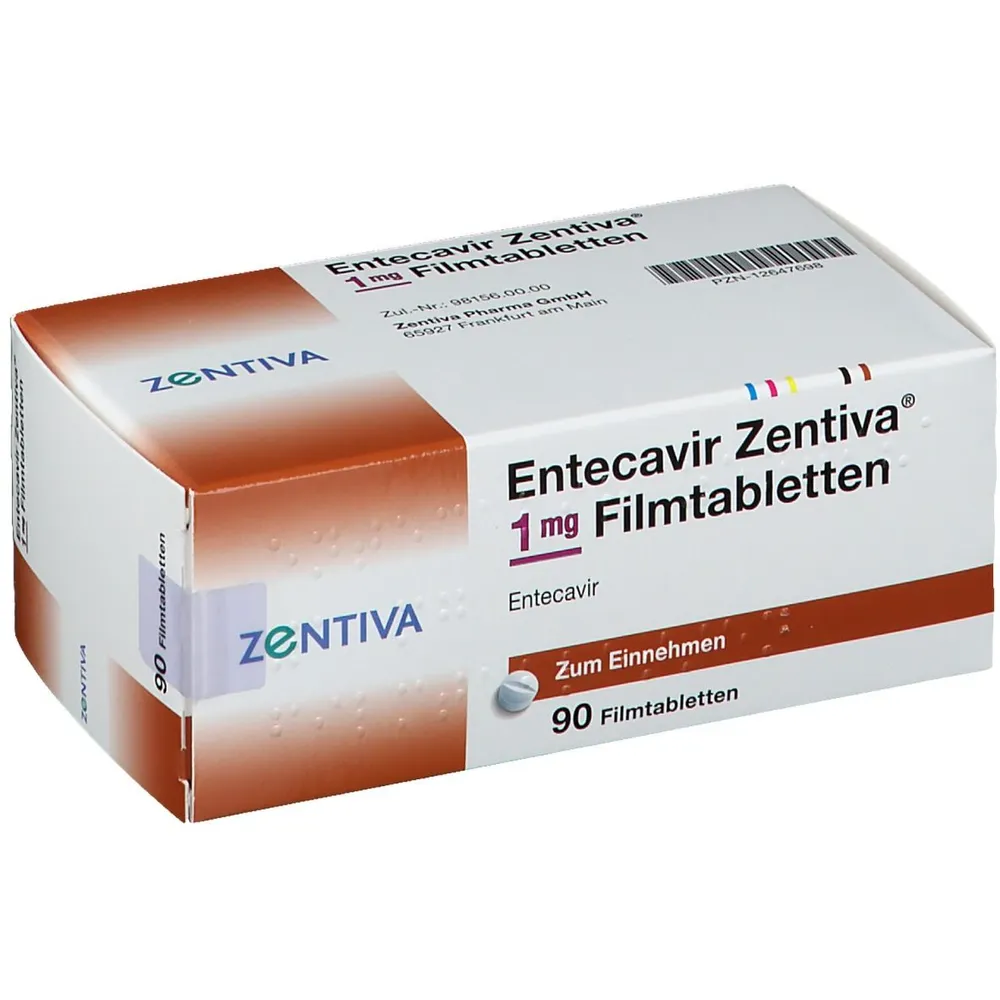
Table of Contents
Package leaflet: Information for the patient
Entecavir Zentiva, 0.5 mg, film-coated tablets
Entecavir Zentiva, 1 mg, film-coated tablets
Entecavir
Please read this leaflet carefully before taking this medicine, because it contains
important information for you.
- Keep this leaflet. You may need to read it again.
- If you have any further questions, please ask your doctor or pharmacist.
- This medicine has been prescribed for a specific person only. Do not give it to others. It may harm them, even if their symptoms are the same.
- If you experience any adverse effects, including any not listed in this leaflet, tell your doctor or pharmacist. See section 4.
Table of contents
- What Entecavir Zentiva is and what it is used for
- Important information before taking Entecavir Zentiva
- How to take Entecavir Zentiva
- Possible side effects
- How to store Entecavir Zentiva
- Contents of the pack and other information
1. What Entecavir Zentiva is and what it is used for
Entecavir Zentiva in tablet form is an antiviral medicine used in adults for the treatment of chronic (long-term) hepatitis B virus (HBV) infection. Entecavir Zentiva can be used in patients with liver damage but whose liver still functions properly (with compensated liver function) and in patients whose liver does not function properly (with decompensated liver function).
Entecavir, the active substance in Entecavir Zentiva, is also used to treat chronic (long-term) HBV infection in children and adolescents aged 2 years to less than 18 years. Medicines containing entecavir can be used in children whose liver is damaged but still functions properly (with compensated liver function).
Hepatitis B virus infection may lead to liver damage. Entecavir Zentiva reduces the amount of virus in the body and improves liver function.
2. Important information before taking Entecavir Zentiva
Do not take Entecavir Zentiva:
- If you are allergic (hypersensitive) to entecavir or to any of the other ingredients of this medicine (listed in section 6).
Warnings and precautions
Before starting Entecavir Zentiva, discuss this with your doctor or pharmacist.
- If you have any kidney disease, tell your doctor. This is important because Entecavir Zentiva is eliminated from the body through the kidneys, and it may be necessary to reduce the dose or change the dosing schedule.
- Do not stop taking Entecavir Zentiva without consulting your doctor, as this may negatively affect the course of hepatitis. After stopping Entecavir Zentiva, your doctor will monitor your condition and perform blood tests for several months.
- Discuss with your doctor whether your liver is functioning properly, and if not, what potential impact this may have on treatment with Entecavir Zentiva.
- If you are also infected with HIV (human immunodeficiency virus), tell your doctor. You should not take Entecavir Zentiva to treat hepatitis B if you are not receiving anti-HIV medications, as this may reduce the effectiveness of future HIV treatment. Entecavir Zentiva does not treat HIV infection.
- Taking Entecavir Zentiva does not prevent transmitting hepatitis B virus (HBV) to others through sexual contact or body fluids (including infected blood). Therefore, it is important to take appropriate precautions to prevent spreading HBV to others. A vaccine is available to protect people at risk of HBV infection.
- Entecavir Zentiva belongs to a group of medicines that may cause lactic acidosis (excess lactic acid in the blood) and hepatomegaly (enlarged liver). Symptoms such as nausea, vomiting, and abdominal pain may indicate the development of lactic acidosis. This is a rare but serious side effect, which may occasionally be fatal. Lactic acidosis occurs more frequently in women, especially those with marked obesity. Your doctor will regularly monitor your condition during treatment with Entecavir Zentiva.
- If you have previously been treated for chronic hepatitis B, inform your doctor.
Children and adolescents
Medicines containing entecavir should not be used in children under 2 years of age or with body weight less than 10 kg.
Entecavir Zentiva with other medicines
Tell your doctor or pharmacist about all medicines you are currently taking, have recently taken, or plan to take.
Entecavir Zentiva with food and drink
In most cases, Entecavir Zentiva can be taken with or without food. However, if you previously took medicines containing lamivudine as the active substance, consider the following recommendations. If treatment has been switched to Entecavir Zentiva due to lamivudine treatment failure, Entecavir Zentiva should be taken once daily on an empty stomach. If liver disease is very advanced, your doctor may also recommend taking Entecavir Zentiva on an empty stomach. This means taking the medicine at least 2 hours after a meal and at least 2 hours before the next meal.
Entecavir Zentiva 0.5 mg
Children and adolescents (aged 2 to less than 18 years, with body weight at least 32.6 kg) may take entecavir-containing medicines regardless of meals.
Pregnancy, breastfeeding, and fertility
If you are pregnant or planning to become pregnant, consult your doctor. To date, it has not been established that using Entecavir Zentiva during pregnancy is safe. Entecavir Zentiva should not be used during pregnancy unless specifically recommended by your doctor. It is important that women of childbearing potential using Entecavir Zentiva use effective contraception to avoid pregnancy.
Do not breastfeed while taking Entecavir Zentiva. If you are breastfeeding, inform your doctor. It is not known whether entecavir, the active substance in Entecavir Zentiva, passes into human milk.
Driving and operating machinery
Dizziness, fatigue, and somnolence are common side effects that may impair the ability to drive or operate machinery. If in doubt, consult your doctor.
Entecavir Zentiva contains lactose
This medicine contains lactose. If you have previously been diagnosed with an intolerance to certain sugars, consult your doctor before taking this medicinal product.
3. How to take Entecavir Zentiva
Not every patient requires the same dose of Entecavir Zentiva. This medicine should always be taken exactly as prescribed by your doctor. If in doubt, consult your doctor or pharmacist.
The recommended dose in adults is 0.5 mg or 1 mg once daily (orally).
The dose depends on:
- Prior treatment for HBV infection and medicines used;
- Presence of kidney function disorders; in such cases, your doctor may prescribe a lower dose or recommend taking the medicine less frequently than once daily;
- The patient's liver condition.
Use in children and adolescents
Entecavir Zentiva 0.5 mg
In children and adolescents (aged 2 to less than 18 years), your doctor will determine the appropriate dose based on the child's body weight.
Children and adolescents with body weight of at least 32.6 kg may take 0.5 mg tablets or an oral solution containing entecavir may be available. The oral solution form of entecavir is recommended for patients with body weight from 10 kg to 32.5 kg. All doses are taken once daily (orally). No recommendations have been established for entecavir in children under 2 years of age or with body weight less than 10 kg.
Entecavir Zentiva 1 mg
For children and adolescents (aged 2 to less than 18 years), Entecavir Zentiva is available as 0.5 mg film-coated tablets or an oral solution containing entecavir may be available. Your doctor will determine the appropriate dose based on the child's body weight.
Your doctor will recommend the most suitable dose for you. Always take the dose prescribed by your doctor to ensure full effectiveness of the medicine and to minimize the risk of developing treatment resistance. Entecavir Zentiva should be taken for as long as your doctor recommends. Your doctor will inform you when to stop treatment.
Some patients must take Entecavir Zentiva on an empty stomach
(see Entecavir Zentiva with food and drink in section 2).
If your doctor advises taking Entecavir Zentiva on an empty stomach, this means at least 2 hours after a meal and at least 2 hours before the next meal.
Taking more Entecavir Zentiva than prescribed
Contact your doctor immediately.
If you miss a dose of Entecavir Zentiva
It is important not to miss any dose. If you miss a dose of Entecavir Zentiva, take it as soon as possible, then take the next dose at the usual time. If it is almost time for the next dose, do not take the missed dose. Wait and take the next dose at the usual time. Do not take a double dose to make up for a missed dose.
Do not stop treatment with Entecavir Zentiva without medical advice
After stopping Entecavir Zentiva, some people may experience severe symptoms of hepatitis. Inform your doctor immediately about any changes in symptoms occurring after stopping treatment.
If you have any further questions about the use of this medicine, ask your doctor or pharmacist.
4. Possible adverse reactions
Like all medicines, this medicine can cause adverse reactions, although not everybody will experience them.
Patients treated with Entecavir Zentiva have reported the following adverse effects:
Adults
Common (may occur in up to 1 in 10 patients):
- insomnia (inability to sleep)
- feeling of fatigue (very strong exhaustion)
- headache, dizziness, somnolence
- vomiting, diarrhoea, nausea, dyspepsia (indigestion)
- increased liver enzyme activity in blood
Uncommon (may occur in up to 1 in 100 patients):
- rash
- hair loss
Rare (may occur in up to 1 in 1000 patients):
- severe allergic reactions
Children and adolescents
Adverse reactions observed in children and adolescents are similar to those occurring in adults and described above, with the following difference:
Very common (may occur in more than 1 in 10 patients):
- low neutrophil granulocyte count (one type of white blood cells important in fighting infections).
Reporting of adverse reactions
If any adverse reactions occur, including any adverse reactions not listed in the leaflet, inform a doctor or pharmacist. Adverse reactions can be reported directly to the Department of Monitoring Adverse Drug Reactions of the Office for Registration of Medicinal Products, Medical Devices and Biocidal Products:
Al. Jerozolimskie 181 C, 02-222 Warsaw, tel.: + 48 22 49 21 301, fax: + 48 22 49 21 309,
website: https://smz.ezdrowie.gov.pl
Adverse reactions can also be reported to the marketing authorisation holder or its representative in Poland.
By reporting adverse reactions, additional information on the safety of the medicine can be collected.
5. How to store Entecavir Zentiva
Keep this medicine out of sight and reach of children.
Do not use this medicine after the expiry date stated on the blister pack or carton after EXP. The expiry date refers to the last day of the specified month.
There are no special storage instructions for this medicine.
Medicines must not be disposed of via wastewater or household waste. Ask your pharmacist how to dispose of medicines no longer required. These measures will help protect the environment.
6. Contents of the pack and other information
What Entecavir Zentiva contains
- Entecavir Zentiva 0.5 mg
- The active substance is entecavir. One film-coated tablet contains 0.5 mg of entecavir (as entecavir monohydrate).
- The other ingredients are: monohydrate lactose, microcrystalline cellulose PH 101, microcrystalline cellulose PH 102, crospovidone (Type B), and magnesium stearate. The tablet coating: Opadry White YS-1-7003 (contains titanium dioxide (E 171), hypromellose 3 mPas, hypromellose 6 mPas, polyethylene glycol 400, polysorbate 80).
Entecavir Zentiva 1 mg
- The active substance is entecavir. One film-coated tablet contains 1 mg of entecavir (as entecavir monohydrate).
- The other ingredients are: monohydrate lactose, microcrystalline cellulose PH 101, microcrystalline cellulose PH 102, crospovidone (Type B), and magnesium stearate. The tablet coating: Opadry White YS-1-7003 (contains titanium dioxide (E 171), hypromellose 3 mPas, hypromellose 6 mPas, polyethylene glycol 400, polysorbate 80).
What Entecavir Zentiva looks like and contents of the pack
Entecavir Zentiva 0.5 mg
Film-coated tablets are white to off-white, round, biconvex, approximately 7 mm in diameter, smooth on both sides.
Entecavir Zentiva 0.5 mg film-coated tablets are available in cardboard boxes containing 30 or 90 film-coated tablets in blisters made of OPA/Aluminium/PVC/Aluminium foil.
Entecavir Zentiva 1 mg
Film-coated tablets are white to off-white, round, biconvex, approximately 8.9 mm in diameter, with a score line on one side and smooth on the other. The score line is not intended to facilitate breaking the tablet.
Entecavir Zentiva 1 mg film-coated tablets are available in cardboard boxes containing 30 or 90 film-coated tablets in blisters made of OPA/Aluminium/PVC/Aluminium foil.
Not all pack sizes may be marketed.
Marketing Authorisation Holder
Zentiva k.s.
U kabelovny 130, Dolni Měcholupy
102 37 Prague 10
Czech Republic
Manufacturer
S.C. Laropharm S.R.L.
Șos. Alexandriei nr. 145A
Oras Bragadiru
Jud. Ilfov 077025, Romania
For further information about this medicinal product and its names in the European Economic Area countries, please contact the local representative of the Marketing Authorisation Holder in Poland:
Zentiva Polska Sp. z o.o.
ul. Bonifraterska 17
00-203 Warsaw
tel.: +48 22 375 92 00