Ebrantil 25
Poland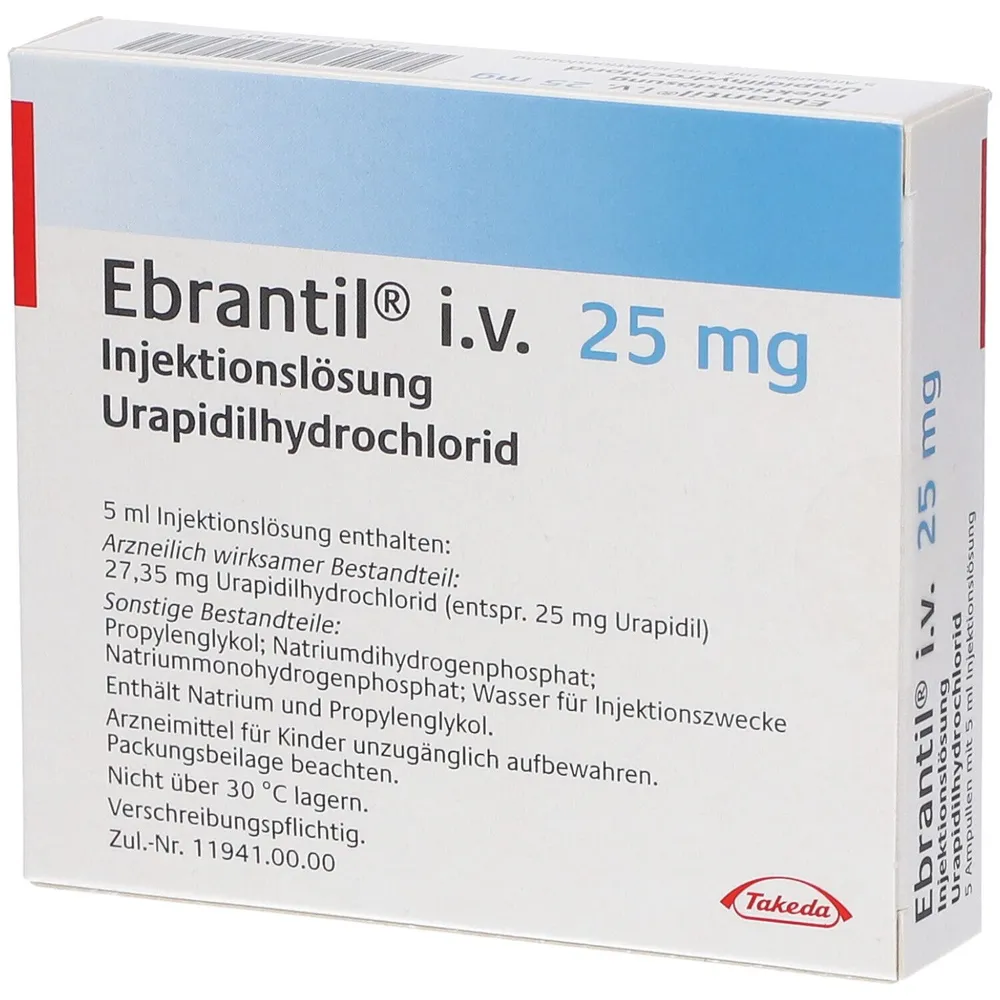
Table of Contents
- Package leaflet: Information for the patient
- 1. What Ebrantil 25 is and what it is used for
- 2. Important information before using Ebrantil 25
- 3. How to use Ebrantil 25
- 4. Possible adverse reactions
- 5. How to store Ebrantil 25
- 6. Contents of the pack and other information
- Information intended exclusively for healthcare professionals:
Package leaflet: Information for the patient
Ebrantil 25, 5 mg/ml, solution for injection
Urapidilum
Please read all of this leaflet carefully before using this medicine, because it contains
important information for you.
- Keep this leaflet. You may need to read it again.
- If you have any further questions, please ask your doctor or nurse.
- This medicine has been prescribed for a specific individual. Do not pass it on to others. It may harm them even if their symptoms are the same.
- If you experience any adverse reactions, including any not listed in this leaflet, inform your doctor or nurse. See section 4.
Contents of the leaflet
- What Ebrantil 25 is and what it is used for
- What you need to know before using Ebrantil 25
- How to use Ebrantil 25
- Possible side effects
- How to store Ebrantil 25
- Contents of the pack and other information
1. What Ebrantil 25 is and what it is used for
Urapidil, the active substance in Ebrantil 25, reduces both systolic and diastolic arterial pressure by decreasing peripheral resistance.
Heart rate usually remains unchanged.
Cardiac output is generally unaffected by Ebrantil 25, but may increase if it was previously reduced due to elevated afterload.
Ebrantil 25 is used:
- in hypertensive emergencies (e.g. hypertensive crisis), in severe and very severe forms of arterial hypertension, and in hypertension resistant to pharmacological treatment;
- for controlled reduction of arterial pressure during and/or after surgical procedures.
2. Important information before using Ebrantil 25
When not to use Ebrantil 25
- if the patient is allergic to the active substance or to any of the other ingredients of this medicine (listed in section 6);
- if the patient has aortic stenosis or arteriovenous fistula (except for a hemodynamically inactive fistula used for dialysis).
Warnings and precautions
Special caution is required when administering Ebrantil 25:
- in patients with heart failure caused by mechanical obstruction (e.g. aortic or mitral valve stenosis), pulmonary embolism, or cardiac dysfunction of pericardial origin;
- in children, due to lack of experience with the use of this medicine in this patient group;
- in patients with impaired liver function (a reduced dose of Ebrantil 25 may be necessary);
- in patients with moderate to severe renal impairment (a reduced dose of Ebrantil 25 may be necessary);
- in elderly patients. Due to increased sensitivity in the elderly, antihypertensive drugs should initially be administered in lower doses;
- in patients receiving concomitant cimetidine treatment (see section Ebrantil 25 and other medicines).
If another antihypertensive medicine has been administered previously, wait until the effect of that medicine on blood pressure becomes apparent before administering Ebrantil 25, and then adjust the dose of Ebrantil 25 accordingly.
An excessively rapid decrease in blood pressure may lead to bradycardia or cardiac arrest.
Pregnancy and breastfeeding
If the patient is pregnant or breastfeeding, suspects she may be pregnant, or is planning to become pregnant, she should consult her doctor before using this medicine.
The use of Ebrantil 25 during pregnancy is not recommended unless the potential benefit to the mother outweighs the potential risk to the fetus.
Breastfeeding should be discontinued during treatment with Ebrantil 25.
Driving and operating machinery
Due to individual responses to the medicine, the ability to drive or operate machinery may be impaired. This may occur especially at the beginning of treatment, when increasing the dose, when switching from another medicine, or when consuming alcohol during treatment.
Ebrantil 25 and other medicines
Inform the doctor about all medicines currently used or recently used, as well as any medicines planned for future use.
The effect of the medicine may be enhanced by:
- concomitant use of alpha-adrenergic receptor antagonists (e.g. clonidine), vasodilators, and other antihypertensive medicines;
- dehydration caused, for example, by vomiting or diarrhoea;
- alcohol.
Concomitant use of cimetidine (a medicine for hyperacidity) may increase the serum concentration of urapidil.
Due to insufficient data on potential interactions between Ebrantil 25 and angiotensin-converting enzyme (ACE) inhibitors (medicines used for hypertension and heart conditions), concomitant use of these medicines is not recommended.
The medicine contains 500 mg of propylene glycol in 5 ml of injection solution (1 ampoule).
Women who are pregnant or breastfeeding should not use this medicine without medical advice. The doctor may decide to perform additional monitoring in such patients.
Patients with impaired liver or kidney function should not use this medicine without medical advice. The doctor may decide to perform additional monitoring in such patients.
Propylene glycol contained in this medicine may cause symptoms similar to those after alcohol consumption and may increase the likelihood of adverse reactions.
This medicine must not be used in children under 5 years of age.
This medicine should only be used under medical supervision. The doctor may decide to perform additional monitoring in patients receiving this medicine.
The medicine contains less than 1 mmol (23 mg) of sodium in 5 ml of injection solution (1 ampoule), meaning the medicine is considered "sodium-free".
3. How to use Ebrantil 25
- Acute conditions in the course of arterial hypertension (e.g. hypertensive crisis), severe and very severe forms of arterial hypertension, hypertension resistant to pharmacological treatment.
1) Intravenous injections
10 to 50 mg of urapidil should be slowly administered intravenously with simultaneous monitoring of blood pressure.
Reduction of blood pressure usually occurs within 5 minutes after administration. Depending on the response, administration of Ebrantil 25 may be repeated.
2) Intravenous drip infusion or continuous infusion using an infusion pump
- To maintain the arterial pressure level achieved after the injection, prepare an infusion solution as follows: add 250 mg of urapidil (10 ampoules of Ebrantil 25) to 500 ml of infusion solution, e.g. 0.9% sodium chloride solution, 5% or 10% glucose solution.
- If the maintenance dose is administered using an infusion pump, dilute 100 mg of urapidil (4 ampoules of Ebrantil 25) in the infusion pump syringe with one of the infusion solutions listed above to a volume of 50 ml.
The maximum concentration of urapidil in the infusion solution must not exceed 4 mg/ml.
Infusion rate:
The infusion rate depends on the individual patient's response to the drug.
The recommended initial maximum administration rate is 2 mg/min.
Maintenance dose:
Average 9 mg/hour: this corresponds to 250 mg of urapidil added to 500 ml of infusion solution (1 mg = 44 drops = 2.2 ml).
- Controlled reduction of arterial pressure in cases of increased blood pressure during and (or) after surgical procedures.
Maintenance of arterial pressure at the desired level is achieved by applying continuous drip infusion or infusion using an infusion pump following the initial injection.
Dosage regimen
| Intravenous injection 25 mg urapidil (= 5 ml injection solution) | |
| after 2 min | No decrease in blood pressure |
| Intravenous injection 25 mg urapidil (= 5 ml injection solution) | |
| after 2 min | No decrease in blood pressure |
| Slow intravenous injection 50 mg urapidil (= 10 ml injection solution) | |
General instructions
- During intravenous administration of Ebrantil 25, either by injection or infusion, the patient must remain in a lying position.
- Single or repeated intravenous injections and infusions are possible. Injections may be followed by continuous infusion.
- Concomitant use of oral antihypertensive medication is possible during parenteral administration of Ebrantil 25.
- Due to toxicological safety, Ebrantil 25 may be administered parenterally for up to 7 days. This period should not be extended. Parenteral treatment may be repeated if arterial hypertension recurs.
Administration of a higher than recommended dose of Ebrantil 25
Symptoms of overdose include:
- cardiovascular symptoms: dizziness, orthostatic reduction in arterial pressure, and fainting;
- central nervous system symptoms: fatigue and reduced reaction speed.
In case of overdose, a physician must be notified immediately.
Excessive reduction in blood pressure can be counteracted by positioning the patient with elevated legs and appropriate fluid replacement.
4. Possible adverse reactions
Like all medicines, this medicine can cause adverse reactions, although not everybody will experience them.
Most of the adverse reactions listed below result from a sudden drop in blood pressure. According to current experience, adverse reactions usually resolve within a few minutes, even during intravenous infusion. Depending on their severity, treatment interruption should be considered.
The following adverse reactions may occur during treatment with Ebrantil 25:
Common (more frequent than 1 in 100 patients):
- nausea;
- headache, dizziness.
Uncommon (more frequent than 1 in 1,000 patients):
- palpitations, increased heart rate (tachycardia), decreased heart rate (bradycardia), sensation of pressure or pain in the chest (symptoms resembling angina pectoris);
- vomiting;
- fatigue;
- irregular heartbeat;
- sudden excessive sweating;
- drop in blood pressure upon changing body position, e.g. when standing up from a lying position (orthostatic hypotension).
Rare (more frequent than 1 in 10,000 patients):
- prolonged penile erection (priapism);
- nasal mucosa congestion;
- hypersensitivity reactions such as itching, skin redness, rash.
Very rare (less frequent than 1 in 10,000 patients):
- decreased platelet count;
- anxiety.
Frequency not known (cannot be estimated from available data):
- angioedema (a potentially life-threatening condition characterized by localized, painless swelling, most commonly affecting the face, limbs and joint areas, without itching), urticaria.
Reporting of adverse reactions
If any adverse reactions occur, including any adverse reactions not listed in this leaflet, inform your doctor or nurse. Adverse reactions can be reported directly to the Department of Monitoring Adverse Drug Reactions of the Office for Registration of Medicinal Products, Medical Devices and Biocidal Products
Al. Jerozolimskie 181 C, 02-222 Warsaw
Tel.: +48 22 49 21 301
Fax: +48 22 49 21 309
e-mail: [email protected] .
Adverse reactions can also be reported to the marketing authorization holder.
Reporting adverse reactions helps to provide more information on the safety of this medicine.
5. How to store Ebrantil 25
Do not store above 25°C.
Keep the medicine in a place out of sight and reach of children.
Do not use this medicine after the expiry date stated on the label and carton,
following the abbreviation EXP. The expiry date refers to the last day of the stated month.
6. Contents of the pack and other information
What Ebrantil 25 contains
- The active substance is urapidil (Urapidilum). One 5 ml ampoule of injection solution contains 27.35 mg of urapidil hydrochloride (equivalent to 25 mg of urapidil). 1 ml of the injection solution contains 5 mg of urapidil.
- The other ingredients are: propylene glycol, disodium phosphate dihydrate, sodium dihydrogen phosphate dihydrate, water for injections.
What Ebrantil 25 looks like and contents of the pack
A clear, colourless injection solution.
The pack contains 5 ampoules of 5 ml each.
Marketing Authorisation Holder
CHEPLAPHARM Arzneimittel GmbH
Ziegelhof 24
17489 Greifswald
Germany
Manufacturer
Takeda Austria GmbH
St. Peter Strasse 25
A-4020 Linz
Austria
Information intended exclusively for healthcare professionals:
Ebrantil 25 is acidic and must not be mixed with alkaline injection solutions or infusion solutions, as this may cause cloudiness and precipitation.
The prepared infusion solution is chemically and physically stable for 50 hours at 15–25°C. To maintain microbiological purity, the solution should be used immediately after preparation.
If the infusion solution is not administered immediately after preparation, responsibility for the storage time and conditions, as well as for administration, lies with the medical personnel.
The infusion solution may be used within 50 hours after preparation, provided it has been prepared and stored under controlled and validated aseptic conditions.