Dynid
Poland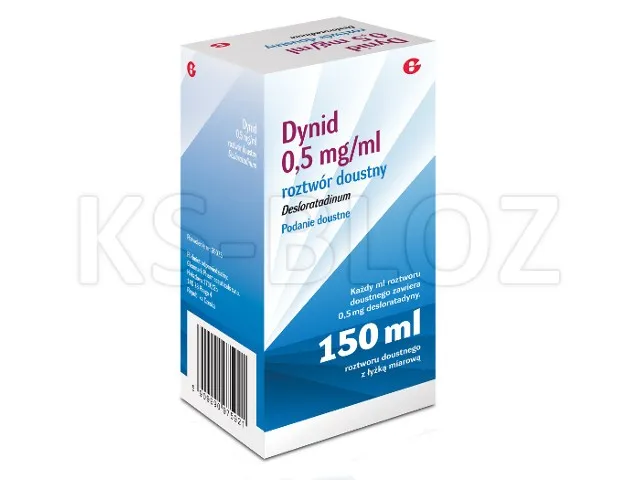
Table of Contents
Patient Information Leaflet
Dynid, 0.5 mg/ml, oral solution
Desloratadine
Please read all of this leaflet carefully before taking this medicine, because it contains
important information for you.
- Keep this leaflet. You may need to read it again.
- If you have any further questions, please ask your doctor, pharmacist, or nurse.
- This medicine has been prescribed for a specific individual. Do not pass it on to others. It may harm them, even if their symptoms are the same as yours.
- If you experience any side effects, including any not listed in this leaflet, tell your doctor, pharmacist, or nurse. See section 4.
Contents of the leaflet
- What Dynid is and what it is used for
- Important information before taking Dynid
- How to take Dynid
- Possible side effects
- How to store Dynid
- Contents of the pack and other information
1. What Dynid is and what it is used for
What Dynid is
Dynid contains desloratadine, which is an antihistamine medicine.
How Dynid works
Dynid oral solution is an antiallergy medicine that does not cause drowsiness. It helps control allergic reactions and their symptoms.
When Dynid should be used
Dynid oral solution relieves symptoms associated with allergic rhinitis (inflammation of the nasal mucosa caused by allergy, such as hay fever or dust mite allergy) in adults, adolescents, and children above 1 year of age. Symptoms include: sneezing, watery or itchy nose, itchy palate, as well as itchy, red, or watery eyes.
Dynid oral solution is also used to relieve symptoms associated with urticaria (skin condition caused by allergy). Symptoms include skin itching and hives.
Relief from these symptoms lasts throughout the day, helping you return to normal daily activities and sleep.
2. Important information before using Dynid
When not to use Dynid
- if the patient is allergic to desloratadine or any of the other ingredients of this medicine (listed in section 6), or to loratadine.
Warnings and precautions
Before taking Dynid, consult your doctor, pharmacist, or nurse:
- if the patient has kidney disease.
- if the patient has a history or family history of seizures.
Children and adolescents
This medicine should not be given to children under 1 year of age.
Interaction of Dynid with other medicines
No interactions between Dynid and other medicines are known. Tell your doctor or pharmacist about all medicines the patient is currently taking or has recently taken, as well as any medicines the patient plans to take.
Taking Dynid with food, drink, and alcohol
Dynid can be taken during or between meals.
Caution should be exercised when taking Dynid with alcohol.
Pregnancy, breastfeeding, and fertility
If the patient is pregnant or breastfeeding, suspects she may be pregnant, or is planning to have a baby, she should consult a doctor or pharmacist before using this medicine.
Use of Dynid is not recommended during pregnancy or breastfeeding.
Fertility
There is no data available on the effect on fertility in men and women.
Driving and operating machinery
It is not expected that this medicine, when used at the recommended dose, affects the ability to drive or operate machinery. Although drowsiness does not occur in most patients, it is recommended to refrain from activities requiring mental alertness, such as driving or operating machinery, until the patient's response to this medicine is known.
Dynid oral solution contains sorbitol liquid
The medicine contains 150 mg of sorbitol in each ml of oral solution.
Sorbitol is a source of fructose. If the patient (or the patient's child) has previously been diagnosed with intolerance to certain sugars or hereditary fructose intolerance, a rare genetic disorder in which the patient's body cannot break down fructose, the patient should contact a doctor before taking the medicine or giving it to a child.
Dynid oral solution contains propylene glycol
The medicine contains 150 mg of propylene glycol in each ml of oral solution.
Dynid oral solution contains sodium
The medicine contains less than 1 mmol (23 mg) of sodium per dose, meaning the medicine is considered "sodium-free".
3. How to take Dynid
This medicine should always be taken exactly as directed by your doctor or pharmacist. If you are unsure,
you should consult your doctor or pharmacist.
Use in children
Children aged 1 to 5 years:
The recommended dose is 2.5 ml (½ measuring spoon with a capacity of 5 ml) of oral solution once daily.
Children aged 6 to 11 years:
The recommended dose is 5 ml (one 5 ml measuring spoon) of oral solution once daily.
Use in adults and adolescents aged 12 years and older:
The recommended dose is 10 ml (two 5 ml measuring spoons) of oral solution once daily.
If an oral syringe is provided with the bottle of oral solution, it may be used interchangeably to measure
the appropriate amount of oral solution.
This medicine is intended for oral use.
The dose of oral solution should be swallowed with water. The medicine may be taken during or between meals.
The duration of treatment with Dynid will be determined by the attending physician after identifying the type of allergic
rhinitis present in the patient.
If the patient has intermittent allergic rhinitis (symptoms occurring for fewer than 4 days per week or for less than 4 weeks),
the attending physician will recommend a treatment regimen based on the previous course of the disease.
If the patient has persistent allergic rhinitis (symptoms occurring for 4 or more days per week and for more than 4 weeks),
the attending physician will recommend longer-term use of the medicine.
In cases of urticaria, the duration of treatment may vary between individual patients. Therefore, the patient should follow
the instructions provided by the attending physician.
Taking more than the recommended dose of Dynid
Dynid should only be taken as prescribed. Accidental overdose is unlikely to cause severe adverse effects. However,
if more than the recommended dose of Dynid has been taken, you should immediately inform your doctor, pharmacist, or nurse.
Missing a dose of Dynid
If a dose is missed, take it as soon as possible, then return to the regular dosing schedule. Do not take a double dose to
make up for a missed dose.
Stopping Dynid treatment
If you have any further questions about the use of this medicine, consult your doctor, pharmacist, or nurse.
4. Possible adverse reactions
Like all medicines, this medicine can cause adverse reactions, although they do not occur in everyone.
Since desloratadine has been placed on the market, very rare cases of severe allergic reactions (difficulty breathing, wheezing, itching, hives and swelling) have been reported. If any of these severe adverse reactions occur, you should stop taking the medicine and contact a doctor immediately.
In clinical studies, adverse reactions in most children and adults were almost the same as those observed after administration of placebo solution or placebo tablet (i.e. containing no active substance). However, in children younger than 2 years of age, diarrhoea, fever and insomnia were common adverse reactions, whereas in adult patients fatigue, dry mouth and headache were reported more frequently than after administration of a tablet containing no active substance.
The following adverse reactions have been reported in clinical studies with desloratadine:
Common: may occur in up to 1 in 10 patients
- fatigue
- dry mouth
- headache
Children
Common in children under 2 years of age: may occur in up to 1 in 10 patients
- diarrhoea
- fever
- insomnia
After desloratadine has been placed on the market, the following adverse reactions have been reported:
Very rare: may occur in up to 1 in 10,000 patients
- severe allergic reactions ● rash ● palpitations and irregular heartbeat
- rapid heartbeat ● abdominal pain ● nausea (feeling sick)
- vomiting ● stomach discomfort ● diarrhoea
- dizziness ● somnolence ● insomnia
- muscle pain ● hallucinations ● seizures
- restlessness with excessive motor activity ● hepatitis ● abnormalities in liver function tests
Frequency not known: frequency cannot be estimated from the available data
- unusual weakness
- yellowing of the skin and (or) eyes
- increased sensitivity of the skin to sunlight, even on cloudy days and to UV (ultraviolet) radiation, for example UV radiation from sunbeds
- changes in heart rhythm
- unusual behaviour
- aggressive behaviour
- weight gain
- increased appetite
- low mood
- dry eyes
Children
Frequency not known: frequency cannot be estimated from the available data
- slow heartbeat
- change in heart rhythm
- unusual behaviour
- aggressive behaviour
- low mood
- dry eyes
Reporting of adverse reactions
If any adverse reactions occur, including any adverse reactions not listed in this leaflet, please inform your doctor, pharmacist or nurse. Adverse reactions can be reported directly to the Department of Monitoring of Adverse Drug Reactions of the Office for Registration of Medicinal Products, Medical Devices and Biocidal Products
Al. Jerozolimskie 181C; 02-222 Warsaw; tel.: + 48 22 49 21 301; fax: + 48 22 49 21 309
website: https://smz.ezdrowie.gov.pl
Adverse reactions can also be reported to the marketing authorization holder.
Reporting adverse reactions helps to provide more information on the safety of the medicine.
5. How to store Dynid medicine
Keep the medicine out of sight and reach of children.
Do not use this medicine after the expiry date stated on the box after: Expiry
date (EXP) and on the bottle after: "EXP". The expiry date refers to the last day of the stated month.
There are no special storage temperature requirements; store in the original immediate packaging.
Do not use this medicine if the patient notices any change in the appearance of the oral solution.
Medicines must not be disposed of via wastewater or household waste. Ask your pharmacist how to dispose of medicines no longer in use. This helps protect the environment.
6. Contents of the package and other information
What Dynid contains
- The active substance is desloratadine 0.5 mg in 1 ml.
- Other ingredients are: sodium citrate, liquid sorbitol, sucralose, anhydrous citric acid, propylene glycol, hypromellose, Tutti Frutti flavouring liquid, and purified water.
What Dynid looks like and contents of the pack
Dynid oral solution is available in bottles closed with a child-resistant cap.
A measuring spoon or an oral syringe is supplied with the 150 ml bottle. A measuring spoon is supplied with the 300 ml bottle.
The measuring spoon allows measuring 2.5 ml and 5 ml of the solution.
The oral syringe has graduations allowing measuring 2.5 ml and 5 ml of the solution.
Pack sizes:
150 ml or 300 ml of oral solution.
Not all pack sizes may be marketed.
Marketing Authorisation Holder
Glenmark Pharmaceuticals s.r.o.
Hvĕzdova 1716/2b
140 78 Prague 4
Czech Republic
Manufacturer
Genepharm S.A.
18km Marathon Avenue
15351 Pallini
Greece
Glenmark Pharmaceuticals s.r.o.
Fibichova 143
566 17 Vysoké Mýto
Czech Republic
Famar A.V.E.
49th km National road Athens-Lamia
Avlona Attiki, 19011
Greece
For further information about this medicinal product and its names in other European Economic Area countries, please contact the local representative of the Marketing Authorisation Holder:
Glenmark Pharmaceuticals Sp. z o.o.
Dziekonskiego 3 Street
00-728 Warsaw
Email: [email protected]