Duosol without potassium
PolandTable of Contents
- Package leaflet: Information for the patient
- 1. What Duosol potassium-free is and what it is used for
- 2. Important information before using Duosol potassium-free
- 3. How to use Duosol potassium-free
- 4. Possible side effects
- 5. How to store Duosol without potassium
- 6. Contents of the pack and other information
- Information intended exclusively for medical professionals:
Package leaflet: Information for the patient
Duosol potassium-free, solution for hemofiltration
Please read the following information carefully before using the medicine, as it contains
important information for the patient
- Keep this leaflet, as you may need to read it again.
- If you have any questions, please consult your doctor or pharmacist.
- If you experience any adverse reactions, including any not listed in this leaflet, inform your doctor or pharmacist immediately. See section 4.
Table of contents
- What Duosol potassium-free is and what it is used for
- Important information before using Duosol potassium-free
- How to use Duosol potassium-free
- Possible side effects
- How to store Duosol potassium-free
- Contents of the pack and other information
1. What Duosol potassium-free is and what it is used for
Duosol potassium-free is a solution for hemofiltration. This medicine is intended for use in
patients with acute renal failure, whose kidneys are unable to remove metabolic waste products from the blood.
Continuous hemofiltration is a process that removes metabolic waste products from the body that would normally be excreted by the kidneys. The solution helps restore fluid balance and replenishes lost salts (electrolytes).
2. Important information before using Duosol potassium-free
Do not use Duosol potassium-free if:
- the patient has abnormally low blood potassium levels (hypokalaemia);
- the patient has low blood acid levels (metabolic alkalosis).
Haemofiltration should not be used in the following cases:
- renal failure combined with very intense metabolic processes (hypercatabolism); in such cases, accumulated metabolic products cannot be removed effectively over a prolonged period by haemofiltration;
- insufficient blood flow from the venous access;
- any conditions associated with an increased risk of bleeding, since the patient is receiving drugs preventing blood clotting (systemic anticoagulation).
Warnings and precautions
Before starting treatment with Duosol potassium-free, discuss this with your doctor or
pharmacist.
Blood pressure, fluid balance, electrolyte (salt) balance, acid-base balance, and kidney function should be monitored before and during haemofiltration. Blood glucose and phosphate levels should be checked regularly.
Blood potassium levels should also be monitored before and during haemofiltration.
Duosol potassium-free and other medicines
Inform your doctor or pharmacist about all medicines the patient is currently taking or has recently taken, as well as any medicines the patient plans to take.
The blood concentration of other medicines may decrease during haemofiltration, and your doctor will take this into account.
By using appropriate doses of the haemofiltration solution and careful monitoring, interactions with other medicines can be avoided.
The following interactions should be considered:
- Infusions used in intensive medical care may alter the patient's blood composition and fluid status.
- Toxic effects of certain medicines used to treat heart failure (digitalis-containing drugs) may not be apparent when potassium or magnesium levels are too high or calcium levels are too low. If these levels are corrected by haemofiltration, toxic effects may then appear, possibly causing, for example, cardiac arrhythmias. If the patient has low potassium levels or high calcium levels in the blood, digitalis may exert toxic effects at doses lower than those usually used in treatment.
- Administration of vitamin D and calcium-containing medicines may increase the risk of excessively high blood calcium levels (hypercalcaemia).
- Additional administration of sodium bicarbonate may increase the risk of abnormally low blood acid levels (metabolic alkalosis).
Pregnancy, breastfeeding, and fertility
If the patient is pregnant or breastfeeding, suspects she may be pregnant, or is planning to have a child, she should consult her doctor or pharmacist before receiving this medicine.
There are no data on the use of haemofiltration solutions in pregnant women. However, since all components of this medicine are naturally occurring substances that merely replace those lost from the body during haemofiltration, no risk to the unborn child during pregnancy or to the infant during breastfeeding is expected, nor is any effect on fertility anticipated.
Driving and operating machinery
This medicine is usually administered to immobilized patients in hospital/dialysis units. This excludes the possibility of driving vehicles or operating machinery.
3. How to use Duosol potassium-free
This medicine will be administered to the patient only under the supervision of a physician experienced in haemofiltration techniques.
The physician will determine the appropriate dose for the patient, taking into account the clinical condition, body weight, and metabolic status. Unless otherwise directed, a filtration rate of 20–25 mL/kg body weight per hour is recommended for patients of all age groups to ensure elimination of substances normally excreted in urine.
The ready-to-use haemofiltration solution is administered to the patient via tubing of the haemofiltration device (so-called extracorporeal circuit) using an infusion pump.
Treatment of acute renal failure is conducted for a limited period and ends when kidney function is restored.
Administration of a higher than recommended dose of Duosol potassium-free
No life-threatening cases have been reported following administration of the recommended doses of this medicine. If necessary, administration can be stopped at any time.
Improper fluid balance may lead to excessive or insufficient body water (overhydration or dehydration). These conditions may manifest as changes in blood pressure or heart rate.
Overdose of bicarbonate may occur when an excessive amount of haemofiltration solution is administered. This may lead to abnormally low blood acid levels (metabolic alkalosis), reduced levels of ionized calcium in the blood (hypocalcemia), or muscle spasms (tetany).
Overdose may cause congestive heart failure and/or pulmonary congestion, and may also disrupt electrolyte and acid-base balance.
The physician will decide on appropriate treatment.
If you have any further doubts regarding the use of this medicine, consult your doctor or pharmacist.
4. Possible side effects
Like all medicines, this medicine can cause side effects, although not everyone will experience them.
No side effects associated with the use of this medicine have been reported to date; however, the following side effects are possible. The frequency of these side effects is unknown (cannot be determined from available data):
Excess or deficiency of body water (overhydration or dehydration), electrolyte imbalance, low blood phosphate levels (hypophosphatemia), high blood sugar (hyperglycemia), abnormally low levels of acids in the blood (metabolic alkalosis), blood pressure that is too high or too low (hypertension, hypotension), nausea, vomiting, and muscle cramps.
Reporting of side effects
After a medicinal product has been granted marketing authorization, it is important to report suspected side effects. This enables continuous monitoring of the benefit-risk ratio of the medicinal product. Healthcare professionals should report any suspected side effects via the Department of Monitoring Adverse Drug Reactions at the Office for Registration of Medicinal Products, Medical Devices and Biocidal Products, Al. Jerozolimskie 181C, 02-222 Warsaw
Tel.: +48 22 49 21 301
Fax: +48 22 49 21 309
Website: https://smz.ezdrowie.gov.pl
Suspected side effects can also be reported to the marketing authorization holder.
Reporting side effects helps to gather more information on the safe use of this medicine.
5. How to store Duosol without potassium
Keep this medicine out of the sight and reach of children.
Do not use this medicine after the expiry date stated on the bag and carton after:
"Expiry date". The expiry date refers to the last day of the stated month.
Storage conditions
Do not store above 25°C. Do not store in the refrigerator or freeze.
Storage conditions after preparation of the ready-to-use solution
The mixed product should be used immediately. The product remains physically and chemically stable for 24 hours at 25°C after mixing.
6. Contents of the pack and other information
What Duosol potassium-free contains
| Active substances: | Smaller chamber Electrolyte solution | Larger chamber Bicarbonate solution | ||
| 555 ml contains | per 1000 ml | 4445 ml contains | per 1000 ml | |
| sodium chloride | 2.34 g | 4.21 g | 27.47 g | 6.18 g |
| calcium chloride dihydrate | 1.10 g | 1.98 g | ||
| magnesium chloride hexahydrate | 0.51 g | 0.91 g | ||
| glucose monohydrate corresponds to anhydrous glucose | 5.49 g 5.0 g | 9.90 g 9.0 g | ||
| sodium bicarbonate | 15.96 g | 3.59 g | ||
| Electrolytes: | [mmol/ chamber] | [mmol/l] | [mmol/ chamber] | [mmol/l] |
| Na+ | 40.0 | 72 | 660 | 149 |
| Ca2+ | 7.5 | 13.5 | ||
| Mg2+ | 2.5 | 4.5 | ||
| Cl- | 75.0 | 135 | 470 | 106 |
| HCO3- | 190 | 42.8 | ||
| theoretical osmolarity [mOsm/l] | 275 | 297 | ||
Composition of the ready-to-use hemofiltration solution after mixing:
1000 ml of ready-to-use hemofiltration solution contains [mmol/l]:
Na 140
Ca 1.5
Mg 0.5
Cl 109
HCO₃ 35.0
anhydrous glucose 5.6 (equivalent to 1.0 g)
Theoretical osmolarity [mOsm/l] 292
pH 7.0–8.0
Other components are:
Electrolyte solution (smaller chamber)
hydrochloric acid 25% (for pH adjustment), water for injections
Bicarbonate solution (larger chamber)
carbon dioxide (for pH adjustment), water for injections
What Duosol without Potassium looks like and contents of the package
Hemofiltration solution
A clear, colourless solution free from visible particles
The medicine is supplied in a dual-chamber bag. By mixing both solutions after opening the partition between the chambers, a ready-to-use hemofiltration solution is obtained.
2 bags of 5000 ml (dual-chamber bags, 4445 ml and 555 ml) in a cardboard box
Marketing Authorisation Holder and Manufacturer
B. Braun Avitum AG
Schwarzenberger Weg 73-79
34212 Melsungen
Germany
This medicinal product is authorised for marketing in the European Economic Area countries under the following names:
Czech Republic: Duosol bez kalia
Estonia: Duosol ilma kaaliumita, hemofiltratsioonilahus
Finland: Duosol sine Kalium hemofiltraationeste
Italy: Duosol senza potassio soluzione per emofiltrazione
Latvia: Duosol bez kālija šķīdums hemofiltrācijai
Lithuania: Duosol K 0 hemofiltracijos tirpalas
Germany, Luxembourg: Duosol ohne Kalium Hämofiltrationslösung
Poland: Duosol without Potassium
Slovenia: Duosol brez kalija raztopina za hemofiltracijo
Spain: Priosol sin Potasio solución para hemofiltración
Netherlands: Duosol zonder Kalium, oplossing voor hemofiltratie
United Kingdom: Duosol without Potassium solution for haemofiltration
Information intended exclusively for medical professionals:
Instructions for preparing the ready-to-use hemofiltration solution
Before use, visually inspect the container and solution. The hemofiltration solution may be used only if the container (protective outer packaging and dual-chamber bag), the partition between chambers, and the ports are intact and undamaged, and the solution is clear, colorless, and free from visible particles.
Remove the protective outer packaging immediately before use.
- Remove the protective outer packaging.
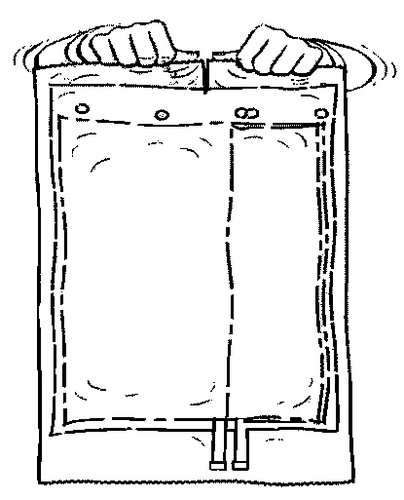

- Smooth out the bag and place it on a clean, flat surface.

- Press the smaller chamber of the bag with both hands to fully open the partition between the chambers along its entire length.

- Ensure thorough mixing by rotating the bag five times in each direction.
Administration of the ready-to-use hemofiltration solution
The hemofiltration solution should be warmed to approximately body temperature using an integrated or external warmer. Under no circumstances should the solution be administered if its temperature is below room temperature.
Rare cases of white precipitate of calcium carbonate in the tubing, particularly near the pump and heating device, have been observed during administration of this medicinal product. Therefore, during hemofiltration, the solution in the infusion lines must be visually monitored every 30 minutes to ensure that it remains clear and free from precipitates.
Precipitation may also occur with a significant delay after initiation of treatment. If precipitates are observed, the solution and infusion sets must be immediately replaced, and the patient must be closely monitored.
For single use only. Any unused solution and any damaged containers must be discarded.