Dotarem multidose
Poland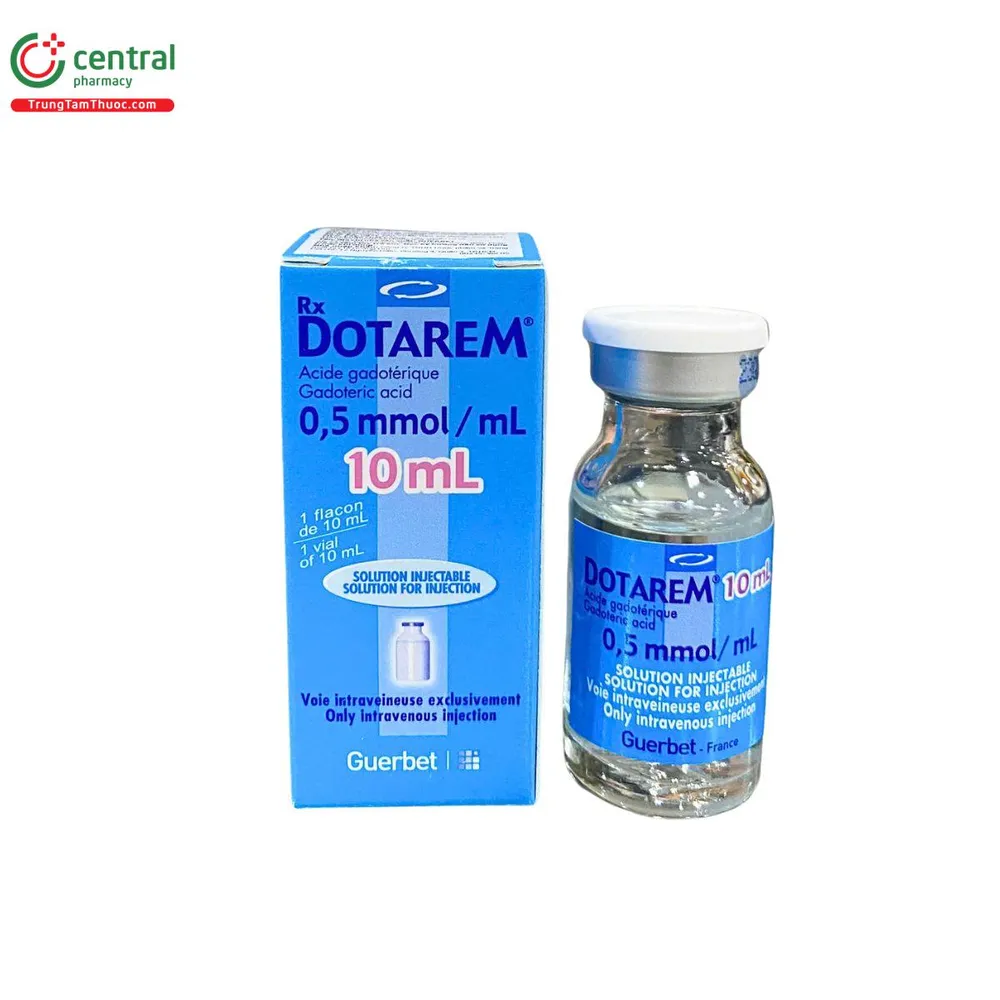
Table of Contents
Package leaflet: Information for the user
DOTAREM multidose, 0.5 mmol/ml
Injection solution in a vial
Acidum gadotericum
Please read all of this leaflet carefully before using this medicine, because it contains
important information for the patient.
- Keep this leaflet, as you may need to read it again.
- If you have any questions, please consult your doctor or radiologist.
- If you experience any adverse reactions, including any not listed in this leaflet, inform your doctor, radiologist, or pharmacist. See section 4.
Leaflet contents
- What DOTAREM multidose is and what it is used for
- Important information before using DOTAREM multidose
- How to use DOTAREM multidose
- Possible side effects
- How to store DOTAREM multidose
- Contents of the pack and other information
1. What DOTAREM multidose is and what it is used for
DOTAREM multidose is a diagnostic agent used in adults and children. It belongs to a group of contrast agents used in magnetic resonance imaging (MRI).
DOTAREM multidose is used to enhance the contrast of images obtained during MRI examinations. This contrast enhancement improves the visibility and delineation of:
- Pathological lesions in the brain, spinal cord, and surrounding tissues;
- Pathological lesions in the liver, kidneys, pancreas, pelvis, lungs, heart, breast, and musculoskeletal system;
- Pathological lesions and stenoses in arteries, particularly in the coronary arteries (in adults only).
This medicine is intended for diagnostic use only.
2. Important information before using DOTAREM multidose
When NOT to use DOTAREM multidose
- if the patient is allergic to the active substance or to any of the other ingredients of this medicine (listed in section 6.).
- if the patient is allergic to medicines containing gadolinium (such as other contrast agents used in magnetic resonance imaging).
Warnings and precautions
You should inform your doctor or radiologist if any of the following apply to the patient:
- the patient has previously had a reaction to a contrast agent during an examination;
- the patient suffers from asthma;
- the patient has a history of allergies (e.g. to seafood, hives, hay fever);
- the patient is being treated with beta-blockers (medicines used to treat heart disorders and blood pressure, such as metoprolol);
- the patient's kidneys are not functioning properly;
- the patient has recently undergone or is scheduled for a liver transplant in the near future;
- the patient has a disease affecting the heart or blood vessels;
- the patient has had seizures or is being treated for epilepsy.
In all such cases, the doctor or radiologist will assess the benefit-risk ratio and determine whether DOTAREM multidose can be administered to the patient. If DOTAREM multidose is administered, the doctor or radiologist will take necessary precautions and the administration of DOTAREM multidose will be closely monitored.
The doctor or radiologist may decide to perform a blood test to check kidney function before administering DOTAREM multidose, especially in patients aged 65 years or older.
Newborns and infants
Due to immature kidney function in newborns up to 4 weeks of age and infants up to 1 year of age, DOTAREM multidose will be administered to such patients only after careful consideration by the doctor.
Before the examination, all metallic objects the patient may be wearing should be removed. The patient should inform the doctor or radiologist if they have any of the following implanted:
- cardiac pacemaker,
- vascular clip,
- infusion pump,
- nerve stimulator,
- cochlear implant (inner ear implant),
- any suspected metallic foreign body, especially in the eye. This is very important because MRI imaging equipment uses very strong magnetic fields, which may cause serious problems.
DOTAREM multidose and other medicines
You should tell the doctor or radiologist about all medicines the patient is currently taking or has recently taken, as well as any medicines the patient plans to take. In particular, inform the treating physician, radiologist, or pharmacist if the patient is taking or has recently taken medicines for heart disorders and blood pressure, such as beta-blockers, vasoactive agents, angiotensin-converting enzyme inhibitors, or angiotensin II receptor antagonists.
DOTAREM multidose with food and drink
No interactions between DOTAREM multidose and food or drink are known. However, you should ask your doctor, radiologist, or pharmacist whether it is necessary to refrain from eating or drinking before the examination.
Pregnancy and breastfeeding
If the patient is pregnant or breastfeeding, suspects she may be pregnant, or is planning to have a child, she should consult her doctor or radiologist before using this medicine.
Pregnancy
Gadoteric acid may cross the placenta. It is not known whether this affects the unborn child.
DOTAREM multidose must not be used during pregnancy unless absolutely necessary.
Breastfeeding
The doctor or radiologist will discuss with the patient and advise whether breastfeeding can be continued or should be interrupted for 24 hours after administration of DOTAREM multidose.
Driving and operating machinery
There are no data available on the effects of DOTAREM multidose on the ability to drive. If the patient feels unwell after the examination, for example experiences nausea, the patient should not drive or operate machinery.
3. How to use DOTAREM multidose
DOTAREM multidose will be administered as an intravenous injection.
During the examination, the patient will be closely monitored by a doctor or radiologist.
An intravenous needle will remain in place so that, if necessary, the doctor or radiologist can
rapidly administer life-saving medications. If the patient experiences an allergic reaction,
administration of DOTAREM multidose will be immediately stopped.
DOTAREM multidose may be injected manually or using an automatic injector. In newborns and infants,
this medicine is administered exclusively by manual injection.
The procedure may be performed in a hospital, outpatient clinic, or private office. Medical personnel
are aware of the precautions to be taken during the examination and are familiar with potential
complications that may occur.
Dosing
The doctor or radiologist will determine the appropriate dose for the patient and will supervise
the injection of the medicine.
Dosing in special patient groups
DOTAREM multidose is not recommended for patients with severe renal function impairment or for
patients who have recently undergone or are scheduled to undergo liver transplantation. However,
if administration of DOTAREM multidose is necessary, the patient should receive only a single dose
during the examination and should not receive another dose within at least 7 days.
Use in newborns, infants, children, and adolescents
Due to immature kidney function in newborns up to 4 weeks of age and infants up to 1 year of age,
DOTAREM multidose should be used in these patients only after careful consideration by the doctor.
Children should receive only a single dose during the examination and should not receive another
injection within at least 7 days.
Its use in angiography is not recommended in children under 18 years of age.
Elderly patients
There is no need to adjust the dose in patients aged 65 years and older; however, blood tests may
be necessary to assess kidney function.
Administration of a higher than recommended dose of DOTAREM multidose
It is highly unlikely that a patient would receive an excessive dose of the medicine. DOTAREM
multidose is administered in a medical facility by appropriately trained personnel.
In the event of actual overdose, DOTAREM multidose may be removed from the body by hemodialysis
(blood cleansing).
Additional information on the use and handling of this medicine by medical personnel is provided
at the end of this leaflet.
If you have any further questions regarding the use of this medicine, please consult your doctor or
radiologist.
4. Possible adverse reactions
Like all medicines, this medicine can cause adverse reactions, although not everyone will experience them.
After administration, the patient will be monitored for at least half an hour. Most adverse
reactions occur immediately or shortly after administration. Some adverse reactions may even
occur up to seven days after injection of DOTAREM multidose.
There is a small risk of an allergic reaction to DOTAREM multidose in patients. Such reactions
can be severe and may lead to shock (an allergic reaction which may be life-threatening). The
following symptoms may be early signs of shock. If the patient experiences any of the symptoms
listed below, they should immediately inform the doctor, radiologist, or another healthcare professional:
- swelling of the face, lips and (or) throat, which may cause difficulty in swallowing or breathing
- swelling of the hands or feet
- feeling of dizziness (hypotension)
- difficulty breathing
- wheezing
- cough
- skin itching
- watery nasal discharge
- sneezing
- eye irritation
- urticaria
- rash
Uncommon adverse reactions (may occur in up to 1 in 100 people)
- hypersensitivity
- headache
- unusual taste in the mouth
- dizziness
- drowsiness
- tingling sensation, feeling of warmth or cold and (or) pain
- increased or decreased blood pressure
- nausea
- abdominal pain
- rash
- feeling of warmth, feeling of cold
- discomfort at injection site, reaction at injection site, feeling of cold at injection site, swelling at injection site, extravasation of the product (leakage outside blood vessels), which may lead to inflammation (redness and local pain)
Rare adverse reactions (may occur in up to 1 in 1,000 people)
- anxiety, fainting (dizziness and risk of loss of consciousness)
- eyelid swelling
- palpitations
- sneezing
- vomiting
- diarrhea
- increased salivation
- urticaria, itching, sweating
- chest pain, chills
Very rare adverse reactions (may occur in up to 1 in 10,000 people)
- anaphylactic and anaphylactoid reactions
- agitation
- coma, seizures, syncope (transient loss of consciousness), disturbances in smell (perception of often unpleasant odors), convulsions
- conjunctivitis, blurred vision, excessive tearing
- sudden cardiac arrest, accelerated or slowed heartbeat, arrhythmia, vasodilation, pallor
- respiratory arrest, pulmonary edema, breathing difficulties, wheezing, nasal congestion, cough, dry throat, throat spasm with sensation of suffocation, respiratory muscle spasms, throat swelling
- rash, skin redness, lip swelling, local swelling in the oral cavity
- muscle spasms, muscle weakness, back pain
- weakness, chest discomfort, fever, facial swelling, extravasation of the drug outside blood vessels, which may lead to tissue necrosis at the injection site, phlebitis
- decreased oxygen content in blood.
There have been reports of nephrogenic systemic fibrosis (which causes hardening of the skin and may also affect soft tissues and internal organs), which usually occurred in patients who received DOTAREM multidose together with other contrast agents containing gadolinium. If, in the weeks following an MRI examination, the patient notices changes in skin color and (or) thickness at any body site, they should inform the radiologist who performed the examination.
Reporting of adverse reactions
If any adverse reactions occur, including any not listed in this leaflet, the patient should inform their doctor or radiologist.
Adverse reactions can be reported directly to the Department of Monitoring Adverse Reactions of Medicinal Products at the Office for Registration of Medicinal Products, Medical Devices and Biocidal Products – Al. Jerozolimskie 181 C, 02-222 Warsaw
Tel.: +48 22 49 21 301
Fax: +48 22 49 21 309
e-mail: [email protected]
Adverse reactions can also be reported to the marketing authorization holder.
Reporting adverse reactions helps to provide more information on the safety of the medicine.
5. How to store DOTAREM multidose
Keep this medicine out of sight and reach of children.
No special storage conditions are required.
Do not use this medicine after the expiry date stated on the vial and carton following the abbreviation "EXP". The expiry date refers to the last day of the stated month.
It is highly unlikely that a patient will be asked to dispose of any leftover DOTAREM multidose medicine.
6. Contents of the pack and other information
What DOTAREM multidose contains
- The active substance is gadoteric acid. One millilitre of injection solution contains 279.32 mg of gadoteric acid (as meglumine salt), equivalent to 0.5 mmol of gadoteric acid (as meglumine salt).
- The other components are meglumine and water for injections.
What DOTAREM multidose looks like and contents of the pack
DOTAREM multidose is a clear, colourless solution for intravenous injection,
colourless or slightly yellow in various shades.
The pack contains one vial with 60 or 100 ml of injection solution.
Not all pack sizes may be marketed.
Marketing Authorisation Holder and Manufacturer:
GUERBET
BP 57400
95943 Roissy CdG cedex
France
This medicinal product is authorised in the European Economic Area under the following name: DOTAREM multidose
Information intended exclusively for medical professionals or healthcare personnel:
Dosage
Adults:
- MRI of the brain and spine: In neurological imaging, doses range from 0.1 to 0.3 mmol/kg body weight, corresponding to 0.2 to 0.6 ml/kg body weight. After administration of 0.1 mmol/kg body weight in patients with brain tumours, an additional dose of 0.2 mmol/kg body weight may improve tumour visibility and assist in treatment decisions.
- Whole-body MRI and angiography: The recommended intravenous dose providing diagnostically adequate contrast enhancement is 0.1 mmol/kg body weight (i.e., 0.2 ml/kg body weight).
- Angiography: In exceptional circumstances (e.g., when satisfactory image quality covering a large vascular area has not been achieved), administration of a second sequential dose of 0.1 mmol/kg body weight (corresponding to 0.2 ml/kg body weight) may be justified. However, if two sequential doses of DOTAREM multidose are anticipated before starting the angiography, it may be beneficial to administer 0.05 mmol/kg body weight (i.e., 0.1 ml/kg body weight) per dose, depending on the available imaging equipment.
Children and adolescents (0–18 years):
-
MRI of the brain and spine / whole-body MRI: The recommended and maximum dose of DOTAREM multidose is 0.1 mmol/kg body weight. No more than one dose should be administered during a single imaging session. Due to the immaturity of renal function in neonates up to 4 weeks of age and infants up to 1 year of age, DOTAREM multidose should only be used in these patients after careful consideration at a dose not exceeding 0.1 mmol/kg body weight. No more than one dose should be administered during an imaging procedure. Due to lack of data on repeated administration, repeat injections of DOTAREM multidose should not be performed unless the interval between injections is at least 7 days.
-
Angiography: The use of DOTAREM multidose in angiography in children under 18 years of age is not recommended due to insufficient data on efficacy and safety for this indication.
Special patient groups:
- Patients with renal impairment: In patients with mild to moderate renal impairment (GFR ≥30 ml/min/1.73 m²), the standard adult doses are used. See section "Renal impairment" below.
- Patients with hepatic impairment: The standard adult doses are used in these patients. Caution is recommended, particularly in the perioperative period related to liver transplantation.
Method of administration
DOTAREM multidose is indicated for intravenous use only.
DOTAREM multidose must not be administered by intrathecal or epidural injection.
Infusion rate: 3–5 ml/min (in angiographic procedures, higher infusion rates up to 120 ml/min, i.e., 2 ml/sec, may be used).
Optimal imaging: within 45 minutes after injection
Optimal imaging sequence: T1-weighted sequences
Whenever possible, the contrast agent should be administered intravenously while the patient is in a supine position. After administration, the patient should be monitored for at least 30 minutes, as experience shows that most adverse reactions occur during this period.
The rubber stopper should be punctured only once using an appropriate solution withdrawal spike device.
Generally, the withdrawal device should contain the following components: a trocar, a sterile air filter, a Luer connector, and a protective closure cap.
It may be used with a sterile, single-use syringe for single administration of the product or for bolus injection of a second contrast agent if clinically indicated.
An automated injection system may be used only for a single patient to allow multiple administrations of the product.
Any remaining volume of product in the vial or single-use container after completion of the procedure must be discarded within 24 hours of piercing the rubber stopper. The manufacturer's instructions must be strictly followed.
The injection solution should be visually inspected before use. Only clear solutions free from visible particles should be used.
Children and adolescents (0–18 years)
Depending on the amount of DOTAREM multidose to be administered to a child, it is recommended to use vials of DOTAREM multidose in combination with a single-use syringe of appropriate capacity to ensure higher precision of the injected dose.
In neonates and infants, the required dose should be administered manually.
Renal impairment
It is recommended that all patients undergo laboratory tests to assess renal function before administration of DOTAREM multidose.
There have been reports of nephrogenic systemic fibrosis (NSF) associated with the use of gadolinium-containing contrast agents in patients with acute or chronic renal impairment (GFR < 30 ml/min/1.73 m²). Patients undergoing liver transplantation are at particular risk due to the high incidence of acute renal failure in this group. Because of the risk of NSF associated with the use of DOTAREM multidose, this product should be used in patients with severe renal impairment and in patients in the perioperative period of liver transplantation only after careful benefit-risk assessment and only when essential diagnostic information cannot be obtained by non-contrast MRI. If administration of DOTAREM multidose is necessary, the dose should not exceed 0.1 mmol/kg body weight. No more than one dose should be administered during an imaging session. Due to lack of data on repeated administration, repeat injections of DOTAREM multidose should not be performed unless the interval between injections is at least 7 days.
Haemodialysis shortly after administration of DOTAREM multidose may facilitate elimination of the product from the body. There is no evidence supporting the initiation of haemodialysis for prophylaxis or treatment of NSF in patients who are not currently undergoing haemodialysis.
Elderly patients
Since renal clearance of gadoteric acid may be reduced in elderly patients, it is particularly important to assess renal function in patients aged 65 years and older prior to administration.
Neonates and infants
See section "Dosage and method of administration, use in children".
Pregnancy and breastfeeding
DOTAREM multidose should not be used during pregnancy unless the clinical condition of the woman requires the use of gadoteric acid.
Continuation or interruption of breastfeeding for 24 hours after administration of DOTAREM multidose should be decided by the physician and the breastfeeding mother.
Instructions for use
Removable identification labels from the vials should be attached to the patient's medical record to allow accurate identification of the gadolinium-containing contrast agent used. The administered dose should also be recorded. When using an electronic patient record, the product name, batch number, and administered dose should be entered.