Donepezil bluefish
Poland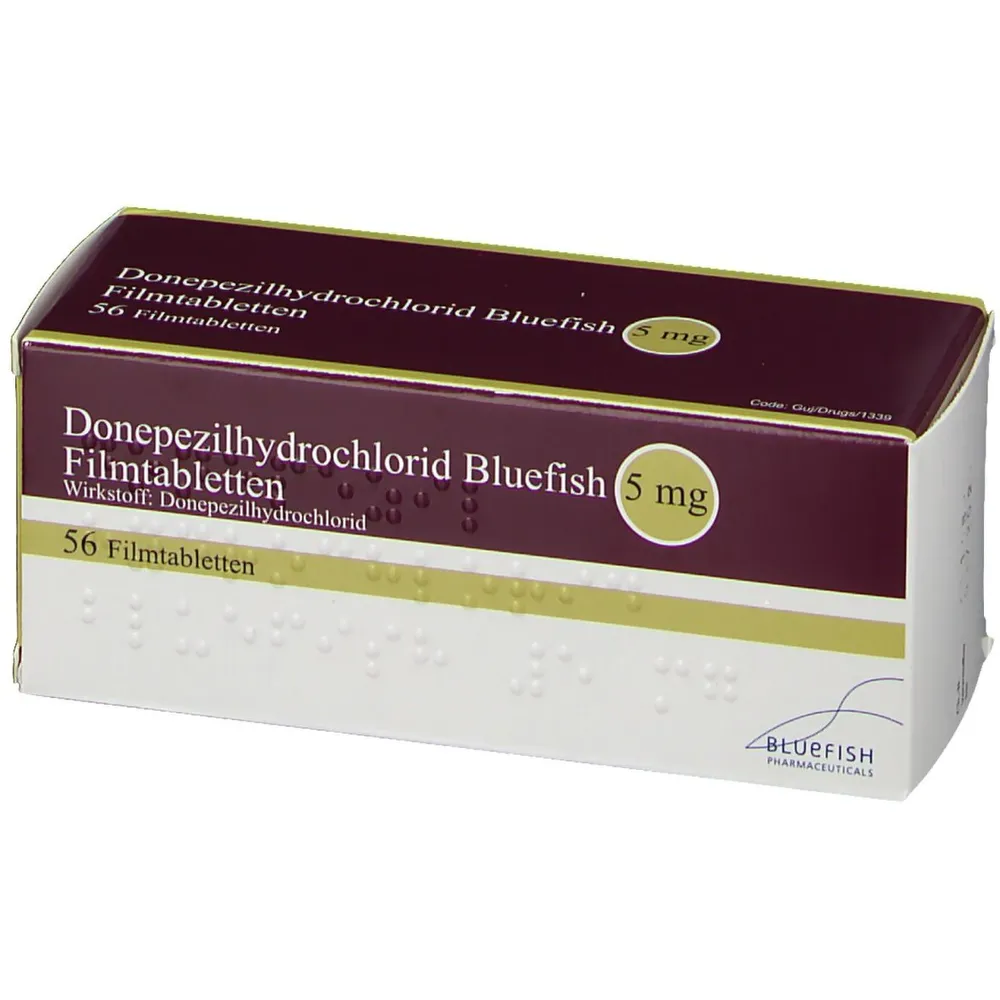
Table of Contents
Package leaflet: Information for the user
Donepezil Bluefish, 5 mg, film-coated tablets
Donepezil Bluefish, 10 mg, film-coated tablets
Donepezili hydrochloridum
Please read all of this leaflet carefully before taking this medicine because it contains important information for you.
- Keep this leaflet. You may need to read it again.
- If you have any further questions, ask your doctor, pharmacist, or nurse.
- This medicine has been prescribed for you only. Do not pass it on to others. It may harm them, even if their symptoms are the same as yours.
- If you experience any side effects, including any not listed in this leaflet, tell your doctor, pharmacist, or nurse. See section 4.
Contents of the leaflet:
- What Donepezil Bluefish is and what it is used for
- What you need to know before taking Donepezil Bluefish
- How to take Donepezil Bluefish
- Possible side effects
- How to store Donepezil Bluefish
- Contents of the pack and other information
1. What Donepezil Bluefish is and what it is used for
Donepezil Bluefish contains donepezil hydrochloride as the active substance.
Donepezil Bluefish belongs to a group of medicines called acetylcholinesterase inhibitors.
Donepezil increases levels of a substance (acetylcholine) in the brain involved in memory function by inhibiting the breakdown of acetylcholine.
This medicine is used to treat the symptoms of dementia in people with Alzheimer's disease of mild to moderate severity. Symptoms include memory loss, disorientation, and changes in behaviour. As a result of these symptoms, people with Alzheimer's disease have increasing difficulty performing everyday, routine tasks.
Donepezil is intended for use in adult patients only.
2. Important information before taking Donepezil Bluefish
When not to take Donepezil Bluefish
- if the patient is allergic (hypersensitive) to donepezil hydrochloride, piperidine derivatives, or any of the other ingredients of this medicine (listed in section 6).
Warnings and precautions
Before starting treatment with Donepezil Bluefish, discuss with your doctor, pharmacist,
or nurse if the patient has or has ever had:
- stomach or duodenal ulcers,
- seizures or epileptic fits,
- heart problems (such as irregular or very slow heartbeat, heart failure, myocardial infarction),
- a heart condition known as "prolonged QT interval", or if certain rhythm disorders called torsade de pointes have been diagnosed previously, or if there is a family history of "prolonged QT interval",
- low levels of magnesium or potassium in the blood,
- asthma or other chronic lung disease,
- liver dysfunction or hepatitis,
- difficulty passing urine or mild kidney impairment.
You should also inform the doctor if the patient is pregnant or suspects she may be pregnant.
Children and adolescents
Donepezil Bluefish is not recommended for use in children and adolescents (under 18 years of age).
Donepezil Bluefish with other medicines
Tell your doctor or pharmacist about all medicines the patient is currently taking or has recently taken, as well as any medicines the patient plans to take. This includes medicines not prescribed by a doctor but purchased over-the-counter at a pharmacy/from a pharmacist. This also applies to medicines that may be taken in the future while continuing treatment with Donepezil Bluefish. Other medicines may reduce or increase the effect of Donepezil Bluefish.
It is especially important to tell your doctor if the patient is taking any of the following medicines:
- medicines used to treat heart rhythm disorders, e.g. amiodarone, sotalol,
- medicines used to treat depression, e.g. citalopram, escitalopram, amitriptyline, fluoxetine,
- antipsychotic medicines, e.g. pimozide, sertindole, ziprasidone,
- medicines used to treat bacterial infections, e.g. clarithromycin, erythromycin, levofloxacin, moxifloxacin, rifampicin,
- antifungal medicines, e.g. ketoconazole,
- other medicines used to treat Alzheimer's disease, e.g. galantamine,
- painkillers or medicines used to treat joint inflammation, e.g. acetylsalicylic acid, non-steroidal anti-inflammatory drugs (NSAIDs) such as ibuprofen or sodium diclofenac,
- anticholinergic medicines, such as tolterodine,
- anticonvulsant medicines, e.g. phenytoin, carbamazepine,
- medicines used for heart conditions, e.g. quinidine, beta-blockers (propranolol and atenolol),
- muscle relaxants, e.g. diazepam, suxamethonium,
- medicines used for general anaesthesia,
- over-the-counter medicines, e.g. herbal remedies.
If a procedure requiring general anaesthesia is planned, the patient should inform the doctor and anaesthetist that they are taking Donepezil Bluefish, as this medicine may affect the amount of anaesthetic drugs required.
Donepezil Bluefish can be used in patients with mild to moderate renal or hepatic impairment.
Inform your doctor in advance if the patient has kidney or liver problems.
Patients with severe hepatic impairment should not take Donepezil Bluefish.
Provide the name of a caregiver to your doctor or pharmacist. The caregiver will help the patient take the medicine as directed.
Donepezil Bluefish with food, drink and alcohol
Food does not affect the action of Donepezil Bluefish.
Alcohol should not be consumed during treatment with Donepezil Bluefish, as alcohol may alter the effect of this medicine.
Pregnancy, breastfeeding and fertility
If the patient is pregnant or breastfeeding, suspects she may be pregnant, or is planning to become pregnant, she should consult her doctor or pharmacist before using this medicine.
Donepezil Bluefish should not be used during pregnancy unless absolutely necessary.
Donepezil Bluefish should not be used if the patient is breastfeeding.
Driving and using machines
Alzheimer's disease may impair the ability to drive vehicles or operate machinery; therefore, such activities should not be performed until the doctor confirms it is safe.
This medicine may also cause fatigue, dizziness, and muscle cramps. If these symptoms occur, the patient should not drive or operate machinery.
Donepezil Bluefish contains lactose.
If the patient has previously been diagnosed with intolerance to certain sugars, the patient should consult their doctor before taking Donepezil Bluefish.
3. How to take Donepezil Bluefish
How much Donepezil Bluefish should be taken
This medicine should always be taken exactly as prescribed by the doctor, pharmacist, or nurse.
If in doubt, consult the doctor, pharmacist, or nurse.
Initially, the recommended dose is 5 mg (one white tablet) once daily in the evening, before bedtime. After one month, the doctor may recommend increasing the dose to 10 mg (one yellow tablet) once daily in the evening, before bedtime.
If the patient experiences unusual dreams, nightmares, or difficulty sleeping (see section 4), the doctor may advise taking Donepezil Bluefish in the morning instead.
The strength of the tablet taken by the patient may be adjusted depending on the duration of treatment and the doctor's recommendations. The maximum recommended dose is 10 mg taken once daily in the evening.
Always follow the doctor's or pharmacist's instructions regarding how and when to take the medicine. Do not change the dose without consulting the doctor.
How to take the medicine
Donepezil Bluefish should be taken in the evening, before bedtime, with water.
Use in children and adolescents
Donepezil Bluefish is not indicated for use in children and adolescents (under 18 years of age).
How long to take Donepezil Bluefish
The doctor or pharmacist will advise the patient on how long to continue taking the tablets. Periodic check-ups with the doctor are necessary to assess the effectiveness of treatment and the course of the disease.
If more Donepezil Bluefish has been taken than recommended
Do not take more than one tablet per day. If an overdose is taken, contact a doctor immediately or go to the nearest hospital emergency department. Always bring any remaining tablets and this leaflet to the hospital so the doctor knows which medicine has been taken.
Symptoms of overdose may include nausea (feeling sick) and vomiting, excessive salivation, sweating, slow heartbeat, low blood pressure (feeling dizzy or dizziness upon standing), breathing difficulties, loss of consciousness, and seizures or epileptic fits.
If a dose of Donepezil Bluefish is missed
If the patient forgets to take a tablet, the next tablet should be taken the following day at the usual time. Do not take a double dose to make up for the missed tablet.
If the patient has forgotten to take the medicine for more than one week, contact the doctor before restarting treatment.
Stopping Donepezil Bluefish
Do not stop taking this medicine unless advised by the doctor. If the patient stops taking Donepezil Bluefish, the benefits of treatment will gradually diminish.
If there are any further questions about the use of this medicine, consult the doctor, pharmacist, or nurse.
4. Possible adverse reactions
Like all medicines, this medicine can cause adverse reactions, although not everyone will experience them.
The adverse reactions listed below have been reported in patients taking
Donepezil Bluefish.
You should tell the doctor if any of the following adverse reactions occur in the patient while taking Donepezil Bluefish.
Serious adverse reactions:
Tell the doctor immediately if the patient experiences any of the serious adverse reactions listed below.
The patient may require urgent medical treatment.
- Gastric or duodenal ulceration. Symptoms of gastric ulcer include pain and discomfort (dyspepsia) felt in the abdominal area between the navel and the ribs (may occur in up to 1 in 100 people).
- Gastrointestinal bleeding. This may cause black stools or visible rectal bleeding (may occur in up to 1 in 100 people).
- Seizures or epileptic fits (may occur in up to 1 in 100 people).
- Liver damage, for example hepatitis. Symptoms of hepatitis include nausea or vomiting, loss of appetite, general malaise, fever, itching, yellowing of the skin and eyes (jaundice), and dark urine (may occur in up to 1 in 10,000 people).
- Tell the doctor immediately if fever occurs with associated muscle stiffness, excessive sweating, or reduced level of consciousness (a condition known as neuroleptic malignant syndrome) (may occur in up to 1 in 10,000 people).
- Muscle weakness, tenderness or pain, especially when occurring together with malaise, high fever, or dark urine. This may be due to a life-threatening breakdown of muscle tissue leading to kidney problems (a condition called rhabdomyolysis) (may occur in up to 1 in 10,000 people).
- Rapid or irregular heartbeat and fainting, which may be symptoms of a disease called Torsade de Pointes (frequency cannot be estimated from available data).
Other possible adverse reactions:
Very common adverse reactions: may affect more than 1 in 10 people
- Diarrhea
- Nausea, vomiting
- Headache
Common adverse reactions: may affect up to 1 in 10 people
- Muscle cramps
- Fatigue
- Difficulty sleeping (insomnia)
- Common cold
- Loss of appetite
- Hallucinations (seeing or hearing things that are not there)
- Unusual dreams, including nightmares
- Restlessness
- Aggressive behaviour
- Fainting
- Dizziness
- Feeling of stomach discomfort
- Rash
- Itching
- Involuntary urination
- Pain
- Accidents (patients may be more prone to falls and injuries)
Uncommon adverse reactions: may affect up to 1 in 100 people
- Slow heartbeat
- Excessive salivation
Rare adverse reactions: may affect up to 1 in 1,000 people
- Tremors, muscle stiffness, or involuntary movements, particularly of the face and tongue, but also of the limbs
Frequency not known (frequency cannot be estimated from available data)
- Changes in heart function seen on ECG known as "QT interval prolongation"
- Increased libido, hypersexuality
- Pisa syndrome (a condition involving involuntary muscle contractions causing abnormal bending of the body and head to one side)
Reporting of adverse reactions
If any adverse reactions occur, including any adverse reactions not listed in this leaflet, tell a doctor, pharmacist, or nurse. Adverse reactions can be reported directly to the Department of Monitoring Adverse Drug Reactions, Office for Registration of Medicinal Products, Medical Devices and Biocidal Products, Al. Jerozolimskie 181 C, 02-222 Warsaw, Tel.: +48 22 49 21 301, Fax: +48 22 49 21 309, Website: https://smz.ezdrowie.gov.pl
Adverse reactions can also be reported to the responsible entity.
Reporting adverse reactions helps provide more information on the safety of this medicine.
5. How to store Donepezil Bluefish
- Keep this medicine out of sight and reach of children.
- Do not use this medicine after the expiry date stated on the outer carton and blister after “Expiry date” or “EXP”. The expiry date refers to the last day of the stated month.
- No special storage conditions required.
- Medicines should not be disposed of via wastewater or household waste. Ask your pharmacist how to dispose of medicines no longer required. These measures will help protect the environment.
6. Contents of the pack and other information
What Donepezil Bluefish contains
The active substance is donepezil hydrochloride.
Each tablet of Donepezil Bluefish 5 mg contains donepezil hydrochloride monohydrate,
equivalent to 5 mg of donepezil hydrochloride.
Each tablet of Donepezil Bluefish 10 mg contains donepezil hydrochloride monohydrate,
equivalent to 10 mg of donepezil hydrochloride.
The other ingredients are:
Tablet core: lactose monohydrate, maize starch, microcrystalline cellulose,
low-substituted hydroxypropyl cellulose, magnesium stearate.
Coating:
5 mg tablets: Opadry OY-38951 white: hypromellose (6 cp), titanium dioxide (E 171), polyethylene glycol 400, talc.
10 mg tablets: Opadry 03B32654 yellow: hypromellose (6 cp), polyethylene glycol 400, talc, titanium dioxide (E 171), iron oxide yellow (E 172).
What Donepezil Bluefish looks like and contents of the pack
Donepezil Bluefish is available as 5 mg and 10 mg film-coated tablets. The description of the tablets is given below.
5 mg: white to off-white, round, biconvex, film-coated tablets with bevelled edges, marked with "5" on one side and plain on the other, with a diameter of approximately 7.14 mm.
10 mg: yellow, round, biconvex, film-coated tablets marked with "10" on one side and plain on the other, with a diameter of approximately 8.73 mm.
Donepezil Bluefish 5 mg and 10 mg are available in the following pack sizes:
PVC/Aluminium blisters:
5 mg: 7, 28, 56, 98, 119, 120 tablets
10 mg: 28, 56, 98, 119, 120 tablets
HDPE bottles with PP closure and seal: 100 tablets
Not all pack sizes may be marketed.
Marketing Authorisation Holder and Manufacturer
Marketing Authorisation Holder
Bluefish Pharmaceuticals AB, P.O. Box 490 13, 100 28 Stockholm, Sweden
Manufacturer
Bluefish Pharmaceuticals AB, Gävlegatan 22, 113 30 Stockholm, Sweden
Laboratori FUNDACIO DAU, C/De la letra C, 12-14, Polígono Industrial de la Zona Franca
Barcelona 08040, España
This medicinal product is authorised in the European Economic Area under the following names:
Austria Donepezil Bluefish 5 mg Filmtabletten
Donepezil Bluefish 10 mg Filmtabletten
Germany Donepezilhydrochlorid Bluefish 5 mg Filmtabletten
Donepezilhydrochlorid Bluefish 10 mg Filmtabletten
Spain Donepezilo Bluefish 5 mg comprimidos recubiertos con película
EFG
Donepezilo Bluefish 10 mg comprimidos recubiertos con película
EFG
Portugal Donepezil Bluefish 5 mg Comprimidos revestidos por película
Donepezil Bluefish 10 mg Comprimidos revestidos por película
Ireland Donepezil Hydrochloride Bluefish 5 mg film-coated Tablets
Donepezil Hydrochloride Bluefish 10 mg film-coated Tablets
Poland Donepezil Bluefish