Dolenio
Poland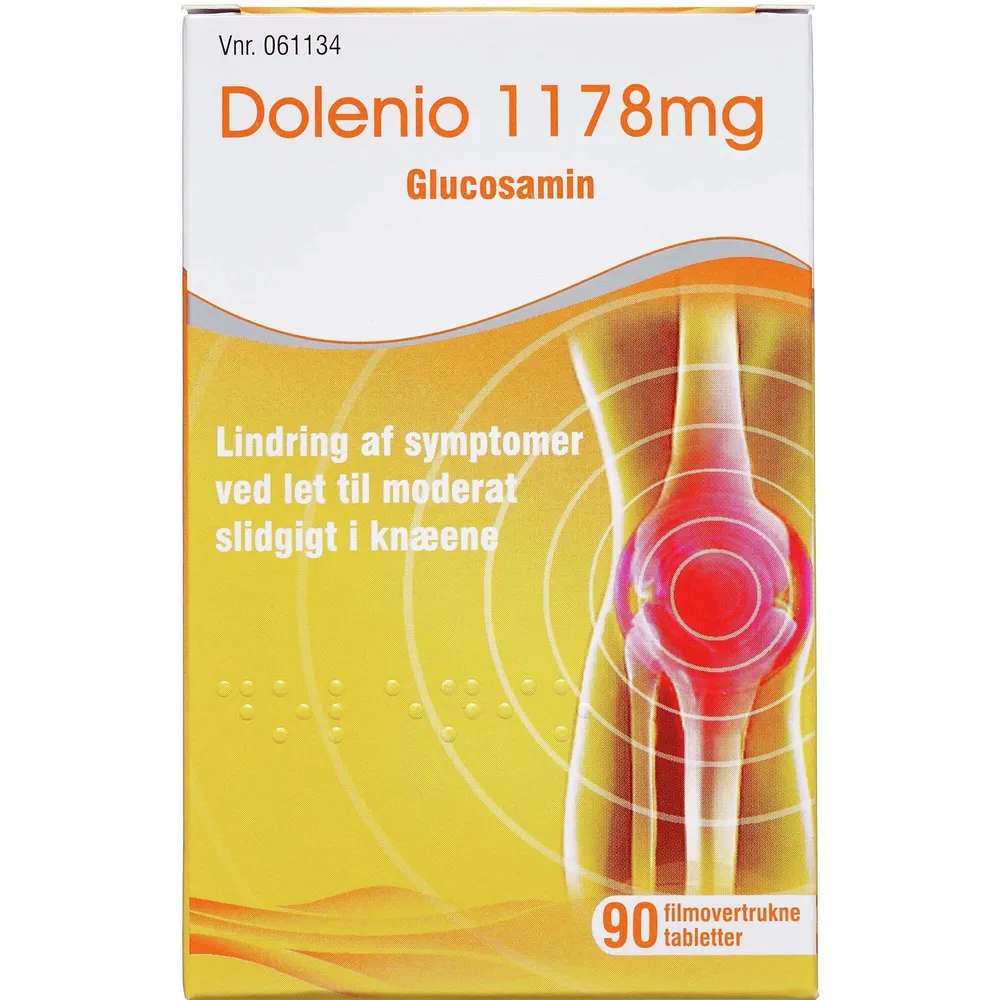
Table of Contents
Dolenio, 1178 mg, coated tablets
Glucosamine
Please read the entire leaflet carefully before taking this medicine, as it contains important information for the patient.
- Keep this leaflet for future reference.
- If you have any questions, consult your doctor or pharmacist.
- This medicine has been prescribed for a specific individual. Do not share it with others. The medicine may harm someone else, even if their symptoms are similar.
- If the patient experiences any adverse reactions, including those not listed in this leaflet, inform your doctor or pharmacist. See section 4.
Leaflet Contents:
- What Dolenio is and what it is used for
- Important information before taking Dolenio
- How to take Dolenio
- Possible side effects
- How to store Dolenio
- Contents of the pack and other information
1. What Dolenio is and what it is used for
Dolenio belongs to the group of non-steroidal anti-inflammatory and analgesic drugs.
Dolenio, available in tablet form, is used to reduce symptoms of mild to moderate osteoarthritis of the knee.
2. Important information before taking Dolenio
When not to take Dolenio
- if the patient is allergic to glucosamine or any of the other ingredients of this medicine (listed in section 6);
- if the patient is allergic to shellfish, because the active substance in this medicine, glucosamine, is derived from shellfish;
- if the patient is pregnant or breastfeeding, suspects she may be pregnant, or is planning to become pregnant.
Dolenio must not be used in children under 2 years of age and its use is not recommended in children and adolescents under 18 years of age.
Warnings and precautions
Before starting Dolenio, discuss with your doctor:
- if the patient has glucose intolerance. Blood glucose monitoring may need to be performed more frequently after starting glucosamine treatment;
- if the patient has risk factors for cardiovascular diseases (e.g. high blood pressure, diabetes, hypercholesterolaemia, or if the patient smokes). It is recommended to measure cholesterol levels before starting treatment;
- if the patient has asthma. Glucosamine treatment may worsen asthma symptoms;
- if the patient has impaired kidney or liver function.
Children and adolescents
Dolenio must not be used in children under 2 years of age and its use is not recommended in children and adolescents under 18 years of age.
Dolenio and other medicines
Tell your doctor about all medicines the patient is currently taking or has recently taken, as well as any medicines the patient plans to take.
It is especially important to inform your doctor or pharmacist if the patient is taking any of the following medicines:
- anticoagulants (medicines used to prevent blood clotting), such as warfarin, whose effect may be enhanced when taken concomitantly with glucosamine;
- tetracyclines (antibacterial medicines used in infections).
Dolenio with food and drink
Tablets should be swallowed with a small amount of liquid and may be taken with or without food.
Pregnancy and breastfeeding
If the patient is pregnant or breastfeeding, suspects she may be pregnant, or is planning to become pregnant, she should consult a doctor or pharmacist before using this medicine.
Pregnancy
Dolenio should not be used during pregnancy.
Breastfeeding
Use of Dolenio is not recommended during breastfeeding.
Driving and operating machinery
No studies have been conducted on the effect of the medicine on the ability to drive motor vehicles or operate mechanical equipment. If dizziness or drowsiness occurs during treatment with Dolenio, the patient should not drive motor vehicles or operate machinery.
Important information about some ingredients of Dolenio
Each tablet contains 6.52 mmol (151 mg) of sodium, which should be taken into consideration in patients who are controlling their dietary sodium intake.
3. How to take Dolenio
This medicine should always be taken as directed by your doctor. If in doubt,
consult your doctor or pharmacist.
Adults
The recommended dose is 1 tablet (1178 mg of glucosamine) per day for adults.
Elderly patients
Dose adjustment is not required.
Patients with renal and/or hepatic impairment
Dosage recommendations cannot be provided, as no studies have been conducted.
The medicine should be taken orally. Tablets should be swallowed with a small amount of water or another
liquid and may be taken with food or independently of meals.
Glucosamine is not indicated for the treatment of acute pain symptoms. Symptoms may not improve
(especially pain) for several weeks of treatment, and in some cases, even longer. If symptoms do not improve after
2–3 months, inform your doctor or pharmacist, as re-evaluation of further treatment will be required.
Taking more Dolenio than recommended
If a patient has taken too many Dolenio tablets, discontinue taking Dolenio and
any other products containing glucosamine, and contact your doctor or
go to hospital immediately.
Symptoms of glucosamine overdose may include headache,
dizziness, disorientation, joint pain, nausea, vomiting, diarrhoea, and constipation.
Missed dose of Dolenio
Do not take a double dose to make up for a missed dose.
Stopping Dolenio treatment
Talk to your doctor before stopping treatment, as changing therapy may
cause symptoms to return.
If you have any further questions about the use of this medicine, consult your
doctor or pharmacist.
4. Possible adverse reactions
Like all medicines, this medicine can cause adverse reactions, although not everyone experiences them.
However, emergency medical assistance should be sought or the patient should go to hospital and stop taking
the medicine Dolenio if symptoms such as: swelling of the face, tongue and (or) throat, and (or) difficulty
swallowing, or hives combined with breathing difficulties (angioedema) occur.
The following adverse reactions have been reported:
Common adverse reactions (occur in 1 to 10 patients): headache, feeling of fatigue,
nausea, abdominal pain, indigestion, diarrhoea, constipation.
Uncommon adverse reactions (occur in 1 to 100 patients): rash, itching and sudden redness of the skin.
Frequency not known (frequency cannot be estimated from the available data): vomiting, urticaria,
swelling of feet or ankles, angioedema. Exacerbation of pre-existing asthma, worsening of blood glucose control in patients with diabetes.
Increased cholesterol levels have also been reported.
Dolenio may cause increased liver enzyme activity and, rarely, jaundice.
If any of the adverse reactions worsen or if any adverse reactions not listed in this leaflet occur, the doctor or pharmacist should be informed.
Reporting of adverse reactions
If any adverse reactions occur, including any adverse reactions not listed in this leaflet, please inform <,>.
Adverse reactions can be reported directly to the "national reporting system" listed in Annex V*. Reporting adverse reactions helps to provide more information on the safety of the medicine.
Adverse reactions may also be reported to the marketing authorization holder.
5. How to store Dolenio
Keep this medicine out of the sight and reach of children.
Do not use this medicine after the expiry date stated on the packaging after "EXP". The expiry date refers to the last day of the stated month.
No special storage conditions are required.
Medicines must not be disposed of via wastewater or household waste. Ask your pharmacist how to dispose of medicines no longer required. Such measures help protect the environment.
6. Contents of the pack and other information
What Dolenio contains
- The active substance in this medicine is glucosamine. One coated tablet contains 1884.60 mg of glucosamine sulfate with sodium chloride, equivalent to 1500 mg of glucosamine sulfate or 1178 mg of glucosamine.
- Other ingredients are:
Tablet core
Povidone K30
Macrogol 4000
Magnesium stearate
Coating
Hypromellose
Titanium dioxide (E 171)
Talc
Propylene glycol
Polysorbate 80
What Dolenio looks like and contents of the pack
Dolenio are white or almost white, oval, biconvex coated tablets with a breakline on one side.
The breakline is intended for breaking the tablet to facilitate swallowing and is not intended for dividing the tablet into two equal doses.
Pack sizes: 30 or 90 coated tablets in an HDPE bottle with an HDPE screw cap, or
4, 20, 30, 60 and 90 coated tablets in Al/PVC/PVDC blisters.
Marketing Authorisation Holder and Manufacturer
Marketing Authorisation Holder:
Blue Bio Pharmaceuticals Limited, 5th Floor, Beaux Lane House, Mercer Street Lower, Dublin 2,
Ireland
Manufacturers:
Jemo-pharm A/S
Hasselvej 1
DK-4780 Stege
Denmark
Central – Pharma Limited
Caxton Road
Bedford
MK41 0XZ
United Kingdom
Wasdell Packaging Limited
Unit 6-8, Euroway Industrial Estate,
Blagrove, Swindon, Wiltshire,
SN5 8YW,
United Kingdom
This medicinal product is authorised in the Member States of the European Economic Area under the following names:
Austria: Tavimin 1500 mg Filmtabletten
Belgium: Dolenio 1178 mg Filmomhulde tabletten
Bulgaria: Bonartos 1178 мг филмирани таблетки
Czech Republic: Bayflex 1178 mg
Cyprus: Dolenio
Germany: Dolenio 1178 mg Filmtabletten
Denmark: Dolenio
Estonia: Dolenio
France: Dolenio 1178 mg, comprimé pelliculé
Greece: Dolenio
Hungary: Dolenio 1500 mg filmtabletta
Iceland: Dolenio
Ireland: Dolenio 1178 mg Film-coated tablets
Lithuania: Dolenio 1178 mg plėvele dengtos tabletės
Luxembourg: Dolenio 1178 mg, comprimé pelliculé
Latvia: Dolenio 1178 mg apvalkotās tablets
Malta: Dolenio
Netherlands: Dolenio 1178 mg Filmomhulde tablet
Norway: Dolenio
Poland: Dolenio
Portugal: Dolenio
Romania: Slideflex
Sweden: Dolenio 1178 mg filmdragerade tabletter
Slovenia: Dolenio 1178 mg
Slovakia: Dolenio 1178 mg filmsko obložene tablete
United Kingdom: Dolenio 1500 mg Film-coated tablets