Diuver
Poland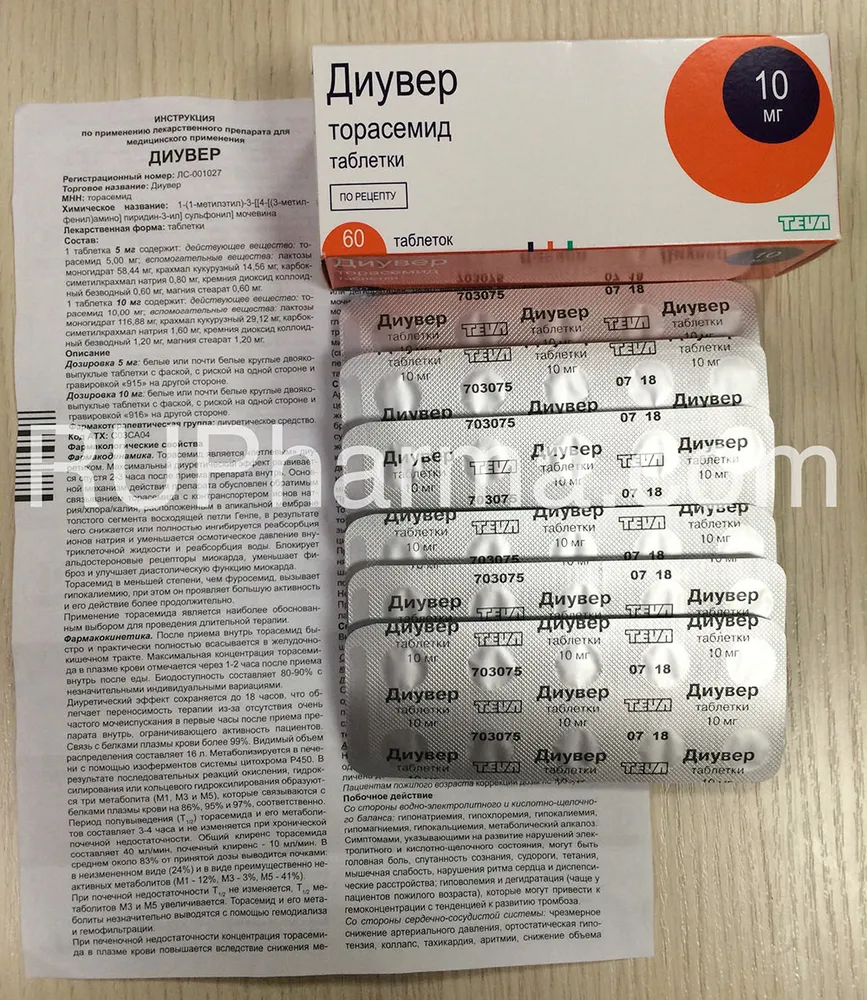
Table of Contents
Patient Information Leaflet: Information for the User
Warning! Keep this leaflet. Information on the immediate packaging is in a foreign language.
Diuver, 5 mg, tablets
Torasemidum
Please read the entire leaflet before using the medicine, as it contains important information for the patient.
- Keep this leaflet for future reference.
- If you have any questions, consult your doctor or pharmacist.
- This medicine has been prescribed for a specific individual. Do not pass it on to others. This medicine may harm others, even if their symptoms are the same.
- If you experience any adverse reactions, including any adverse reactions not listed in this leaflet, inform your doctor, pharmacist, or nurse. See section 4.
Table of Contents:
- What is Diuver and what is it used for
- Important information before taking Diuver
- How to take Diuver
- Possible side effects
- How to store Diuver
- Contents of the pack and other information
1. What is Diuver and what is it used for
Diuver is a diuretic medicine. After oral administration, torasemide is rapidly and almost completely absorbed, with peak plasma concentrations occurring within 1 to 2 hours. Approximately 80% of the administered dose is excreted in the urine.
Indications:
- Essential hypertension;
- Oedema caused by congestive heart failure, pulmonary oedema, hepatic oedema, renal oedema.
2. Important information before using Diuver
When not to use Diuver
- if the patient is hypersensitive to torasemide, sulfonylurea derivatives (drugs used in diabetes), or any of the other components of this medicine (listed in section 6);
- if the patient has renal dysfunction with anuria;
- if the patient has hepatic coma or pre-comatose states;
- if the patient has hypotension;
- if the patient is breastfeeding.
Warnings and precautions
Before starting treatment with Diuver, discuss the following with your doctor or pharmacist:
- if the patient has disorders in urine excretion, the cause of these disorders should be eliminated and water-electrolyte balance restored before starting treatment (especially in patients receiving concomitant treatment with cardiac glycosides, glucocorticoids, mineralocorticoids, or laxatives);
- if torasemide therapy is long-term. During prolonged treatment, regular monitoring of water-electrolyte balance, blood glucose, uric acid, creatinine, and lipid levels is recommended, as well as blood morphology tests (red and white blood cells and platelets);
- if the patient has a tendency towards increased blood uric acid levels or a history of gout;
- if the patient has latent or overt diabetes. In such patients, carbohydrate metabolism should be monitored.
Due to insufficient experience with torasemide treatment, caution should be exercised in the following situations:
- pathological disturbances in acid-base balance;
- concomitant treatment with lithium, aminoglycosides, or cephalosporins;
- renal failure caused by nephrotoxic agents;
- children under 12 years of age.
Use of Diuver may lead to positive results in anti-doping controls.
The use of Diuver as a doping agent may pose a health risk.
Children and adolescents
There is a lack of clinical experience with the use of torasemide in this age group.
Diuver with other medicines
Inform your doctor or pharmacist about all medicines currently used, recently used, or planned for use.
When torasemide is used concomitantly with cardiac glycosides (drugs that stimulate heart function, increase myocardial contractility, and simultaneously reduce heart rate), increased myocardial sensitivity to these drugs may occur due to reduced plasma potassium and (or) magnesium levels.
When used together with mineralocorticoids (hormones regulating mineral and ion balance in the body), glucocorticoids (hormones regulating protein, carbohydrate, and fat metabolism), and laxatives, increased potassium excretion in urine may occur.
As with other diuretics (drugs that increase urine volume), the blood pressure-lowering effect may be enhanced when used concomitantly with other antihypertensive drugs.
Torasemide, especially in high doses, may increase the toxicity of aminoglycoside antibiotics, cisplatin, the nephrotoxic effect of cephalosporins, and the cardiotoxic and central nervous system toxic effects of lithium.
The effects of curare-like muscle relaxants and theophylline may be enhanced during concomitant use with torasemide.
Since torasemide inhibits tubular excretion of salicylates, toxicity may increase in patients receiving high doses of salicylates.
The effectiveness of antidiabetic drugs may be reduced.
Initiating treatment with angiotensin-converting enzyme (ACE) inhibitors after torasemide therapy, or starting combined therapy with these drugs, may cause transient drops in blood pressure. This effect can be minimized by reducing the initial dose of the ACE inhibitor and (or) reducing the dose of, or temporarily discontinuing, torasemide for 2–3 days before administering the ACE inhibitor.
Torasemide may reduce arterial responsiveness to vasoconstrictive drugs (e.g., adrenaline, noradrenaline).
Non-steroidal anti-inflammatory drugs (e.g., indomethacin) may reduce the diuretic and antihypertensive effects of torasemide by inhibiting prostaglandin synthesis.
Probenecid may reduce the efficacy of torasemide by inhibiting its renal tubular secretion.
Concomitant administration of torasemide and cholestyramine has not been studied in humans, but animal studies have shown reduced absorption of torasemide.
Diuver with food and drink
Diuver should be taken in the morning with a small amount of fluid, regardless of meals.
Patients with liver function disorders
Patients with impaired liver function should be under special monitoring during torasemide treatment due to the risk of increased blood torasemide levels.
Elderly patients
Dosage adjustment is not required in elderly patients.
Pregnancy and breastfeeding
If the patient is pregnant or breastfeeding, suspects she may be pregnant, or plans to become pregnant, she should consult her doctor or pharmacist before using this medicine.
Pregnancy:
Diuver is contraindicated during pregnancy.
Breastfeeding:
There are no data on the passage of Diuver into breast milk. Diuver is contraindicated during breastfeeding.
Fertility:
Non-clinical studies have not shown any effect of torasemide on fertility.
Driving and operating machinery
As with other drugs affecting blood pressure, patients using torasemide who experience dizziness or similar symptoms should not drive or operate machinery.
Diuver contains lactose monohydrate
If the patient has previously been diagnosed with intolerance to certain sugars, the patient should consult a doctor before taking this medicine.
Diuver contains sodium
This medicine contains less than 1 mmol (23 mg) of sodium per dose, meaning it is considered "sodium-free".
3. How to take Diuver
This medicine should always be taken exactly as directed by your doctor. If in doubt, consult your
doctor or pharmacist.
Diuver is available in the following strengths: 5 mg and 10 mg.
Recommended dose
Adults:
Primary hypertension
The recommended dose is 2.5 mg orally once daily. If necessary, the dose may be increased to
5 mg once daily. Clinical studies suggest that doses higher than 5 mg daily do not lead to further
blood pressure reduction. The maximum therapeutic effect is achieved after approximately
12 weeks of treatment.
Edema
The usual dose is 5 mg orally once daily. If necessary, the dose may be gradually increased
up to 20 mg once daily. In individual, exceptional cases, 40 mg daily has been used.
Use of a higher than recommended dose of Diuver
The typical clinical picture of torasemide overdose is not well known. In case of overdose,
marked diuresis may occur, with risk of fluid and electrolyte loss, leading to somnolence, confusion,
hypotension, and circulatory collapse. Gastrointestinal disturbances may also occur.
There is no specific antidote. Symptoms of overdose require dose reduction or discontinuation
of the medicine, along with administration of fluids and electrolytes.
If you have taken more than the recommended dose of Diuver, seek immediate medical advice
from your doctor or pharmacist.
Missed dose of Diuver
Take the missed dose as soon as possible. If it is almost time for the next dose, take the next dose
at the scheduled time.
Do not take a double dose to make up for a missed dose.
4. Possible adverse effects
Like all medicines, this medicine can cause adverse effects, although they do not occur in everyone.
Common (may occur in up to 1 in 100 patients):
As with other diuretics, disturbances in water and electrolyte balance may occur depending on the dose used and duration of treatment, particularly when a low-sodium diet is followed. Hypokalaemia (reduced potassium levels in the blood) may occur, especially in patients on a potassium-deficient diet, with vomiting, diarrhoea, using large amounts of laxatives, or in patients with impaired liver function.
In case of significant diuresis, especially at the beginning of treatment and in elderly patients, symptoms of fluid and electrolyte loss may appear, such as pain and dizziness, drops in blood pressure, weakness, drowsiness, confusion, loss of appetite, and muscle cramps. A dose adjustment may become necessary.
Torasemide may increase plasma concentrations of uric acid, glucose, and lipids.
Symptoms of metabolic alkalosis may worsen.
Gastrointestinal disturbances may occur (e.g. loss of appetite, abdominal pain, nausea, vomiting, diarrhoea, constipation).
Torasemide may increase the activity of certain liver enzymes, e.g. gamma-GT (gamma-glutamyltransferase).
Uncommon (may occur in up to 1 in 100 patients):
In patients with impaired urine outflow, sudden urinary retention may occur.
Increased plasma concentrations of urea and creatinine may occur.
Rare (may occur in fewer than 1 in 1,000 patients):
Paresthesia of the limbs.
Very rare (occurring in fewer than 1 in 10,000 patients, including single cases):
In isolated cases, thrombotic complications and circulatory disorders affecting the heart and brain due to blood concentration (including myocardial and cerebral ischaemia) have been reported, leading, for example, to cardiac arrhythmias, angina pectoris, acute myocardial infarction, or fainting.
Pancreatitis.
There have been reports of isolated cases of reduced numbers of red blood cells, white blood cells, and platelets.
In isolated cases, allergic reactions such as itching, rash, and photosensitivity may occur.
Isolated cases of visual and auditory disturbances (e.g. tinnitus, hearing loss) may occur.
Rarely, reports have included sensations of numbness, tingling, and limb paraesthesia.
Frequency not known (cannot be estimated from available data):
Dryness of the oral mucous membranes.
Reporting of adverse effects
If any adverse effects occur, including any not listed in this leaflet, inform your doctor, pharmacist, or nurse. Adverse effects can be reported directly to the Department of Monitoring of Adverse Drug Reactions at the Office for Registration of Medicinal Products, Medical Devices and Biocidal Products, Al. Jerozolimskie 181 C, 02-222 Warsaw
Tel.: + 48 22 49 21 301
Fax: + 48 22 49 21 309
Website: https://smz.ezdrowie.gov.pl
Reporting adverse effects helps to provide more information on the safety of the medicine.
5. How to store Diuver
Keep this medicine out of sight and reach of children.
Store below 25°C.
Do not use this medicine after the expiry date stated on the packaging. The expiry date refers to the last day of the stated month.
Medicines must not be disposed of via wastewater or household waste. Ask your pharmacist how to dispose of medicines no longer required. This will help protect the environment.
6. Contents of the pack and other information
What Diuver contains
- The active substance in Diuver is torasemide. Each tablet contains 5 mg of torasemide.
Other components are: monohydrate lactose, maize starch,
sodium carboxymethyl starch (type A), colloidal anhydrous silica, magnesium stearate.
What Diuver looks like and contents of the pack
Diuver 5 mg is white or almost white, round, biconvex tablets with a score line on one side and
imprint 915 on the other side of the tablet.
Pack size:
30 tablets per pack.
For more detailed information, please contact the marketing authorisation holder or the parallel importer.
Marketing authorisation holder in Croatia, country of export:
Pliva Hrvatska d.o.o., Prilaz baruna Filipovića 25, 10 000 Zagreb, Croatia
Manufacturer:
Pliva Hrvatska d.o.o., Prilaz baruna Filipovića 25, 10 000 Zagreb, Croatia
Parallel importer:
Delfarma Sp. z o.o., ul. Św. Teresy od Dzieciątka Jezus 111, 91-222 Łódź
Repackaged in:
Delfarma Sp. z o.o., ul. Św. Teresy od Dzieciątka Jezus 111, 91-222 Łódź
Marketing authorisation number in Croatia, country of export: HR-H-706220672-01
HR-H-706220672-02
Parallel import authorisation number: 102/23