Dipeptiven
Poland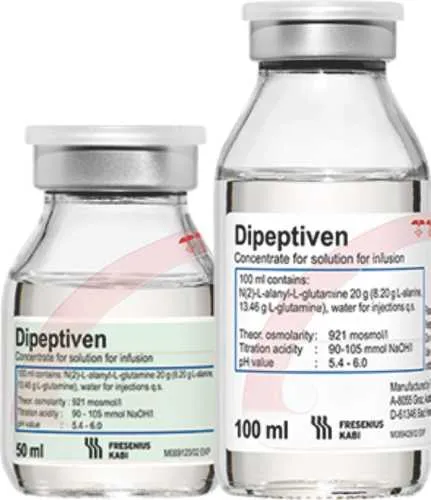
Instructions for Use
Patient Information Leaflet
Caution! Keep this leaflet. The information on the immediate packaging is in a foreign language.
Dipeptiven
200 mg/ml, concentrate for solution for infusion
N(2)-L-alanyl-L-glutamine
Please read this leaflet carefully before using the medicine, as it contains
important information for the patient.
- Keep this leaflet, as you may need to read it again.
- If you have any questions, please consult your doctor, pharmacist, or nurse.
- If you experience any adverse reactions, including any not listed in this leaflet, inform your doctor, pharmacist, or nurse. See section 4.
Table of contents of the leaflet
- What Dipeptiven is and what it is used for
- Important information before using Dipeptiven
- How to use Dipeptiven
- Possible side effects
- How to store Dipeptiven
- Contents of the pack and other information
1. What Dipeptiven is and what it is used for
Dipeptiven is a protein-containing medicinal product administered intravenously as a component of parenteral and/or enteral clinical nutrition, together with electrolytes, trace elements, and vitamins.
2. Important information before using Dipeptiven
When not to use Dipeptiven
Do not use this medicine:
- if the patient is allergic to the active substance or to any of the other ingredients of this medicine (listed in section 6); symptoms of an allergic reaction may include high fever, chills, rash, or shortness of breath;
- if the patient has impaired liver or kidney function;
- if the patient has metabolic acidosis – a condition in which blood pH is low;
- if the patient is in circulatory shock – a condition in which blood flow is reduced;
- if the patient is hypoxic – a condition in which oxygen levels in the body are low;
- if the patient has multiple organ failure – a condition in which two or more organs do not function properly;
- if the patient is pregnant or breastfeeding.
Dipeptiven must be diluted before administration. Dipeptiven is added to another solution administered to the patient. The doctor or nurse will ensure proper preparation of the Dipeptiven solution before administration to the patient.
Warnings and precautions
Before starting treatment with Dipeptiven, discuss this with the doctor or nurse.
In patients receiving Dipeptiven, the doctor may order regular blood tests to monitor health status and confirm the proper effect of Dipeptiven. Experience with use of Dipeptiven for longer than nine days is limited.
Dipeptiven and other medicines
Inform the doctor or pharmacist about all medicines currently used or recently taken, as well as any medicines the patient plans to use.
Pregnancy and breastfeeding
If the patient is pregnant or breastfeeding, suspects she may be pregnant, or is planning to have a child, she should consult her doctor or pharmacist before using this medicine.
This medicine should not be used during pregnancy and while breastfeeding.
Driving and operating machinery
Dipeptiven has no influence on the ability to drive or operate machinery.
3. How to use Dipeptiven
This medicine is administered by intravenous infusion into a central or peripheral vein (intravenous drip).
The dose is determined individually by the doctor for each patient, based on body weight in kilograms, capacity to metabolize nutrients, and amino acid requirements.
The doctor decides the dose to be administered to a given patient.
Use of a higher than recommended dose of Dipeptiven
The doctor or nurse will monitor the patient's condition during infusion, so the likelihood of administering a higher than recommended dose is low. However, if the patient believes they have received a higher than recommended dose of Dipeptiven, they should immediately inform the doctor or nurse. Symptoms of overdose may include chills, nausea, and vomiting.
If you have any further questions about the use of this medicine, consult your doctor or nurse.
4. Possible adverse reactions
Like all medicines, this medicine can cause adverse reactions, although not everybody will experience them.
Not known when administered according to recommendations.
Reporting of adverse reactions
If any adverse reactions occur, including any adverse reactions not listed
in this leaflet, inform a doctor, pharmacist or nurse. Adverse reactions
can be reported directly to the Department of Monitoring Adverse Drug Reactions of the Office for Registration of Medicinal Products, Medical Devices and Biocidal Products
Al. Jerozolimskie 181C
02-222 Warsaw
tel.: + 48 22 49 21 301
fax: + 48 22 49 21 309
Website: https://smz.ezdrowie.gov.pl
Reporting adverse reactions enables further collection of information on the safety of using this medicine.
5. How to store Dipeptiven
Keep the medicine out of sight and reach of children.
The doctor or nurse is responsible for ensuring appropriate storage, use and disposal of Dipeptiven. Store below 25°C. After opening: use immediately.
Store in the original packaging. Any unused medicinal product residue is not suitable for further use. Do not use this medicine after the expiry date stated on the packaging.
The expiry date refers to the last day of the stated month.
Medicines must not be disposed of via the sewage system or in household waste. Ask a pharmacist how to dispose of medicines no longer in use. This will help protect the environment.
6. Contents of the packaging and other information
What Dipeptiven contains
100 ml of Dipeptiven contains:
20 g of N(2)-L-alanyl-L-glutamine (= 8.2 g of L-alanine and 13.46 g of L-glutamine).
The other ingredient is water for injections.
What Dipeptiven looks like and contents of the pack
Dipeptiven is a clear, colourless solution. The medicinal product is packed in a colourless glass bottle
of type II with a rubber stopper.
Pack size: 100 ml.
For further information, please contact the marketing authorisation holder or the parallel importer.
Marketing authorisation holder in Bulgaria, country of export:
Fresenius Kabi Deutschland GmbH
Else-Kroner-Strasse 1
D-61346 Bad Homburg v.d.H.
Germany
Manufacturer:
Fresenius Kabi Austria GmbH
Hafnerstrasse 36
A-8055 Graz, Austria
Parallel importer:
Delfarma Sp. z o.o., ul. Św. Teresy od Dzieciątka Jezus 111, 91-222 Łódź
Repackaged in:
Delfarma Sp. z o.o., ul. Św. Teresy od Dzieciątka Jezus 111, 91-222 Łódź
Marketing authorisation number in Bulgaria, country of export: 20020591
Parallel import authorisation number: 171/20
Information intended exclusively for medical professionals:
Warnings and precautions for use
To ensure safe administration of Dipeptiven, the maximum daily dose of 2.5 ml/kg body weight (corresponding to 0.5 g of N(2)-L-alanyl-L-glutamine) must not be exceeded.
Dipeptiven should be used only as part of clinical nutrition, and dosing should be adjusted according to the required amount of protein/amino acids. Dipeptiven must not be administered if the patient's clinical condition does not allow for clinical nutrition (e.g. circulatory shock, hypoxia, critically ill unstable patients, severe metabolic acidosis).
When calculating the recommended dose of Dipeptiven, the amount of glutamine contained in oral/enteral products administered concomitantly with parenteral nutrition should be taken into account.
Regular monitoring of liver function parameters is recommended in patients with stable liver insufficiency.
Serum electrolyte concentrations, serum osmolarity, fluid balance, acid-base balance, creatinine clearance, urea concentration, as well as liver function tests (alkaline phosphatase, AlAT, AspAT) and potential signs of hyperammonemia should be monitored.
The choice between peripheral or central vein administration depends on the final osmolarity of the mixture.
An osmolarity of approximately 800 mOsm/L is generally considered the upper limit for peripheral infusion; however, this value varies significantly depending on the patient's age, general condition, and status of peripheral veins.
Experience with the use of Dipeptiven for periods longer than nine days is limited.
Dosage and method of administration
The infusion solution is obtained by mixing Dipeptiven with a pharmaceutically compatible solution.
Solutions with an osmolarity exceeding 800 mOsm/L should be administered via a central vein.
Adult patients
Dipeptiven is used in parenteral or enteral nutrition, or in combined parenteral and enteral nutrition. Dosage depends on the severity of the catabolic state and the requirement for amino acids/protein.
During parenteral/enteral nutrition, the maximum daily dose of 2 g of amino acids/protein per kilogram of body weight must not be exceeded. The content of alanine and glutamine in Dipeptiven must be included in these calculations. The proportion of amino acids derived from Dipeptiven should not exceed approximately 30% of the total amino acid/protein intake.
Dipeptiven is a concentrate for preparing an infusion solution and is not intended for direct administration.
Parenterally fed patients
The infusion rate depends on the type of carrier solution and should not exceed 0.1 g of amino acids per kg of body weight per hour.
Dipeptiven must be mixed before administration with a compatible amino acid solution or a nutrient mixture containing amino acids.
Enterally fed patients
Dipeptiven should be administered by continuous infusion over 20 to 24 hours per day.
When administered via peripheral veins, Dipeptiven must be diluted to achieve an osmolarity ≤ 800 mOsm/L (e.g. 100 ml Dipeptiven + 100 ml physiological saline solution).
Patients receiving combined enteral and parenteral nutrition
The total daily dose of Dipeptiven should be administered as part of parenteral nutrition, e.g. by mixing it before administration with a compatible amino acid solution or a nutrient mixture containing amino acids.
The infusion rate depends on the type of carrier solution and should be adjusted according to the ratio of parenteral to enteral nutrition.
Duration of treatment
The duration of treatment should not exceed 3 weeks.
Disposal of unused medication
The container and solution should be inspected before use. Use only clear solutions free from particulate matter and from undamaged containers.
For single use only. Any unused portion of the medication is not suitable for further use.
Compatibility
The addition of the concentrate to the carrier solution must be performed under aseptic conditions prior to administration to the patient. Adequate mixing and pharmaceutical compatibility must be ensured.
Shelf life
The medication should be used immediately after opening the vial.
Shelf life after mixing
Dipeptiven must not be stored after mixing with other components.
Similar Medications
-
Dipeptiven
Form: solution for infusion, concentrate
Active substance Dosage L-alanyl-L-glutamine 200 mg/ml Manufacturer: Fresenius Kabi AB
-
Dipeptiven
Form: solution for infusion, concentrate
Active substance Dosage L-alanyl-L-glutamine 200 mg/ml Manufacturer: Fresenius Kabi Hellas S.A.
-
Dipeptiven
Form: solution for infusion, concentrate
Active substance Dosage L-alanyl-L-glutamine 200 mg/ml Manufacturer: Fresenius Kabi Hellas S.A.
-
Dipeptiven
Form: solution for infusion, concentrate
Active substance Dosage L-alanyl-L-glutamine 200 mg/ml Manufacturer: Fresenius Kabi Deutschland GmbH
This page has been machine-translated and may contain inaccuracies. The original data is available in the manufacturing country's language.
Last data check: June 04, 2026 · Data source: Rejestr Produktów Leczniczych (URPL)