Diosminex max
Poland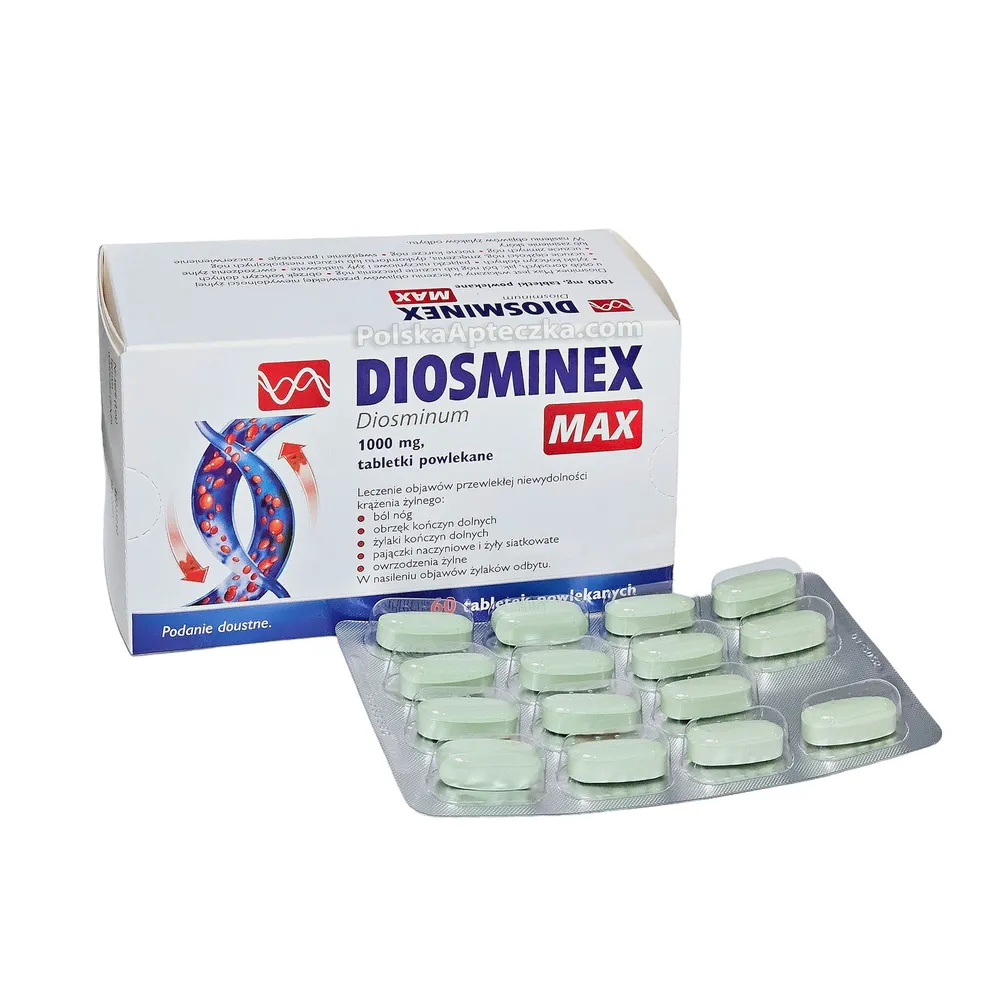
Table of Contents
Package leaflet: Information for the patient
Diosminex Max, 1000 mg, coated tablets
Diosminum
Please read carefully all the information in this leaflet before taking the medicine, as it contains
important information for the patient.
This medicine should always be taken exactly as described in this patient leaflet or as directed by
the physician or pharmacist.
- Keep this leaflet, so that you can read it again if necessary.
- If you need advice or further information, please consult your pharmacist.
- If you experience any adverse reactions, including any possible side effects not listed in this leaflet, inform your doctor or pharmacist. See section 4.
- If your symptoms do not improve or if you feel worse, contact your doctor.
Table of contents of the leaflet:
- What is Diosminex Max and what is it used for
- Important information before taking Diosminex Max
- How to take Diosminex Max
- Possible side effects
- How to store Diosminex Max
- Contents of the pack and other information
1. What is Diosminex Max and what is it used for
Diosminex Max contains micronized diosmin. Diosminex Max increases venous tone and exerts a protective effect on blood vessels.
Diosminex Max is indicated for the treatment of symptoms of chronic venous insufficiency in adults, such as:
- varicose veins of the lower limbs
- venous ulcers
- telangiectases (spider veins) and reticular veins
- sensation of heaviness, fatigue, discomfort, or restless legs
- leg pain or burning sensation
- feeling of cold legs
- nocturnal leg cramps
- swelling of the lower limbs
- itching and paresthesias (tingling, pricking, or itching of the skin of the lower limbs)
- redness (erythema) or bluish discoloration of the skin. Diosmin is used as monotherapy in the early stages of chronic venous insufficiency or as an adjunct to other therapies in all stages of venous insufficiency (C0–C6 according to CEAP classification). Diosminex Max is indicated for the treatment of severe symptoms associated with haemorrhoids in adults. If no improvement occurs or if you feel worse, consult your doctor.
2. Important information before taking Diosminex Max
When not to take Diosminex Max
- if the patient is allergic to the active substance or to any of the other ingredients of this medicine (listed in section 6).
Warnings and precautions
Before starting treatment with Diosminex Max, discuss it with your doctor or pharmacist. In cases of worsening symptoms related to haemorrhoids, remember that treatment with Diosminex Max is only symptomatic and should be short-term. If symptoms do not improve, a proctologist should perform an examination to determine the appropriate treatment method. The use of Diosminex Max for symptomatic treatment during an exacerbation of haemorrhoidal symptoms does not exclude the simultaneous use of other rectal medications. Diosminex Max is not effective in treating oedema associated with congestive heart failure. Diosminex Max must not be used in patients with heart failure. In case of venous circulation disorders in the legs, the therapeutic effect of Diosminex Max can be enhanced by adopting an appropriate lifestyle:
- avoiding exposure to sunlight,
- avoiding prolonged standing,
- maintaining a healthy body weight,
- wearing special compression stockings.
If symptoms worsen—for example, if skin inflammation, phlebitis, subcutaneous tissue hardening, severe pain, skin ulceration, or atypical symptoms such as sudden swelling of one or both legs—consult a doctor immediately. Diosminex Max is ineffective when leg oedema is caused by heart, kidney, or liver disease.
Diosminex Max and other medicines
Inform your doctor or pharmacist about all medicines currently taken or recently used, as well as any medicines you plan to take. Diosmin may increase blood concentrations and reduce the elimination of metronidazole (an antibacterial and antiprotozoal agent), diclofenac (an analgesic and anti-inflammatory drug), fexofenadine (an antihistamine), warfarin (an anticoagulant), and carbamazepine (an antiepileptic drug).
Diosminex Max with food and drink
Take the medicine during meals.
Pregnancy and breastfeeding
If you are pregnant or breastfeeding, think you may be pregnant, or are planning to have a baby, consult your doctor or pharmacist before using this medicine. As a precaution, it is recommended to avoid using Diosminex Max during pregnancy.
Pregnancy
Before using Diosminex Max during pregnancy, or if pregnancy occurs while taking this medicine, consult your doctor.
Breastfeeding
It is unknown whether diosmin or its metabolites pass into human breast milk. A risk to the breastfed infant cannot be excluded. Diosminex Max should not be used during breastfeeding.
Driving and operating machinery
Diosminex Max has no effect or has a negligible effect on the ability to drive
motor vehicles and operate mechanical equipment.
Diosminex Max contains lactose
If the patient has previously been diagnosed with intolerance to certain sugars, the patient should
consult a doctor before taking this medicine.
Diosminex Max contains sunset yellow (E 110)
The coating of the tablet contains sunset yellow (E 110). This medicine may cause allergic reactions.
Diosminex Max contains sodium
The medicine contains less than 1 mmol of sodium (23 mg) per tablet; therefore, this product is considered "sodium-free".
3. How to take Diosminex Max
This medicine should always be taken exactly as described in the patient leaflet or as directed by your doctor or pharmacist. If in doubt, consult your doctor or pharmacist.
Treatment of symptoms of chronic venous insufficiency
The recommended dose is 1 tablet once daily, taken during a meal.
To achieve improvement, this medicine should be used for several weeks. If, after five weeks of treatment, the severity of disease symptoms has increased or has not improved, consult your doctor.
Treatment of acute flare-up of haemorrhoidal symptoms
The recommended dose is 3 tablets daily for the first 4 days, followed by 2 tablets daily for the next 3 days.
If, after seven days of treatment, the severity of symptoms has increased or has not improved, consult your doctor.
Do not take more than the recommended dose of this medicine.
Taking more than the recommended dose of Diosminex Max
No cases of overdose have been reported.
In case of overdose, contact your doctor.
Missing a dose of Diosminex Max
Do not take a double dose to make up for a missed dose.
Stopping treatment with Diosminex Max
If you have any further questions about the use of this medicine, consult your doctor or pharmacist.
4. Possible adverse reactions
Like all medicines, this medicine can cause adverse reactions, although not everyone experiences them.
Adverse reactions are listed below according to the following frequency categories:
Very common (more than 1 in 10 people),
Common (more than 1 in 100 people, but less than 1 in 10 people),
Uncommon (more than 1 in 1,000 people, but less than 1 in 100 people),
Rare (more than 1 in 10,000 people, but less than 1 in 1,000 people),
Very rare (less than 1 in 10,000 people).
Rare: Diarrhea, dyspepsia, nausea, vomiting, dizziness, headache, malaise, rash, itching, urticaria.
In case of mild gastrointestinal adverse reactions and autonomic nervous system disturbances (e.g. increased anxiety, palpitations, excessive sweating, nervousness), discontinuation of the medicine is not required.
Reporting of adverse reactions
If any adverse reactions occur, including any adverse reactions not listed in this leaflet, inform your doctor or pharmacist.
Adverse reactions can be reported directly to the Department of Monitoring Adverse Drug Reactions at the Office for Registration of Medicinal Products, Medical Devices and Biocidal Products, Al. Jerozolimskie 181 C, 02-222 Warsaw,
Tel.: +48 22 49 21 301, Fax: +48 22 49 21 309, website: https://smz.ezdrowie.gov.pl
Adverse reactions may also be reported to the marketing authorization holder.
Reporting adverse reactions helps to provide more information on the safety of the medicine.
5. How to store Diosminex Max
Keep this medicine out of sight and reach of children.
Store below 25°C.
Do not use this medicine after the expiry date stated on the carton and blister pack after: EXP.
The expiry date refers to the last day of the stated month.
Medicines must not be disposed of via wastewater or household waste. Ask your pharmacist how to dispose of medicines no longer required. Such measures will help protect the environment.
6. Contents of the package and other information
What Diosminex Max contains
- The active substance is diosmin (Diosminum). Each tablet contains 1000 mg of micronized diosmin.
- Other ingredients are:
Tablet core: microcrystalline cellulose, monohydrate lactose, sodium croscarmellose, colloidal silicon dioxide, magnesium stearate.
Coating: polyvinyl alcohol, titanium dioxide (E 171), macrogol 3350, talc, quinoline yellow lake (E 104), indigo carmine lake (E 132), sunset yellow lake (E 110), black iron oxide (E 172).
What Diosminex Max looks like and contents of the pack
The coated tablets are green, elongated, biconvex, with a smooth surface, free from spots and damage.
Diosminex Max is available in packages containing: 30, 60 or 90 coated tablets. Not all pack sizes may be marketed.
The tablets are packed in transparent PVC/Aluminium blisters, placed in a cardboard box.
Marketing Authorisation Holder
Bausch Health Ireland Limited
3013 Lake Drive
Citywest Business Campus
Dublin 24, D24PPT3
Ireland
Manufacturer
ICN Polfa Rzeszów S.A.
Przemysłowa 2 Street
35-105 Rzeszów
Poland