Dhc continus
Poland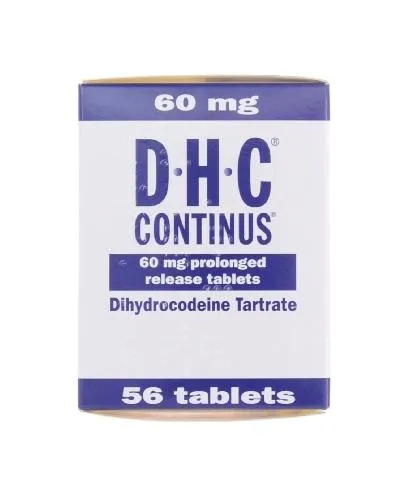
Table of Contents
Package leaflet: Information for the patient
DHC Continus, 60 mg, modified release tablets
DHC Continus, 90 mg, modified release tablets
Dihydrocodeine tartrate
Please read the entire leaflet before using the medicine, as it contains important information
for the patient.
- Keep this leaflet for future reference.
- If you have any questions, consult your doctor or pharmacist.
- This medicine has been prescribed for a specific individual. Do not share it with others. This medicine may harm others, even if their symptoms are the same.
- If you experience any adverse reactions, including those not listed in this leaflet, inform your doctor or pharmacist. See section 4.
Table of contents:
- What DHC Continus is and what it is used for
- Important information before taking DHC Continus
- How to take DHC Continus
- Possible side effects
- How to store DHC Continus
- Contents of the pack and other information
1. What DHC Continus is and what it is used for
DHC Continus contains the active substance dihydrocodeine tartrate, which belongs to a group of strong painkillers called opioids.
DHC Continus is used to treat severe cancer-related pain and chronic (long-term) pain of other origins.
2. Important information before using DHC Continus
When not to use DHC Continus:
- if the patient is allergic to dihydrocodeine or any of the other ingredients of this medicine (listed in section 6);
- if the patient has severe chronic obstructive pulmonary disease (COPD);
- if the patient has a condition known as acute cor pulmonale;
- if the patient has severe bronchial asthma;
- if the patient has severe respiratory depression with hypoxia;
- in children under 12 years of age;
- if the patient has paralytic ileus;
- if the patient has head injury or increased intracranial pressure;
- if the patient suffers from alcoholism (acute phase);
- if the patient has previously been diagnosed with intolerance to certain sugars.
Warnings and precautions
If the patient is or has previously been addicted to opioid drugs, other drugs, or alcohol, the use of DHC Continus should be avoided. However, if a doctor has prescribed DHC Continus to a patient with alcohol problems or who is taking drugs that may affect liver function, the doctor will regularly monitor liver function parameters.
DHC Continus should be used with caution in the following cases:
- if the patient has respiratory centre depression (manifested by shallow breathing, followed by cessation of breathing) with hypoxia;
- if the patient has chronic obstructive pulmonary disease (COPD);
- if the patient suffers from bronchial asthma;
- if the patient has cor pulmonale;
- if the patient has sleep apnoea;
- if the patient is simultaneously taking any other medicines affecting the central nervous system (see section 2. DHC Continus with other medicines);
- if the patient is taking monoamine oxidase inhibitors (MAOIs) or has discontinued treatment with such drugs within the previous 2 weeks;
- if the patient has developed tolerance to the drug, physical dependence, or withdrawal syndrome;
- if the patient has psychological dependence on drugs, psychotropic substances, and/or alcohol;
- if the patient has head injury, intracranial lesions, or increased intracranial pressure;
- if the patient has disturbances of consciousness of unknown origin;
- if the patient has biliary tract dysfunction;
- if the patient has pancreatitis;
- if the patient has liver function impairment;
- if the patient has severe renal insufficiency;
- if the patient suffers from constipation;
- if the patient has hypothyroidism;
- if the patient has benign prostatic hyperplasia;
- if the patient is elderly;
Respiratory depression
The primary risk of opioid overdose is respiratory depression.
Sleep-related breathing disorders
Opioids may cause sleep-related breathing disorders, including central sleep apnoea (CSA) and sleep-related hypoxia. In some patients, opioid use may increase the risk of CSA in a dose-dependent manner. Opioids may also worsen existing sleep apnoea (see section 4). In such cases, the doctor may consider reducing the total daily opioid dose.
Concomitant use of DHC Continus with sedative medicines, e.g. benzodiazepines or their derivatives, increases the risk of drowsiness, breathing difficulties (respiratory depression), or coma, which may be life-threatening. Therefore, combined treatment should only be considered when no other treatment options are available. If dihydrocodeine is used together with sedative medicines, the doctor should limit the dose and duration of concomitant use.
Inform your doctor about all sedative medicines you are taking and strictly follow the prescribed dosage.
It may be helpful to inform a relative or close friend about the possibility of the above-mentioned symptoms occurring.
If the described symptoms occur, consult your doctor.
Tolerance, physical dependence, withdrawal syndrome
During prolonged use, the patient may develop tolerance to the active substance (increasingly higher doses of the medicine will be required to achieve a consistent analgesic effect). DHC Continus, like other opioids, may cause dependence and may be misused. The medicine may cause physical dependence resulting in withdrawal symptoms. If the doctor decides that treatment with DHC Continus is no longer necessary, a gradual dose reduction will be recommended.
Avoid administering dihydrocodeine to patients with a high potential for addiction, especially to alcohol or other drugs affecting liver function. However, if the doctor, after weighing benefits and risks, decides to prescribe this medicine, treatment should be conducted under strict medical supervision with periodic monitoring of liver function (e.g. determination of AspAT, AlAT, GGTP).
Dose reduction is recommended in patients with hypothyroidism, liver or renal insufficiency, and in elderly patients.
Opioid medicines may affect the hormonal system, thereby disrupting the function of adrenal glands, ovaries, and testes. These medicines may, among others, increase prolactin levels, decrease blood cortisol and testosterone levels, leading to clinical symptoms.
This medicine may increase sensitivity to pain, especially when high doses are used. Inform your doctor if this occurs. Dose reduction or switching to another medicine may be necessary.
Modified-release tablets must be swallowed whole, without breaking, chewing, or crushing. Administration of broken or crushed tablets will result in rapid release and absorption of an excessive dose of dihydrocodeine, which may lead to overdose symptoms or even death (see section "Use of more than the recommended dose of DHC Continus").
Improper use of oral medicines by administering them via alternative routes may result in serious adverse reactions, potentially life-threatening.
DHC Continus with other medicines
Inform your doctor about all medicines the patient is currently taking or has recently taken, as well as any medicines the patient plans to take.
Do not use DHC Continus simultaneously with medicines belonging to the monoamine oxidase inhibitors group (medicines used in the treatment of depression and hypotension).
DHC Continus with food, drink, and alcohol
Do not consume alcohol while taking DHC Continus.
Pregnancy, breastfeeding, and fertility
If the patient is pregnant or breastfeeding, suspects she may be pregnant, or is planning to have a child, she should consult a doctor or pharmacist.
Do not use DHC Continus during pregnancy unless specifically advised by a doctor.
Do not breastfeed while taking DHC Continus.
There is no data available on the effect of dihydrocodeine on fertility.
Driving and operating machinery
Do not drive or operate any machinery, as DHC Continus may cause drowsiness, thereby impairing the patient's ability to react.
DHC Continus contains lactose.
One DHC Continus 60 mg tablet contains 58.4 mg of lactose.
One DHC Continus 90 mg tablet contains 40.5 mg of lactose.
If the patient has previously been diagnosed with intolerance to certain sugars, the patient should contact a doctor before taking the medicine.
3. How to use DHC Continus
This medicine should always be taken exactly as prescribed by your doctor. If in doubt, consult your
doctor or pharmacist.
Do not use in children under 12 years of age.
Adults and adolescents over 12 years of age
The usual starting dose is 60 mg every 12 hours.
Your doctor may increase the dose up to the maximum dose of 120 mg every 12 hours.
DHC Continus 60 mg: 1 or 2 tablets every 12 hours.
DHC Continus 90 mg: 1 tablet every 12 hours.
In elderly patients, and in patients with hepatic or renal impairment or hypothyroidism,
your doctor may recommend lower doses.
The tablet should be swallowed whole and must not be divided, chewed or crushed. Taking a crushed
tablet may result in too rapid absorption of the medicine and lead to symptoms of overdose (see
below).
If you feel that the effect of DHC Continus is too strong or too weak, consult your doctor.
Concomitant use of opioid medicines and sedatives, such as benzodiazepines or other sedative
medicines, increases the risk of excessive sedation, respiratory depression, coma or death due to
additive central nervous system depressant effects. Your doctor may reduce the daily dose of the
medicine and the duration of treatment.
Taking more DHC Continus than prescribed
If you take more than the prescribed dose or suspect an overdose, contact your doctor or pharmacist
immediately.
Symptoms of overdose include drowsiness progressing to stupor or coma, pinpoint pupils, vomiting,
muscle spasms, rhabdomyolysis, irregular heartbeat – rapid heartbeat (tachycardia) or slow heartbeat
(bradycardia), low blood pressure, cardiovascular collapse and respiratory failure or apnea, which in
severe cases may be life-threatening.
Management: Seek immediate medical attention. The doctor will initiate treatment appropriate to the
type and severity of symptoms. Maintain patient consciousness and ensure continuous breathing.
Hospitalization may be necessary to provide continuous medical care.
Missing a dose of DHC Continus
Do not take a double dose to make up for a missed tablet.
Stopping DHC Continus
Do not stop taking DHC Continus without consulting your doctor. If in doubt about using the medicine,
consult your doctor or pharmacist. Abrupt discontinuation of DHC Continus after long-term therapy may
lead to withdrawal symptoms such as pain, severe irritability and motor restlessness.
4. Possible adverse reactions
Like all medicines, this medicine can cause adverse reactions, although not everyone experiences them.
The risk of occurrence of adverse reactions is described by the following categories:
Common (occur in 1 to 10 out of 100 people):
drowsiness, abdominal pain, constipation, dry mouth, nausea, vomiting.
Uncommon (occur in 1 to 10 out of 1,000 people):
angioedema, disorientation, drug dependence, hallucinations, mood changes, dysphoria
manifesting as irritability, outbursts of anger, anxiety, tendency to cry, hypotension,
seizure attacks (especially in patients with epilepsy or a predisposition to seizures), dizziness, headache,
paresthesia, sedation (dose-dependent, drowsiness up to disturbances in consciousness), vertigo,
excessive sweating, rash, itching, urticaria, diarrhea, paralytic ileus, biliary colic, spasm of the biliary tract,
increased liver enzyme activity, urinary retention, shortness of breath, asthma attack (especially in patients with asthma),
respiratory depression, weakness, fatigue, malaise, physical dependence with withdrawal syndrome.
Rare (occur in 1 to 10 out of 10,000 people):
visual disturbances.
Frequency not known (frequency cannot be estimated from available data):
increased blood levels of prolactin hormone (hyperprolactinemia), sleep apnoea syndrome, drug tolerance.
Reporting of adverse reactions
If any adverse symptoms occur, including any adverse symptoms not listed in this leaflet, inform your doctor or pharmacist.
Adverse reactions can be reported directly to: Department of Monitoring Adverse Drug Reactions, Office for Registration of Medicinal Products, Medical Devices and Biocidal Products,
Al. Jerozolimskie 181C, 02-222 Warsaw, phone: +48 22 4921301, fax: +48 22 4921309, website: https://smz.ezdrowie.gov.pl .
Adverse reactions can also be reported to the marketing authorization holder.
Reporting adverse reactions helps to provide more information on the safety of the medicine.
5. How to store DHC Continus
Store below 25°C.
Keep the medicine in a place out of sight and reach of children.
Do not use this medicine after the expiry date stated on the carton. The expiry date refers to the last day of the stated month.
Medicines must not be disposed of via wastewater or household waste. Ask your pharmacist how to dispose of medicines no longer required. This helps protect the environment.
6. Contents of the packaging and other information
What DHC Continus contains
- The active substance is dihydrocodeine tartrate.
- Tablet core: anhydrous lactose, hydroxyethylcellulose, cetostearyl alcohol, magnesium stearate, talc.
What DHC Continus looks like and contents of the pack
The packaging consists of a polypropylene container in a cardboard box containing 30, 56 or 60 modified-release tablets.
Marketing Authorisation Holder:
Ennogen Healthcare (Europe) Ltd
Block B, The Crescent Building,
Northwood, Santry
Dublin 9, D09 C6X8, Ireland
Manufacturer:
Fidelio Healthcare Limburg GmbH
Mundipharma Strasse 2,
D-65549 Limburg, Germany
Importer:
Mundipharma DC B.V.
Leusderend 16
Leusden, 3832RC, Netherlands