Dezaftan med
Poland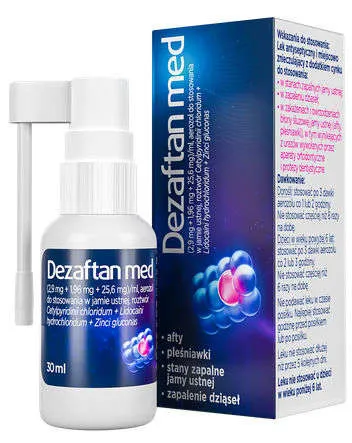
Table of Contents
Package leaflet: information for the patient
Dezaftan med
(2.9 mg + 1.96 mg + 25.6 mg)/ml, oral spray, solution
Cetylpyridinii chloridum + Lidocaini hydrochloridum monohydricum + Zinci gluconas
Please read this leaflet carefully before using the medicine, as it contains
important information for the patient.
This medicine should always be used exactly as described in this patient leaflet, or as directed by a
physician or pharmacist.
- Keep this leaflet, so that you can read it again if necessary.
- If you need advice or further information, please consult your pharmacist.
- If you experience any adverse reactions, including any not listed in this leaflet, inform your doctor or pharmacist. See section 4.
- If there is no improvement after 5 days, or if your condition worsens, consult your doctor.
Table of contents
- What Dezaftan med is and what it is used for
- Important information before using Dezaftan med
- How to use Dezaftan med
- Possible side effects
- How to store Dezaftan med
- Contents of the pack and other information
1. What Dezaftan med is and what it is used for
Dezaftan med is an oral spray solution. It acts as an antiseptic and local anesthetic.
It contains three active substances:
- cetylpyridinium chloride, which has antiseptic, bactericidal, antifungal, and antiviral properties;
- lidocaine hydrochloride monohydrate, which provides local anesthesia and relieves pain;
- zinc gluconate, which supports the body's immune system.
Indications
An antiseptic and locally anesthetic product with added zinc, indicated for:
- inflammatory conditions of the oral cavity;
- gingivitis;
- infections and ulcerations of the oral mucosa (aphthae, candidiasis), including those caused by trauma from orthodontic appliances and dental prostheses.
If there is no improvement after 5 days, or if your condition worsens, consult your doctor.
2. Important information before using Dezaftan med
When not to use Dezaftan med
- if the patient is allergic to cetylpyridinium chloride, lidocaine hydrochloride monohydrate, zinc gluconate (the active substances in this medicine), other local anaesthetics of the amide group, or any of the other ingredients of this medicine (listed in section 6);
- if the patient has severe liver or kidney impairment;
- if the patient has methemoglobinemia – a very rare condition in which hemoglobin in the blood loses its ability to carry oxygen to body cells;
- in children under 6 years of age;
- if the patient suffers from myasthenia gravis (a disease characterized by excessive muscle fatigue and weakness).
Warnings and precautions
Before starting treatment with Dezaftan med, consult a doctor if the patient has:
- throat inflammation and fever persisting for several days before using Dezaftan med;
- sore throat associated with fever, dizziness, nausea, or vomiting.
Do not use Dezaftan med for longer than 5 consecutive days. If there is no improvement after 5 days of treatment, consult a doctor immediately, as persistent or recurrent aphthae may be the first sign of a serious illness.
Lidocaine hydrochloride monohydrate, one of the components of Dezaftan med, may cause swallowing difficulties and increase the risk of choking (see also section: "Use of Dezaftan med with food and drink").
Children
Do not use Dezaftan med in children under 6 years of age.
Dezaftan med and other medicines
Tell your doctor or pharmacist about all medicines the patient is currently taking or has recently taken, as well as any medicines planned for future use.
In particular, inform the doctor if the patient is using:
- acetylsalicylic acid (an ingredient of medicines used to reduce fever);
- sulfonamides (medicines used to treat, among others, bacterial infections);
- cimetidine (a medicine used in the treatment of peptic ulcer disease);
- beta-blockers (medicines used, among others, in the treatment of hypertension and ischemic heart disease, e.g. propranolol);
- norepinephrine (a medicine used, among others, in resuscitation and anaphylactic shock treatment);
- inhalational anaesthetics (medicines used for general anaesthesia);
- barbiturates (medicines used in the treatment of insomnia and epilepsy);
- rifampicin (an antibiotic used to treat tuberculosis and certain other infections);
- phenytoin (a medicine used in the treatment of epilepsy);
- skeletal muscle relaxants (e.g. pancuronium);
- tetracycline antibiotics (medicines used in bacterial infections);
- chelating agents (medicines used in metal poisoning, e.g. D-penicillamine);
- ibuprofen or indomethacin (analgesic medicines belonging to the group of non-steroidal anti-inflammatory drugs – NSAIDs);
- thiazide diuretics (medicines that increase urine production);
- corticosteroids (medicines used, among others, in the treatment of rheumatic diseases);
- medicines and dietary supplements containing calcium, iron, and copper.
Use of Dezaftan med with food and drink
Do not use the medicine during or immediately before meals due to the risk of choking. It is best to use the medicine one hour before or one hour after a meal.
Exercise caution when drinking hot beverages or eating hot food. Due to reduced sensitivity to heat, there is an increased risk of burning the mucous membranes of the oral cavity and throat.
During treatment with Dezaftan med, do not consume dairy products, as they reduce zinc absorption.
Pregnancy and breastfeeding
If the patient is pregnant or breastfeeding, suspects she might be pregnant, or is planning to have a child, she should consult a doctor or pharmacist before using this medicine.
Dezaftan med is not recommended for use during pregnancy or in women of childbearing age who are not using an effective method of contraception.
This medicine should not be used by breastfeeding women.
Driving and operating machinery
There is no data available on the effect of this medicine on the ability to drive or operate machinery.
Dezaftan med contains ethanol
This medicine contains 27 mg of alcohol (96% ethanol) in 3 doses of the medicine (0.51 ml), equivalent to 27 mg/0.51 ml (5.1% m/v). The amount of alcohol in 3 doses (0.51 ml) of this medicine is equivalent to less than 1 ml of beer or 1 ml of wine.
The small amount of alcohol in this medicine will not cause noticeable effects.
3. How to use Dezaftan med
This medicine should always be used exactly as described in this patient information leaflet or as directed by a doctor or pharmacist. If in doubt, consult a doctor or pharmacist.
Dezaftan med is for topical use, applied by spraying onto the oral mucosa.
Duration of treatment
Do not use for longer than 5 consecutive days without consulting a doctor.
Recommended dose
Adults:
apply 3 sprays every 1 or 2 hours.
Do not use more frequently than 8 times per day.
Children over 6 years of age:
apply 3 sprays every 2 or 3 hours.
Do not use more frequently than 6 times per day.
Instructions for administering Dezaftan med
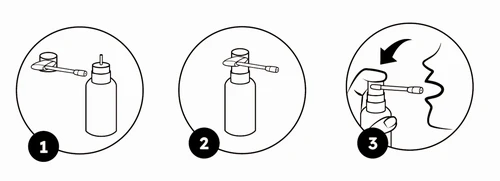
Before first use, press the spray pump 6 times vigorously, holding the container upright with the nozzle pointing away from you, to prime the pump and ensure proper spray function.
If the medicine has not been used for two days or longer, re-prime the pump by spraying 3 times, holding the container upright with the nozzle pointing away from you.
The medicine requires attachment of the spray nozzle before first use – Fig. 1.
- Attach the spray nozzle as shown in Fig. 2.
- Direct the spray nozzle into the mouth – as shown in Fig. 3.
- Press the spray pump firmly with the thumb or index finger. Repeat the appropriate number of times according to the recommended dosage.
Use in children
Dezaftan med must not be used in children under 6 years of age.
Overdose of Dezaftan med
If more medicine has been used than recommended, contact a doctor or pharmacist.
Symptoms of overdose may include:
nausea, vomiting, abdominal pain, diarrhoea, metallic taste in the mouth, headache, collapse (circulatory arrest with loss of consciousness), seizures, coma.
Missed dose of Dezaftan med
Do not use a double dose to make up for a missed dose.
If you have any further doubts about the use of this medicine, consult your doctor or pharmacist.
4. Possible adverse reactions
Like all medicines, this medicine can cause adverse reactions, although they do not occur in everyone.
The following adverse reactions may occur
Not common (may occur in less than 1 in 100 people):
- local skin reactions such as: erythema (local redness of the skin), itching, rash, burning sensation.
Rare (may occur in less than 1 in 1,000 people):
- severe skin reactions such as: bullous or acneiform rash, which may spread or become generalized;
- urticaria (pinkish, itchy wheals on the skin);
- photosensitivity;
- headache;
- gastrointestinal disturbances (nausea, abdominal pain, diarrhoea);
- vomiting, metallic taste in the mouth;
- stomatitis (inflammation of the mucous membrane of the mouth).
Very rare (may occur in less than 1 in 10,000 people):
- worsening of pre-existing renal failure.
Reporting of adverse reactions
If any adverse reactions occur, including any adverse reactions not listed
in this leaflet, patients should inform their doctor or pharmacist.
Adverse reactions can be reported directly to the Department of Monitoring of Adverse Drug Reactions at the Office for Registration of Medicinal Products, Medical Devices and Biocidal Products
Al. Jerozolimskie 181C, 02-222 Warsaw
Tel.: + 48 22 49 21 301
Fax: + 48 22 49 21 309
Website: https://smz.ezdrowie.gov.pl
Adverse reactions can also be reported to the marketing authorization holder.
Reporting adverse reactions helps to provide more information on the safety of the medicine.
5. How to store Dezaftan med
Keep this medicine out of sight and reach of children.
No special storage instructions are required for this medicine.
Do not use this medicine after the expiry date stated on the label and carton. The expiry date refers to the last day of the stated month.
The shelf life after first opening is 3 months.
Medicines must not be disposed of via wastewater or household waste. Ask your pharmacist how to dispose of medicines no longer required. This will help protect the environment.
6. Contents of the package and other information
What Dezaftan med contains
- The active substances in the medicine are: cetilopyridinium chloride, lidocaine hydrochloride monohydrate, zinc gluconate. 1 ml of aerosol contains: 2.9 mg cetilopyridinium chloride, 1.96 mg lidocaine hydrochloride monohydrate, and 25.6 mg zinc gluconate (equivalent to 3.7 mg zinc ions). A single sprayed dose contains 0.17 ml of solution. 3 doses (0.51 ml of solution) contain 1.5 mg cetilopyridinium chloride, 1.0 mg lidocaine hydrochloride monohydrate, and 13.065 mg zinc gluconate (equivalent to 1.875 mg zinc ions).
- Other ingredients: levomenthol, ethanol 96%, glycerol, sucralose (E 955), purified water.
What Dezaftan med looks like and contents of the pack
Dezaftan med is a clear solution with a minty taste and odour.
The packaging consists of an HDPE polyethylene bottle with a spray pump (made of LDPE polyethylene, polypropylene PP, silicone, stainless steel) and a throat applicator (polypropylene PP) delivering a dose of 0.17 ml, packed in a cardboard box.
1 bottle of 30 ml
Marketing Authorisation Holder and Manufacturer
Aflofarm Farmacja Polska Sp. z o.o.
ul. Partyzancka 133/151
95-200 Pabianice
Tel. + 48 42 22-53-100