Dexamethasone wzf 0,1%
Poland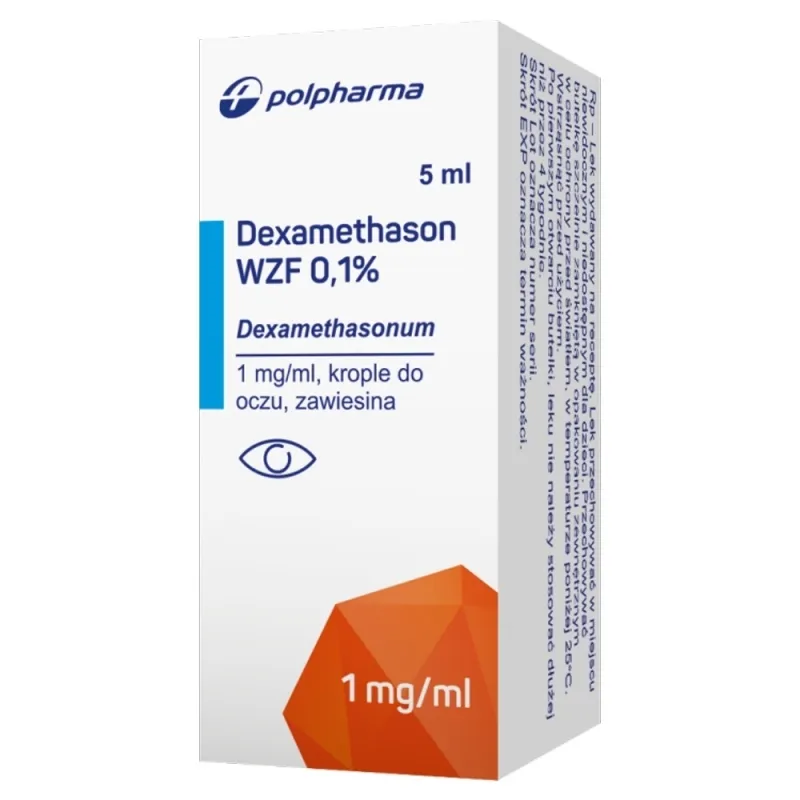
Table of Contents
Patient Information Leaflet
DEXAMETHASON WZF 0.1%, 1 mg/ml, eye drops, suspension
Dexamethasonum
Please read this leaflet carefully before using the medicine, as it contains
important information for you.
- Keep this leaflet, so that you can read it again if necessary.
- If you have any questions, please consult your doctor or pharmacist.
- This medicine has been prescribed for a specific individual. Do not pass it on to others. The medicine may harm another person, even if their symptoms are the same.
- If you experience any adverse reactions, including any possible side effects not listed in this leaflet, inform your doctor or pharmacist. See section 4.
Table of contents
- What Dexamethason WZF 0.1% is and what it is used for
- Important information before using Dexamethason WZF 0.1%
- How to use Dexamethason WZF 0.1%
- Possible side effects
- How to store Dexamethason WZF 0.1%
- Contents of the pack and other information
1. What Dexamethason WZF 0.1% is and what it is used for
The medicine contains dexamethasone, which has anti-inflammatory, antiallergic, and antipruritic properties.
The product is indicated for the treatment of inflammatory conditions of the conjunctiva, cornea, and anterior segment of the eye that respond to steroid therapy, such as: anterior uveitis, iritis, cyclitis, allergic and vernal conjunctivitis, dendritic keratitis, superficial punctate keratitis, and nonspecific superficial keratitis.
It is also indicated for the treatment of corneal injuries resulting from chemical, radiation, or thermal burns, as well as following foreign body penetration.
It is indicated for use after surgical procedures to reduce the intensity of inflammatory reactions and to prevent graft rejection.
2. Important information before using Dexamethason WZF 0.1%
When not to use Dexamethason WZF 0.1%
- if the patient is allergic to dexamethasone or any of the other ingredients of this medicine (listed in section 6);
- if the patient has cowpox, chickenpox, or other viral diseases of the cornea and conjunctiva (except for herpes zoster keratitis);
- if the patient has herpes simplex keratitis;
- if the patient has fungal infections of the eye;
- if the patient has eye infections caused by Mycobacteriae;
- if the patient has untreated acute purulent bacterial eye infections.
Warnings and precautions
Before starting treatment with Dexamethason WZF 0.1%, discuss this with your doctor or
pharmacist.
- In patients with bacterial, viral, or fungal eye infections, the medicine may mask infection symptoms. In such cases, the doctor may prescribe an antibiotic.
- In patients who have had diseases causing thinning of the cornea or sclera (eye structures), very rarely, use of the medicine may lead to perforation (puncturing) of these eye structures.
- Prolonged (much longer than recommended) use of the medicine increases the risk of secondary infections caused by fungi, bacteria, and viruses. It may also lead to or accelerate the development of cataracts (clouding of the eye lens), increased intraocular pressure in predisposed individuals, and in some cases, even glaucoma.
- During long-term treatment with dexamethasone, the doctor may recommend regular ophthalmological examinations (assessment of the lens and cornea, and measurement of intraocular pressure).
- Wearing contact lenses is not recommended during treatment for eye inflammation.
If the patient experiences blurred vision or other visual disturbances, contact a doctor.
Consult a doctor if the patient develops swelling and weight gain, particularly noticeable in the trunk and face, as these are usually the first signs of a condition called Cushing's syndrome. Adrenal suppression may occur following discontinuation of prolonged or intensive treatment with Dexamethason WZF 0.1%. Consult a doctor before deciding to stop treatment. This risk is particularly relevant in children and in patients treated with ritonavir or cobicistat.
Topically applied corticosteroids should not be used for longer than one week unless under ophthalmological supervision with regular monitoring of intraocular pressure.
Children
There is no safety data available for use in children under 2 years of age.
Dexamethason WZF 0.1% and other medicines
Tell your doctor or pharmacist about all medicines you are currently taking or have recently taken, as well as any medicines you plan to use.
Concomitant use of topical steroids and non-steroidal anti-inflammatory drugs (NSAIDs) may increase the potential for corneal healing disturbances.
Inform your doctor if you are taking ritonavir or cobicistat, as these medicines may increase dexamethasone blood levels.
If other eye medications are used simultaneously, a 5-minute interval should be maintained between applications. Ointments should always be applied last.
Pregnancy and breastfeeding
If the patient is pregnant or breastfeeding, suspects she may be pregnant, or is planning to have a child, she should consult a doctor or pharmacist before using this medicine.
Dexamethason WZF 0.1% is not recommended during pregnancy unless the woman's clinical condition requires administration of dexamethasone.
The decision to use the medicine during breastfeeding will be made by the doctor.
Driving and operating machinery
As with other eye drops, transient blurred vision or other visual disturbances may affect the ability to drive or operate machinery. If blurred vision occurs, wait until vision is fully restored before driving or operating machinery.
Dexamethason WZF 0.1% contains benzalkonium chloride and phosphates
The medicine contains 0.1 mg of benzalkonium chloride in each ml of suspension. Benzalkonium chloride may be absorbed by soft contact lenses, altering their color. Remove contact lenses before instilling the drops and wait at least 15 minutes before reinserting them. Benzalkonium chloride may also cause eye irritation, especially in individuals with dry eye syndrome or corneal disorders (transparent front layer of the eye). If abnormal sensations, stinging, or eye pain occur after using the medicine, contact a doctor.
The medicine contains 1.58 mg of phosphates in each ml of suspension. In patients with severe damage to the transparent front part of the eye (cornea), phosphates may very rarely cause corneal clouding due to calcium accumulation during treatment.
3. How to use Dexamethason WZF 0.1%
This medicine should always be used exactly as directed by your doctor. If in doubt, consult your
doctor or pharmacist.
Adults, adolescents and children (aged 2 years and older)
Your doctor will determine the dose according to the severity of the condition.
In acute inflammatory conditions, instill 1 to 2 drops into the conjunctival sac every 30 to 60 minutes,
until improvement occurs. Once improvement is observed, reduce the dose to one drop every four hours.
Instructions for administration
This medicine is intended for external use only – locally into the conjunctival sac.
Do not touch the dropper tip, as this may lead to contamination of the bottle contents.
- Wash your hands thoroughly before instilling the drops.
2. Shake the bottle before use.
- Unscrew the cap on the bottle.
- Tilt your head backward and gently pull down the lower eyelid to form a pouch between the eyelid and the eyeball.
- Invert the bottle and gently press with your thumb or index finger on the side of the bottle until one drop of medicine is dispensed into the eye. Do not touch the eye or eyelids with the dropper tip. If the drop missed the eye, instill another drop.
- Immediately after instillation of Dexamethason WZF 0.1%, gently press on the inner corner of the eye for about 1 minute. This helps reduce the risk of systemic adverse effects.
- If your doctor has prescribed instillation into the other eye as well, repeat steps 4, 5, and 6.
- The dropper is designed to deliver drops of precise volume; therefore, do not enlarge the dropper opening.
- After instillation, replace the cap on the bottle. Do not overtighten.
It is recommended to use the medicine regularly throughout the entire treatment period prescribed by your doctor.
Use of a higher than recommended dose of Dexamethason WZF 0.1%
In case of local overdose when administered into the eye, excess medicine can be rinsed out of the eye(s) with lukewarm water.
Missed dose of Dexamethason WZF 0.1%
If you miss a dose, take it as soon as possible. However, if it is almost time for your next dose, skip the missed dose and continue with your regular dosing schedule. Do not use a double dose to make up for a missed dose.
If you have any further questions about the use of this medicine, consult your doctor or pharmacist.
4. Possible adverse effects
Like all medicines, this medicine can cause adverse effects, although not everyone will experience them.
Common (less than 1 in 10 people):
- eye discomfort.
Uncommon (less than 1 in 100 people):
- taste disturbances;
- keratitis, conjunctivitis, dry keratoconjunctivitis, corneal pigmentation, photophobia, blurred vision, eye itching, sensation of a foreign body in the eye, increased tearing, unusual sensations in the eyes, crusts at the eyelid margins, eye irritation, eye hyperemia.
Frequency not known (cannot be estimated from the available data):
- hypersensitivity;
- dizziness, headache;
- increased intraocular pressure, corneal ulceration, eyelid ptosis, eye pain, pupillary dilation, blurred vision;
- hormonal disturbances: excessive body hair growth (especially in women), muscle weakness and loss of muscle mass, purple skin striae, increased blood pressure, irregular menstruation or amenorrhea, changes in protein and calcium levels in the body, growth suppression in children and adolescents, and swelling and weight gain, particularly noticeable in the trunk and face (a condition known as Cushing's syndrome) (see section 2 "Warnings and precautions").
Prolonged use of corticosteroids administered locally to the eye may lead to increased intraocular pressure with optic nerve damage, reduced visual acuity, visual field disturbances, and the development of posterior subcapsular cataract.
Due to the presence of corticosteroids, when used in conditions involving thinning of the cornea or sclera, there is an increased risk of perforation, particularly after prolonged treatment.
Corticosteroids may reduce resistance to infections and may promote the occurrence of infections.
In patients with significantly damaged anterior transparent layer of the eye (cornea), corneal opacities caused by calcium deposits have very rarely been observed during treatment.
Reporting of adverse effects
If any adverse symptoms occur, including any adverse effects not listed in this leaflet, inform a doctor, pharmacist, or nurse. Adverse effects can be reported directly to the Department of Monitoring Adverse Drug Reactions of the Office for Registration of Medicinal Products, Medical Devices and Biocidal Products
Al. Jerozolimskie 181C
02-222 Warsaw
Tel.: + 48 22 49 21 301
Fax: + 48 22 49 21 309
Website: https://smz.ezdrowie.gov.pl
Adverse effects can also be reported to the marketing authorization holder.
Reporting adverse effects helps to provide more information on the safety of the medicine.
5. How to store Dexamethason WZF 0,1%
Keep the bottle tightly closed in the outer packaging to protect from light, at a temperature below 25°C.
The medicine should be stored in a place out of sight and reach of children.
Shake before use.
Do not use this medicine after the expiry date stated on the carton and bottle.
The expiry date refers to the last day of the stated month.
The marking on the packaging following "EXP" indicates the expiry date, and following "Lot" indicates the batch number.
After first opening the bottle, the medicine should not be used for longer than 4 weeks.
Medicines must not be disposed of via wastewater or household waste. Ask your pharmacist how to dispose of medicines no longer in use. Such measures will help protect the environment.
6. Contents of the package and other information
What Dexamethason WZF 0.1% contains
- The active substance is dexamethasone. 1 ml of suspension contains 1 mg of dexamethasone.
- The other ingredients are: disodium phosphate dodecahydrate, monosodium dihydrogen phosphate monohydrate, sodium chloride, disodium edetate, benzalkonium chloride solution, polysorbate 80, ethanol 96%, sodium hydroxide 10%, purified water.
What Dexamethason WZF 0.1% looks like and contents of the pack
Dexamethason WZF 0.1% is a sterile, white suspension for ocular instillation. The medicine is available in polyethylene bottles containing 5 ml of suspension, packed in a cardboard box.
Marketing Authorisation Holder
Zakłady Farmaceutyczne POLPHARMA S.A.
ul. Pelplińska 19, 83-200 Starogard Gdański
tel. + 48 22 364 61 01
Manufacturer
Rompharm Company SRL
1A Eroilor Street, 075100 Otopeni, Ilfov
Romania